Results by title
436 books match the query 'Renaissance' and 7 start with d
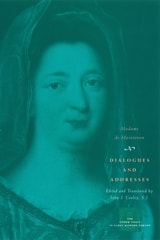
Dialogues and Addresses
Madame de Maintenon
University of Chicago Press, 2004
Denounced by her contemporaries as a political schemer and religious fanatic, Maintenon has long been criticized as an opponent of gender equality. The writings in this volume faithfully reflect Maintenon's respect for social hierarchy and her stoic call for women to accept the duties of their state in life. But the writings also echo Maintenon's more feminist concerns: the need to redefine the virtues in the light of women's experience, the importance of naming the constraints on women's freedom, and the urgent need to remedy the scandalous neglect of the education of women.
In her writings as well as in her own model school at Saint-Cyr, Maintenon embodies the demand for educational reform as the key to the empowerment of women at the dawn of modernity.
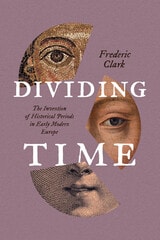
Dividing Time
The Invention of Historical Periods in Early Modern EuropeFrederic Clark
University of Chicago Press, 2027
A bold reconstruction of the origins of the “ancient, medieval, modern” trope used to define historical eras and the transitions between them.
We are used to dividing time, indicating the beginning or end of an era based on a year, a month, or even a specific day, after which (supposedly) “nothing was the same.” In this book, historian and classicist Frederic Clark looks at a particularly enduring form of dividing time—the tripartite distinction between antiquity, the Middle Ages, and modernity—in order to analyze the history of this division, how it has been constructed and deployed, and what its past and present implications are.
Clark argues that the study of the past has always depended on subdividing it into multiple parts, which tend to underpin any attempt to articulate a system of culture or value. After all, certain eras, ages, and epochs are celebrated as having ushered in a new, better time, whereas others are depicted as extended periods of decay and darkness. Clark provides an ingenious critique of the foundational assumptions underlying our narratives of periodization and the complex and messy process by which historical schemas develop, from the Renaissance through the early modern period to the Enlightenment and beyond. The result is an engaging and erudite tour through time and its many contested divisions, imagined and reimagined across history.

Doctors, Ambassadors, Secretaries
Humanism and Professions in Renaissance ItalyDouglas Biow
University of Chicago Press, 2002
Examining a wide range of treatises, poems, and other works that humanists wrote both as and about doctors, ambassadors, and secretaries, Biow shows how interactions with these professions forced humanists to make their studies relevant to their own times, uniting theory and practice in a way that strengthened humanism. His detailed analyses of writings by familiar and lesser-known figures, from Petrarch, Machiavelli, and Tasso to Maggi, Fracastoro, and Barbaro, will especially interest students of Renaissance Italy, but also anyone concerned with the rise of professionalism during the early modern period.
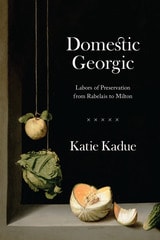
Domestic Georgic
Labors of Preservation from Rabelais to MiltonKatie Kadue
University of Chicago Press, 2021
When is literary production more menial than inspired, more like housework than heroics of the mind? In this revisionist study, Katie Kadue shows that some of the authors we credit with groundbreaking literary feats—including Michel de Montaigne and John Milton—conceived of their writing in surprisingly modest and domestic terms. In contrast to the monumental ambitions associated with the literature of the age, and picking up an undercurrent of Virgil’s Georgics, poetic labor of the Renaissance emerges here as often aligned with so-called women’s work. Kadue reveals how male authors’ engagements with a feminized georgic mode became central to their conceptions of what literature is and could be. This other georgic strain in literature shared the same primary concern as housekeeping: the necessity of constant, almost invisible labor to keep the things of the world intact. Domestic Georgic brings into focus a conception of literary—as well as scholarly and critical—labor not as a striving for originality and fame but as a form of maintenance work that aims at preserving individual and collective life.
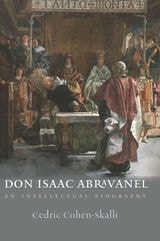
Don Isaac Abravanel
An Intellectual BiographyCedric Cohen-Skalli
Brandeis University Press, 2020
Don Isaac Abravanel (1437–1508) was one of the great inventors of Jewish modernity. A merchant, banker, and court financier, a scholar versed in both Jewish and Christian writings, a preacher and exegete, a prominent political actor in royal entourages and Jewish communities, Abravanel was one of the greatest leaders and thinkers of Iberian Jewry in the aftermath of the expulsion of 1492. This book, the first new intellectual biography of Abravanel in twenty years, depicts his life in three cultural milieus—Portugal, Castile, and post-expulsion Italy—and analyzes his major literary accomplishments in each period. Abravanel was a traditionalist with innovative ideas, a man with one foot in the Middle Ages and the other in the Renaissance. An erudite scholar, author of a monumental exegetical opus that is still studied today, and an avid book collector, he was a transitional figure, defined by an age of contradictions. Yet, it is these very contradictions that make him such an important personality for understanding the dawn of Jewish modernity.
Drama, Poetry and Music in Late-Renaissance Italy
The Life and Works of Leonora BernardiVirginia Cox and Lisa Sampson
University College London, 2023
Leonora Bernardi (1559–1616), a gentlewoman of Lucca, was a highly regarded poet, dramatist, and singer. She was active in the brilliant courts of Ferrara and Florence at a time when creative women enjoyed exceptional visibility in Italy. Like many such figures, she has since suffered historical neglect. Drama, Poetry and Music in Late-Renaissance Italy presents the first-ever study of Bernardi’s life along with a modern edition of her recently discovered literary corpus, which mostly exists in manuscripts. Her writings are presented in the original Italian with new English translations, scholarly notes, and critical essays. Based on new archival research, the substantial opening section reconstructs Bernardi’s unusually colorful life. The second major section presents her pastoral tragicomedy Clorilli, one of the earliest secular dramatic works by a woman. The third section presents Bernardi’s secular and religious verse, which engaged with new trends in lyric and poetry for music, and was set by various key composers across Italy. The volume thus firmly positions Leonora Bernardi as a distinctive voice and dynamic player in the extraordinarily rich social, cultural, and geo-political networks of late-Renaissance Italy.
Dürer's Coats
Renaissance Men and Material Cultures of Social RecognitionUlinka Rublack
Central European University Press, 2025