Results by title
76 books match the query 'Representation' and 3 start with d

Dangerous Dames
Women and Representation in Film Noir and the Weimar Street FilmJans B. Wager
Ohio University Press, 1999
Both film noir and the Weimar street film hold a continuing fascination for film spectators and film theorists alike. The female characters, especially the alluring femmes fatales, remain a focus for critical and popular attention. In the tradition of such attention, Dangerous Dames focuses on the femme fatale and her antithesis, the femme attrapée.
Unlike most theorists, Jans Wager examines these archetypes from the perspective of the female spectator and rejects the persistence of vision that allows a reading of these female characters only as representations of unstable postwar masculinity. Professor Wager suggests that the woman in the audience has always seen and understood these characters as representations of a complex aspect of her existence.
Dangerous Dames looks at the Weimar street films The Street, Variety, Asphalt, and M and the film noir movies The Maltese Falcon, Gun Crazy, and The Big Heat. This book opens the doors to spectators and theorists alike, suggesting cinematic pleasures outside the bounds of accepted readings and beyond the narrow categorization of film noir and the Weimar street film as masculine forms.
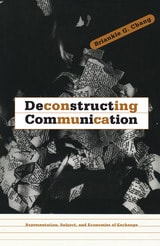
Deconstructing Communication
Representation, Subject, and Economies of ExchangeBriankle Chang
University of Minnesota Press, 1996
A philosophical critique of modern communication theories.
Situated at the intersection of current debates regarding meaning and representation, Deconstructing Communication casts doubt on the seeming innocence of the activity of communication. Using poststructuralist literary theory and philosophy, Briankle G. Chang argues that modern communication theories fail to provide an adequate explanation for how communication is possible.
Through a detailed examination of the basis of the idea of communication-with its semantic core of “commonality” or the transcendence of difference-Chang argues against the tendency of theorists to value understanding over misunderstanding, clarity over ambiguity, order over disorder. To this end the author revisits the thought of Derrida and considers deconstruction in general. Specifically, he uses the critique of the phenomenological tradition emerging from poststructuralism to clarify the commitments and assumptions inherent in models of communication. Chang then discusses the contributions of Husserl, particularly regarding the interconnections between concepts, metaphors, and rhetoric. He develops the strategy of deconstruction through a comparative analysis of Heidegger and Derrida, ultimately linking communication theory to the general question of philosophical reason. Chang concludes with a set of key questions about theory formation in the field, questions that elucidate the future direction for critical reflection in the philosophy of communication. A seminal work in communication theory, Deconstructing Communication will serve as the guiding framework for a constructive debate about the future direction of the field.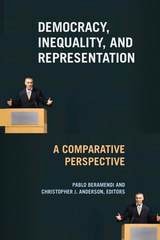
Democracy, Inequality, and Representation in Comparative Perspective
Pablo Beramendi
Russell Sage Foundation, 2008