Results by title
51 books match the query 'Risk' and 5 start with d
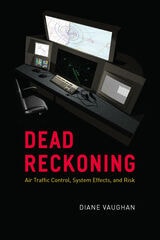
Dead Reckoning
Air Traffic Control, System Effects, and RiskDiane Vaughan
University of Chicago Press, 2021
When two airplanes were flown into the World Trade Center towers on September 11, 2001, Americans watched in uncomprehending shock as first responders struggled to react to the situation on the ground. Congruently, another remarkable and heroic feat was taking place in the air: more than six hundred and fifty air traffic control facilities across the country coordinated their efforts to ground four thousand flights in just two hours—an achievement all the more impressive considering the unprecedented nature of the task.
In Dead Reckoning, Diane Vaughan explores the complex work of air traffic controllers, work that is built upon a close relationship between human organizational systems and technology and is remarkably safe given the high level of risk. Vaughan observed the distinct skill sets of air traffic controllers and the ways their workplaces changed to adapt to technological developments and public and political pressures. She chronicles the ways these forces affected their jobs, from their relationships with one another and the layouts of their workspace to their understanding of their job and its place in society. The result is a nuanced and engaging look at an essential role that demands great coordination, collaboration, and focus—a role that technology will likely never be able to replace. Even as the book conveys warnings about complex systems and the liabilities of technological and organizational innovation, it shows the kinds of problem-solving solutions that evolved over time and the importance of people.
Dealing with Risk
Why the Public and the Experts Disagree on Environmental IssuesHoward Margolis
University of Chicago Press, 1997
In Dealing with Risk, Howard Margolis moves beyond the usual "rival rationalities" explanation proffered by risk analysts for the rift between expert and lay opinion. He reveals the conflicts of intuition that undergird those concerns, and proposes a new approach to the psychology of persuasion and belief. Examining the role of intuition, mental habits, and cognitive frameworks in the construction of public opinion, this compelling account bridges the public policy impasse that has plagued controversial environmental issues.
Dedicated to the People of Darfur
Writings on Fear, Risk, and HopeEdited and with an Introduction by Luke Reynolds and Jennifer Reynolds
Rutgers University Press, 2009
Nobel and Pulitzer Prize winners, a gallery of O.Henry award recipients, and many best-selling authors come together to share personal and compelling challenges and experiences. From contemplations on past drug use to reflections on gun control, social justice, passion and its sacrifices, and adventures such as skydiving, mountain climbing, and golfing, the topics vary greatly. This kaleidoscopic anthology is a commentary on the lives of prominent literary artists and ordinary citizens who have made simple, yet powerful choices that provoked change in one's self and for humanityùmuch the same way that Luke and Jennifer Reynolds do by building this invaluable collection for readers and the world of human rights.
Not too long ago, as struggling graduate students, Luke and Jennifer Reynolds conceived this uniquely themed volume as a way to raise funds to support ending the genocide in Darfur. Some people carry signs, others make speeches, many take action. What is most special about this book is that it extends beyond words and ideas, into a tangible effort to effect change. To this end, all royalties from the sales of Dedicated to the People of Darfur:Writings on Fear, Risk, and Hope will benefit The Save Darfur Coalition, an organization that seeks to end the genocide in Darfur, Sudan.
Degrees of Risk
Navigating Insecurity and Inequality in Public Higher EducationBlake R. Silver
University of Chicago Press, 2024
Institutions of higher education are often described as “ivory towers,” places of privilege where students exist in a “campus bubble,” insulated from the trials of the outside world. These metaphors reveal a widespread belief that college provides young people with stability and keeps insecurity at bay. But for many students, that’s simply not the case.
Degrees of Risk reveals how insecurity permeates every facet of college life for students at public universities. Sociologist Blake Silver dissects how these institutions play a direct role in perpetuating uncertainty, instability, individualism, and anxiety about the future. Silver examined interviews with more than one hundred students who described the risks that surrounded every decision: which major to choose, whether to take online classes, and how to find funding. He expertly identified the ways the college experience played out differently for students from different backgrounds. For students from financially secure families with knowledge of how college works, all the choices and flexibility of college felt like an adventure or a wealth of opportunities. But for many others, especially low-income, first-generation students, their personal and family circumstances meant that that flexibility felt like murkiness and precarity. In addition, he discovered that students managed insecurity in very different ways, intensifying inequality at the intersections of socioeconomic status, race, gender, and other sociodemographic dimensions. Drawing from these firsthand accounts, Degrees of Risk presents a model for a better university, one that fosters success and confidence for a diverse range of students.
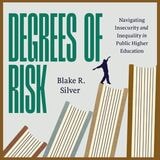
Degrees of Risk
Navigating Insecurity and Inequality in Public Higher EducationBlake R. Silver
University of Chicago Press, 2024
An ethnographic analysis of how insecurity is at the heart of contemporary higher education.
Institutions of higher education are often described as “ivory towers,” places of privilege where students exist in a “campus bubble,” insulated from the trials of the outside world. These metaphors reveal a widespread belief that college provides young people with stability and keeps insecurity at bay. But for many students, that’s simply not the case.
Degrees of Risk reveals how insecurity permeates every facet of college life for students at public universities. Sociologist Blake Silver dissects how these institutions play a direct role in perpetuating uncertainty, instability, individualism, and anxiety about the future. Silver examined interviews with more than one hundred students who described the risks that surrounded every decision: which major to choose, whether to take online classes, and how to find funding. He expertly identified the ways the college experience played out differently for students from different backgrounds. For students from financially secure families with knowledge of how college works, all the choices and flexibility of college felt like an adventure or a wealth of opportunities. But for many others, especially low-income, first-generation students, their personal and family circumstances meant that that flexibility felt like murkiness and precarity. In addition, he discovered that students managed insecurity in very different ways, intensifying inequality at the intersections of socioeconomic status, race, gender, and other sociodemographic dimensions. Drawing from these firsthand accounts, Degrees of Risk presents a model for a better university, one that fosters success and confidence for a diverse range of students.