Results by title
70 books match the query 'Rock music' and 3 start with d
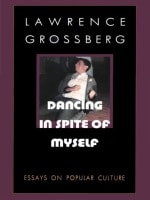
Dancing in Spite of Myself
Essays on Popular CultureLawrence Grossberg
Duke University Press, 1997
In Dancing in Spite of Myself, Lawrence Grossberg—well known as a pioneering figure in cultural studies—has collected essays written over the past twenty years that have also established him as one of the leading theorists of popular culture and, specifically, of rock music. Grossberg offers an original and sophisticated view of the growing power of popular culture and its increasing inseparability from contemporary structures of economic and political power and from our everyday lives.
In the course of conducting this exploration into the meaning of "popularity," he investigates the nature of fandom, the social effects of rock music and youth culture, and the possibilities for understanding the history of popular texts and practices. Describing what he calls "the postmodernity of everyday life," Grossberg offers important insights into the relation of pop music to issues of postmodernity and inton the growing power of the new cultural conservatism and its relationship to "the popular." Exploring the limits of existing theories of hegemony in cultural studies, Grossberg reveals the ways in which popular culture is being mobilized in the service of economic and political struggles. In articulating his own critical practice, Grossberg surveys and challenges some of the major assumptions of popular culture studies, including notions of domination and resistance, mainstream and marginality, and authenticity and incorporation.
Dancing in Spite of Myself provides an introduction to contemporary theories of popular culture and a clear statement of relationships among theories of the nature of rock music, postmodernity, and conservative hegemony.
[more]
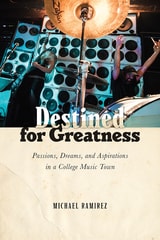
Destined for Greatness
Passions, Dreams, and Aspirations in a College Music TownRamirez, Michael
Rutgers University Press, 2018
Pursuing the dream of a musical vocation—particularly in rock music—is typically regarded as an adolescent pipedream. Music is marked as an appropriate leisure activity, but one that should be discarded upon entering adulthood. How then do many men and women aspire to forge careers in music upon entering adulthood?
In Destined for Greatness, sociologist Michael Ramirez examines the lives of forty-eight independent rock musicians who seek out such non-normative choices in a college town renowned for its music scene. He explores the rich life course trajectories of women and men to explore the extent to which pathways are structured to allow some, but not all, individuals to fashion careers in music worlds. Ramirez suggests a more nuanced understanding of factors that enable the pursuit of musical livelihoods well into adulthood.
In Destined for Greatness, sociologist Michael Ramirez examines the lives of forty-eight independent rock musicians who seek out such non-normative choices in a college town renowned for its music scene. He explores the rich life course trajectories of women and men to explore the extent to which pathways are structured to allow some, but not all, individuals to fashion careers in music worlds. Ramirez suggests a more nuanced understanding of factors that enable the pursuit of musical livelihoods well into adulthood.
[more]
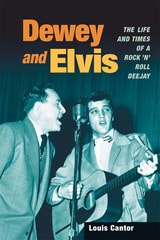
Dewey and Elvis
The Life and Times of a Rock 'n' Roll DeejayLouis Cantor
University of Illinois Press, 2010
Beginning in 1949, while Elvis Presley and Sun Records were still virtually unknown--and two full years before Alan Freed famously "discovered" rock 'n' roll--Dewey Phillips brought the budding new music to the Memphis airwaves by playing Howlin' Wolf, B. B. King, and Muddy Waters on his nightly radio show Red, Hot and Blue. The mid-South's most popular white deejay, "Daddy-O-Dewey" soon became part of rock 'n' roll history for being the first major disc jockey to play Elvis Presley and, subsequently, to conduct the first live, on-air interview with the singer.
Louis Cantor illuminates Phillips's role in turning a huge white audience on to previously forbidden race music. Phillips's zeal for rhythm and blues legitimized the sound and set the stage for both Elvis's subsequent success and the rock 'n' roll revolution of the 1950s. Using personal interviews, documentary sources, and oral history collections, Cantor presents a personal view of the disc jockey while restoring Phillips's place as an essential figure in rock 'n' roll history.
[more]