Results by title
111 books match the query 'Science Fiction' and 7 start with d

Daydreamers
A NovelAlvin Lu
University of Alabama Press, 2025
A fragmented manuscript left unfinished, a voice inherited by time, a ghost lingering in the margins—Daydreamers is what remains when fiction forgets its fiction and when the story you’re translating becomes your own.
Upon the discovery of an unfinished manuscript left behind by his late father, a son’s act of literary translation quickly descends into a ghost story of family rumors, art, and the history we inherit, whether we want them or not. As the son translates the mysterious text, what emerges is a narrative haunted by betrayal, artistic rivalry, and a murder in California’s Chinese literary underground—one that was never solved but perhaps was fictionalized.
Cycling between San Francisco, Los Angeles, China, and Taiwan, the novel unfolds across generations of Chinese immigrants and diaspora artists, linked by tenuous friendships, publishing feuds, and the obscure threads of an act of violence. At the center: a spectral woman named Lena Wu, the object of literary fixation, political allegory, and real-life scandal.
Was the manuscript meant as a novel or a confession? Was the story’s central figure—Lena Wu—a real person or an idea and persona passed between generations of writers, each shaping her into their own myth? And what is the narrator’s responsibility when his father’s version of events begins to implicate those still living?
Told through letters, interviews, travelogues, and unclaimed fragments, Daydreamers moves through foggy cities, cluttered studios, desert highways, and vanished publishing circles—where stories are currency and silence is survival. Lu constructs a novel that is both noir and anti-noir, both memoir and anti-memoir—a mystery that resists solving, and a translation that becomes its own original work.
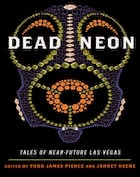
Dead Neon
Tales of Near-Future Las VegasTodd Pierce
University of Nevada Press, 2010
Las Vegas is considered a modern icon of excess. It offers every imaginable extreme of greed, pleasure, and despair, all supported by technology that enhances fantasy and allows residents and visitors alike to forget reality and responsibility. The authors of the fourteen stories in Dead Neon imagine Sin City in the near future, when excess has led to social, environmental, or economic collapse. Their stories range from futuristic casinos to the seared post-apocalyptic desert, from the struggle to survive in a repressive theocracy to the madness of living in a world where most life forms and all moral codes have vanished. Dead Neon explores the possible future of America by examining the near future of Las Vegas. The authors, all either Vegas-based or intimately familiar with the city, capture its unique rhythms and flavor and probe its potential for evoking the fullest range of the human spirit in settings of magic, horror, and despair.
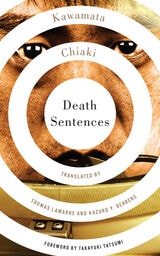
Death Sentences
Kawamata Chiaki
University of Minnesota Press, 2012
Japan, 1980s: A special police squad is tracking down one of the “afflicted” to recover the “stuff.” Although the operation seems like a drug bust, the “stuff” is actually some kind of text. Death Sentences—a work of science fiction that shares its conceit with the major motion picture The Ring—tells the story of a mysterious surrealist poem, penned in the 1940s, which, through low-tech circulation across time, kills its readers, including Arshile Gorky and Antonin Artaud, before sparking a wave of suicides after its publication in 1980s Japan. Mixing elements of Japanese hard-boiled detective story, horror, and science fiction, the novel ranges across time and space, from the Left Bank of Paris to the planet Mars.
Paris, 1948: André Breton anxiously awaits a young poet, Who May. He recalls their earlier encounter in New York City and the mysterious effects of reading Who May’s poem “Other World.” Upon meeting, Who May gives Breton another poem, “Mirror,” an even more unsettling work. Breton shares it with his fellow surrealists. Before Breton can discuss the poem with him, Who May vanishes. Who May contacts Breton about a third poem, “The Gold of Time,” and then slips into a coma and dies (or enters another dimension). Copies of the poem are mailed to all of Who May’s friends—Breton, Gorky, Paul Éluard, Marcel Duchamp, and other famous surrealists and dadaists. Thus begins the “magic poem plague.”
Death Sentences is the first novel by the popular and critically acclaimed science fiction author Kawamata Chiaki to be published in English. Released in Japan in 1984 as Genshi-gari (Hunting the magic poems), Death Sentences was a best seller and won the Japan Science Fiction Grand Prize. With echoes of such classic sci-fi works as George Orwell’s 1984, Ray Bradbury’s Fahrenheit 451, William Gibson’s Neuromancer, and Philip K. Dick’s Martian Time-Slip, Death Sentences is a fascinating mind-bender with a style all its own.
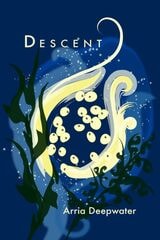
Descent
Arria Deepwater
Omnidawn, 2025
Arria Deepwater’s Descent is a modern fairy tale exploring the vulnerability and strength that come with living in an unconventional body, especially for those living with the experience of disabilities, chronic illness, hyper-medicalization, objectification, and 2SLGBTQIA+ identities. The reader is invited to become an observer of isolation, violation, and the magic of secret joy. Descent moves through entangled connections and dissolving boundaries between humanity and the natural world as it seeks to weave a spell of protection for those whose bodies do not conform, for whom existence is a radical act of rebellion and creativity.
Exploring boundaries of intimacy, fluidity, and grief, Deepwater brings an eco-feminist speculative twist to the growing canon of writers with marginalized identities. Deepwater considers the fractured reality of living in a queer disabled body and how we might find freedom, safety, and spiritual healing despite grief.
Descent is the winner of Omnidawn’s 2022 Fabulist Fiction Contest, chosen by Michelle Ruiz Keil.
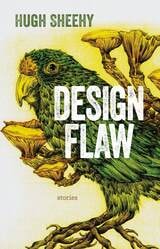
Design Flaw
StoriesHugh Sheehy
Acre Books, 2022
These are tales of seekers, often damaged, who find themselves caught up in skewed realities, facing lurking threats, violent deaths, strange entities, and alienating technologies. Confronted with unsettling, escalating, circumstances, the disparate cast of characters are driven toward self-revelation and perverse moments of poignancy.
A troubled high schooler traps a peer in an underground storage space. A traumatized felon returns home to rob the man who molested him as a child. A videogame help-line operator suspects a regular caller, obsessed with a disturbing role-playing game, of real-life misdeeds. In the title story, an unhappy couple adopts a “designer animal,” a genetic hybrid created to be the perfect pet. But the “grot” makes trouble in the neighborhood, becoming emblematic of a deeper problem. “Something is wrong with the world,” the narrator’s husband explains. “A design flaw. It’s so thoroughly corrupted, I’m not sure how to fix it.”
Inventive and unpredictable, these thirteen stories are wholly immersive, showing Sheehy at his captivating best.

Dialogic Novels of Malcolm Bradbury and David Lodge
Robert A. Morace
Southern Illinois University Press, 1989
Morace analyzes the novels of Malcolm Bradbury and David Lodge together because they provide a dialogue of conflicting views, styles, and forms of the contemporary novel. This dialogue parallels the views of these two British novelists as critics.
Beginning as realists, as novelists of manners, as writers of campus novels, Bradbury and Lodge explore the possibilities and the limitations of realistic writing. Bradbury and Lodge, however, are not only heirs of English literary tradition. Both are also literary critics with a keen interest in recent critical theories. Morace shows us how the debate between Bradbury and Lodge over the nature and purpose of fiction and criticism has found its way into their novels. The realistic conflicts between civilian and military, English and American, pre- and post-Vatican II values gradually give way to an exploration of the semiotics behind such conflicts.
Morace finds Bradbury’s and Lodge’s works far more open-ended than the "doggedly indeterminate fictions" of many contemporary writers. Using Mikhail Bakhtin’s theory of dialogism, he identifies the ways in which language and values simultaneously compete with and support one another in their novels.
This first book-length study of Bradbury or Lodge deals with all of their novels, including Changing Places, How Far Can You Go?, and Small World by Lodge, as well as Bradbury’s The History of Man and Rates of Exchange.
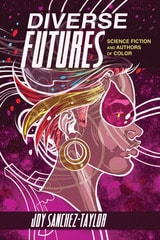
Diverse Futures
Science Fiction and Authors of ColorJoy Sanchez-Taylor
The Ohio State University Press, 2021