53 books match the query 'Secondary' and 3 start with d
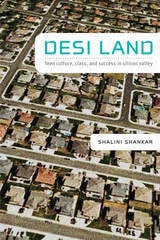
cover of Desi Land: Teen Culture, Class, and Success in Silicon Valley

Desi Land

Teen Culture, Class, and Success in Silicon Valley

Shalini Shankar

Duke University Press, 2008

Desi Land is Shalini Shankar’s lively ethnographic account of South Asian American teen culture during the Silicon Valley dot-com boom. Shankar focuses on how South Asian Americans, or “Desis,” define and manage what it means to be successful in a place brimming with the promise of technology. Between 1999 and 2001 Shankar spent many months “kickin’ it” with Desi teenagers at three Silicon Valley high schools, and she has since followed their lives and stories. The diverse high-school students who populate Desi Land are Muslims, Hindus, Christians, and Sikhs, from South Asia and other locations; they include first- to fourth-generation immigrants whose parents’ careers vary from assembly-line workers to engineers and CEOs. By analyzing how Desi teens’ conceptions and realizations of success are influenced by community values, cultural practices, language use, and material culture, she offers a nuanced portrait of diasporic formations in a transforming urban region.

Whether discussing instant messaging or arranged marriages, Desi bling or the pressures of the model minority myth, Shankar foregrounds the teens’ voices, perspectives, and stories. She investigates how Desi teens interact with dialogue and songs from Bollywood films as well as how they use their heritage language in ways that inform local meanings of ethnicity while they also connect to a broader South Asian diasporic consciousness. She analyzes how teens negotiate rules about dating and reconcile them with their longer-term desire to become adult members of their communities. In Desi Land Shankar not only shows how Desi teens of different socioeconomic backgrounds are differently able to succeed in Silicon Valley schools and economies but also how such variance affects meanings of race, class, and community for South Asian Americans.
[more]
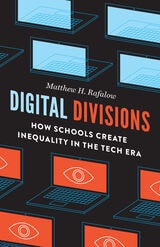
cover of Digital Divisions: How Schools Create Inequality in the Tech Era

Digital Divisions

How Schools Create Inequality in the Tech Era

Matthew H. Rafalow

University of Chicago Press, 2020

In the digital age, schools are a central part of a nationwide effort to make access to technology more equitable, so that all young people, regardless of identity or background, have the opportunity to engage with the technologies that are essential to modern life. Most students, however, come to school with digital knowledge they’ve already acquired from the range of activities they participate in with peers online. Yet, teachers, as Matthew H. Rafalow reveals in Digital Divisions, interpret these technological skills very differently based on the race and class of their student body.
 
While teachers praise affluent White students for being “innovative” when they bring preexisting and sometimes disruptive tech skills into their classrooms, less affluent students of color do not receive such recognition for the same behavior. Digital skills exhibited by middle class, Asian American students render them “hackers,” while the creative digital skills of working-class, Latinx students are either ignored or earn them labels troublemakers. Rafalow finds in his study of three California middle schools that students of all backgrounds use digital technology with sophistication and creativity, but only the teachers in the school serving predominantly White, affluent students help translate the digital skills students develop through their digital play into educational capital. Digital Divisions provides an in-depth look at how teachers operate as gatekeepers for students’ potential, reacting differently according to the race and class of their student body. As a result, Rafalow shows us that the digital divide is much more than a matter of access: it’s about how schools perceive the value of digital technology and then use them day-to-day.
[more]
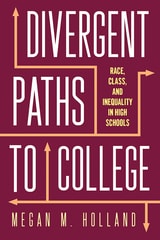
cover of Divergent Paths to College: Race, Class, and Inequality in High Schools

Divergent Paths to College

Race, Class, and Inequality in High Schools

Holland, Megan M

Rutgers University Press, 2019

In Divergent Paths to College, Megan M. Holland examines how high schools structure different pathways that lead students to very different college destinations based on race and class. She finds that racial and class inequalities are reproduced through unequal access to key sources of information, even among students in the same school and even in schools with well-established college-going cultures. As the college application process becomes increasingly complex and high-stakes, social capital, or relationships with people who can provide information as well as support and guidance, becomes much more critical. Although much has been written about the college-bound experience, we know less about the role that social capital plays, and specifically how high schools can serve as organizational brokers of social ties. The relationships that high schools cultivate between students and higher education institutions by inviting college admissions officers into their schools to market to students, is a particularly critical, yet unexplored source of college information.
[more]