Results by title
64 books match the query 'Self in literature' and 4 start with d
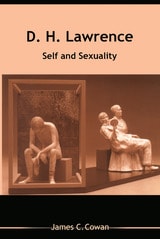
D H LAWRENCE
SELF AND SEXUALITYJames C. Cowan
The Ohio State University Press, 2003
D. H. Lawrence: Self and Sexuality is a psychoanalytic study of D. H. Lawrence’s life and writings. James Cowan relies most notably the methods of Heinz Kohut, psychoanalytic “self psychology,” and employs as well the object relation theories of D. W. Winnicott and others. This work also examines sexual issues in Lawrence’s work from a literary and critical perspective, employing authoritative medical and psychoanalytic sources in human sexuality. Lawrence’s work, which was early read in traditional Freudian terms, has only recently been considered from other psychoanalytic perspectives. In this self psychological study, Cowan provides a new and path-breaking analysis of Lawrence.
Turning to several problematic issues of sexuality in Lawrence, the author first discusses a number of Lawrence’s sexual fallacies, and personal and cultural issues. Cowan also considers contrasting idealized and negative presentations of Mellors and Sir Clifford Chatterley in Lady Chatterley’s Lover, and the theme of the “loss of desire” sequence of poems in Pansies.
Discerning The Subject
Paul Smith
University of Minnesota Press, 1988
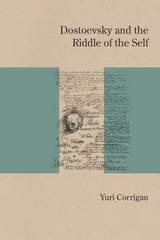
Dostoevsky and the Riddle of the Self
Yuri Corrigan
Northwestern University Press, 2017
Dostoevsky was hostile to the notion of individual autonomy, and yet, throughout his life and work, he vigorously advocated the freedom and inviolability of the self. This ambivalence has animated his diverse and often self-contradictory legacy: as precursor of psychoanalysis, forefather of existentialism, postmodernist avant la lettre, religious traditionalist, and Romantic mystic.
Dostoevsky and the Riddle of the Self charts a unifying path through Dostoevsky's artistic journey to solve the “mystery” of the human being. Starting from the unusual forms of intimacy shown by characters seeking to lose themselves within larger collective selves, Yuri Corrigan approaches the fictional works as a continuous experimental canvas on which Dostoevsky explored the problem of selfhood through recurring symbolic and narrative paradigms. Presenting new readings of such works as The Idiot, Demons, and The Brothers Karamazov, Corrigan tells the story of Dostoevsky’s career-long journey to overcome the pathology of collectivism by discovering a passage into the wounded, embattled, forbidding, revelatory landscape of the psyche.
Corrigan’s argument offers a fundamental shift in theories about Dostoevsky's work and will be of great interest to scholars of Russian literature, as well as to readers interested in the prehistory of psychoanalysis and trauma studies and in theories of selfhood and their cultural sources.
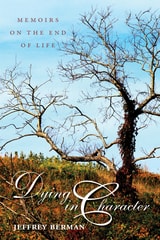
Dying in Character
Memoirs on the End of LifeJeffrey Berman
University of Massachusetts Press, 2012
Examining the works cited above, as well as memoirs by Mitch Albom, Roland Barthes, Jean-Dominique Bauby, Art Buchwald, Randy Pausch, David Rieff, Philip Roth, and Morrie Schwartz, Jeffrey Berman's analysis of this growing genre yields some surprising insights. While the authors have much to say about the loneliness and pain of dying, many also convey joy, fulfillment, and gratitude. Harold Brodkey is willing to die as long as his writings survive. Art Buchwald and Randy Pausch both use the word fun to describe their dying experiences. Dying was not fun for Morrie Schwartz and Tony Judt, but they reveal courage, satisfaction, and fearlessness during the final stage of their lives, when they are nearly paralyzed by their illnesses.
It is hard to imagine that these writers could feel so upbeat in their situations, but their memoirs are authentically affirmative. They see death coming, yet they remain stalwart and focused on their writing. Berman concludes that the contemporary end-of-life memoir can thus be understood as a new form of death ritual, "a secular example of the long tradition of ars moriendi, the art of dying."