Results by title
546 books match the query 'Semiotics & Theory' and 20 start with d
Dark Conceit
The Making of AllegoryEdwin Honig
Northwestern University Press, 1959
Dear Incomprehension
On American Speculative FictionStéphane Vanderhaeghe
University of Alabama Press, 2024
WINNER OF THE ELIZABETH AGEE PRIZE IN AMERICAN LITERARY STUDIES
A philosophical and formally inventive inquiry into the experimental terrains of American speculative fiction, where meaning emerges through ambiguity, rupture, and critical refusal.
Dear Incomprehension: On American Speculative Fiction is a thought-provoking exploration of the fascinating field of contemporary speculative fiction, a genre that transcends boundaries and encompasses science fiction, fabulist tales, modern fairy tales, and experimental narratives that challenge the very essence of storytelling and reading.
Written as a philosophical essay that mirrors the unorthodox nature of the texts it analyzes, Dear Incomprehension examines American works that defy traditional narrative devices such as plot, character, logic, and even legibility. Drawing on a number of philosophical theories, among them object-oriented ontology and speculative realism, Vanderhaeghe argues that these unconventional works resist the standard tools of criticism, demanding instead a novel perspective and approach.
An in-depth resource for scholars and students of contemporary literature, philosophy, and digital literary studies, Dear Incomprehension offers a fresh framework for analyzing experimental fiction and alternative modes of meaning-making. It is a must-read for those seeking to grasp the complexities and nuances of American experimental and speculative fiction.
Dear Science and Other Stories
Katherine McKittrick
Duke University Press, 2021
Debating Rhetorical Narratology
On the Synthetic, Mimetic, and Thematic Aspects of NarrativeMatthew Clark and James Phelan
The Ohio State University Press, 2020
Clark and Phelan’s deep dive into the synthetic, mimetic, and thematic leads them to explore many other aspects of narrative and narrative theory: style, audiences, the mimetic illusion, fictionality, and more. Their investigation also leads them into questions about rhetorical narratology’s relation to other projects in narrative theory, especially unnatural narratology, and, indeed, about how to assess the explanatory power of competing theories. Ultimately, their debate is compelling testimony about the power of both narrative theory and narrative itself.
Decolonizing Memory
Algeria and the Politics of TestimonyJill Jarvis
Duke University Press, 2021
Deformative Fictions
Cruelty and Narrative Ethics in Twentieth-Century Latin American LiteratureAshley Hope Pérez
The Ohio State University Press, 2024

Demarcating the Disciplines
Philosophy, Literature, ArtSamuel Weber, Henry Sussman, and Wlad Godzich, Editors
University of Minnesota Press, 1986
Demarcating the Disciplines was first published in 1986. Minnesota Archive Editions uses digital technology to make long-unavailable books once again accessible, and are published unaltered from the original University of Minnesota Press editions.
With publication of this volume, Glyph begins a new stage in its existence: the move from Johns Hopkins University Press to the University of Minnesota Press is accompanied by a change in focus. In its first incarnation Glyph provided a forum in which established notions of reading, writing, and criticism could be questioned and explored. Since then, the greater currency of such concerns has brought with it new problems and priorities. Setting aside the battles of the past, the new Glyph looks ahead - to confront historical issues and to address the institutional and pedagogical questions emerging from the contemporary critical landscape.
Each volume in the new Glyph series is organized around a specific issue. The essays in this first volume explore the relations between the practice of reading and writing and the operations of the institution. Though their approaches differ from one another, the authors of these essays all recognize that the questions of the institution - most notably the university - points toward a series of constraints that define, albeit negatively, the possibilities for change.
The contributors: Samuel Weber, Jacques Derrida, Tom Conley, Malcolm Evans, Ruth Salvaggio, Robert Young, Henry Sussman, Peter Middleton, David Punter, and Donald Preziosi.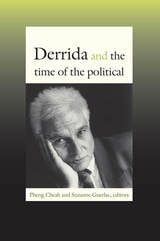
Derrida and the Time of the Political
Pheng Cheah and Suzanne Guerlac, eds.
Duke University Press, 2009
The volume opens with a substantial introduction in which Pheng Cheah and Suzanne Guerlac survey Derrida’s entire corpus and position his later work in relation to it. The remaining essays address the concerns that arise out of Derrida’s analysis of politics and the conditions of the political, such as the meaning and scope of democracy, the limits of sovereignty, the relationship between the ethical and the political, the nature of responsibility, the possibility for committed political action, the implications of deconstructive thought for non-Western politics, and the future of nationalism in an era of globalization and declining state sovereignty. The collection is framed by original contributions from Hélène Cixous and Judith Butler.
Contributors. Étienne Balibar, Geoffrey Bennington, Wendy Brown, Judith Butler, Pheng Cheah, Hélène Cixous, Rodolphe Gasché, Suzanne Guerlac, Marcel Hénaff, Martin Jay, Anne Norton, Jacques Rancière, Soraya Tlatli, Satoshi Ukai
Desiring Freedom
Counter-Imaginaries of Work, Sex, and Family After West Indian EmancipationKaneesha Cherelle Parsard
University of Chicago Press, 2026
A groundbreaking account of concepts of freedom in West Indian literature and visual culture.
Desiring Freedom examines post-emancipation West Indian literature and visual culture to ask how they reimagine freedom. Ranging from emancipation in the 1830s to the arrival of independence in the 1960s, Kaneesha Cherelle Parsard analyzes a literary and visual repertoire through which West Indians and Britons cast doubt on wage labor and domesticity as freedom. Whereas freedom was traditionally conceived around narratives of the self-governing individual, Parsard unearths a diverse range of materials—fiction, poetry, painting, photography, imperial correspondence, social scientific discourse, and economic history—in which this plot breaks down, finding practices of freedom in hoarding, pleasure-seeking, hustling, and siphoning.
Parsard focuses on conceptions of freedom in Trinidad, British Guiana, and Jamaica. Along the way, she shows how indentured Indian women’s jewelry reveals contradictions in imperial capital, studies the short fiction of a 1930s Trinidadian literary collective called the Beacon group to reveal how women find both profit and pleasure in their affairs, and offers a fascinating reading of C. L. R. James’s only novel, Minty Alley—including a little-known alternative ending. In a key methodological contribution, Parsard develops proposition as a critical tool, drawing on its many valences—a sexual advance, a contract before its signing, and, in philosophy, the act of saying “this is how things stand.” Parsard’s own propositions show that West Indian culture offers new ways of seeing the relationships among race, labor, capital, gender, and sexuality after emancipation.
Digital Fiction and the Unnatural
Transmedial Narrative Theory, Method, and AnalysisAstrid Ensslin and Alice Bell
The Ohio State University Press, 2021
Digital Poetics
Hypertext, Visual-Kinetic Text and Writing in Programmable MediaLoss Pequeño Glazier
University of Alabama Press, 2001
Glazier investigates the ways in which computer technology has influenced and transformed the writing and dissemination of poetry.
In Digital Poetics, Loss Pequeño Glazier argues that the increase in computer technology and accessibility, specifically the World Wide Web, has created a new and viable place for the writing and dissemination of poetry. Glazier’s work not only introduces the reader to the current state of electronic writing but also outlines the historical and technical contexts out of which electronic poetry has emerged and demonstrates some of the possibilities of the new medium.
Glazier examines three principal forms of electronic textuality: hypertext, visual/kinetic text, and works in programmable media. He considers avant-garde poetics and its relationship to the on-line age, the relationship between web “pages” and book technology, and the way in which certain kinds of web constructions are in and of themselves a type of writing. With convincing alacrity, Glazier argues that the materiality of electronic writing has changed the idea of writing itself. He concludes that electronic space is the true home of poetry and, in the 20th century, has become the ultimate “space of poesis.”
Digital Poetics will attract a readership of scholars and students interested in contemporary creative writing and the potential of electronic media for imaginative expression.
Discourse Analysis
The Sociolinguistic Analysis of Natural LanguageMichael Stubbs
University of Chicago Press, 1983
Discourse, Consciousness, and Time
The Flow and Displacement of Conscious Experience in Speaking and WritingWallace Chafe
University of Chicago Press, 1994
Chafe draws on several decades of research to demonstrate that understanding the nature of consciousness is essential to understanding many linguistic phenomena, such as pronouns, tense, clause structure, and intonation, as well as stylistic usages, such as the historical present and the free indirect style. While the book focuses on English, there are also discussions of the North American Indian language Seneca and the music of Mozart and of the Seneca people.
This work offers a comprehensive picture of the dynamic natures of language and consciousness that will interest linguists, psychologists, literary scholars, computer scientists, anthropologists, and philosophers.
Disoriented Disciplines
China, Latin America, and the Shape of World LiteratureRosario Hubert
Northwestern University Press, 2024
In the absence of specialized programs of study, abstract discussions of China in Latin America took shape in contingent critical infrastructures built at the crossroads of the literary market, cultural diplomacy, and commerce. As Rosario Hubert reveals, modernism flourishes comparatively, in contexts where cultural criticism is a creative and cosmopolitan practice.
Disoriented Disciplines: China, Latin America, and the Shape of World Literature understands translation as a material act of transfer, decentering the authority of the text and connecting seemingly untranslatable cultural traditions. In this book, chinoiserie, “coolie” testimonies, Maoist prints, visual poetry, and Cold War memoirs compose a massive archive of primary sources that cannot be read or deciphered with the conventional tools of literary criticism. As Hubert demonstrates, even canonical Latin American authors, including Jorge Luis Borges, Octavio Paz, and Haroldo de Campos, write about China from the edges of philology, mediating the concrete as well as the sensorial.
Advocating for indiscipline as a core method of comparative literary studies, Disoriented Disciplines challenges us to interrogate the traditional contours of the archives and approaches that define the geopolitics of knowledge.
Disrupting Narrative Rhetoric
Experimental Fictionality on Digital PlatformsStefan Iversen
The Ohio State University Press, 2026
Disturbing the Universe
Power and Repression in Adolescent LiteratureRoberta S. Trites
University of Iowa Press, 2004
The Young Adult novel is ordinarily characterized as a coming-of-age story, in which the narrative revolves around the individual growth and maturation of a character, but Roberta Trites expands this notion by chronicling the dynamics of power and repression that weave their way through YA books. Characters in these novels must learn to negotiate the levels of power that exist in the myriad social institutions within which they function, including family, church, government, and school.
Trites argues that the development of the genre over the past thirty years is an outgrowth of postmodernism, since YA novels are, by definition, texts that interrogate the social construction of individuals. Drawing on such nineteenth-century precursors as Little Women and Adventures of Huckleberry Finn, Disturbing the Universe demonstrates how important it is to employ poststructuralist methodologies in analyzing adolescent literature, both in critical studies and in the classroom. Among the twentieth-century authors discussed are Blume, Hamilton, Hinton, Le Guin, L'Engle, and Zindel.
Trites' work has applications for a broad range of readers, including scholars of children's literature and theorists of post-modernity as well as librarians and secondary-school teachers.
Disturbing the Universe: Power and Repression in Adolescent Literature by Roberta Seelinger Trites is the winner of the 2002 Children's Literature Association's Book Award. The award is given annually in order to promote and recognize outstanding contributions to children's literature, history, scholarship, and criticisim; it is one of the highest academic honors that can accrue to an author of children's literary criticism.

Dockside Reading
Hydrocolonialism and the Custom HouseIsabel Hofmeyr
Duke University Press, 2022
Doing What Comes Naturally
Change, Rhetoric, and the Practice of Theory in Literary & Legal StudiesStanley Fish
Duke University Press, 1989
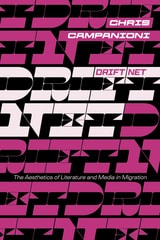
Drift Net
The Aesthetics of Literature and Media in MigrationChris Campanioni
Lever Press, 2025
Through a model Campanioni calls a “migratory text,” Drift Net advances a theory of literature and art born in translation that calls into question established theories of world literature, national literatures, literary periodization, and translation itself. Through an analysis of works born in translation and produced in passage, detention, and exile, Campanioni utilizes this model to read creatively across a wide range of social and political formations, from the experience of his parents' exiles to alternative housing initiatives and asylum reform efforts throughout Europe, including the largest LGBT+ refugee center in the world. Drawing on a mixed methodology of qualitative interviews with asylum applicants and shelter directors, textual analysis, and autoethnographic narrative, Drift Net traces literary developments alongside contemporary social and political interventions. This approach proposes interventions on the organizational levels of asylum, integration, public housing, and membership. It also marks the ways migrant creators have reformulated subjectivity through the same genres and modes that have contributed to their devaluation as minoritized subjects.
Drift Net both deepens and broadens our conceptualization of migrant literature, and recovers an understanding and application of transmedia that predates digital cultures. Campanioni offers a wide-ranging study of texts including Edward Said and Jean Mohr’s After the Last Sky: Palestinian Lives, Edgar Garcia’s Skins of Columbus, Anna Seghers’s Transit, Francis Ponge’s Soap, Walid Raad’s The Atlas Group, Klára Hosnedlová’s embroidered paintings, Reem Karssli and Caroline Williams’s Now is the Time To Say Nothing, Cornelia Schleime’s paper prints, and more. Drift Net formulates the “migratory” as a site of artistic production, resistance, and possibility, where theory is not an end but the beginning of tools and practices that might help researchers, instructors, and organizers to develop their strategies.
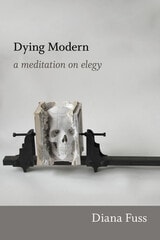
Dying Modern
A Meditation on ElegyDiana Fuss
Duke University Press, 2013
Focusing primarily on American and British poetry written during the past two centuries, Fuss maintains that poetry can still offer genuine ethical compensation, even for the deep wounds and shocking banalities of modern death. As dying, loss, and grief become ever more thoroughly obscured from public view, the dead start chattering away in verse. Through bold, original interpretations of little-known works, as well as canonical poems by writers such as Emily Dickinson, Randall Jarrell, Elizabeth Bishop, Richard Wright, and Sylvia Plath, Fuss explores modern poetry's fascination with pre- and postmortem speech, pondering the literary desire to make death speak in the face of its cultural silencing.