Results by title
127 books match the query 'Sexual behavior' and 8 start with d
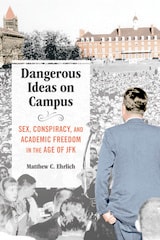
Dangerous Ideas on Campus
Sex, Conspiracy, and Academic Freedom in the Age of JFKMatthew C. Ehrlich
University of Illinois Press, 2021
In 1960, University of Illinois professor Leo Koch wrote a public letter condoning premarital sex. He was fired. Four years later, a professor named Revilo Oliver made white supremacist remarks and claimed there was a massive communist conspiracy. He kept his job.
Matthew Ehrlich revisits the Koch and Oliver cases to look at free speech, the legacy of the 1960s, and debates over sex and politics on campus. The different treatment of the two men marked a fundamental shift in the understanding of academic freedom. Their cases also embodied the stark divide over beliefs and values--a divide that remains today. Ehrlich delves into the issues behind these academic controversies and places the events in the context of a time rarely associated with dissent, but in fact a harbinger of the social and political upheavals to come.
An enlightening and entertaining history, Dangerous Ideas on Campus illuminates how the university became a battleground for debating America's hot-button issues.

Dangerous Intimacies
Toward a Sapphic History of the British NovelLisa L. Moore
Duke University Press, 1997
Moore demonstrates that intimacy between women was vividly imagined in the British eighteenth century as not only chaste and virtuous, but also insistently and inevitably sexual. She looks at instances of sapphism in such novels as Millenium Hall, Memoirs of a Woman of Pleasure, Belinda, and Emma and analyzes how the new literary form of the novel made the bourgeois heroine’s successful negotiation of female friendship central to the establishment of her virtue. Moore also examines representations of sapphism through the sweeping economic and political changes of the period and claims that middle-class readers’ identifications with the heroine’s virtue helped the novel’s bourgeois audience justify the violent bases of their new prosperity, including slavery, colonialism, and bloody national rivalry.
In revealing the struggle over sapphism at the heart of these novels of female friendship—and at the heart of England’s national identity—Moore shows how feminine sexual agency emerged as an important cultural force in post-Enlightenment England
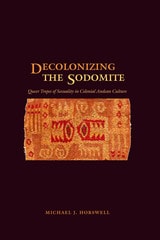
Decolonizing the Sodomite
Queer Tropes of Sexuality in Colonial Andean CultureBy Michael J. Horswell
University of Texas Press, 2006
Early Andean historiography reveals a subaltern history of indigenous gender and sexuality that saw masculinity and femininity not as essential absolutes. Third-gender ritualists, Ipas, mediated between the masculine and feminine spheres of culture in important ceremonies and were recorded in fragments of myths and transcribed oral accounts. Ritual performance by cross-dressed men symbolically created a third space of mediation that invoked the mythic androgyne of the pre-Hispanic Andes. The missionaries and civil authorities colonizing the Andes deemed these performances transgressive and sodomitical.
In this book, Michael J. Horswell examines alternative gender and sexuality in the colonial Andean world, and uses the concept of the third gender to reconsider some fundamental paradigms of Andean culture. By deconstructing what literary tropes of sexuality reveal about Andean pre-Hispanic and colonial indigenous culture, he provides an alternative history and interpretation of the much-maligned aboriginal subjects the Spanish often referred to as "sodomites." Horswell traces the origin of the dominant tropes of masculinist sexuality from canonical medieval texts to early modern Spanish secular and moralist literature produced in the context of material persecution of effeminates and sodomites in Spain. These values traveled to the Andes and were used as powerful rhetorical weapons in the struggle to justify the conquest of the Incas.
Deserving Desire
Women's Stories of Sexual EvolutionMontemurro, Beth
Rutgers University Press, 2015

Desiring Arabs
Joseph A. Massad
University of Chicago Press, 2007
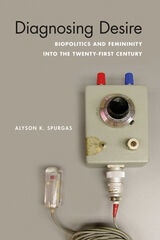
Diagnosing Desire
Biopolitics and Femininity into the Twenty-First CenturyAlyson K. Spurgas
The Ohio State University Press, 2020
In Diagnosing Desire: Biopolitics and Femininity into the Twenty-First Century, Alyson K. Spurgas examines the “new science of female sexuality” from a critical, sociological perspective, considering how today’s feminist-identified sex researchers study and manage women with low desire. Diagnosing Desire investigates experimental sex research that measures the disconnect between subjective and genital female arousal, contemporary psychiatric diagnoses for low female desire, new models for understanding women’s sexual response, and cutting-edge treatments for low desire in women—including from the realms of mindfulness and alternative healing.
Spurgas makes the case that, together, all of these technologies create a “feminized responsive desire framework” for understanding women’s sexuality, and that this, in fact, produces women’s sexuality as a complex problem to be solved. The biggest problem, Spurgas argues, is that gendered and sexualized trauma—including as it is produced within technoscientific medicine itself—is too often ignored in contemporary renderings. Through incisive textual analysis and in-depth qualitative research based on interviews with women with low desire, Spurgas argues for a more radical and communal form of care for feminized—and traumatized—populations, in opposition to biopolitical mandates to individualize and neoliberalize forms of self-care. Ultimately, this is a book not just about a specific diagnosis or dysfunction but about the material-discursive regimes that produce and regulate femininity.
Disobedience, Slander, Seduction, and Assault
Women and Men in Cajamarca, Peru, 1862-1900By Tanja Christiansen
University of Texas Press, 2004
Though the law and courts of nineteenth-century Peru were institutions created by and for the ruling elite, women of all classes used the system to negotiate the complexities of property rights, childrearing, and marriage, and often to defend their very definitions of honor. Drawing on the trial transcripts of Cajamarca, a northern Peruvian province, from more than a century ago, this book shares eye-opening details about life among this community, in which reputation could determine a woman's chances of survival.
Exploring the processes of courtship, seduction, and familial duties revealed in these court records, historian Tanja Christiansen has unearthed a compelling panorama that includes marital strife, slander, disobedience, street brawls, and spousal abuse alongside documents that give evidence of affection and devotion. Her research also yields much new information about the protocols for conflict and cooperation among nineteenth-century Peruvian women from all social strata, and the prevalence of informal unions in an economy driven in large part by migratory male labor. Reviving a little-known aspect of Latin American history, Christiansen's book simultaneously brings to light an important microcosm of women's history during the nineteenth century.
Disturbing Practices
History, Sexuality, and Women's Experience of Modern WarLaura Doan
University of Chicago Press, 2013