Results by title
151 books match the query 'Sign Language' and 11 start with d
Deaf Epistemologies
Multiple Perspectives on the Acquisition of KnowledgePeter V. Paul
Gallaudet University Press, 2012
Epistemology is the study of how “knowledge” is formed. Standard epistemology isolates the “known” from the “knowers,” thereby defining “knowledge” as objectively constant. Multiple epistemologies suggest that individuals learn in different ways shaped by life factors such as education, family, ethnicity, history, and regional beliefs. In this groundbreaking volume, editors Peter V. Paul and Donald F. Moores call on ten other noted scholars and researchers to join them in examining the many ways that deaf people see and acquire deaf knowledge.
This collection considers three major groups of deaf knowledge perspectives: sociological and anthropological, historical/psychological and literary, and educational and philosophical. The first explores the adoption of a naturalized, critical epistemological stance in evaluating research; the epistemology of a positive deaf identity; how personal epistemologies can help form deaf education policies; and valuing deaf indigenous knowledge in research. The next part considers dueling epistemologies in educating deaf learners; reforms in deaf education; the role of deaf children of hearing parents in creating Deaf epistemologies; and the benefit of reading literature with deaf characters for all students. The final part explores the application of the Qualitative-Similarity Hypothesis to deaf students’ acquisition of knowledge; a metaparadigm for literacy instruction in bilingual-bicultural education; collaborative knowledge-building to access academia; and examination of the benefits and disadvantages of being deaf.
Deaf Eyes on Interpreting
Thomas K. Holcomb
Gallaudet University Press, 2018
Deaf Eyes on Interpreting brings Deaf people to the forefront of the discussions about what constitutes quality interpreting services. The contributors are all Deaf professionals who use interpreters on a regular basis, and their insights and recommendations are based on research as well as on personal experiences. These multiple perspectives reveal strategies to maximize access to interpreted work and hearing environments and to facilitate trust and understanding between interpreters and Deaf consumers. Interpreter educators, interpreting students, professional interpreters, and Deaf individuals will all benefit from the approaches offered in this collection.

Deaf Interpreters at Work
International InsightsRobert Adam
Gallaudet University Press, 2014
Along with volume coeditors Robert Adam, Christopher Stone, and Steven D. Collins, contributors include Markus Aro, Karen Bontempo, Juan Carlos Druetta, Senan Dunne, Eileen Forestal, Della Goswell, Juli af Klintberg, Patricia Levitzke-Gray, Jemina Napier, Brenda Nicodemus, Debra Russell, Stephanie Sforza, Marty Taylor, and Linda Warby. The scope of their research spans the world, including many unique facets of interpreting by deaf people in Argentina, Australia, Canada, England, Finland, Ireland, Sweden, and the United States, establishing this work as the standard in this burgeoning discipline.
Deaf Learners
Developments in Curriculum and InstructionDonald F. Moores
Gallaudet University Press, 2006
Deaf Mobility Studies
Exploring International Networks, Tourism, and MigrationAnnelies Kusters
Gallaudet University Press, 2024
The text is augmented by direct links to clips in nine ethnographic films, analysis of selected film excerpts and screenshots, and compelling data visualizations. QR codes throughout the book link to the film clips to create this dual narrative experience. Deaf Mobility Studies is an expansive odyssey through the complexities and opportunities inherent in deaf international mobility.
Deaf Mobility Studies: Exploring International Networks, Tourism, and Migration © 2024 by Gallaudet University is licensed under CC BY-NC-ND 4.0.
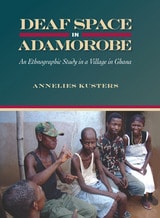
Deaf Space in Adamorobe
An Ethnographic Study in a Village in GhanaAnnelies Kusters
Gallaudet University Press, 2015
Deaf Space in Adamorobe reveals one example of the considerable variation in shared signing communities regarding rates of sign language proficiency and use, deaf people’s marriage rates, deaf people’s participation in village economies and politics, and the role of deaf education. Kusters describes spaces produced by both deaf and hearing people as a cohesive community where living together is an integral fact of their sociocultural environments. At the same time, Kusters identifies tension points between deaf and hearing perspectives and also between outside perspectives and discourses that originated within the community. Because of these differences and the relatively high number of deaf people in the community, Kusters concludes it is natural that they form deaf spaces within the shared space of the village community.
Deaf Studies for Educators
Onudeah D. Nicolarakis
Gallaudet University Press, 2025
This is the second volume in the Early Papers in Deaf Studies series, which consists of reissued works originally published by the Gallaudet University College for Continuing Education but long out of print. The aim of this series is to restore these foundational papers to the scholarly community. Deaf Studies for Educators is available in both print and open digital formats, ensuring broad access to this important contribution to the literature.

Deaf in DC
A MemoirMadan Vasishta
Gallaudet University Press, 2011
In his first memoir, Madan Vasishta described being a deaf boy in his homeland India, where “deaf” meant someone who is not human. After rising from herding cattle to being a respected photographer in Delhi, his first memoir concluded with his acceptance at Gallaudet College far away in America. Vasishta’s new memoir begins with his arrival in Washington, DC in 1967 with $40.00 in his pocket and very little knowledge of the new worlds he was entering.
Vasishta faced myriad challenges from the outset— he knew no American Sign Language and could not speech read, yet he found himself thrust into classes at Gallaudet two weeks into the semester. Cultural differences mystified him, such as how all American car accidents were someone else’s fault even when one’s car hits a stationary object. He was amazed that his fellow students did not deride him for his mistakes, unlike in India where he would have been scorned for his weakness. After five years, he returned home to India for a visit and was stunned to learn that he no longer fit in, that “even if you do not have an American Dream, the American Dream will have you.”
Deaf in DC follows Vasishta through half a century living in America. He witnessed the transformation from facing bias as a deaf, foreign man of color who could not get a job despite having a Ph.D., to receiving five offers as a school superintendent in the wake of the Civil Rights movement and Deaf President Now. His new memoir reflects a genuine worldview informed by the sage perceptions of a person who has lived widely in many worlds.
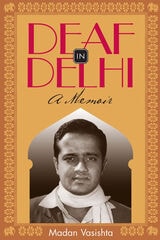
Deaf in Delhi
A MemoirMadan Vasishta
Gallaudet University Press, 2006
Vasishta’s story reflects the India of his youth, an emerging nation where most people struggled with numbing poverty and depended upon close family ties, tradition, and faith to see them through. His family’s search for a cure took him to a host of medical specialists and just as many sadhus and mahatmas, holy men and priests. The school in his small village was ill-prepared to educate deaf students then, so he herded the family cattle, usually the work of hired servants. Vasishta refused to accept this as his final lot in life and fantasized constantly about better jobs. Eventually, he moved to Delhi where his dream of becoming a photographer came true. He also discovered the Delhi Deaf community that, with his family, helped him to achieve an even higher goal, traveling to America to earn a degree at Gallaudet College.
Vasishta, a natural raconteur, imbues Deaf in Delhi with the ever-present ebullience that served him so well in his journey. Readers will savor his good humor and honest observations and look forward to his next book with great relish.
Discourse in Signed Languages
Cynthia B. Roy
Gallaudet University Press, 2011
In this volume, editor Cynthia B. Roy presents a stellar cast of cognitive linguists, sociolinguists, and discourse analysts to discover and demonstrate how sign language users make sense of what is going on within their social and cultural contexts in face-to-face interactions. In the first chapter, Paul Dudis presents an innovative perspective on depiction in discourse. Mary Thumann follows with her observations on constructed dialogue and constructed action. Jack Hoza delineates the discourse and politeness functions of hey and well in ASL as examples of discourse markers in the third chapter.
Laurie Swabey investigates reference in ASL discourse in the fourth chapter. In Chapter 5, Christopher Stone offers insights on register related to genre in British Sign Language discourse, and Daniel Roush addresses in Chapter 6 the “conduit” metaphor in English and ASL. Jeffrey Davis completes this collection by mapping out the nature of discourse in Plains Indian Sign Language, a previously unstudied language. The major thread that ties together the work of these varying linguists is their common focus on the forms and functions of sign languages used by people in actual situations. They each provide new keys to answering how thoughts expressed in one setting with one term or one utterance may mean something totally different when expressed in a different setting with different participants and different purposes.
Discovering Sign Language
Laura Greene
Gallaudet University Press, 1981