Results by title
216 books match the query 'Social' and 9 start with d

Darwin's Conjecture
The Search for General Principles of Social and Economic EvolutionGeoffrey M. Hodgson and Thorbjørn Knudsen
University of Chicago Press, 2010
Of paramount importance to the natural sciences, the principles of Darwinism, which involve variation, inheritance, and selection, are increasingly of interest to social scientists as well. But no one has provided a truly rigorous account of how the principles apply to the evolution of human society—until now.
In Darwin’s Conjecture, Geoffrey Hodgson and Thorbjørn Knudsen reveal how the British naturalist’s core concepts apply to a wide range of phenomena, including business practices, legal systems, technology, and even science itself. They also critique some prominent objections to applying Darwin to social science, arguing that ultimately Darwinism functions as a general theoretical framework for stimulating further inquiry. Social scientists who adopt a Darwinian approach, they contend, can then use it to frame and help develop new explanatory theories and predictive models.
This truly pathbreaking workat long last makes the powerful conceptual tools of Darwin available to the social sciences and will be welcomed by scholars and students from a range of disciplines.

Deaf People in the Criminal Justice System
Selected Topics on Advocacy, Incarceration, and Social JusticeDebra Guthmann
Gallaudet University Press, 2021
The contributors address issues such as accessibility needs; gaps regarding data collection and the need for more research; additional training for attorneys, court personnel, and prison staff; the need for more qualified sign language interpreters, including Certified Deaf Interpreters who provide services in court, prison, and juvenile facilities; substance use disorders; the school to prison nexus; and the need for advocacy. Students in training programs, researchers, attorneys, mental health professionals, sign language interpreters, family members, and advocates will be empowered by this much-needed resource to improve the experiences and outcomes for deaf people in the criminal justice system.
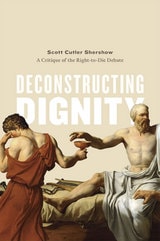
Deconstructing Dignity
A Critique of the Right-to-Die DebateScott Cutler Shershow
University of Chicago Press, 2013
Shershow examines texts from Cicero’s De Officiis to Kant’s Groundwork of the Metaphysics of Morals to court decisions and religious declarations. Through them he reveals how arguments both supporting and denying the right to die undermine their own unconditional concepts of human dignity and the sanctity of life with a hidden conditional logic, one often tied to practical economic concerns and the scarcity or unequal distribution of medical resources. He goes on to examine the exceptional case of self-sacrifice, closing with a vision of a society—one whose conditions we are far from meeting—in which the debate can finally be resolved. A sophisticated analysis of a heated topic, Deconstructing Dignity is also a masterful example of deconstructionist methods at work.
Deep Rhetoric
Philosophy, Reason, Violence, Justice, WisdomJames Crosswhite
University of Chicago Press, 2013
Chapter by chapter, Deep Rhetoric develops an understanding of rhetoric not only in its philosophical dimension but also as a means of guiding and conducting conflicts, achieving justice, and understanding the human condition. Along the way, Crosswhite restores the traditional dignity and importance of the discipline and illuminates the twentieth-century resurgence of rhetoric among philosophers, as well as the role that rhetoric can play in future discussions of ontology, epistemology, and ethics. At a time when the fields of philosophy and rhetoric have diverged, Crosswhite returns them to their common moorings and shows us an invigorating new way forward.

Designs on the Contemporary
Anthropological TestsPaul Rabinow and Anthony Stavrianakis
University of Chicago Press, 2014
The authors continue their prior explorations of the contemporary in past works: How to conceptualize, test, and give form to breakdowns of truth and conduct, as well as how to open up possibilities for the remediation of such breakdowns. They offer a surprising and contrasting pair of case studies of two figures who engaged with contemporary breakdowns: Salman Rushdie and Gerhard Richter. Approaching Richter’s artistic struggles with form and technique in the long wake of modernism and Rushdie’s struggles to find a narrative form—as well as a form for living—to respond to the Iranian fatwa issued against him, they show how both men formulated different new approaches to anthropology for the twenty-first century.
Dimensions Of Forgiveness
A Research ApproachEverett L. Worthington
Templeton Press, 1999
The scientific study of forgiveness is a new approach to an age-old problem. For thousands of years, people have practiced forgiveness within religious systems. Now, the field of scholarly research of forgiveness reveals the beneficial aspects of the process.
p>Contributors include Elliot Dorff and Martin Marty discussing religious interpretations, followed by social implications explained by Kenneth Pargament and Mark Rye. Roy Baumeister, Julie Exline, and Kristin Sommer present the victim's point of view. Other contributors focusing on the forgiveness research are: Everett Worthington, Robert Enright, Catherine Coyle, Carl Thoresen, Frederic Luskin, and Alex Harris. An annotated bibliography by Michael McCullough, Julie Exline, and Roy Baumeister, covers the empirical literature on the subject. Lewis Smedes concludes with the four steps necessary for forgiveness: moving from estrangement to forgiveness to reconciliation to hope.

Dimensions Of Forgiveness
A Research ApproachEverett L. Worthington
Templeton Press, 0
The scientific study of forgiveness is a new approach to an age-old problem. For thousands of years, people have practiced forgiveness within religious systems. Now, the field of scholarly research of forgiveness reveals the beneficial aspects of the process.
p>Contributors include Elliot Dorff and Martin Marty discussing religious interpretations, followed by social implications explained by Kenneth Pargament and Mark Rye. Roy Baumeister, Julie Exline, and Kristin Sommer present the victim's point of view. Other contributors focusing on the forgiveness research are: Everett Worthington, Robert Enright, Catherine Coyle, Carl Thoresen, Frederic Luskin, and Alex Harris. An annotated bibliography by Michael McCullough, Julie Exline, and Roy Baumeister, covers the empirical literature on the subject. Lewis Smedes concludes with the four steps necessary for forgiveness: moving from estrangement to forgiveness to reconciliation to hope.

Disorienting Phenomenology
Queer Space and Trans LifeEden Kinkaid
University of Minnesota Press, 2026
Rethinking space from the ground up through trans theory, philosophy, and radical possibility
Disorienting Phenomenology takes as its point of departure the trans mundane: entering a public restroom, moving through airport security, navigating professional spaces. These ordinary yet unsettling encounters become portals into urgent philosophical questions about space, embodiment, perception, power, and violence. Attending closely to how trans people experience everyday life, Eden Kinkaid shows that space is never neutral. It is felt, negotiated, and contested at the level of the body, shaping one’s capacities, safety, and sense of self.
Weaving together philosophy, queer and trans studies, geography, and personal narrative, Kinkaid develops an intersectional theory of space grounded in lived experience. They bring the foundational spatial theories of Henri Lefebvre together with critical phenomenologies of gender, race, and disability to demonstrate how systems of oppression are built into the environments we inhabit, configuring movement and constraining possibility for minoritized people. Bold and interdisciplinary, Disorienting Phenomenology offers vital conceptual tools for understanding—and transforming—the worlds we move through each day.
Retail e-book files for this title are screen-reader friendly.

Displacing Whiteness
Essays in Social and Cultural CriticismRuth Frankenberg, ed.
Duke University Press, 1997
Approaching whiteness as a plural rather than singular concept, the essays describe, for instance, African American, Chicana/o, European American, and British experiences of whiteness. The contributors offer critical readings of theory, literature, film and popular culture; ethnographic analyses; explorations of identity formation; and examinations of racism and political process. Essays examine the alarming epidemic of angry white men on both sides of the Atlantic; far-right electoral politics in the UK; underclass white people in Detroit; whiteness in "brownface" in the film Gandhi; the engendering of whiteness in Chicana/o movement discourses; "whiteface" literature; Roland Barthes as a critic of white consciousness; whiteness in the black imagination; the inclusion and exclusion of suburban "brown-skinned white girls"; and the slippery relationships between culture, race, and nation in the history of whiteness. Displacing Whiteness breaks new ground by specifying how whiteness is lived, engaged, appropriated, and theorized in a range of geographical locations and historical moments, representing a necessary advance in analytical thinking surrounding the burgeoning study of race and culture.
Contributors. Rebecca Aanerud, Angie Chabram-Dernersesian, Phil Cohen, Ruth Frankenberg, John Hartigan Jr., bell hooks, T. Muraleedharan, Chéla Sandoval, France Winddance Twine, Vron Ware, David Wellman