Results by title
101 books match the query 'Social Activists' and 7 start with d
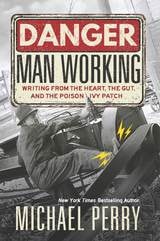
Danger, Man Working
Writing from the Heart, the Gut, and the Poison Ivy PatchArenas
Wisconsin Historical Society Press, 2017
"Every writer has advice for aspiring writers. Mine is predicated on formative years spent cleaning my father’s calf pens: Just keep shoveling until you’ve got a pile so big, someone has to notice. The fact that I cast my life’s work as slung manure simply proves that I recognize an apt metaphor when I accidentally stick it with a pitchfork. . . . Poetry was my first love, my gateway drug—still the poets are my favorites—but I quickly realized I lacked the chops or insights to survive on verse alone. But I wanted to write. Every day. And so I read everything I could about freelancing, and started shoveling."
The pieces gathered within this book draw on fifteen years of what Michael Perry calls "shovel time"—a writer going to work as the work is offered. The range of subjects is wide, from musky fishing, puking, and mountain-climbing Iraq War veterans to the frozen head of Ted Williams. Some assignments lead to self-examination of an alarming magnitude (as Perry notes, "It quickly becomes obvious that I am a self-absorbed hypochondriac forever resolving to do better nutritionally and fitness-wise but my follow-through is laughable.") But his favorites are those that allow him to turn the lens outward: "My greatest privilege," he says, "lies not in telling my own story; it lies in being trusted to tell the story of another."
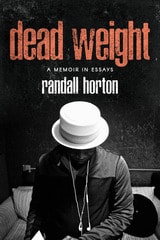
Dead Weight
A Memoir in EssaysRandall Horton
Northwestern University Press, 2022
The memoir begins with a conversation between Horton and Ralph Ellison’s Invisible Man statue in New York City. Their imagined dialogue examines the psychological impact of racism on Black men and boys, including Horton’s separation from his mother, immediately after his birth, in a segregated Alabama hospital. From his current life as a professor and prison reformer, Horton looks back on his experiences as a drug smuggler and trafficker during the 1980s–1990s as well as the many obstacles he faced after his release. He also examines the lasting impact of his drug activity on those around him, reflecting on the allure of economic freedom and the mental escapism that cocaine provided, an allure so strong that both sellers and users were willing to risk prison. Horton shares historical context and vivid details about people caught in the war on drugs who became unsuspecting protagonists in somebody else’s melodrama.
Lyrical and gripping, Dead Weight reveals the lifelong effects of one man’s incarceration on his psyche, his memories, and his daily experience of American society.
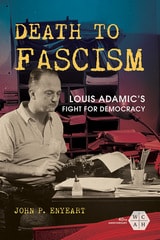
Death to Fascism
Louis Adamic's Fight for DemocracyJohn P. Enyeart
University of Illinois Press, 2019
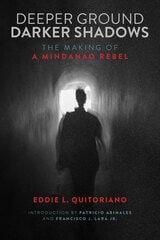
Deeper Ground, Darker Shadows
The Making of a Mindanao RebelEddie L. Quitoriano
University of Wisconsin Press, 2025
Quitoriano finds revolutionary life thrilling but dangerous, with secretly arranged meetings and drops, doctored passports, and hastily planned plastic surgery. He wrestles with the global implications of his work, experiences daily struggles to survive in always-changing political circumstances, and is profoundly human in his love and concern for the family he has left behind in the Philippines. What emerges is a view of international revolutionary movements that only an insider could write. Quitoriano provides an essential and unique missing piece of twentieth-century Philippine and leftist history.
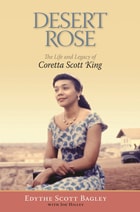
Desert Rose
The Life and Legacy of Coretta Scott KingEdythe Scott Bagley with Joe Hilley
University of Alabama Press, 2012
An intimate biography illuminating the life, leadership, and legacy of Coretta Scott King within the American Civil Rights Movement.
Coretta Scott King—noted author, human rights activist, and wife and partner of famed Civil Rights Movement leader Martin Luther King Jr.—grew up in the rural Alabama Black Belt with her older sister, Edythe Scott Bagley. Bagley chronicles the sisters’ early education together at the Crossroads School and later at the progressive Lincoln School in Marion. She describes Coretta’s burgeoning talent for singing and her devotion to musical studies, and the sisters’ experiences matriculating at Antioch College, an all-white college far from the rural South. Bagley provides vivid insights into Coretta’s early passion for racial and economic justice, which lead to her involvement in the Peace Movement and the National Association for the Advancement of Colored People.
As Coretta’s older sister, Edythe shared in almost all of Coretta’s many trials and tribulations. Desert Rose charts Coretta’s hesitance about her romance with Martin Luther King and the prospect of having to sacrifice her dream of a career in music to become a minister’s wife. Ultimately, Coretta chose to utilize her artistic gifts and singing voice for the Movement through the development and performance of Freedom Concerts. This book also charts Coretta’s own commitment and dedication, in the years that followed King’s death, to the causes of international civil rights, the antiapartheid movement, and the establishment of the King Center in Atlanta and the national King Holiday. Coretta’s devotion to activism, motherhood, and the movement led by her husband, and her courageous assumption of the legacy left in the wake of King’s untimely assassination, are wonderfully detailed in this intimate biography.
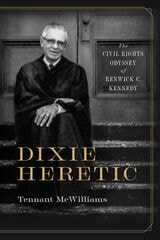
Dixie Heretic
The Civil Rights Odyssey of Renwick C. KennedyTennant McWilliams
University of Alabama Press, 2023
A life-and-times biography of the minister and social reformer Renwick C. Kennedy
Drawn from some 5,000 letters, six decades of daily-diary writings, and extensive interviews, Dixie Heretic: The Civil Rights Odyssey of Renwick C. Kennedy offers a life-and-times biography of the Alabama Black Belt minister, Renwick C. Kennedy (1900–1985). Here, Tennant McWilliams gives an unvarnished account of Kennedy’s tortuous efforts to make his congregants and other southern whites “better Christians.”
Kennedy came from “upcountry” South Carolina, a place rife with Scotch-Irish Associate Reformed Presbyterians—people of biblical infallibility and individual piety and salvation. In 1927, after a life-changing theology education at Princeton, he moved to Camden, Alabama, county seat of Wilcox County. There, he came to believe that God had a mandate for him: to change the “Half Christian” conservative, and the often violent, racial behaviors around him. As a neo-orthodox Protestant, Kennedy never rejected literal approaches to the Bible. Still, out of the “Full Christian” Social Gospel, he urged changed racial behavior. Ultimately this led him to publish confrontational short stories and essays in Christian Century and New Republic—most set in fictitious “Yaupon County.”
In World War II, Kennedy served as a chaplain with the famed 102nd Evacuation Hospital. He came home hoping the Allied victory would spur Americans to fight racial segregation just as they had fought racial fascism in Europe. The 1948 Dixiecrat movement dashed these hopes, turning much of his neo-orthodox optimism to cynicism. His hope found fleeting resurgence in the civil rights movement, and saw Kennedy quietly leading desegregation of Troy University, where he was an administrator. But the era’s assassinations, combined with George Wallace and the rise of southern white Republicans, regularly returned him to the frustrated hopes of 1948 and fostered a pessimism about truly changed hearts that he took to his grave in 1985.
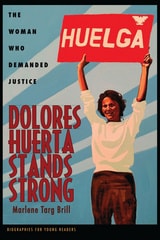
Dolores Huerta Stands Strong
The Woman Who Demanded JusticeMarlene Targ Brill
Ohio University Press, 2018
Selected as a Bank Street College of Education Best Children’s Book of the Year for 2018 (Category: Twelve–Fourteen)
“A biography for the times … An excellent read for anyone hoping to believe one person can make a difference.” —Kirkus (starred review)
“This well-told, age-appropriate account of a vital and essential activist deserves a place in all middle grade collections.” —School Library Journal (starred review)
Today, we know Dolores Huerta as the cofounder, with Cesar Chavez, of the National Farmworkers Association, which later became the United Farm Workers of America. We know her as a tireless advocate for the rights of farmworkers, Mexican American immigrants, women, and LGBTQ populations. And we know her as the recipient of the Presidential Medal of Freedom from Barack Obama in 2012.
Before all that, though, Huerta was a child in the farming community of Stockton, California, and then a teenager whose teachers underestimated her because she was Chicana. When she became a teacher herself, she witnessed her students coming to school shoeless and hungry. Many took days off from school to work in the farm fields to help feed their families. What could she do to help them? A young mother at the time, Huerta quit her teaching job to organize their parents. That began her journey to educate a nation about who produces our food and the conditions under which they work.
Dolores Huerta Stands Strong follows Huerta’s life from the mining communities of the Southwest where her father toiled, to the vineyards and fields of California, and across the country to the present day. As she worked for fair treatment for others, Dolores earned the nation’s highest honors. More important, she found her voice.