Results by title
322 books match the query 'Social Policy' and 18 start with d

Dangerous Frames
How Ideas about Race and Gender Shape Public OpinionNicholas J. G. Winter
University of Chicago Press, 2008

Debating the American Dream
How Explanations for Inequality Polarize PoliticsElizabeth Suhay
Russell Sage Foundation, 2025
Drawing on public opinion surveys spanning more than four decades, Suhay finds that Americans’ belief in the American Dream is strongly related to their political party affiliation. Democratic Party leaders have increasingly questioned the fairness of the American economy, and, in effect, have called into question whether the American Dream is “real.” Republican Party leaders, by contrast, have consistently defended the fairness of the economy and the American Dream. While it is true that Americans have become more skeptical of the American Dream overall, Suhay finds this skepticism is concentrated among Democratic members of the public. Despite the increasingly working-class make-up of the Republican coalition, most Republican members of the public continue to believe the American Dream is reality.
Suhay finds that both Democrats and Republicans tend to adhere to their party’s economic narratives when identifying the causes of inequality between rich and poor, White and Black and Latino Americans, and men and women. Democrats and liberals often attribute inequality between these groups to societal causes, such as lack of access to education and jobs or discrimination. Republicans and conservatives, on the other hand, are more likely to blame individuals and lower income groups for their difficulties. However, Americans’ beliefs are less polarized when they consider socioeconomic inequalities rarely debated by politicians. For example, when asking Republicans and Democrats about the roots of rural-urban and White-Asian inequality, there is no clear unequal opportunity-individual responsibility partisan divide. Suhay argues that the availability of partisan “scripts” helps to explain differences in the public’s views on inequality between groups that have been politicized. These beliefs appear to bolster support for the two parties’ policy agendas among party supporters, driving a wedge between Democrats and Republicans in support for redistributive economic policy as well as the political candidates who support or oppose redistribution.
Debating the American Dream provides fascinating insights into politics’ role in Americans’ beliefs and attitudes concerning inequality.
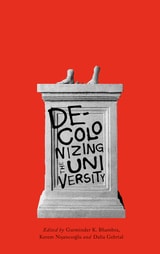
Decolonizing the University
Edited by Gurminder K. Bhambra, Kerem Nisancioglu and Dalia Gebrial
Pluto Press, 2018
In 2015, students at the University of Cape Town demanded the removal of a statue of Cecil Rhodes, the imperialist, racist business magnate, from their campus. Their battle cry, #RhodesMustFall, sparked an international movement calling for the decolonization of universities all over the world.
Today, as the movement develops beyond the picket line, how might it go on to radically transform the terms upon which universities exist? In this book, students, activists, and scholars discuss the possibilities and the pitfalls of doing decolonial work in the heart of the establishment. Subverting curricula, demanding diversity, and destroying old boundaries, this is a radical call for a new era of education. Chapters include:
*Rhodes Must Fall: Oxford and Movements for Change (Dalia Febrial)
*Race and the Neoliberal University ((John Holmwood)
*Black/Academia (Robbie Shilliam)
*The Challenge for Black Studies in the Neoliberal University (Kehinde Andrews)
*Open Initiatives for Decolonising the Curriculum (Pat Lockley)
*Decolonising Education: A Pedagogic Intervention (Carol Azumah Dennis)
*Understanding Eurocentrism as a Structural Problem of Undone Science (William Jamal Richardson)
As the book’s insightful Introduction states, "Taking colonialism as a global project as a starting point, it becomes difficult to turn away from the Western university as a key site through which colonialism—and colonial knowledge in particular—is produced, consecrated, institutionalized and naturalized." Offering resources for students and academics to challenge and resist colonialism inside and outside the classroom, Decolonizing the University provides the tools for radical change in educational disciplines, pedagogies, and institutions.
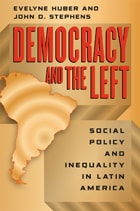
Democracy and the Left
Social Policy and Inequality in Latin AmericaEvelyne Huber and John D. Stephens
University of Chicago Press, 2012
Although inequality in Latin America ranks among the worst in the world, it has notably declined over the last decade, offset by improvements in health care and education, enhanced programs for social assistance, and increases in the minimum wage.

Democracy's Hidden Heroes
Fitting Policy to People and PlaceDavid C. Campbell
Temple University Press, 2024
David Campbell recounts compelling stories of the workarounds, sidesteps, informal agreements, and grantor–grantee negotiations that help policy initiatives succeed as intended. The settings include schools, human services departments, workforce development agencies, and community-based organizations. He explains why it is difficult, though necessary, to translate locally attuned implementation dynamics into accountability metrics for distant funders.
Drawing on 2,000 interviews, Democracy’s Hidden Heroes is the culmination of decades spent talking to people who must reconcile bureaucratic and community cultures. Campbell’s grounded approach and balanced perspective bring fresh insights to the analysis of policy implementation, public management, and results accountability, while offering both cautionary advice and a hopeful prognosis.
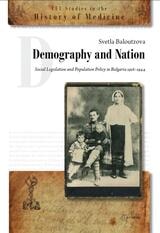
Demography and Nation
Social Legislation and Population Policy in BulgariaSvetla Baloutzova
Central European University Press, 2011
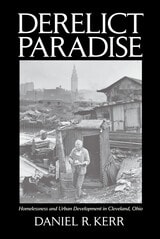
Derelict Paradise
Homelessness and Urban Development in Cleveland, OhioDaniel R. Kerr
University of Massachusetts Press, 2011
Seeking answers to the question, “Who benefits from homelessness?” this book takes the reader on a sweeping tour of Cleveland's history from the late nineteenth-century through the early twenty-first. Daniel Kerr shows that homelessness has deep roots in the shifting ground of urban labor markets, social policy, downtown development, the criminal justice system, and corporate power. Rather than being attributable to the illnesses and inadequacies of the unhoused themselves, it is a product of both structural and political dynamics shaping the city. Kerr locates the origins of today's shelter system in the era that followed the massive railroad rebellions of 1877. From that period through the Great Depression, business and political leaders sought to transform downtown Cleveland to their own advantage. As they focused on bringing business travelers and tourists to the city and beckoned upper-income residents to return to its center, they demolished two downtown working-class neighborhoods and institutionalized a shelter system to contain and control the unhoused and unemployed. The precedents from this period informed the strategies of the post–World War II urban renewal era as the "new urbanism" of the late twentieth century. The efforts of the city's elites have not gone uncontested. Kerr documents a rich history of opposition by people at the margins of whose organized resistance and everyday survival strategies have undermined the grand plans crafted by the powerful and transformed the institutions designed to constrain the lives of the homeless.

Deserving Americans
Partisanship and the New Politics of Social PolicyChris Faricy and Christopher Ellis
University of Chicago Press, 0
A new framework for showing why deservingness politics, more than ideology, has become the central battleground for social policy in a polarized age.
Why do Americans support some government programs but not others? In Deserving Americans, Chris Faricy and Christopher Ellis argue that the answer lies in identity, not ideology. Specifically, support for particular social policies depends on perceptions of whether beneficiaries of government assistance actually deserve the aid that they receive. As partisanship and social identity have converged, partisans increasingly view government aid as a vehicle for rewarding ingroups and punishing outgroups, creating a politics polarized on identity and who government should serve.
Faricy and Ellis show how these dynamics play out across a wide range of policy domains, from antipoverty to health care to family policy and more. Their findings help to clarify many of our current predicaments, yielding insights that explain trends in public opinion and partisan debates over public policy. Deserving Americans offers a powerful new framework for understanding how Americans view social policy—and each other.

Destinies of the Disadvantaged
The Politics of Teen ChildbearingFrank F. Furstenberg
Russell Sage Foundation, 2007

Diploma of Whiteness
Race and Social Policy in Brazil, 1917–1945Jerry Dávila
Duke University Press, 2003
Providing a unique historical perspective on how racial attitudes move from elite discourse into people’s lives, Diploma of Whiteness shows how public schools promoted the idea that whites were inherently fit and those of African or mixed ancestry were necessarily in need of remedial attention. Analyzing primary material—including school system records, teacher journals, photographs, private letters, and unpublished documents—Dávila traces the emergence of racially coded hiring practices and student-tracking policies as well as the development of a social and scientific philosophy of eugenics. He contends that the implementation of the various policies intended to “improve” nonwhites institutionalized subtle barriers to their equitable integration into Brazilian society.
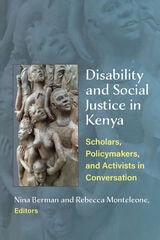
Disability and Social Justice in Kenya
Scholars, Policymakers, and Activists in ConversationNina Berman and Rebecca Monteleone, Editors
University of Michigan Press, 2022
Disability in Africa has received significant attention as a dimension of global development and humanitarian initiatives. Little international attention is given, however, to the ways in which disability is discussed and addressed in specific countries in Africa. Little is known also about the ways in which persons with disabilities have advocated for themselves over the past one hundred years and how their needs were or were not met in locations across the continent. Kenya has been on the forefront of disability activism and disability rights since the middle of the twentieth century. The country was among the first African states to create a legal framework addressing the rights of persons with disabilities, namely the Persons with Disabilities Act of 2003. Kenya, however, has a much longer history of institutions and organizations that are dedicated to addressing the specific needs of persons with disabilities, and substantial developments have occurred since the introduction of the legal framework in 2003.
Disability and Social Justice in Kenya: Scholars, Policymakers, and Activists in Conversation is the first interdisciplinary and multivocal study of its kind to review achievements and challenges related to the situation of persons with disabilities in Kenya today, in light of the country’s longer history of disability and the wide range of local practices and institutions. It brings together scholars, activists, and policymakers who comment on topics including education, the role of activism, the legal framework, culture, the impact of the media, and the importance of families and the community.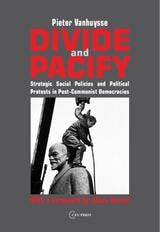
Divide and Pacify
Strategic Social Policies and Political Protests in Post-Communist DemocraciesPieter Vanhuysse
Central European University Press, 2006
Despite dramatic increases in poverty, unemployment, and social inequalities, the Central and Eastern European transitions from communism to market democracy in the 1990s have been remarkably peaceful. This book proposes a new explanation for this unexpected political quiescence. It shows how reforming governments in Poland, Hungary and the Czech Republic have been able to prevent massive waves of strikes and protests by the strategic use of welfare state programs such as pensions and unemployment benefits.
Divide and Pacify explains how social policies were used to prevent massive job losses with softening labor market policies, or to split up highly aggrieved groups of workers in precarious jobs by sending some of them onto unemployment benefits and many others onto early retirement and disability pensions. From a narrow economic viewpoint, these policies often appeared to be immensely costly or irresponsibly populist. Yet a more inclusive social-scientific perspective can shed new light on these seemingly irrational policies by pointing to deeper political motives and wider sociological consequences.

Divide, Provide and Rule
An Integrative History of Poverty Policy, Social Reform, and Social Policy in Hungary under the Habsburg MonarchySusan Zimmermann
Central European University Press, 2011
Doctors and Demonstrators
How Political Institutions Shape Abortion Law in the United States, Britain, and CanadaDrew Halfmann
University of Chicago Press, 2011
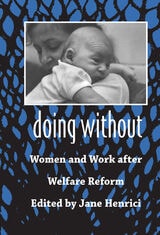
Doing Without
Women and Work after Welfare ReformEdited by Jane Henrici
University of Arizona Press, 2006
In Doing Without, Jane Henrici brings together nine contributions to tell the story of welfare reform from inside the lives of the women who live with it. Cases from Chicago and Boston are combined with a focus on San Antonio from one of the largest multi-city investigations on welfare reform ever undertaken. The contributors argue that the employment opportunities available to poorer women, particularly single mothers and ethnic minorities, are insufficient to lift their families out of poverty. Typically marked by variable hours, inadequate wages, and short-term assignments, both employment and training programs fail to provide stability or the kinds of benefits—such as health insurance, sick days, and childcare options—that are necessary to sustain both work and family life. The chapters also examine the challenges that the women who seek assistance, and those who work in public and private agencies to provide it, together must face as they navigate ever-changing requirements and regulations, decipher alterations in Medicaid, and apply for training and education. Contributors urge that the nation should repair the social safety net for women in transition and offer genuine access to jobs with wages that actually meet the cost of living.
Domestic Contradictions
Race and Gendered Citizenship from Reconstruction to Welfare ReformPriya Kandaswamy
Duke University Press, 2021
Down Ballot
How a Local Campaign Became a National Referendum on AbortionPatrick Wohl
University of Illinois Press, 2024
In 1990, a suburban Chicago race for the Republican Party nomination for state representative unexpectedly became a national proxy battle over abortion in the United States. But the hard-fought primary also illustrated the overlooked importance of down-ballot contests in America’s culture wars. Patrick Wohl offers the dramatic account of a rollercoaster campaign that, after attracting political celebrities and a media circus, came down to thirty-one votes, a coin toss to determine the winner, and a recount fight that set a precedent for how to count dimpled chads. As the story unfolds, Wohl provides a rare nuts-and-bolts look at an election for state office from its first days through the Illinois Supreme Court decision that decided the winner--and set the stage for a decisive 1992 rematch.
A compelling political page-turner, Down Ballot takes readers behind the scenes of a legendary Illinois election.

Down, Out, and Under Arrest
Policing and Everyday Life in Skid RowForrest Stuart
University of Chicago Press, 2016
Juliette, a woman he met during that time, has been stopped by police well over one hundred times, arrested upward of sixty times, and has given up more than a year of her life serving week-long jail sentences. Her most common crime? Simply sitting on the sidewalk—an arrestable offense in LA.
Why? What purpose did those arrests serve, for society or for Juliette? How did we reach a point where we’ve cut support for our poorest citizens, yet are spending ever more on policing and prisons? That’s the complicated, maddening story that Stuart tells in Down, Out and Under Arrest, a close-up look at the hows and whys of policing poverty in the contemporary United States. What emerges from Stuart’s years of fieldwork—not only with Skid Row residents, but with the police charged with managing them—is a tragedy built on mistakes and misplaced priorities more than on heroes and villains. He reveals a situation where a lot of people on both sides of this issue are genuinely trying to do the right thing, yet often come up short. Sometimes, in ways that do serious harm.
At a time when distrust between police and the residents of disadvantaged neighborhoods has never been higher, Stuart’s book helps us see where we’ve gone wrong, and what steps we could take to begin to change the lives of our poorest citizens—and ultimately our society itself—for the better.