Results by title
1861 books match the query 'Social life and customs' and 68 start with d
Daily Life in Biblical Times
Oded Borowski
SBL Press, 2003
Daily Life in Johnson's London
Richard B. Schwartz
University of Wisconsin Press, 1983
"Outstanding. . . . The author packs a remarkable quantity of detail into a small space, even including a discussion of price and wage figures that will be intelligible to Americans [today]. . . . His prose is lucid, graceful, lively. Generously illustrated, the book also includes an extensive bibliography."—Choice
"An excellent source for English Literature and history students studying this period or Samuel Johnson."—Booklist
Daily Life in Portugal in the Late Middle Ages
A.H. de Oliviera Marques; Translated by S.S. Wyatt
University of Wisconsin Press, 1971
Dairylandia
Dispatches from a State of MindSteve Hannah
University of Wisconsin Press, 2022
Dairylandia recounts Steve Hannah’s burgeoning love for his adopted state through the writings of his long-lived column, “State of Mind.” He profiles the lives of the seemingly ordinary, yet quite (and quietly) extraordinary folks he met and befriended on his travels. From Norwegian farmers to rattlesnake hunters to a woman who kept her favorite dead bird in the freezer, Hannah was charmed and fascinated by practically everyone he met. These captivating vignettes are by turns humorous, tragic, and remarkable—and remind us of our shared humanity.
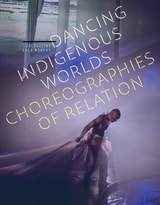
Dancing Indigenous Worlds
Choreographies of RelationJacqueline Shea Murphy
University of Minnesota Press, 2023
The vital role of dance in enacting the embodied experiences of Indigenous peoples
In Dancing Indigenous Worlds, Jacqueline Shea Murphy brings contemporary Indigenous dance makers into the spotlight, putting critical dance studies and Indigenous studies in conversation with one another in fresh and exciting new ways. Exploring Indigenous dance from North America and Aotearoa (New Zealand), she shows how dance artists communicate Indigenous ways of being, as well as generate a political force, engaging Indigenous understandings and histories.
Following specific dance works over time, Shea Murphy interweaves analysis, personal narrative, and written contributions from multiple dance artists, demonstrating dance’s crucial work in asserting and enacting Indigenous worldviews and the embodied experiences of Indigenous peoples. As Shea Murphy asserts, these dance-making practices can not only disrupt the structures that European colonization feeds upon and strives to maintain, but they can also recalibrate contemporary dance.
Based on more than twenty years of relationship building and research, Shea Murphy’s work contributes to growing, and largely underreported, discourses on decolonizing dance studies, and the geopolitical, gendered, racial, and relational meanings that dance theorizes and negotiates. She also includes discussions about the ethics of writing about Indigenous knowledge and peoples as a non-Indigenous scholar, and models approaches for doing so within structures of ongoing reciprocal, respectful, responsible action.
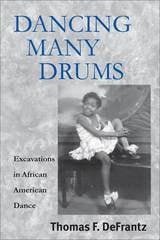
Dancing Many Drums
Excavations In African American DanceThomas F. Defrantz
University of Wisconsin Press, 2002
Few will dispute the profound influence that African American music and movement has had in American and world culture. Dancing Many Drums explores that influence through a groundbreaking collection of essays on African American dance history, theory, and practice. In so doing, it reevaluates "black" and "African American " as both racial and dance categories. Abundantly illustrated, the volume includes images of a wide variety of dance forms and performers, from ring shouts, vaudeville, and social dances to professional dance companies and Hollywood movie dancing.
Bringing together issues of race, gender, politics, history, and dance, Dancing Many Drums ranges widely, including discussions of dance instruction songs, the blues aesthetic, and Katherine Dunham’s controversial ballet about lynching, Southland. In addition, there are two photo essays: the first on African dance in New York by noted dance photographer Mansa Mussa, and another on the 1934 "African opera," Kykunkor, or the Witch Woman.
Dancing in Spite of Myself
Essays on Popular CultureLawrence Grossberg
Duke University Press, 1997
In the course of conducting this exploration into the meaning of "popularity," he investigates the nature of fandom, the social effects of rock music and youth culture, and the possibilities for understanding the history of popular texts and practices. Describing what he calls "the postmodernity of everyday life," Grossberg offers important insights into the relation of pop music to issues of postmodernity and inton the growing power of the new cultural conservatism and its relationship to "the popular." Exploring the limits of existing theories of hegemony in cultural studies, Grossberg reveals the ways in which popular culture is being mobilized in the service of economic and political struggles. In articulating his own critical practice, Grossberg surveys and challenges some of the major assumptions of popular culture studies, including notions of domination and resistance, mainstream and marginality, and authenticity and incorporation.
Dancing in Spite of Myself provides an introduction to contemporary theories of popular culture and a clear statement of relationships among theories of the nature of rock music, postmodernity, and conservative hegemony.
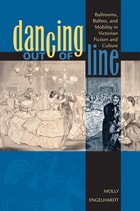
Dancing out of Line
Ballrooms, Ballets, and Mobility in Victorian Fiction and CultureMolly Engelhardt
Ohio University Press, 2009
Dancing out of Line transports readers back to the 1840s, when the craze for social and stage dancing forced Victorians into a complex relationship with the moving body in its most voluble, volatile form.
By partnering cultural discourses with representations of the dance and the dancer in novels such as Jane Eyre, Bleak House, and Daniel Deronda, Molly Engelhardt makes explicit many of the ironies underlying Victorian practices that up to this time have gone unnoticed in critical circles. She analyzes the role of the illustrious dance master, who created and disseminated the manners and moves expected of fashionable society, despite his position as a social outsider of nebulous origins. She describes how the daughters of the social elite were expected to “come out” to society in the ballroom, the most potent space in the cultural imagination for licentious behavior and temptation. These incongruities generated new, progressive ideas about the body, subjectivity, sexuality, and health.
Engelhardt challenges our assumptions about Victorian sensibilities and attitudes toward the sexual/social roles of men and women by bringing together historical voices from various fields to demonstrate the versatility of the dance, not only as a social practice but also as a forum for Victorians to engage in debate about the body and its pleasures and pathologies.
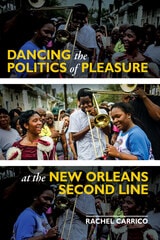
Dancing the Politics of Pleasure at the New Orleans Second Line
Rachel Carrico
University of Illinois Press, 2024
On many Sundays, Black New Orleanians dance through city streets in Second Lines. These processions invite would-be spectators to join in, grooving to an ambulatory brass band for several hours. Though an increasingly popular attraction for tourists, parading provides the second liners themselves with a potent public expression of Black resistance.
Rachel Carrico examines the parading bodies in motion as a form of negotiating and understanding power. Seeing pleasure as a bodily experience, Carrico reveals how second liners’ moves link joy and liberation, self and communal identities, play and dissent, and reclamations of place. As she shows, dancers’ choices allow them to access the pleasure of reclaiming self and city through motion and rhythm while expanding a sense of the possible in the present and for the future.
In-depth and empathetic, Dancing the Politics of Pleasure at the New Orleans Second Line blends analysis with a chorus of Black voices to reveal an indelible facet of Black culture in the Crescent City.
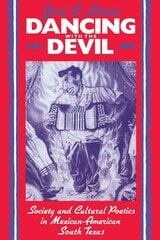
Dancing with the Devil
Society and Cultural Poetics in Mexican-American South TexasJose Limon
University of Wisconsin Press, 1994
Combining shrewd applications of current cultural theory with compelling autobiography and elegant prose, José E. Limón works at the intersection of anthropology, folklore, popular culture, history, and literary criticism. A native of South Texas, he renders a historical and ethnographic account of its rich Mexican-American folk culture. This folk culture, he shows—whether expressed through male joking rituals, ballroom polka dances, folk healing, or eating and drinking traditions—metaphorically dances with the devil, both resisting and accommodating the dominant culture of Texas.
Critiquing the work of his precursors— John Gregory Bourke, J. Frank Dobie, Jovita Gonzalez, and Americo Paredes—Limón deftly demonstrates that their accounts of Mexican-Americans in South Texas contain race, class, and gender contradictions, revealed most clearly in their accounts of the folkloric figure of the devil. Limón's own field-based ethnography follows, and again the devil appears as a recurrent motif, signaling the ideological contradictions of folk practices in a South Texas on the verge of postmodernity.

Danger, Man Working
Writing from the Heart, the Gut, and the Poison Ivy PatchArenas
Wisconsin Historical Society Press, 2017
"Every writer has advice for aspiring writers. Mine is predicated on formative years spent cleaning my father’s calf pens: Just keep shoveling until you’ve got a pile so big, someone has to notice. The fact that I cast my life’s work as slung manure simply proves that I recognize an apt metaphor when I accidentally stick it with a pitchfork. . . . Poetry was my first love, my gateway drug—still the poets are my favorites—but I quickly realized I lacked the chops or insights to survive on verse alone. But I wanted to write. Every day. And so I read everything I could about freelancing, and started shoveling."
The pieces gathered within this book draw on fifteen years of what Michael Perry calls "shovel time"—a writer going to work as the work is offered. The range of subjects is wide, from musky fishing, puking, and mountain-climbing Iraq War veterans to the frozen head of Ted Williams. Some assignments lead to self-examination of an alarming magnitude (as Perry notes, "It quickly becomes obvious that I am a self-absorbed hypochondriac forever resolving to do better nutritionally and fitness-wise but my follow-through is laughable.") But his favorites are those that allow him to turn the lens outward: "My greatest privilege," he says, "lies not in telling my own story; it lies in being trusted to tell the story of another."

Dangerous Gifts
Gender and Exchange in Ancient GreeceBy Deborah Lyons
University of Texas Press, 2012
Deianeira sends her husband Herakles a poisoned robe. Eriphyle trades the life of her husband Amphiaraos for a golden necklace. Atreus’s wife Aerope gives away the token of his sovereignty, a lamb with a golden fleece, to his brother Thyestes, who has seduced her. Gifts and exchanges always involve a certain risk in any culture, but in the ancient Greek imagination, women and gifts appear to be a particularly deadly combination.
This book explores the role of gender in exchange as represented in ancient Greek culture, including Homeric epic and tragedy, non-literary texts, and iconographic and historical evidence of various kinds. Using extensive insights from anthropological work on marriage, kinship, and exchange, as well as ethnographic parallels from other traditional societies, Deborah Lyons probes the gendered division of labor among both gods and mortals, the role of marriage (and its failure) in transforming women from objects to agents of exchange, the equivocal nature of women as exchange-partners, and the importance of the sister-brother bond in understanding the economic and social place of women in ancient Greece. Her findings not only enlarge our understanding of social attitudes and practices in Greek antiquity but also demonstrate the applicability of ethnographic techniques and anthropological theory to the study of ancient societies.
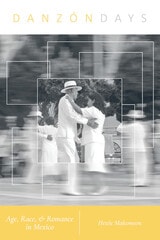
Danzón Days
Age, Race, and Romance in MexicoHettie Malcomson
University of Illinois Press, 2023
Winner of the 2024 BFE Book Prize (British Forum for Ethnomusicology)
Older people negotiating dance routines, intimacy, and racialized differences provide a focal point for an ethnography of danzón in Veracruz, the Mexican city closely associated with the music-dance genre. Hettie Malcomson draws upon on-site research with semi-professional musicians and amateur dancers to reveal how danzón connects, and does not connect, to blackness, joyousness, nostalgia, ageing, and romance. Challenging pervasive utopian views of danzón, Malcomson uses the idea of ambivalence to explore the frictions and opportunities created by seemingly contrary sentiments, ideas, sensations, and impulses. Interspersed with experimental ethnographic vignettes, her account takes readers into black and mestizo elements of local identity in Veracruz, nostalgic and newer styles of music and dance, and the friendships, romances, and rivalries at the heart of regular danzón performance and its complex social world.
Fine-grained and evocative, Danzón Days journeys to one of the genre’s essential cities to provide new perspectives on aging and romance and new explorations of nostalgia and ambivalence.
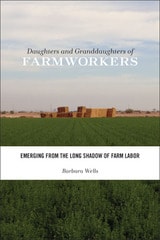
Daughters and Granddaughters of Farmworkers
Emerging from the Long Shadow of Farm LaborWells, Barbara
Rutgers University Press, 0
In Daughters and Granddaughters of Farmworkers, Barbara Wells examines the work and family lives of Mexican American women in a community near the U.S.-Mexican border in California’s Imperial County. Decades earlier, their Mexican parents and grandparents had made the momentous decision to migrate to the United States as farmworkers. This book explores how that decision has worked out for these second- and third-generation Mexican Americans.
Wells provides stories of the struggles, triumphs, and everyday experiences of these women. She analyzes their narratives on a broad canvas that includes the social structures that create the barriers, constraints, and opportunities that have shaped their lives. The women have constructed far more settled lives than the immigrant generation that followed the crops, but many struggle to provide adequately for their families.
These women aspire to achieve the middle-class lives of the American Dream. But upward mobility is an elusive goal. The realities of life in a rural, agricultural border community strictly limit social mobility for these descendants of immigrant farm laborers. Reliance on family networks is a vital strategy for meeting the economic challenges they encounter. Wells illustrates clearly the ways in which the “long shadow” of farm work continues to permeate the lives and prospects of these women and their families.
Dawnland Encounters
Indians and Europeans in Northern New EnglandEdited by Colin G. Calloway
University Press of New England, 1991
Day of the Dead in the USA, Second Edition
The Migration and Transformation of a Cultural PhenomenonRegina M Marchi
Rutgers University Press, 2022
Focusing on the power of public ritual to serve as a communication medium, this revised and updated edition combines a mix of ethnography, historical research, oral history, and critical cultural analysis to explore the manifold and unexpected transformations that occur when the tradition is embraced by the mainstream. A testament to the complex role of media and commercial forces in constructions of ethnic identity, Day of the Dead in the USA provides insight into the power of art and ritual to create community, transmit oppositional messages, and advance educational, political, and economic goals.
Today Chicano-style Day of the Dead events take place in all fifty states. This revised edition provides new information about:
- The increase in events across the US, incorporating media coverage and financial aspects,
- Recent political movements expressed in contemporary Day of the Dead celebrations, including #BlackLivesMatter and #MeToo
- Greater media coverage and online presence of the celebration in blogs, websites, and streaming video
- Día de los Muertos themes and iconography in video games and films
- The proliferation of commercialized merchandise such as home goods, apparel, face paints and jewelry at mainstream big box and web retailers, as well as the widespread proliferation of calavera-themed decorations and costumes for Halloween
- 24 new full color illustrations
Day of the Dead in the USA
The Migration and Transformation of a Cultural PhenomenonMarchi, Regina M
Rutgers University Press, 2009
Focusing on the power of ritual to serve as a communication medium, Regina M. Marchi combines a mix of ethnography, historical research, oral history, and critical cultural analysis to explore the manifold and unexpected transformations that occur when the tradition is embraced by the mainstream. A testament to the complex nature of ethnic identity, Day of the Dead in the USA provides insight into the power of ritual to create community, transmit oppositional messages, and advance educational, political, and economic goals.
Deaf Space in Adamorobe
An Ethnographic Study in a Village in GhanaAnnelies Kusters
Gallaudet University Press, 2015
Deaf Space in Adamorobe reveals one example of the considerable variation in shared signing communities regarding rates of sign language proficiency and use, deaf people’s marriage rates, deaf people’s participation in village economies and politics, and the role of deaf education. Kusters describes spaces produced by both deaf and hearing people as a cohesive community where living together is an integral fact of their sociocultural environments. At the same time, Kusters identifies tension points between deaf and hearing perspectives and also between outside perspectives and discourses that originated within the community. Because of these differences and the relatively high number of deaf people in the community, Kusters concludes it is natural that they form deaf spaces within the shared space of the village community.
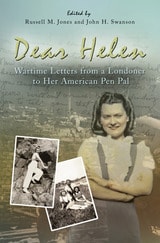
Dear Helen
Wartime Letters from a Londoner to Her American Pen PalEdited by Russell M. Jones & John H. Swanson
University of Missouri Press, 2009
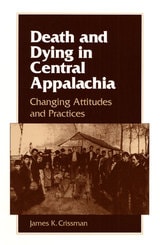
Death and Dying in Central Appalachia
Changing Attitudes and PracticesJames K. Crissman
University of Illinois Press, 1994
Written for both scholarly and general audiences, the book contains sections on the death watch, body preparation, selection or construction of a coffin or casket, digging the grave by hand, the wake, the funeral, and other topics. Crissman then demonstrates how technology and the encroachment of American society have turned these vital traditions into the disappearing practices of the past.

Death and Dying in Colonial Spanish America
Edited by Martina Will de Chaparro and Miruna Achim
University of Arizona Press, 2011
The variety of sources uncovered in the authors’ original archival research suggests the wide diversity of topics and approaches they employ: Nahua annals, Spanish chronicles, Inquisition case records, documents on land disputes, sermons, images, and death registers. Geographically, the range of research focuses on the viceroyalties of New Spain, Peru, and New Granada.
The resulting records—both documentary and archaeological—offer us a variety of vantage points from which to view each of these cultural groups as they came into contact with others. Much less tied to modern national boundaries or old imperial ones, the many facets of the new historical research exploring the topic of death demonstrate that no attitudes or practices can be considered either “Western” or universal.

Death in England
An Illustrated HistoryEdited by Peter C. Jupp and Clare Gittings
Rutgers University Press, 2000
Death in England provides the first ever social history of death-from the earliest times to Diana, Princess of Wales. As we discard the taboos surrounding death, this book charts the fascinating story of how people have coped with this fundamental aspect of their daily lives.
Peter C. Jupp and Clare Gittings reveal how attitudes, practices, and beliefs about death have undergone constant change, as well as how, why, and at what ages people died. Examining how death touches all aspects of society, they cover topics such as plagues and violence; wills and deathbeds; funerals and memorials; and beliefs and bereavement. This wide-ranging analysis is lavishly illustrated with photographs and drawings, their diversity reflecting the breadth of issues and periods covered.
The contributors are all specialists in their own fields, including archaeology, history, and sociology. The ten chapters cover: earliest times to the Bronze Age; the Iron and Roman Ages; the Early Middle Ages; from the advent of Purgatory to the Black Death; the Later Middle Ages and the Reformation; from Elizabeth I to the Civil War; the "Age of Decency"; the Enlightenment; the Victorian era; and the twentieth century.
With the pervasive depiction of death through the media and the ensuing public awareness of this topic, Death in England will be of interest not only to the general reader but also to students of archaeology, art, history, medicine, and sociology.
Debating Muslims
Cultural Dialogues in Postmodernity and TraditionMichael M. J. Fischer and Mehdi Abedi
University of Wisconsin Press, 1990
In a world of multinational commerce, satellite broadcasting, migration, terrorism, and global arms dealing, what is said and how it is said in one society can no longer be isolated from what is said and how it is said in another. Debating Muslims focuses on Iranian culture, Shi’ite Islam, and Iranians in the United States, offering an experiment in postmodern ethnography and an invitation to think in a multifaceted way about Islam in the contemporary world.

Delirio—The Fantastic, the Demonic, and the Réel
The Buried History of Nuevo LeónBy Marie Theresa Hernández
University of Texas Press, 2002
Striking, inexplicable stories circulate among the people of Nuevo León in northern Mexico. Stories of conversos (converted Jews) who fled the Inquisition in Spain and became fabulously wealthy in Mexico. Stories of women and children buried in walls and under houses. Stories of an entire, secret city hidden under modern-day Monterrey. All these stories have no place or corroboration in the official histories of Nuevo León.
In this pioneering ethnography, Marie Theresa Hernández explores how the folktales of Nuevo León encode aspects of Nuevolenese identity that have been lost, repressed, or fetishized in "legitimate" histories of the region. She focuses particularly on stories regarding three groups: the Sephardic Jews said to be the "original" settlers of the region, the "disappeared" indigenous population, and the supposed "barbaric" society that persists in modern Nuevo León. Hernández's explorations into these stories uncover the region's complicated history, as well as the problematic and often fascinating relationship between history and folklore, between officially accepted "facts" and "fictions" that many Nuevoleneses believe as truth.
Deliver Us
Luigi Meneghello, Translated from the Russian by Frederika Randall
Northwestern University Press, 2011
Only loosely chronological, Deliver Us proceeds by themes—childhood games, Fascist symbols, religious precepts, and the rites of poverty, of death, of eros, and of love. Meneghello’s ironic musings and profoundly honest recollections make an utterly unsentimental human comedy of that was the whole world to his dawning consciousness.
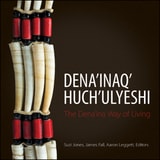
Dena'inaq' Huch'ulyeshi
The Dena'ina Way of LivingEdited by Suzi Jones, James Fall, and Aaron Leggett
University of Alaska Press, 2013
Lavishly illustrated with more than six hundred photographs, maps, and drawings, Dena’inaq’ Huch’ulyeshi contains 469 entries on Dena’ina objects in European and American collections. It is enriched with examples of traditional Dena’ina narratives, first-person accounts, and interviews. Thirteen essays on the history and culture of the Athabascan people put the pieces into a larger historical context. This catalog is a comprehensive reference that will also accompany a large-scale exhibition running September 2013 through January 2014 at the Anchorage Museum.

Denver's Lakeside Amusement Park
From the White City Beautiful to a Century of FunDavid Forsyth
University Press of Colorado, 2016
Once nicknamed White City in part for its glittering display of more than 100,000 lights, the park opened in 1908 in conjunction with Denver's participation in the national City Beautiful movement. It was a park for Denver elites, with fifty different forms of amusement, including the Lakeshore Railway and the Velvet Coaster, a casino, a ballroom, a theater, a skating rink, and avenues decorated with Greek statues. But after metropolitan growth, technological innovation, and cultural shifts in Denver, it began to cater to a working-class demographic as well. Additions of neon and fluorescent lighting, roller coasters like the Wild Chipmunk, attractions like the Fun House and Lakeside Speedway, and rides like the Scrambler, the Spider, and most recently the drop tower Zoom changed the face and feel of Lakeside between 1908 and 2008. The park also has weathered numerous financial and structural difficulties but continues to provide Denverites with affordable, family-friendly amusement today.
To tell Lakeside's story, Forsyth makes use of various primary and secondary sources, including Denver newspapers, Denver's official City Beautiful publication Municipal Facts, Billboard magazine, and interviews with people connected to the park throughout its history. Denver's Lakeside Amusement Park is an important addition to Denver history that will appeal to anyone interested in Colorado history, urban history, entertainment history, and popular culture, as well as to amusement park aficionados.
Desert Dreamers
Barbara Glowczewski
University of Minnesota Press, 2016
In the heart of Australia, on the cracked red earth, among wild vegetation, weathered bush, and dried-up creeks, hundreds of invisible pathways exist that become entangled on the earth's surface, underground, and in the sky, clouds, and wind. The Aboriginal people call them Jukurrpa: “the Dreamings.” This web is the Warlpiri land. Practicing the Dreaming, by ritual art, is for the Warlpiri a way to reactivate their ancestral traditions to connect with the cosmos and respond to current social and political issues.
In 1979, anthropologist Barbara Glowczewski embarked on a journey to study the Warlpiri in the Australian outback. Struggling at once to maintain their traditions and cultural heritage as well as adapting to the continuing secularization and techno-progress of their European Australian counterparts, she takes us into the landscape, artistic rituals, and turmoil of the Warlpiri over three decades. Becoming accepted among Aboriginal families as a translator, and at the same time a negotiator of two vastly different visions of the earth, contemporary Western culture and the ancient indigenous dreaming culture, Glowczewski created a singular document of ethnological fieldwork and of self-transformation and discovery.
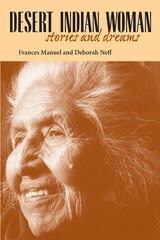
Desert Indian Woman
Stories and DreamsFrances Manuel and Deborah Neff
University of Arizona Press, 2001
Basket weaver, storyteller, and tribal elder, Frances Manuel is a living preserver of Tohono O’odham culture. Speaking in her own words from the heart of the Arizona desert, she now shares the story of her life. She tells of O’odham culture and society, and of the fortunes and misfortunes of Native Americans in the southwestern borderlands over the past century.
In Desert Indian Woman, Frances relates her life and her stories with the wit, humor, and insight that have endeared her to family and friends. She tells of her early childhood growing up in a mesquite brush house, her training in tribal traditions, her acquaintance with Mexican ways, and her education in an American boarding school. Through her recollections of births and deaths, heartache and happiness, we learn of her family’s migration from the reservation to the barrios and back again. In the details of her everyday life, we see how Frances has navigated between O’odham and American societies, always keeping her grandparents’ traditional teachings as her compass.
It is extraordinary to hear from a Native American woman like Frances, in her own words and her own point of view, to enter the complex and sensitive aspects of her life experience, her sorrows, and her dreams. We also become privy to her continuing search for her identity across the border, and the ways in which Frances and Deborah have attempted to make sense of their friendship over twenty-odd years. Throughout the book, Deborah captures the rhythms of Frances’s narrative style, conveying the connectedness of her dreams, songs, and legends with everyday life, bringing images and people from faraway times and places into the present.
Deborah Neff brings a breadth of experience in anthropology and Southwest Native American cultures to the task of placing Frances Manuel’s life in its broader historical context, illuminating how history works itself out in people’s everyday lives. Desert Indian Woman is the story of an individual life lived well and a major contribution to the understanding of history from a Native American point of view.

Desert Mementos
Stories of Iraq and NevadaCaleb S. Cage
University of Nevada Press, 2017
Cage captures similarities in the respective desert landscapes of both Iraq and Nevada, but it is not just a study in contrasting landscapes. The inter-connected stories explore similarities and differences in human needs from the perspectives of vastly different cultures. Specifically, the stories deftly capture the overlap in the respective desert landscapes of each region, the contrasting cultures and worldviews, and the common need for hope. Taken together, the stories represent the arc of a year-long deployment by young soldiers. Cage’s stories are bound together by the soldier’s searing experiences in the desert, bookended by leaving and returning home to Nevada, which in many ways can be just as disorienting as patrolling the Iraq desert.
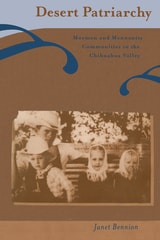
Desert Patriarchy
Mormon and Mennonite Communities in the Chihuahua ValleyJanet Bennion
University of Arizona Press, 2004
Janet Bennion has lived and worked among these people, and in this book she introduces a new paradigm—"desert patriarchy"—to explain their way of life. This perspective sheds light not only on these particular communities but also on the role of the desert environment in the development and maintenance of fundamentalist ideology in other parts of the United States and around the globe.
Making new connections between the arid environment, opposition to technology, and gender ideology, Bennion shows that it is the interplay of the desert and the unique social traditions and gender dynamics embedded in Anglo patriarchal fundamentalism that accounts for the successful longevity of the Mexican colonies. Her model defines the process by which male supremacy, female autonomous networking, and religious fundamentalism all facilitate successful adaptation to the environment.
More than a theoretical analysis, Desert Patriarchy provides an intimate glimpse into the daily lives of these people, showing how they have taken refuge in the desert to escape religious persecution, the forced secular education of their children, and economic and political marginalization. It particularly sheds light on the ironic autonomy of women within a patriarchal system, showing how fundamentalist women in Chihuahua are finding numerous creative ways to access power and satisfaction in a society structured to subordinate and even degrade them.
Desert Patriarchy richly expands the literature on nontraditional religious movements as it enhances our understanding of how environment can shape society. It offers unique insights into women's status in patriarchal communities and provides a new way of looking at similar communities worldwide.
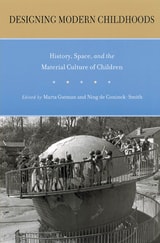
Designing Modern Childhoods
History, Space, and the Material Culture of ChildrenGutman, Marta
Rutgers University Press, 2008
In Designing Modern Childhoods, architectural historians, social historians, social scientists, and architects examine the history and design of places and objects such as schools, hospitals, playgrounds, houses, cell phones, snowboards, and even the McDonald's Happy Meal. Special attention is given to how children use and interpret the spaces, buildings, and objects that are part of their lives, becoming themselves creators and carriers of culture. The authors extract common threads in children's understandings of their material worlds, but they also show how the experience of modernity varies for young people across time, through space, and according to age, gender, social class, race, and culture.
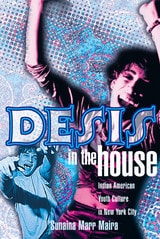
Desis In The House
Indian American Youth Culture In NycSunaina Maira
Temple University Press, 2002
New York City, long the destination for immigrants and migrants, today is home to the largest Indian American population in the United States. Coming of age in a city remarkable for its diversity and cultural innovation, Indian American and other South Asian youth draw on their ethnic traditions and the city's resources to create a vibrant subculture. Some of the city's hottest clubs host regular bhangra parties, weekly events where young South Asians congregate to dance to music that mixes rap beats with Hindi film music, bhangra (North Indian and Pakistani in origin), reggae, techno, and other popular styles. Many of these young people also are active in community and campus organizations that stage performances of "ethnic cultures."
In this book Sunaina Maira explores the world of second-generation Indian American youth to learn how they manage the contradictions of gender roles and sexuality, how they handle their "model minority" status and expectations for class mobility in a society that still racializes everyone in terms of black or white. Maira's deft analysis illuminates the ways in which these young people bridge ethnic authenticity and American "cool."
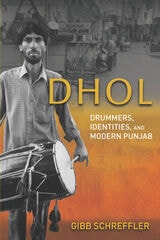
Dhol
Drummers, Identities, and Modern PunjabGibb Schreffler
University of Illinois Press, 2021
Gibb Schreffler draws on two decades of research to investigate dhol's place among the cultural formations within Punjabi communities. Analyzing the identities of musicians, Schreffler illuminates concepts of musical performance, looks at how these concepts help create or articulate Punjabi social structure, and explores identity construction at the intersections of ethnicity, class, and nationality in Punjab and the diaspora. As he shows, understanding the identities of dhol players is an ethical necessity that acknowledges their place in Punjabi cultural history and helps to repair their representation.
An engaging and rich ethnography, Dhol reveals a beloved instrumental form and the musical and social practices of its overlooked performers.
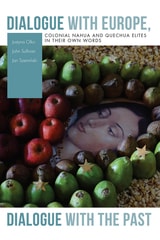
Dialogue with Europe, Dialogue with the Past
Colonial Nahua and Quechua Elites in Their Own WordsJustyna Olko
University Press of Colorado, 2018
In each chapter a particular document is transcribed exactly as it appears in the original manuscript or colonial printed document, with the editor placing it in historical context and considering the degree of European influence. These texts show the nobility through documents they themselves produced or caused to be produced—such as wills, land deeds, and petitions—and prioritize indigenous ways of expression, perspectives, and concepts. Together, the chapters demonstrate that native elites were independent actors as well as agents of social change and indigenous sustainability in colonial society. Additionally, the volume diversifies the commonly homogenous term “cacique” and recognizes the differences in elites throughout Mesoamerica and the Andes.
Showcasing important and varied colonial genres of indigenous writing, Dialogue with Europe, Dialogue with the Past reveals some of the realities, needs, strategies, behaviors, and attitudes associated with the lives of the elites. Each document and its accompanying commentary provide additional insight into how the nobility negotiated everyday life. The book will be of great interest to students and researchers of Mesoamerican and Andean history, as well as those interested in indigenous colonial societies in the Spanish Empire.
Contributors: Agnieszka Brylak, Maria Castañeda de la Paz, Katarzyna Granicka, Gregory Haimovich, Anastasia Kalyuta, Julia Madajczak, Patrycja Prządka-Giersz

Dialogues in Paradise
Can Xue
Northwestern University Press, 1989
Diamond and Juba
The Raucous World of 19th-Century Challenge DancingApril F. Masten
University of Illinois Press, 2025

Diary of Caroline Seabury
Caroline Seabury
University of Wisconsin Press, 1991
In 1854 Caroline Seabury of Brooklyn, New York, set out for Columbus, Mississippi, to teach French at its Institute for Young Ladies. She lived in Columbus until 1863, through the years of mounting sectional bitterness that preceded the Civil War and through the turmoil and hardships of the war itself. During that time, her most intimate confidant was her diary. Discovered in the archives of the Minnesota State Historical Society, it is published here for the first time.
The diary is an illuminating account of southern plantation society and the “peculiar institution” of slavery on the eve of its destruction. Seabury also records her uneasy attempts to come to terms with her position as an unmarried, white, Northern woman whose job was to educate wealthy, white, Southern girls in a setting seemingly oblivious to the horrors of slavery. The diary is not simply a chronicle of daily happenings; Seabury concentrates on remarkable events and the memorable feelings and ideas they generate, shaping them into entries that reveal her as an accomplished writer. She frames her narrative with her journey south in 1854 and the hazardous and exhausting return north through battle lines in 1863.
Disapproving of slavery, yet deeply attached to friends and her life in Columbus and also painfully conscious of the fragility of her own economic and social position, Seabury condemned privately in her diary the evils that she endured silently in public. There are striking scenes of plantation life that depict the brutalities of slavery and benumbed responses to them. Seabury also successfully captures the mood of Mississippi as it changed from a fire-eating appetite to fight the Yankees to a grim apprehension of inexorable defeat. Most impressive of all is Seabury’s poignantly honest presentation of herself, caught in the middle.
Diaspora Without Displacement
The Coloniality and Promise of Capoeira in SenegalCelina de Sá
Duke University Press, 2025
Digging The Days Of The Dead
Juanita Garciagodo
University Press of Colorado, 1998
Digging in the City of Brotherly Love
Stories from Philadelphia ArchaeologyYamin, Rebecca
Temple University Press, 2023
Rebecca Yamin adds three new chapters that showcase several major discoveries from recent finds including unmarked early eighteenth-century burial grounds, one of which associated with the first African Methodist Episcopal (AME) Church, in the oldest part of the city; a nineteenth-century working-class neighborhood built along the path of what is now Route I-95 and was once home to Native American life; and the remains of two taverns found on the site of the current Museum of the American Revolution.
Yamin describes the research and state-of-the-art techniques used to study these exciting discoveries. In chronicling the value of looking into a city’s past, Digging in the City of Brotherly Love brings to life the people who lived in the early city and the people in the present who study them.
Dining at the Lineman's Shack
John Weston
University of Arizona Press, 2003
The place is Skull Valley in central Arizona, the time the 1930s. Taking food as his theme, Weston paints an instructive and often hilarious portrait of growing up, of rural family life under difficult circumstances, and of a remote Arizona community trying to hold body and soul together during tough times. His book recalls life in a lineman's shack, interlaced with "disquisitions on swamp life, rotting water, and the complex experience of finding enough to eat during the Great Depression."
Central to Weston's account is his mother Eloine, a valiant woman rearing a large brood in poverty with little help from her husband. Eloine cooks remarkably well—master of a small repertory from which she coaxes ideas surprising even to herself—and feeds her family on next to nothing. She is a woman whose first instinct is to cry out "Lord, what am I going to feed them" whenever visitors show up close to mealtime. Recalls Weston, "Her strength lay in a practical- and poverty-born sense that there must be more edible food in the world than most people realized," and he swears that six out of seven meals were from parts of four or five previous meals coming round again, like the buckets on a Ferris wheel.
Although Weston evokes a fond remembrance of a bygone era that moves from Depression-era Skull Valley to wartime Prescott, rest assured: food—its acquisition, its preparation, its wholehearted enjoyment—is the foundation of this book. "I did not have a deprived childhood, despite its slim pickings," writes Weston. "If I recall a boiling pig's head now and then, it is not to be read as some Jungian blip from Lord of the Flies but simply a recurring flicker of food-memory." Whether remembering his father's occasional deer poaching or his community's annual Goat Picnic, Weston laces his stories with actual recipes—even augmenting his instructions for roasted wild venison with tips for preparing jerky.
Dining at the Lineman's Shack teems with sparkling allusions, both literary and culinary, informed by Weston's lifetime of travels. Even his nagging memory of desperate boyhood efforts to trade his daily peanut-butter sandwich for bacon-and-egg, baloney, jelly, or most anything else is tempered by his acquaintance with "the insidious sa-teh sauce in Keo Sananikone's hole-in-the-wall restaurant on Kapahulu Street"—a peanut-butter-based delicacy for which he obligingly provides the ingredients (and which he promises will keep, refrigerated in a jar, for several weeks before baroque things begin to grow on it).
Through this tantalizing smorgasbord of memories, stories, and recipes, John Weston has fashioned a wholly captivating commentary on American culture, both in an earlier time and in our own. Dining at the Lineman's Shack is a book that will satisfy any reader's hunger for the unusual—and a book to savor, in every sense of the word.

Dining in a Classical Context
William J. Slater, Editor
University of Michigan Press, 1991

Dinner in Camelot
The Night America's Greatest Scientists, Writers, and Scholars Partied at the Kennedy White HouseJoseph A. Esposito
University Press of New England, 2018
Dinéjí Na`nitin
Navajo Traditional Teachings and HistoryRobert S. McPherson
University Press of Colorado, 2012
Historian Robert McPherson discusses basic Navajo concepts such as divination, good and evil, prophecy, and metaphorical thought, as well as these topics' relevance in daily life, making these far-ranging ideas accessible to the contemporary reader. He also considers the toll of cultural loss on modern Navajo culture as many traditional values and institutions are confronted by those of dominant society. Using both historical and modern examples, he shows how cultural change has shifted established views and practices and illustrates the challenge younger generations face in maintaining the beliefs and customs their parents and grandparents have shared over generations.
This intimate look at Navajo values and customs will appeal not only to students and scholars of Native American studies, ethnic studies, and anthropology but to any reader interested in Navajo culture or changing traditional lifeways.
Discourses of the Vanishing
Modernity, Phantasm, JapanMarilyn Ivy
University of Chicago Press, 1995
Ivy shows how a fascination with cultural margins accompanied the emergence of Japan as a modern nation-state. This fascination culminated in the early twentieth-century establishment of Japanese folklore studies and its attempts to record the spectral, sometimes violent, narratives of those margins. She then traces the obsession with the vanishing through a range of contemporary reconfigurations: efforts by remote communities to promote themselves as nostalgic sites of authenticity, storytelling practices as signs of premodern presence, mass travel campaigns, recallings of the dead by blind mediums, and itinerant, kabuki-inspired populist theater.
Discriminating Taste
How Class Anxiety Created the American Food RevolutionFinn, S. Margot
Rutgers University Press, 2017
For the past four decades, increasing numbers of Americans have started paying greater attention to the food they eat, buying organic vegetables, drinking fine wines, and seeking out exotic cuisines. Yet they are often equally passionate about the items they refuse to eat: processed foods, generic brands, high-carb meals. While they may care deeply about issues like nutrition and sustainable agriculture, these discriminating diners also seek to differentiate themselves from the unrefined eater, the common person who lives on junk food.
Discriminating Taste argues that the rise of gourmet, ethnic, diet, and organic foods must be understood in tandem with the ever-widening income inequality gap. Offering an illuminating historical perspective on our current food trends, S. Margot Finn draws numerous parallels with the Gilded Age of the late nineteenth century, an era infamous for its class divisions, when gourmet dinners, international cuisines, slimming diets, and pure foods first became fads.
Examining a diverse set of cultural touchstones ranging from Ratatouille to The Biggest Loser, Finn identifies the key ways that “good food” has become conflated with high status. She also considers how these taste hierarchies serve as a distraction, leading middle-class professionals to focus on small acts of glamorous and virtuous consumption while ignoring their class’s larger economic stagnation. A provocative look at the ideology of contemporary food culture, Discriminating Taste teaches us to question the maxim that you are what you eat.
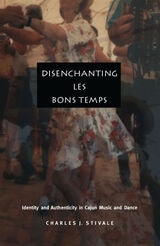
Disenchanting Les Bons Temps
Identity and Authenticity in Cajun Music and DanceCharles J. Stivale
Duke University Press, 2003
Stivale combines his personal knowledge and love of Cajun music and dance with the theoretical insights of Gilles Deleuze and Félix Guattari to consider representations of things Cajun. He examines the themes expressed within the lyrics of the Cajun musical repertoire and reflects on the ways Cajun cultural practices are portrayed in different genres including feature films, documentaries, and instructional dance videos. He analyzes the dynamic exchanges between musicians, dancers, and spectators at such venues as bars and music festivals. He also considers a number of thorny socio-political issues underlying Cajun culture, including racial tensions and linguistic isolation. At the same time, he describes various efforts by contemporary musicians and their fans to transcend the limitations of cultural stereotypes and social exclusion.
Disenchanting Les Bons Temps will appeal to those interested inCajun culture, issues of race and ethnicity, music and dance, and the intersection of French and Francophone studies with Anglo and American cultural studies.
Divine Days
A NovelLeon Forrest; Foreword by Kenneth W. Warren, Preface by Zachary Price
Northwestern University Press, 2023
“I have an awful memory for faces, but an excellent one for voices,” muses Joubert Jones, the aspiring playwright at the center of Divine Days. A kaleidoscopic whorl of characters, language, music, and Black experience, this saga follows Jones for one week in 1966 as he pursues the lore and legends of fictional Forest County, a place resembling Chicago’s South Side. Joubert is a veteran, recently returned to the city, who works for his aunt Eloise’s newspaper and pours drinks at her Night Light Lounge. He wants to write a play about Sugar-Groove, a drifter, “eternal wunderkind,” and local folk hero who seems to have passed away. Sugar-Groove’s disappearance recalls the subject of one of Joubert’s earlier writing attempts—W. A. D. Ford, a protean, diabolical preacher who led a religious sect known as “Divine Days.” Joubert takes notes as he learns about both tricksters, trying to understand their significance.
Divine Days introduces readers to a score of indelible characters: Imani, Joubert’s girlfriend, an artist and social worker searching for her lost siblings and struggling to reconcile middle class life with her values and Black identity; Eloise, who raised Joubert and whose influence is at odds with his writerly ambitions; (Oscar) Williemain, a local barber, storyteller, and founder of the Royal Rites and Righteous Ramblings Club; and the Night Light’s many patrons. With a structure inspired by James Joyce and jazz, Leon Forrest folds references to African American literature and cinema, Shakespeare, the Bible, and classical mythology into a heady quest that embraces life in all its tumult and adventure.
This edition brings Forrest’s masterpiece back into print, incorporating hundreds of editorial changes that the author had requested from W. W. Norton, but were not made for their editions in 1993 and 1994. Much of the inventory from the original printing of the book by Another Chicago Press in 1992 had been destroyed in a disastrous warehouse fire.
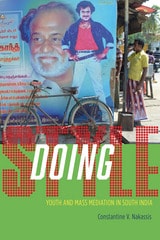
Doing Style
Youth and Mass Mediation in South IndiaConstantine V. Nakassis
University of Chicago Press, 2016
As Nakassis shows, while signs of the global, modern world are everywhere in post-liberalization India, for most of these young people this world is still very distant—a paradox that results in youth’s profound sense of being in between. This in-betweenness manifests itself in the ambivalent quality of style, the ways in which stylish objects are necessarily marked as counterfeit, mixed, or ironical. In order to show how this in-betweenness materializes in particular media, Nakassis explores the entanglements between youth peer groups and the sites where such stylish media objects are produced, arguing that these entanglements deeply condition the production and circulation of the media objects themselves. The result is an important and timely look at the tremendous forces of youth culture, globalization, and mass media as they interact in the vibrancy of a rapidly changing India.