Results by title
201 books match the query 'Social movements' and 7 start with d
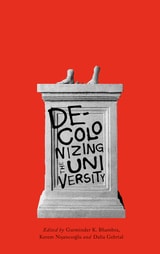
Decolonizing the University
Edited by Gurminder K. Bhambra, Kerem Nisancioglu and Dalia Gebrial
Pluto Press, 2018
In 2015, students at the University of Cape Town demanded the removal of a statue of Cecil Rhodes, the imperialist, racist business magnate, from their campus. Their battle cry, #RhodesMustFall, sparked an international movement calling for the decolonization of universities all over the world.
Today, as the movement develops beyond the picket line, how might it go on to radically transform the terms upon which universities exist? In this book, students, activists, and scholars discuss the possibilities and the pitfalls of doing decolonial work in the heart of the establishment. Subverting curricula, demanding diversity, and destroying old boundaries, this is a radical call for a new era of education. Chapters include:
*Rhodes Must Fall: Oxford and Movements for Change (Dalia Febrial)
*Race and the Neoliberal University ((John Holmwood)
*Black/Academia (Robbie Shilliam)
*The Challenge for Black Studies in the Neoliberal University (Kehinde Andrews)
*Open Initiatives for Decolonising the Curriculum (Pat Lockley)
*Decolonising Education: A Pedagogic Intervention (Carol Azumah Dennis)
*Understanding Eurocentrism as a Structural Problem of Undone Science (William Jamal Richardson)
As the book’s insightful Introduction states, "Taking colonialism as a global project as a starting point, it becomes difficult to turn away from the Western university as a key site through which colonialism—and colonial knowledge in particular—is produced, consecrated, institutionalized and naturalized." Offering resources for students and academics to challenge and resist colonialism inside and outside the classroom, Decolonizing the University provides the tools for radical change in educational disciplines, pedagogies, and institutions.
Deflective Whiteness
Co-Opting Black and Latinx Identity PoliticsHannah Noel
The Ohio State University Press, 2022
White deflection offers a script for how social justice rhetoric and the emotions of victimization are appropriated to conjure a hegemonic White identity. Using derivative language, deflection claims Whiteness as the aggrieved social status. Through case studies of cultural moments and archives including Twitter, country music, the Black Lives Matter movement, and more, Deflective Whiteness exposes the various forms of tacit White supremacy that operate under the alibi of injury and that ultimately serve to deepen racial inequities. By understanding how, where, and why White deflection is used, Noel argues, scholars and social justice advocates can trace, tag, and deconstruct covert White supremacy at its rhetorical foundations.
Digital Activism in the Mexican Nations
Resistance, Catharsis, TransformationDavid S. Dalton
Rutgers University Press, 2026
Digital Activism in the Mexican Nations analyzes Mexico’s rich history of digital activism, which is among the most vibrant of any country in the Hispanic world. The book begins with a discussion of the Zapatista uprising of 1994—which is widely understood as the first digital social movement in the history of the world—and ends with a discussion of the digital strategies of migrant communities trekking through Mexico into the present.
Conceptualizing (digital) activism as a type of performance, the book opens a dialogue with Brecht’s binary of cathartic and transformative performance. As such, it suggests that activist movements centered on expressive manifestations of emotion tend to stifle a social movement’s revolutionary potential by stifling their ability to resonate with potential allies outside their community. At the same time, it argues that the most successful digital social movements seek strategies to build connections with allies who can help them to shift state policy.
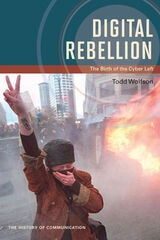
Digital Rebellion
The Birth of the Cyber LeftTodd Wolfson
University of Illinois Press, 2014
Todd Wolfson reveals how aspects of the mid-1990s Zapatistas movement--network organizational structure, participatory democratic governance, and the use of communication tools as a binding agent--became essential parts of Indymedia and other Cyber Left organizations. From there he uses oral interviews and other rich ethnographic data to chart the media-based think tanks and experiments that continued the Cyber Left's evolution through the Independent Media Center's birth around the 1999 WTO protests in Seattle.
Melding virtual and traditional ethnographic practice to explore the Cyber Left's cultural logic, Wolfson maps the social, spatial and communicative structure of the Indymedia network and details its operations on the local, national and global level. He looks at the participatory democracy that governs global social movements and the ways democracy and decentralization have come into tension, and how "the switchboard of struggle" conducts stories from the hyper-local and disperses them worldwide. As he shows, understanding the intersection of Indymedia and the Global Social Justice Movement illuminates their foundational role in the Occupy struggle and other emergent movements that have re-energized radical politics.

Disability Protests
Contentious Politics, 1970 - 1999Sharon N. Barnartt
Gallaudet University Press, 2001

Divined Intervention
Religious Institutions and Collective ActionChristopher W. Hale
University of Michigan Press, 2020
Divined Intervention provides an innovative institutionalist account for why religion enables political activism in some settings, but not others. Christopher W. Hale argues that decentralized religious institutions facilitate grassroots collective action, and he uses a multimethod approach to test this explanation against several theoretical alternatives. Utilizing nationally representative Mexican survey data, the book’s statistical analyses demonstrate that decentralization by the Catholic Church is positively associated with greater individual political activism across the country. Using case studies centered in the Mexican states of Chiapas, Yucatán, and Morelos, the author shows that religious decentralization encourages reciprocal cooperative interactions at a local level. This then increases the ability of religion to provide goods and services to its local adherents. These processes then prompt the growth of organizational capacities at the grassroots, enabling secular political activism.
Because this theoretical framework is grounded in human behavior, it shows how local institutions politically organize at the grassroots level. Divined Intervention also offers an improved understanding of religion’s relationship with political activism, a topic of ever-increasing significance as religion fuels political engagement across the globe. The book further synthesizes seemingly disparate approaches to the study of collective action into a cohesive framework. Finally, there is some debate as to the impact of ethnic diversity on the provision of public goods, and this study helps us understand how local institutional configurations can enable collective action across ethnic boundaries.
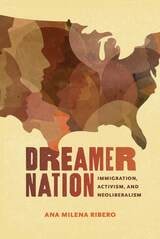
Dreamer Nation
Immigration, Activism, and NeoliberalismAna Milena Ribero
University of Alabama Press, 2023
Dreamer Nation tells the story of how Dreamers in the Obama era creatively confronted a complex sociopolitical landscape to advocate for immigrant rights and empower undocumented youth to proudly represent their lives and identities, all while under the ever-present threat of detention and deportation. Contributing to rhetorical studies of social movements, immigration, and minoritized rhetorics, Ribero argues that even though Dreamer rhetorics were reflective of the discursive limits of the neoliberal milieu, they also worked to disrupt neoliberal constraints through activism that troubled the primacy of the nation-state and citizenship, refused to adhere to respectability politics, forwarded embodied identity and transnational belonging, and looked for liberation in community—not solely in legislative action.
Each chapter presents a different rhetorical situation within the US “crisis” of immigration and the rhetoric that Dreamers used to respond to it. Organized chronologically, the chapters document Dreamer activism during the Obama presidency, from the 2010 hunger strikes advocating for the DREAM Act to undocuqueer “artivism” responding to Trump’s presidential campaign. The author draws not only on the methods and theories of rhetorical studies but also on women of color feminisms, ethnic studies, critical theory, and queer theory. In this way, the book looks across disciplines to illustrate the rhetorical savvy of one of the most important US social movements of our time.