150 books match the query 'Social psychology' and 8 start with d

cover of Death's Dream Kingdom: The American Psyche Since 9-11

Death's Dream Kingdom

The American Psyche Since 9-11

Walter A. Davis

Pluto Press, 2006

"Davis writes with fervor, vision, and keen moral appreciation of our condition. He encourages us to see what we fear to see, to say what we fear to say. This book is illuminating, challenging, fierce." Michael Eigen, author of The Sensitive Self, Rage, Ecstasy, Toxic Nourishment, Damaged Bonds andThe Psychoanalytic Mystic

Why is fear a dominant emotion in contemporary society? Why are politicians using words like 'terror', 'evil' and 'fundamentalism', and what effect is it having on public consciousness?

Answering these questions, Walter A. Davis taps into the cultural psyche to explore the link between ideology and emotional and psychological manipulation. Starting with the three topics that have preoccupied social discourse since 9-11 -- terror, evil and fundamentalism -- he shows that the Bush administration has been hugely successful in controlling and developing a new political climate through the creation of an almost hypnotic mass consciousness.

Davis's findings take us to the heart of the ideological paralysis of the Left, while offering an innovative approach to understanding contemporary history.

Davis fuses a psychoanalytic and philosophical framework to explain the relation between culture and political events, from the sado-masochist hysteria of Mel Gibson's The Passion of the Christ' to the atrocities at Abu Ghraib prison; and from the genocidal use of depleted uranium in Iraq to the apocalyptic language driving the Christian Right's assault on basic human rights.

He exposes the motives and belief-systems of this new American psyche and shows how it sustains the Bush administration's agenda. Illuminating how psychological needs govern political action, Davis reveals why the relationship between politics and public consciousness has massive implications for all of us beyond America's borders.

Walter A. Davis is Professor Emeritus in the Department of English at Ohio State University. He is the author of six previous books, including Inwardness and Existence: Subjectivity in/and Hegel, Heidegger, Marx and Freud (University of Wisconsin Press, 1989) and Deracination: Historicity, Hiroshima, and the Tragic Imperative (SUNY Press, 2001).
[more]
cover of Dialogue Across Difference: Practice, Theory, and Research on Intergroup Dialogue

Dialogue Across Difference

Practice, Theory, and Research on Intergroup Dialogue

Patricia Gurin

Russell Sage Foundation, 2013
Due to continuing immigration and increasing racial and ethnic inclusiveness, higher education institutions in the United States are likely to grow ever more diverse in the 21st century. This shift holds both promise and peril: Increased inter-ethnic contact could lead to a more fruitful learning environment that encourages collaboration. On the other hand, social identity and on-campus diversity remain hotly contested issues that often raise intergroup tensions and inhibit discussion. How can we help diverse students learn from each other and gain the competencies they will need in an increasingly multicultural America? Dialogue Across Difference synthesizes three years’ worth of research from an innovative field experiment focused on improving intergroup understanding, relationships and collaboration. The result is a fascinating study of the potential of intergroup dialogue to improve relations across race and gender. First developed in the late 1980s, intergroup dialogues bring together an equal number of students from two different groups – such as people of color and white people, or women and men – to share their perspectives and learn from each other. To test the possible impact of such courses and to develop a standard of best practice, the authors of Dialogue Across Difference incorporated various theories of social psychology, higher education, communication studies and social work to design and implement a uniform curriculum in nine universities across the country. Unlike most studies on intergroup dialogue, this project employed random assignment to enroll more than 1,450 students in experimental and control groups, including in 26 dialogue courses and control groups on race and gender each. Students admitted to the dialogue courses learned about racial and gender inequalities through readings, role-play activities and personal reflections. The authors tracked students’ progress using a mixed-method approach, including longitudinal surveys, content analyses of student papers, interviews of students, and videotapes of sessions. The results are heartening: Over the course of a term, students who participated in intergroup dialogues developed more insight into how members of other groups perceive the world. They also became more thoughtful about the structural underpinnings of inequality, increased their motivation to bridge differences and intergroup empathy, and placed a greater value on diversity and collaborative action. The authors also note that the effects of such courses were evident on nearly all measures. While students did report an initial increase in negative emotions – a possible indication of the difficulty of openly addressing race and gender – that effect was no longer present a year after the course. Overall, the results are remarkably consistent and point to an optimistic conclusion: intergroup dialogue is more than mere talk. It fosters productive communication about and across differences in the service of greater collaboration for equity and justice. Ambitious and timely, Dialogue Across Difference presents a persuasive practical, theoretical and empirical account of the benefits of intergroup dialogue. The data and research presented in this volume offer a useful model for improving relations among different groups not just in the college setting but in the United States as well.
[more]
cover of Dilemmas Of American Self

Dilemmas Of American Self

John P. Hewitt

Temple University Press, 1991
Charles Horton Cooley Award of the Society for the Study of Symbolic Interaction, 1990 "According to Hewitt, the essence of modernity is tension between community and society. This ambitious, sophisticated, and well-written book is a tonic for those who weary of simplistic sermons on the condition of American culture." --Choice This book explores stability and change in American social character and identity, and offers a theory about what it means to be an individual within contemporary American society. Skeptical of the widely-accepted thesis that the self, at least in America, has drastically changed, John P. Hewitt assumes that there is more historical continuity and that the culture is filled with internal contradictions. Combining the insights of social psychology, with those of writers who have offered critiques of the larger society and its influences on the individual, he revises our understanding of the person in American society. Hewitt examines the theories of such authors as David Riesman, Allen Wheelis, Christopher Lasch, Erving Goffman, Carl Rogers, Ralph Turner, and others. He treats their emphasis on the decline of transformation of the self not as social theory to be tested, but as cultural text that reveals some of the main historical and contemporary features and fault lines of American culture. "American culture is best characterized not as relentlessly individualistic or as lacking in the capacity to conceive of or discuss community, but as torn between individualism and communitarianism, thus creating serious felt difficulties of social adjustment and personal meaning." Proposing a symbolic interactionist theory of culture, Hewitt emphasizes inherent polarities of meaning and dilemmas of conduct that shape the experience of self: conformity versus rebellion, staying versus leaving, and dependence versus independence. He constructs a theory of identity that views personal identity and social identity as contending means for securing the continuity and integration of the self, and applies the theory to American society by depicting autonomous, exclusivist, and pragmatic strategies of self-construction. "This theoretically sophisticated work is very ably organized and marked by superior scholarly and expository craftsmanship. It will be hailed, I believe, as an important contribution to symbolic interactionism and the sociology and social psychology of everyday life. Hewitt's treatment of self, identity, conformity, differentiation, community, and modernity is a fine example of creative scholarship." --Charles H. Page, University of Massachusetts (Emeritus) "Hewitt has set himself the ambitious task of providing a symbolic interactionist analysis of culture, society, and self, and has succeeded admirably in the effort. I found his rich description of cultural types to be especially insightful. It is no exaggeration to characterize this book as a landmark work in the development of symbolic interactions." --Morris Rosenberg, University of Maryland-College Park
[more]
cover of Divest: An Essay on Political Masochism

Divest

An Essay on Political Masochism

Steven Swarbrick

University of Minnesota Press, 2026

A manifesto for liberating desire from the grip of capital and colonial violence in Palestine

Could a psychoanalytic theory of masochism help us to understand the politics of protest? A socially engaged psychoanalysis of 2024’s widespread student uprisings in support of Palestine, Divest posits that masochism, as theorized by Freud in his later years, is a fundamental structure at the heart of anticapitalist and anticolonial resistance. Conceptualizing masochism as a radical form of divestment, Steven Swarbrick theorizes the affective economies of solidarity, self-sacrifice, and collective struggle. Through vivid film readings and sharp critique of state and university violence, Swarbrick explores the emancipatory potential of masochism in the protest movement and the sadistic machinery of capitalist governance it has laid bare.

Divest is both a politically urgent manifesto and a theoretical companion to the global movement for Palestinian liberation. Asserting that the politics of left-wing solidarity must reckon with the libidinal investments that sustain both power and resistance, this bold volume argues that divestment from global capitalism may begin with a revolution in our psychic attachments.

Retail e-book files for this title are screen-reader friendly with image accompanied by short alt text and/or extended descriptions.
[more]
cover of Do Emotions Help or Hurt Decisionmaking?: A Hedgefoxian Perspective

Do Emotions Help or Hurt Decisionmaking?

A Hedgefoxian Perspective

Kathleen D. Vohs

Russell Sage Foundation, 2007

Philosophers have long tussled over whether moral judgments are the products of logical reasoning or simply emotional reactions. From Jane Austen's Sense and Sensibility to the debates of modern psychologists, the question of whether feeling or sober rationality is the better guide to decision making has been a source of controversy. In Do Emotions Help or Hurt Decision Making? Kathleen Vohs, Roy Baumeister, and George Loewenstein lead a group of prominent psychologists and economists in exploring the empirical evidence on how emotions shape judgments and choices. Researchers on emotion and cognition have staked out many extreme positions: viewing emotions as either the driving force behind cognition or its side effect, either an impediment to sound judgment or a guide to wise decisions. The contributors to Do Emotions Help or Hurt Decision Making? provide a richer perspective, exploring the circumstances that shape whether emotions play a harmful or helpful role in decisions. Roy Baumeister, C. Nathan DeWall, and Liqing Zhang show that while an individual's current emotional state can lead to hasty decisions and self-destructive behavior, anticipating future emotional outcomes can be a helpful guide to making sensible decisions. Eduardo Andrade and Joel Cohen find that a positive mood can negatively affect people's willingness to act altruistically. Happy people, when made aware of risks associated with altruistic acts, become wary of jeopardizing their own well-being. Benoît Monin, David Pizarro, and Jennifer Beer find that whether emotion or reason matters more in moral evaluation depends on the specific issue in question. Individual characteristics often mediate the effect of emotions on decisions. Catherine Rawn, Nicole Mead, Peter Kerkhof, and Kathleen Vohs find that whether an individual makes a decision based on emotion depends both on the type of decision in question and the individual's level of self-esteem. And Quinn Kennedy and Mara Mather show that the elderly are better able to regulate their emotions, having learned from experience to anticipate the emotional consequences of their behavior. Do Emotions Help or Hurt Decision Making? represents a significant advance toward a comprehensive theory of emotions and cognition that accounts for the nuances of the mental processes involved. This landmark book will be a stimulus to scholarly debates as well as an informative guide to everyday decisions.
[more]
cover of Don't Call Me Inspirational: A Disabled Feminist Talks Back

Don't Call Me Inspirational

A Disabled Feminist Talks Back

Harilyn Rousso

Temple University Press, 2013

 For psychotherapist, painter, feminist, filmmaker, writer, and disability activist Harilyn Rousso, hearing well-intentioned people tell her, "You're so inspirational!" is patronizing, not complimentary.

In her empowering and at times confrontational memoir, Don't Call Me Inspirational, Rousso, who has cerebral palsy, describes overcoming the prejudice against disability--not overcoming disability. She addresses the often absurd and ignorant attitudes of strangers, friends, and family. 

Rousso also examines her own prejudice toward her disabled body, and portrays the healing effects of intimacy and creativity, as well as her involvement with the disability rights community. She intimately reveals herself with honesty and humor and measures her personal growth as she goes from "passing" to embracing and claiming her disability as a source of pride, positive identity, and rebellion. 

A collage of images about her life, rather than a formal portrait, Don't Call Me Inspirational celebrates Rousso's wise, witty, productive, outrageous life, disability and all.

[more]
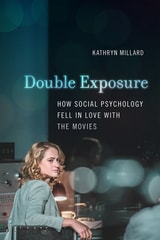
cover of Double Exposure: How Social Psychology Fell in Love with the Movies

Double Exposure

How Social Psychology Fell in Love with the Movies

Kathryn Millard

Rutgers University Press, 2022
Double Exposure examines the role of film in shaping social psychology’s landmark postwar experiments. We are told that most of us will inflict electric shocks on a fellow citizen when ordered to do so. Act as a brutal prison guard when we put on a uniform. Walk on by when we see a stranger in need. But there is more to the story. Documentaries that investigators claimed as evidence were central to capturing the public imagination. Did they provide an alibi for twentieth century humanity? Examining the dramaturgy, staging and filming of these experiments, including Milgram's Obedience Experiments, the Stanford Prison Experiment and many more, Double Exposure recovers a new set of narratives.
[more]
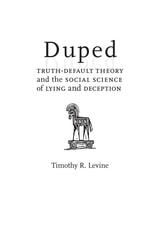
cover of Duped: Truth-Default Theory and the Social Science of Lying and Deception

Duped

Truth-Default Theory and the Social Science of Lying and Deception

Timothy R. Levine

University of Alabama Press, 2020

Unmasking the science of deception—and why truth wins by default.

From the advent of fake news to climate-science denial and Bernie Madoff’s appeal to investors, people can be astonishingly gullible. Some people appear authentic and sincere even when the facts discredit them, and many people fall victim to conspiracy theories and economic scams that should be dismissed as obviously ludicrous. This happens because of a near-universal human tendency to operate within a mindset that can be characterized as a “truth-default.” We uncritically accept most of the messages we receive as “honest.” We all are perceptually blind to deception. We are hardwired to be duped. The question is, can anything be done to militate against our vulnerability to deception without further eroding the trust in people and social institutions that we so desperately need in civil society?

Timothy R. Levine’s Duped: Truth-Default Theory and the Social Science of Lying and Deception recounts a decades-long program of empirical research that culminates in a new theory of deception—truth-default theory. This theory holds that the content of incoming communication is typically and uncritically accepted as true, and most of the time, this is good. Truth-default allows humans to function socially. Further, because most deception is enacted by a few prolific liars, the so called “truth-bias” is not really a bias after all. Passive belief makes us right most of the time, but the catch is that it also makes us vulnerable to occasional deceit.

Levine’s research on lie detection and truth-bias has produced many provocative new findings over the years. He has uncovered what makes some people more believable than others and has discovered several ways to improve lie-detection accuracy. In Duped, Levine details where these ideas came from, how they were tested, and how the findings combine to produce a coherent new understanding of human deception and deception detection.
 

[more]