Results by title
165 books match the query 'Social sciences' and 7 start with d

Damasio's Error and Descartes' Truth
An Inquiry into Consciousness, Metaphysics, and EpistemologyAndrew Gluck
University of Scranton Press, 2007
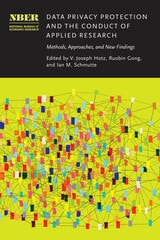
Data Privacy Protection and the Conduct of Applied Research
Methods, Approaches, and New FindingsEdited by V. Joseph Hotz, Ruobin Gong, and Ian M. Schmutte
University of Chicago Press, 2026
A necessary exploration into the mechanics of data privacy protections within empirical social science research.
The explosion of computational power and data availability has revolutionized empirical social science research, but it has also created unprecedented challenges for protecting the privacy of individuals and businesses. As computational tools make it increasingly possible to breach data anonymity in government surveys by combining the survey data with additional information from external sources, statistical agencies face mounting pressure to develop new privacy protection methods while maintaining data quality essential for research and policymaking. This volume explores how innovations in data privacy protection, including differential privacy and synthetic data methods, affect the conduct of empirical analysis in economics, computer science, and statistics. Contributors explore critical questions about the trade-offs between privacy and data usability: How do new protection methods impact statistical inference and parameter estimation? What standards should data providers adopt? The chapters examine frameworks for characterizing privacy protection, disclosure limitation challenges for survey data, methodological innovations for privacy-preserving statistical analysis, regulatory considerations in modern data governance, and strategies for balancing confidentiality with research access.
This volume provides researchers, statistical agencies, and policymakers with essential guidance for navigating the complex landscape where data protection meets scientific inquiry.

Data
Now Bigger and Better!Edited by Tom Boellstorff and Bill Maurer
Prickly Paradigm Press, 2015

Demands of the Day
On the Logic of Anthropological InquiryPaul Rabinow and Anthony Stavrianakis
University of Chicago Press, 2013

Democracy and Social Ethics
Jane Addams
University of Illinois Press, 2001
In this, Addams's earliest book on ethics--presented here with a substantial introduction by Charlene Haddock Seigfried--she reflects on the factors that hinder the ability of all members of society to determine their own well-being. Observing relationships between charitable workers and their clients, between factory owners and their employers, and between household employers and their servants, she identifies sources of friction and shows how conceiving of democracy as a social obligation can lead to new, mutually beneficial lines of conduct. She also considers the proper education of workers, struggles between parents and their adult daughters over conflicting family and social claims, and the merging of politics with the daily lives of constituents.
"The sphere of morals is the sphere of action," Addams proclaims. It is not enough to believe passively in the innate dignity of all human beings. Rather, one must work daily to root out racial, gender, class, and other prejudices from personal relationships.

Designing Experiments in Education and the Social Sciences
Larry V. Hedges
Russell Sage Foundation, 2026
Randomized experiments—often referred to as the gold standard of research design—are generally accepted as the type of studies that provide the strongest evidence about cause and effect. There has been a wide adoption of experimental methods in agriculture, medicine, industrial design, and laboratory social sciences, such as experimental psychology, where conditions can be controlled. Since then, there has been an increase in the use of field experiments to provide evidence of cause and effect beyond the laboratory. However, the social settings in which these studies take place complicate the design and evaluation of experiments because their social contexts must be taken into account in order for the experiment to provide useful and unambiguous results. In Designing Experiments in Education and the Social Sciences, statistician Larry V. Hedges details how to design educational and social science field experiments that are sensitive enough to provide clear-cut evidence on the effects of social interventions.
Hedges draws on one hundred years of statistical theory and classic experimental design in Designing Experiments in Education and the Social Sciences. Highlighting the social-structural information embedded in field experiments, he links this history with contemporary statistical methods in the social sciences to explain how to design social experiments that are adequately sensitive to determine the influence of an intervention. He covers the four basic research designs—and 39 elaborations of those designs—that are used most often in social experiments while also introducing additional, more complex, designs. He brings together, in the same notation, work on experimental design, design sensitivity, and optimal design of experiments for the most frequently used research designs in education and the social sciences, emphasizing their conceptual consistency. Hedges also discusses the practical problems of how to recruit and maintain a sample throughout the duration of an experiment.
Designing Experiments in Education and the Social Sciences is an essential resource for researchers planning educational and social field experiments and graduate students.
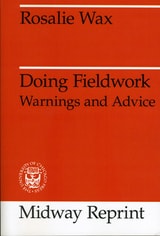
Doing Fieldwork
Warnings and AdviceRosalie Wax
University of Chicago Press, 1971