Results by title
135 books match the query 'Sociological aspects' and 7 start with d
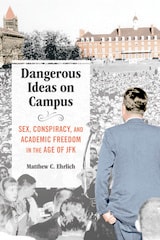
Dangerous Ideas on Campus
Sex, Conspiracy, and Academic Freedom in the Age of JFKMatthew C. Ehrlich
University of Illinois Press, 2021
In 1960, University of Illinois professor Leo Koch wrote a public letter condoning premarital sex. He was fired. Four years later, a professor named Revilo Oliver made white supremacist remarks and claimed there was a massive communist conspiracy. He kept his job.
Matthew Ehrlich revisits the Koch and Oliver cases to look at free speech, the legacy of the 1960s, and debates over sex and politics on campus. The different treatment of the two men marked a fundamental shift in the understanding of academic freedom. Their cases also embodied the stark divide over beliefs and values--a divide that remains today. Ehrlich delves into the issues behind these academic controversies and places the events in the context of a time rarely associated with dissent, but in fact a harbinger of the social and political upheavals to come.
An enlightening and entertaining history, Dangerous Ideas on Campus illuminates how the university became a battleground for debating America's hot-button issues.

Data-Centric Biology
A Philosophical StudySabina Leonelli
University of Chicago Press, 2016
Leonelli is the first scholar to use a study of contemporary data-intensive science to provide a philosophical analysis of the epistemology of data. In analyzing the rise, internal dynamics, and potential impact of data-centric biology, she draws on scholarship across diverse fields of science and the humanities—as well as her own original empirical material—to pinpoint the conditions under which digitally available data can further our understanding of life. Bridging the divide between historians, sociologists, and philosophers of science, Data-Centric Biology offers a nuanced account of an issue that is of fundamental importance to our understanding of contemporary scientific practices.

Debt to Society
Accounting for Life under CapitalismMiranda Joseph
University of Minnesota Press, 2014
It is commonplace to say that criminals pay their debt to society by spending time in prison, but what is a “debt to society”? How is crime understood as a debt? How has time become the equivalent for crime? And how does criminal debt relate to the kind of debt held by consumers and university students?
In Debt to Society, Miranda Joseph explores modes of accounting as they are used to create, sustain, or transform social relations. Envisioning accounting broadly to include financial accounting, managerial accounting of costs and performance, and the calculation of “debts to society” owed by criminals, Joseph argues that accounting technologies have a powerful effect on social dynamics by attributing credits and debts. From sovereign bonds and securitized credit card debt to student debt and mortgages, there is no doubt that debt and accounting structure our lives.
Exploring central components of neoliberalism (and neoliberalism in crisis) from incarceration to personal finance and university management, Debt to Society exposes the uneven distribution of accountability within our society. Joseph demonstrates how ubiquitous the forces of accounting have become in shaping all aspects of our lives, proposing that we appropriate accounting and offer alternative accounts to turn the present toward a more widely shared well-being.
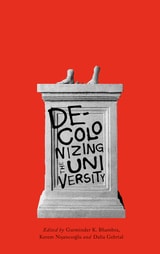
Decolonizing the University
Edited by Gurminder K. Bhambra, Kerem Nisancioglu and Dalia Gebrial
Pluto Press, 2018
In 2015, students at the University of Cape Town demanded the removal of a statue of Cecil Rhodes, the imperialist, racist business magnate, from their campus. Their battle cry, #RhodesMustFall, sparked an international movement calling for the decolonization of universities all over the world.
Today, as the movement develops beyond the picket line, how might it go on to radically transform the terms upon which universities exist? In this book, students, activists, and scholars discuss the possibilities and the pitfalls of doing decolonial work in the heart of the establishment. Subverting curricula, demanding diversity, and destroying old boundaries, this is a radical call for a new era of education. Chapters include:
*Rhodes Must Fall: Oxford and Movements for Change (Dalia Febrial)
*Race and the Neoliberal University ((John Holmwood)
*Black/Academia (Robbie Shilliam)
*The Challenge for Black Studies in the Neoliberal University (Kehinde Andrews)
*Open Initiatives for Decolonising the Curriculum (Pat Lockley)
*Decolonising Education: A Pedagogic Intervention (Carol Azumah Dennis)
*Understanding Eurocentrism as a Structural Problem of Undone Science (William Jamal Richardson)
As the book’s insightful Introduction states, "Taking colonialism as a global project as a starting point, it becomes difficult to turn away from the Western university as a key site through which colonialism—and colonial knowledge in particular—is produced, consecrated, institutionalized and naturalized." Offering resources for students and academics to challenge and resist colonialism inside and outside the classroom, Decolonizing the University provides the tools for radical change in educational disciplines, pedagogies, and institutions.
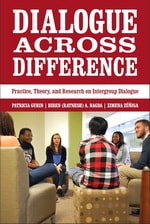
Dialogue Across Difference
Practice, Theory, and Research on Intergroup DialoguePatricia Gurin
Russell Sage Foundation, 2013
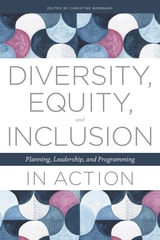
Diversity, Equity, and Inclusion in Action
Planning, Leadership, and ProgrammingChristine Bombaro
American Library Association, 2020
All too often, in a hurried attempt to “catch up,” diversity training can create division among staff or place undue burdens on a handful of employees. Instead, academic libraries need approaches to diversity, equity, and inclusion (DEI) that position these priorities as ongoing institutional and professional goals. This book’s model programs will help academic libraries do exactly that, sharing a variety of initiatives that possess clear goals, demonstrable outcomes, and reproducible strategies. Librarians, administrators, and directors will all benefit from the programs detailed inside, which include such topics as
- a university library’s community of practice for interactions and learning around DEI;
- cultural competency training to create more welcoming instruction spaces;
- student workshops on literature searches that mitigate bias;
- overcoming the historic tendency to marginalize LGBTQ+ representation in archives;
- a curriculum and design workshop that moved from discussing social values to embedding them in actions;
- the founding of a library-led LGBT club for students at a rural community college;
- a liberal arts college’s retention-boosting program for first-generation students;
- tailoring a collection and library services to the unique needs of student veterans; and
- a framework for moving from diversity to equity and inclusion, toward a goal of social justice.
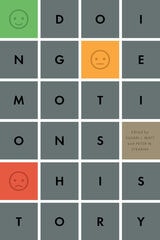
Doing Emotions History
Edited by Susan Matt and Peter N. Stearns
University of Illinois Press, 2013