Results by title
200 books match the query 'Sociology of Religion' and 6 start with d

Degrees of Separation
Identity Formation While Leaving Ultra-Orthodox JudaismSchneur Zalman Newfield
Temple University Press, 2020
Those who exit a religion—particularly one they were born and raised in—often find themselves at sea in their efforts to transition to life beyond their community. In Degrees of Separation, Schneur Zalman Newfield, who went through this process himself, interviews seventy-four Lubavitch and Satmar ultra-Orthodox Hasidic Jews who left their communities.He presents their motivations for leaving as well as how they make sense of their experiences and their processes of exiting, detailing their attitudes and opinions regarding their religious upbringing. Newfield also examines how these exiters forge new ways of being that their upbringing had not prepared them for, while also considering what these particular individuals lose and retain in the exit process.
Degrees of Separation presents a comprehensive portrait of the prolonged state of being “in-between” that characterizes transition out of a totalizing worldview. What Newfield discovers is that exiters experience both a sense of independence and a persistent connection; they are not completely dislocated from their roots once they “arrive” at their new destination. Moreover, Degrees of Separation shows that this process of transitioning identity has implications beyond religion.

Demon Lovers
Witchcraft, Sex, and the Crisis of BeliefWalter Stephens
University of Chicago Press, 2002
As Walter Stephens demonstrates in Demon Lovers, it was not Hausmännin or other so-called witches who were obsessive about sex with demons—instead, a number of devout Christians, including trained theologians, displayed an uncanny preoccupation with the topic during the centuries of the "witch craze." Why? To find out, Stephens conducts a detailed investigation of the first and most influential treatises on witchcraft (written between 1430 and 1530), including the infamous Malleus Maleficarum (Hammer of Witches).
Far from being credulous fools or mindless misogynists, early writers on witchcraft emerge in Stephens's account as rational but reluctant skeptics, trying desperately to resolve contradictions in Christian thought on God, spirits, and sacraments that had bedeviled theologians for centuries. Proof of the physical existence of demons—for instance, through evidence of their intercourse with mortal witches—would provide strong evidence for the reality of the supernatural, the truth of the Bible, and the existence of God. Early modern witchcraft theory reflected a crisis of belief—a crisis that continues to be expressed today in popular debates over angels, Satanic ritual child abuse, and alien abduction.
Disarming Manhood
Roots of Ethical ResistanceDavid A.J. Richards
Ohio University Press, 2005

Disenchanted Lives
Apostasy and Ex-Mormonism among the Latter-day SaintsBrooks, E. Marshall
Rutgers University Press, 2018
Divine Meets Digital
Tech Workers and Religion in the U.S. and ChinaDi Di
Rutgers University Press, 2026
What role does religion play in the tech industry? Based on nearly one hundred interviews, Divine Meets Digital uncovers the ways tech workers engage with religion and make sense of their work through religious and spiritual worldviews. While most identify as nonreligious, they are far from antireligious. Instead, they navigate competing religious and nonreligious views, often distinguishing between what they see as the controversial elements of religion—such as belief in the supernatural in China and its politicized and dogmatic aspects in the United States—and its more noncontroversial aspects. In doing so, they justify their religious engagement by embracing religion's noncontroversial elements while distancing themselves from its controversial features. This book offers a powerful new lens for understanding one of the most influential industries of our time, inviting readers to better understand the people who live and work at the intersection between science, religion, and technology.
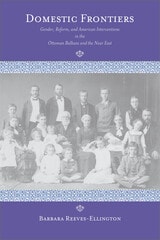
Domestic Frontiers
Gender, Reform, and American Interventions in the Ottoman Balkans and the Near EastBarbara Reeves-Ellington
University of Massachusetts Press, 2013
During the nineteenth and early twentieth centuries, American Protestant missionaries attempted to export their religious beliefs and cultural ideals to the Ottoman Empire. Seeking to attract Orthodox Christians and even Muslims to their faith, they promoted the paradigm of the “Christian home” as the foundation of national progress. Yet the missionaries' efforts not only failed to win many converts but also produced some unexpected results.
Drawing on a broad range of sources—Ottoman, Bulgarian, Russian, French, and English—Barbara Reeves-Ellington tracks the transnational history of this little-known episode of American cultural expansion. She shows how issues of gender and race influenced the missionaries' efforts as well as the complex responses of Ottoman subjects to American intrusions into their everyday lives. Women missionaries—married and single—employed the language of Christian domesticity and female moral authority to challenge the male-dominated hierarchy of missionary society and to forge bonds of feminist internationalism. At the same time, Orthodox Christians adapted the missionaries' ideology to their own purposes in developing a new strain of nationalism that undermined Ottoman efforts to stem growing sectarianism within their empire. By the beginning of the twentieth century, as some missionaries began to promote international understanding rather than Protestantism, they also paved the way for future expansion of American political and commercial interests.