Results by title
171 books match the query 'Soldiers' and 13 start with d
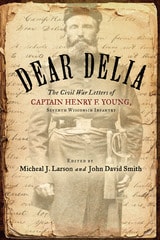
Dear Delia
The Civil War Letters of Captain Henry F. Young, Seventh Wisconsin InfantryHenry F. Young, edited by Micheal J. Larson and John David Smith
University of Wisconsin Press, 2019
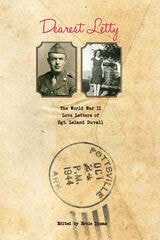
Dearest Letty
The World War II Love Letters of Sgt. Leland DuvallLeland Duvall
University of Arkansas Press, 2011

Death and Life in the Big Red One
A Soldier’s World War II Journey from North Africa to GermanyJoseph P. Olexa
University of North Texas Press, 2023

Death on Base
The Fort Hood MassacreAnita Belles Porterfield
University of North Texas Press, 2015

Desert Mementos
Stories of Iraq and NevadaCaleb S. Cage
University of Nevada Press, 2017
Cage captures similarities in the respective desert landscapes of both Iraq and Nevada, but it is not just a study in contrasting landscapes. The inter-connected stories explore similarities and differences in human needs from the perspectives of vastly different cultures. Specifically, the stories deftly capture the overlap in the respective desert landscapes of each region, the contrasting cultures and worldviews, and the common need for hope. Taken together, the stories represent the arc of a year-long deployment by young soldiers. Cage’s stories are bound together by the soldier’s searing experiences in the desert, bookended by leaving and returning home to Nevada, which in many ways can be just as disorienting as patrolling the Iraq desert.
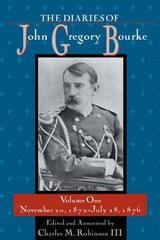
Diaries of John Gregory Bourke Volume 1
November 20, 1872--July 28, 1876Charles M. Robinson III
University of North Texas Press, 2003
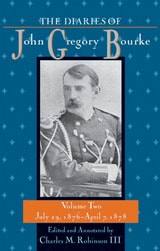
Diaries of John Gregory Bourke Volume 2
July 29, 1876--April 7, 1878Charles M. Robinson III
University of North Texas Press, 2003
Diaries of John Gregory Bourke Volume 3
June 1, 1878--June 22, 1880Charles M. Robinson III
University of North Texas Press, 2003
Diaries of John Gregory Bourke Volume 4
July 3, 1880--May 22, 1881Charles M. Robinson III
University of North Texas Press, 2003
Different Drummers
Military Culture and Its DiscontentsTad Tuleja
Utah State University Press, 2020
This multidisciplinary collection brings in the perspectives of scholars from folklore, literary studies, psychology, and media studies, as well as the first-person perspectives of veterans. It includes chapters on the vernacular genres of bodylore, folksong, personal narrative, and legend; literary items like soldiers’ memoirs and poetry; the artwork of soldier cartoonists; and accounts of defying the chain of command in the field. Ideally, the goal of military basic training is to replace recruits’ focus on their own individuality with an unquestioned devotion to group solidarity. In reality, unit cohesion is constantly challenged by humans clinging obstinately to their non-collective personalities. Different Drummers focuses on those in uniform who feel themselves to be both of the military culture and at odds with it. It shows how these loyal “discontents” find ways of communicating and interacting with others that sometimes defy institutional expectations.
Contributors:
Ron Ben-Tovim, Carol Burke, Richard Allen Burns, Catherine Calloway, James I. Deutsch, Ronald Fry, Angus Kress Gillespie, Christina M. Knopf, Jay Mechling, Matthew David Perry, Mark C. Russell, John Paul Wallis
Do They Miss Me at Home?
The Civil War Letters of William McKnight, Seventh Ohio Volunteer CavalryDonald C. Maness
Ohio University Press, 2010
William McKnight was a member of the Seventh Ohio Volunteer Cavalry from September 1862 until his death in June of 1864. During his time of service, McKnight penned dozens of emotion-filled letters, primarily to his wife, Samaria, revealing the struggles of an entire family both before and during the war.
This collection of more than one hundred letters provides in-depth accounts of several battles in Kentucky and Tennessee, such as the Cumberland Gap and Knoxville campaigns that were pivotal events in the Western Theater. The letters also vividly respond to General John Hunt Morgan’s raid through Ohio and correct claims previously published that McKnight was part of the forces chasing Morgan. By all accounts Morgan did stay for a period of time at McKnight’s home in Langsville during his raid through Ohio, much to McKnight’s horror and humiliation, but McKnight was in Kentucky at the time. Tragically, McKnight was killed in action nearly a year later during an engagement with Morgan’s men near Cynthiana, Kentucky.
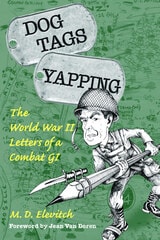
Dog Tags Yapping
The World War II Letters of a Combat GIM.D. Elevitch. Foreword by Jean Van Doren
Southern Illinois University Press, 2003
A chronicle of war infused with uncommon cheer, Dog Tags Yapping: The World War II Letters of a Combat GI is a young man’s education in life and death and a narrative of war told completely in letters.
During World War II, thousands of high school graduates were drafted into the army to be trained in colleges as engineers or other technicians but instead were assigned to fighting units and joined the great assault in Europe after D-Day. One of those reprogrammed combat infantrymen was Morton Elevitch from Duluth, Minnesota. Elevitch’s cartoons, drawings, and extremely unconventional letters home—rescued from box-in-the-basement oblivion after a more than fifty-year dormancy—recover the story of one rerouted GI in a voice that is compelling and new. Embellished with a boyish flair, the quirky and playful documents collected here impart a distinctly personal and uncalculated record of war, family, and coming of age. “It’s much easier to wield a melancholy pen than to sit down and cry,” Elevitch declares to his father.
Sparkling with a patina of wit and the bittersweet allure of lost innocence, the words and letters of “Privitch Elevate” offer the immediacy of the events as they unfolded. With the ease and expertise expected of a more seasoned storyteller, the young Elevitch escorts readers through his basic training and departure for Europe, duty in Brittany with the 94th Division and departure for Germany, combat under Patton’s command, wounding by mortar fragments, convalescence in England, and his return to France with the Signal Corps to guard prisoners and await demobilization. But along with these letters are the stories of his relationships with his parents, his brother, the men of his company and even the prisoners of war. The author’s perspectives on the war radically change. Both comic and tragic in its treatment of war’s chaos and tedium, this sensitive personal history covers experiences from the adjustment to military life and the temptations of flesh to the pain of wounds and recovery and the exposure to foreign countries and cultures.
Presaging his career as a novelist and editor, Elevitch’s words and drawings sketch an audacious and highly imaginative portrait of a young man during an exceptional time in world history. Evocative of life lived and nearly lost, his jarring accounts of combat reveal a soldier who was wounded not only in body but also in soul, in a war that changed him forever—just as it changed everyone it touched. Reproduced here as they were originally written, alongside a gallery of photos and hand-drawn battle maps, Elevitch’s cartoons and letters were initially intended for only three persons. But with their unique historical value and affecting exploration of the human spirit, they resurface in Dog Tags Yapping and result in an exhilarating ride for all readers through his “wild bivouac of the mind.”
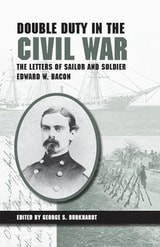
Double Duty in the Civil War
The Letters of Sailor and Soldier Edward W. BaconEdited by George S. Burkhardt
Southern Illinois University Press, 2009
In 1861 at the age of eighteen, Edward Woolsey Bacon, a Yale student and son of well-known abolitionist minister Leonard Bacon, left his home in New Haven, Connecticut, to fight for the United States. Over the next four years Bacon served in both the Union navy and army, which gave him a sweeping view of the Civil War. His postings included being a captain’s clerk on the USS Iroquois, a hospital clerk in his hometown, a captain in the 29th Connecticut Infantry (Colored), and a major in the 117th U.S. Colored Infantry, and he described these experiences in vibrant letters to his friends and family. Historian George S. Burkhardt has compiled these letters, as well as Bacon’s diary in the impressive Double Duty in the Civil War: The Letters of Sailor and Soldier Edward W. Bacon.
Bacon tells of hunting Confederate commerce raiders on the high seas, enduring the tedium of blockade duty, and taking part in riverine warfare on the Mississippi. He recalls sweating in South Carolina as an infantry officer during drill and picket duty, suffering constant danger in the battlefield trenches of Virginia, marching victoriously on fallen Richmond, and tolerating the boredom of occupation duty in Texas.
His highly entertaining letters shed new light on naval affairs and reveal a close-knit family life. The narrative of his duty with black troops is especially valuable, since few first-hand accounts from white officers of the U.S. Colored Troops exist. Furthermore, his beliefs about race, slavery, and the Union cause were unconventional for the time and stand in contrast to those held by many of his contemporaries.
Double Duty in the Civil War is filled with lively descriptions of the men Bacon met and the events he experienced. With Burkhardt’s careful editing and useful annotations, Bacon’s letters and diary excerpts give rare insight into areas of the Civil War that have been neglected because of a lack of available sources. Given the scarcity of eyewitness testimonies to navy life and life in African American regiments, this book is a rarity indeed.