Results by title
51 books match the query 'Songs and music' and 2 start with d

Deathlife
Hip Hop and Thanatological Narrations of BlacknessAnthony B. Pinn
Duke University Press, 2024
In Deathlife, Anthony B. Pinn analyzes hip hop to explore how Blackness serves as a framework for defining and guiding the relationship between life and death in the United States. Pinn argues that white supremacy and white privilege operate based on the right to distinguish death from life. This distinction is produced and maintained through the construction of Blackness as deathlife. Drawing on Afropessimism and Black moralism, Pinn theorizes deathlife as a technology of whiteness that projects whites’ anxieties about the end of their lives onto the Black other. Examining the music of Jay-Z; Kendrick Lamar; Tyler, the Creator; and others, Pinn shows how hip hop configures the interconnection and dependence between death and life in such a way that death and life become indistinguishable. In so doing, Pinn demonstrates that hip hop presents an alternative to deathlife that challenges the white supremacist definitions of Blackness and anti-Blackness more generally.
[more]
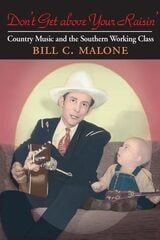
Don't Get above Your Raisin'
Country Music and the Southern Working ClassBill C. Malone
University of Illinois Press, 2002
Combining a high-spirited history of country music's roots with vivid portraits of its principal performers, Don't Get above Your Raisin' examines the close relationship between "America's truest music" and the working-class culture that has constituted its principal source, nurtured its development, and provided its most dedicated supporters.
Widely recognized as country music's ranking senior authority, Bill C. Malone explores how the music's defining themes (home and family, religion, rambling, frolic, humor, and politics) have emerged out of the particularities of working people's day-to-day lives. He traces the many contradictory voices and messages of a music that simultaneously extols the virtues of home and the joys of rambling, the assurances of the Christian life and the ecstasies of hedonism, the strength of working-class life and the material lure of middle-class aspirations. The resulting tensions, Malone argues, are a principal source of the music's enduring appeal.
Country musicians have often been people from undistinguished blue-collar backgrounds who have tried to make their way as entertainers in a society that has little respect for the working class. From this ambivalent position, they have voiced the sometimes contradictory values and longings of their culture while also attempting to fulfill the romantic expectations of outsiders.
"For every Garth Brooks," Malone says, "there are a thousand country musicians who perform in local bars, taverns, and American Legion halls and who have never been able to ‘give up their day jobs.' These are musicians whose middle-class dreams are tempered by working-class realities." A powerful and honest expression of the hopes, longings, frailties, and failings of ordinary people, country music increasingly resonates with listeners beyond its core constituency as they struggle with a complex and uncertain world.
[more]