54 books match the query 'Tanzania' and 2 start with d

cover of Dhows and the Colonial Economy of Zanzibar, 1860-1970: 1860-1970

Dhows and the Colonial Economy of Zanzibar, 1860-1970

1860-1970

Erik Gilbert

Ohio University Press, 2004

Conventional history assumes that the rise of the steamship trade killed off the Indian Ocean dhow trade in the twentieth century. Erik Gilbert argues that the dhow economy played a major role in shaping the economic and social life of colonial Zanzibar. Dhows, and the regional trade they fostered, allowed a class of indigenous entrepreneurs to thrive in Zanzibar. These entrepreneurs, whose economic interests stretched across continents and colonial boundaries, were able to thwart or shape many of the colonial state’s pet projects. Not only did steamships fail to drive out indigenous sailing craft, but in some cases dhows were able to drive the steamer out of specific market niches. In highlighting the role of East Africa’s commercial connections to the Middle East and India during the colonial period, Dhows and the Colonial Economy of Zanzibar, 1860-1970 makes a major contribution to African history as part of world history.
[more]
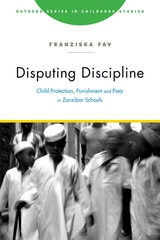
cover of Disputing Discipline: Child Protection, Punishment, and Piety in Zanzibar Schools

Disputing Discipline

Child Protection, Punishment, and Piety in Zanzibar Schools

Franziska Fay

Rutgers University Press, 2021

Disputing Discipline explores how global and local children’s rights activists’ efforts within the school systems of Zanzibar to eradicate corporal punishment are changing the archipelago’s moral and political landscape. Through an equal consideration of child and adult perspectives, Fay explores what child protection means for Zanzibari children who have to negotiate their lives at the intersections of universalized and local "child protection" aspirations while growing up to be pious and responsible adults. Through a visual and participatory ethnographic approach that foregrounds young people’s voices through their poetry, photographs, and drawings, paired with in-depth Swahili language analysis, Fay shows how children’s views and experiences can transform our understanding of child protection. This book demonstrates that to improve interventions, policy makers and practitioners need to understand child protection beyond a policy sense of the term and respond to the reality of children’s lives to avoid unintentionally compromising, rather than improving, young people’s well-being.
 
[more]