Results by title
283 books match the query 'Transportation' and 11 start with d

Days on the Night Train
Millay Hyatt
Haus Publishing, 2026
A paean to traveling by train, to the variety of Europe’s landscape, and to an immersive way of approaching and seeing the world.
For Millay Hyatt, it is the charm of “uncushioned encounters with the world” that makes her, whenever possible, choose to travel by train.
Days on the Night Train is a story of serendipities and missed connections, of sluggish border crossings, of embracing unpredictability and shunning the stifling regimentation of contemporary travel. In her accounts of her journeys across Europe and beyond, ranging from Edinburgh to Tunis, from Valencia to Tbilisi, Hyatt shows us that it is in movement that our perspective changes, and that this is never truer than when traveling by train, at half speed, with wide carriage windows framing a slowly shifting world. Inside, surrounded by strangers, she becomes intrigued by the intimate habits of her fellow passengers, listens in on arguing couples and bantering teenagers, and gives her imagination free rein to speculate about their lives. Later, in a couchette, even sleep takes on an unfamiliar quality, echoing Proust’s comment that people on trains sleep like fish in the sea, gently rocked by the waves and currents.
Traveling by rail brings Hyatt into contact with the world in a way that disturbs and upends her certainties. Perception slows and widens. Experiencing the excitement of departure and arrival—and in between the bittersweet joy of being in limbo, of looking inward—she notices how long train journeys, like books, can still alter us in a way jet travel has all but extinguished. Days on the Night Train is itself a journey, abundant with reflection, poetic observation, revealing encounter, and literary excursions.
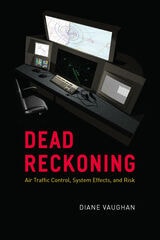
Dead Reckoning
Air Traffic Control, System Effects, and RiskDiane Vaughan
University of Chicago Press, 2021
When two airplanes were flown into the World Trade Center towers on September 11, 2001, Americans watched in uncomprehending shock as first responders struggled to react to the situation on the ground. Congruently, another remarkable and heroic feat was taking place in the air: more than six hundred and fifty air traffic control facilities across the country coordinated their efforts to ground four thousand flights in just two hours—an achievement all the more impressive considering the unprecedented nature of the task.
In Dead Reckoning, Diane Vaughan explores the complex work of air traffic controllers, work that is built upon a close relationship between human organizational systems and technology and is remarkably safe given the high level of risk. Vaughan observed the distinct skill sets of air traffic controllers and the ways their workplaces changed to adapt to technological developments and public and political pressures. She chronicles the ways these forces affected their jobs, from their relationships with one another and the layouts of their workspace to their understanding of their job and its place in society. The result is a nuanced and engaging look at an essential role that demands great coordination, collaboration, and focus—a role that technology will likely never be able to replace. Even as the book conveys warnings about complex systems and the liabilities of technological and organizational innovation, it shows the kinds of problem-solving solutions that evolved over time and the importance of people.
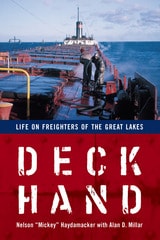
Deckhand
Life on Freighters of the Great LakesNelson "Mickey" Haydamacker with Alan D. Millar
University of Michigan Press, 2009
Long before popular television shows such as Dirty Jobs and The Deadliest Catch, everyday men and women---the unsung heroes of the job world---toiled in important but mostly anonymous jobs. One of those jobs was deckhand on the ore boats.
With numerous photographs and engaging stories, Deckhand offers an insider's view of both the mundane and the intriguing duties performed by deckhands on these gritty cargo vessels. Boisterous port saloons, monster ice jams, near drownings, and the daily drudgery of soogeying---cleaning dirt and grime off the ships---are just a few of the experiences Mickey Haydamacker had as a young deckhand working on freighters of the Great Lakes in the early 1960s. Haydamacker sailed five Interlake Steamship Company boats, from the modern Elton Hoyt 2nd to the ancient coal-powered Colonel James Pickands with its backbreaking tarp-covered hatches.
Deckhand will appeal to shipping buffs and to anyone interested in Great Lakes shipping and maritime history as it chronicles the adventures of living on the lakes from the seldom-seen view of a deckhand.
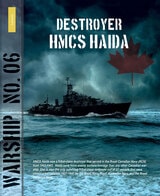
Destroyer HMCS Haida
Rindert van Zinderen-Bakker
Amsterdam University Press, 2023
Nowadays she is the only surviving Tribal-class destroyer out of 27 units that were constructed between 1937-1945 for the Royal Navy, Royal Australian Navy, and the Royal Canadian Navy.
Destroyer HNLMS Kortenaer
Rindert van Zinderen-Bakker
Amsterdam University Press, 2023
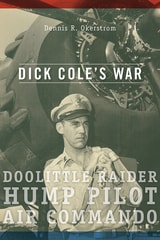
Dick Cole’s War
Doolittle Raider, Hump Pilot, Air CommandoDennis R. Okerstrom
University of Missouri Press, 2026
With the 100th anniversary of his birth on September 7, 2015 Dick Cole has long stood in the powerful spotlight of fame that has followed him since his B-25 was launched from a Navy carrier and flown toward Japan just four months after the attack on Pearl Harbor. In recognition the tremendous boost Doolittle’s Raid gave American morale, members of The Tokyo Doolittle Raiders were awarded the Congressional Gold Medal in May 2014.
Doolittle’s Raid was only the opening act of Cole’s flying career during the war. When that mission was complete and all of the 16 aircraft had crash-landed in China, many of the survivors were assigned to combat units in Europe. Cole remained in India after their rescue and was assigned to Ferrying Command, flying the Hump of the Himalayas for a year in the world’s worst weather, with inadequate aircraft, few aids to navigation, and inaccurate maps. More than 600 aircraft with their crews were lost during this monumental effort to keep China in the war, but Cole survived and rotated home in 1943. He was home just a few months when he was recruited for the First Air Commandos and he returned to India to participate in Project 9, the aerial invasion of Burma.
Digital Transformation in Maritime Transportation and Logistics
Michele Fiorini
The Institution of Engineering and Technology, 2026
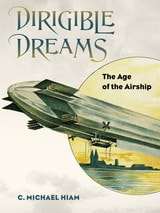
Dirigible Dreams
The Age of the AirshipC. Michael Hiam
University Press of New England, 2014
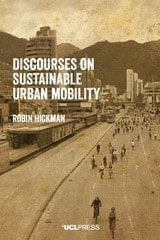
Discourses on Sustainable Urban Mobility
Robin Hickman
University College London, 2025
From reducing car dependency and expanding EVs to promoting public transport, sustainable mobility has been a hot topic in urban planning and the transportation sector. Arriving at this timely moment, Discourses on Sustainable Urban Mobility challenges the dominant discourses of motorization and the ineffective implementation of sustainable mobility. It argues that transport planning history is not merely a record of successful projects but a reflection of how transport has been provided, including who and what has been included or excluded. Using discourse analysis, the book examines physical transport infrastructure against the socially constructed realities in transport planning across a variety of international case studies, including Oxford, Bogotá, Chongqing, Rio de Janeiro, Copenhagen, and Delhi. In each case, the discursive frameworks surrounding transport and urban planning point toward promising pathways for achieving greater sustainability in transportation.
Driver Adaptation to Information and Assistance Systems
Alan Stevens
The Institution of Engineering and Technology, 2013
Driving Simulators for the Evaluation of Human-Machine Interfaces in Assisted and Automated Vehicles
Toshio Ito
The Institution of Engineering and Technology, 2021