Results by title
50 books match the query 'Trust' and 4 start with d
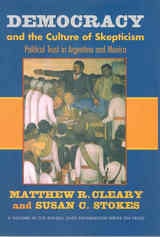
Democracy and the Culture of Skepticism
The Politics of Trust in Argentina and MexicoMatthew R. Cleary
Russell Sage Foundation, 2006
Some theorists claim that democracy cannot work without trust. According to this argument, democracy fails unless citizens trust that their governing institutions are serving their best interests. Similarly, some assert that democracy works best when people trust one another and have confidence that politicians will look after citizen interests. Questioning such claims, Democracy and the Culture of Skepticism, by Matthew Cleary and Susan Stokes, suggests that skepticism, not trust, is the hallmark of political culture in well-functioning democracies. Drawing on extensive research in two developing democracies, Argentina and Mexico, Democracy and the Culture of Skepticism shows that in regions of each country with healthy democracies, people do not trust one another more than those living in regions where democracy functions less well, nor do they display more personal trust in governments or politicians. Instead, the defining features of the healthiest democracies are skepticism of government and a belief that politicians act in their constituents' best interest only when it is personally advantageous for them to do so. In contrast to scholars who lament what they see as a breakdown in civic life, Cleary and Stokes find that people residing in healthy democracies do not participate more in civic organizations than others, but in fact, tend to retreat from civic life in favor of private pursuits. The authors conclude that governments are most efficient and responsive when they know that institutions such as the press or an independent judiciary will hold them accountable for their actions. The question of how much citizens should trust politicians and governments has consumed political theorists since America's founding. In Democracy and the Culture of Skepticism, Matthew Cleary and Susan Stokes test the relationship between trust and the quality of governance, showing that it is not trust, but vigilance and skepticism that provide the foundation for well-functioning democracies. A Volume in the Russell Sage Foundation Series on Trust
[more]
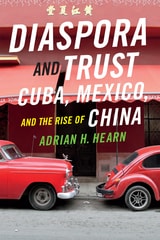
Diaspora and Trust
Cuba, Mexico, and the Rise of ChinaAdrian H. Hearn
Duke University Press, 2016
In Diaspora and Trust Adrian H. Hearn proposes that a new paradigm of socio-economic development is gaining importance for Cuba and Mexico. Despite their contrasting political ideologies, both countries must build new forms of trust among the state, society, and resident Chinese diaspora communities if they are to harness the potentials of China’s rise. Combining political and economic analysis with ethnographic fieldwork, Hearn analyzes Cuba's and Mexico's historical relations with China, and highlights how Chinese diaspora communities are now deepening these ties. Theorizing trust as an alternative to existing models of exchange—which are failing to navigate the world's shifting economic currents—Hearn shows how Cuba and Mexico can reformulate the balance of power between state, market, and society. A new paradigm of domestic development and foreign engagement based on trust is becoming critical for Cuba, Mexico, and other countries seeking to benefit from China’s growing economic power and social influence.
[more]

Digital Authority
How Algorithms Shape Human Obedience and TrustDaan Weggemans
Central European University Press, 2027
Our lives have been flooded with digital technologies that inform, advise, recommend, instruct, and sometimes even order. Most of the time, relying on them makes perfect sense: they are designed to help us solve everyday problems. Yet no technology is perfect. Bugs, flawed algorithms, biased data, and input errors can lead us astray. Although we recognize these risks, we often remain eager to follow what we are digitally told. This extends beyond examples of navigation systems sending drivers in the wrong direction. Digital technologies increasingly shape decisions in domains that profoundly affect human lives. How can we understand this readiness to accept technological outputs without question? The concept of digital authority provides a useful framework. It suggests that digital technologies are not merely tools or assistants, but can become authorities that shape human judgment. Understanding digital authority is crucial for addressing the ethical challenges of our reliance on digital systems.
[more]

Distrust
Russell Hardin
Russell Sage Foundation, 2004
If trust is sometimes the rational response in interpersonal relations, then it can also be rational to distrust. Indeed, distrust is the preferred response when it protects against harm—as when parents do not entrust the safety of their child to a disreputable caretaker. Liberal political theory was largely founded on distrust of government, and the assumption that government cannot and should not be trusted led the framers of the U.S. constitution to establish a set of institutions explicitly designed to limit government power. With contributions from political science, anthropology, economics, psychology, and philosophy, Distrust examines the complex workings of trust and distrust in personal relationships, groups, and international settings. Edna Ullman-Margalit succinctly defines distrust as the negation of trust, and examines the neutral state between the two responses in interpersonal relations. As Margalit points out, people typically defer judgment—while remaining mildly wary of another's intentions—until specific grounds for trust or distrust become evident. In relations between nations, misplaced trust can lead to grievous harm, so nations may be inclined to act as though they distrust other nations more than they actually do. Editor Russell Hardin observes that the United States and the former Soviet Union secured a kind of institutionalized distrust—through the development of the nuclear deterrent system—that stabilized the relationship between the two countries for four decades. In another realm where distrust plays a prominent role, Margaret Levi, Matthew Moe, and Theresa Buckley show that since the National Labor Relations Board has not been able to overcome distrust between labor unions and employers, it strives to equalize the power held by each group in negotiations. Recapitulating liberal concerns about state power, Patrick Troy argues that citizen distrust keeps government regulation under scrutiny and is more beneficial to the public than unconditional trust. Despite the diversity of contexts examined, the contributors reach remarkably similar conclusions about the important role of trust and distrust in relations between individuals, nations, and citizens and their governments. Distrust makes a significant contribution to the growing field of trust studies and provides a useful guide for further research. A Volume in the Russell Sage Foundation Series on Trust
[more]