Results by title
57 books match the query 'Understanding' and 2 start with d
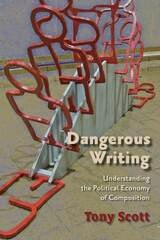
Dangerous Writing
Understanding the Political Economy of CompositionTony Scott
Utah State University Press, 2009
Building on recent work in rhetoric and composition that takes an historical materialist approach, Dangerous Writing outlines a political economic theory of composition. The book connects pedagogical practices in writing classes to their broader political economic contexts, and argues that the analytical power of students’ writing is prevented from reaching its potential by pressures within the academy and without, that tend to wed higher education with the aims and logics of “fast-capitalism.”
Since the 1980s and the “social turn” in composition studies and other disciplines, scholars in this field have conceived writing in college as explicitly embedded in socio-rhetorical situations beyond the classroom. From this conviction develops a commitment to teach writing with an emphasis on analyzing the social and political dimensions of rhetoric.
Ironically, though a leftist himself, Tony Scott’s analysis finds the academic left complicit with the forces in American culture that tend, in his view, to compromise education. By focusing on the structures of labor and of institutions that enforce those structures, Scott finds teachers and administrators are too easily swept along with the inertia of a hyper-commodified society in which students---especially working class students---are often positioned as commodities, themselves. Dangerous Writing, then, is a critique of the field as much as it is a critique of capitalism. Ultimately, Scott’s eye is on the institution and its structures, and it is these that he finds most in need of transformation.
[more]
Dynamic Conceptual Semantics
A Logico-Philosophical Investigation into Concept Formation and UnderstandingRenate Bartsch
CSLI, 1998
Presented in this book is a theory of concept formation and understanding that does not make use of a notion of an innate mental language as a means of concept representation. Instead, experimental concepts are treated semantically as stabilising structuring of growing sets of data, which are sets of experienced satisfaction situations for expressions, and theoretical concepts are based on coherent sets of general sentences held true. There are two kinds of structures to be established: general concepts by means of similarity sets under perspectives and historical concepts. This gives rise to a theory of understanding new situations and expressions by integrating new data into established sets of data salva stability, or by extending the conceptual structure in a metaphorical or metonymical way. The theory provides a way to understand what identity between propositional attitudes amounts to, especially how people can have more or less the same belief.
[more]