Results by title
97 books match the query 'United States. Congress' and 2 start with d
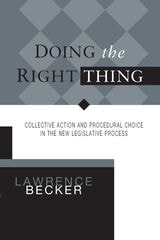
DOING THE RIGHT THING
Collective Action and Procedural Choice in the New Legislative ProcessLawrence Becker
The Ohio State University Press, 2005
Doing the Right Thing examines the use of extraordinary legislative procedures in four cases in the U.S. Congress to accomplish policy objectives that many political scientists would argue are impossible to achieve. It not only shows that Congress is capable of imposing parochial costs in favor of general benefits but it argues that Congress is able to do so in a variety of policy areas through the use of very different kinds of procedural mechanisms that are underappreciated.
The book opens by developing a theory of procedural choice to explain why Congress chooses to delegate in differing degrees in dealing with similar kinds of policy problems. The theory is then applied to four narrative case studies—military base closures, the Yucca Mountain Project, NAFTA, and the Tax Reform Act of 1986—that both show the variety of factors that impact procedural choice and highlight how our national legislature was able to “do the right thing.”
The book concludes by pointing to the variety of ways in which Congress will be confronted with similar policy problems in the coming years and offering some lessons from these cases about what kinds of procedures and policy outcomes we might expect. In short, Congress is remarkably adept at “doing the right thing,” even under difficult circumstances, but only when legislators are willing to manipulate procedures in all the necessary ways.
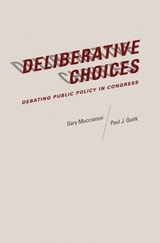
Deliberative Choices
Debating Public Policy in CongressGary Mucciaroni and Paul J. Quirk
University of Chicago Press, 2006
Mucciaroni and Quirk argue that in fashioning the claims they use in debate, legislators make a strategic trade-off between boosting their rhetorical force and ensuring their ability to withstand scrutiny. Using three case studies—welfare reform, repeal of the estate tax, and telecommunications deregulation—the authors show how legislators’ varying responses to such a trade-off shape the issues they focus on, the claims they make, and the information they provide in support of those claims.
Mucciaroni and Quirk conclude that congressional debate generally is only moderately realistic and informed. It often trades in half-truths, omissions, and sometimes even outright falsehoods. Yet some debates are highly informative. Moreover, the authors believe it’s possible to improve congressional deliberation, and they recommend reforms designed to do so.