Results by title
53 books match the query 'Voting' and 3 start with d
Demanding Choices
Opinion, Voting, and Direct DemocracyShaun Bowler and Todd Donovan
University of Michigan Press, 2000
Democracy at Risk
How Terrorist Threats Affect the PublicJennifer L. Merolla and Elizabeth J. Zechmeister
University of Chicago Press, 2009
How do threats of terrorism affect the opinions of citizens? Speculation abounds, but until now no one had marshaled hard evidence to explain the complexities of this relationship. Drawing on data from surveys and original experiments they conducted in the United States and Mexico, Jennifer Merolla and Elizabeth Zechmeister demonstrate how our strategies for coping with terrorist threats significantly influence our attitudes toward fellow citizens, political leaders, and foreign nations.
The authors reveal, for example, that some people try to restore a sense of order and control through increased wariness of others—especially of those who exist outside the societal mainstream. Additionally, voters under threat tend to prize “strong leadership” more highly than partisan affiliation, making some politicians seem more charismatic than they otherwise would. The authors show that a wary public will sometimes continue to empower such leaders after they have been elected, giving them greater authority even at the expense of institutional checks and balances. Having demonstrated that a climate of terrorist threat also increases support for restrictive laws at home and engagement against terrorists abroad, Merolla and Zechmeister conclude that our responses to such threats can put democracy at risk.
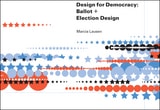
Design for Democracy
Ballot and Election DesignMarcia Lausen
University of Chicago Press, 2007
Handsomely designed itself, this volume showcases adaptable design models that can improve almost every part of the election process by maximizing the clarity and usability of ballots, registration forms, posters and signs, informational brochures and guides, and even administrative materials for poll workers. Design for Democracy also lays out specific guidelines—covering issues of color palette, typography, and image use—that anchor the comprehensive election design system devised by the group of design specialists from whose name the book takes its title. Part of a major AIGA strategic program, this group's prototypes and recommendations have already been used successfully in major Illinois and Oregon elections and, collected here, are likely to spread across the country as more people become aware of the myriad benefits and broad applicability of improved election design.
An essential tool for designers and election officials, lawmakers and citizens, Design for Democracy harnesses the power of design to increase voter confidence, promote government transparency, and, perhaps most important, create an informed electorate.