Results by title
388 books match the query 'War' and 7 start with d
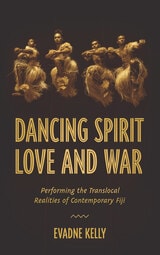
Dancing Spirit, Love, and War
Performing the Translocal Realities of Contemporary FijiEvadne Kelly
University of Wisconsin Press, 2022
Meke, a traditional rhythmic dance accompanied by singing, signifies an important piece of identity for Fijians. Despite its complicated history of colonialism, racism, censorship, and religious conflict, meke remained a vital part of artistic expression and culture. Evadne Kelly performs close readings of the dance in relation to an evolving landscape, following the postcolonial reclamation that provided dancers with political agency and a strong sense of community that connected and fractured Fijians worldwide.
Through extensive archival and ethnographic fieldwork in both Fiji and Canada, Kelly offers key insights into an underrepresented dance form, region, and culture. Her perceptive analysis of meke will be of interest in dance studies, postcolonial and Indigenous studies, anthropology and performance ethnography, and Pacific Island studies.
Through extensive archival and ethnographic fieldwork in both Fiji and Canada, Kelly offers key insights into an underrepresented dance form, region, and culture. Her perceptive analysis of meke will be of interest in dance studies, postcolonial and Indigenous studies, anthropology and performance ethnography, and Pacific Island studies.
[more]

Dancing in Odessa
Ilya Kaminsky
Tupelo Press, 2004
Winner of the 2002 Dorset Prize, and recipient of the Ruth Lilly Fellowship, Ilya Kaminsky is a recent Russian immigrant and rising poetic star. Despite the fact that he is a non-native speaker, Kaminksy's sense of rhythm and lyic surpasses that of most contemporary poets in the English language. This magical, musical book of poems draws readers into its unforgettable heart, and Carolyn Forché wrties simply "I'm in awe of his gifts."
[more]

Daphne
Kristen Case
Tupelo Press, 2025
A meditation on the centrality of predation to the Western lyric tradition.
In dialogue with Wittgenstein's “On Certainty,” Ovid's Metamorphoses, Shakespeare's Hamlet, and Thomas Wyatt’s “Whoso List to Hunt,” among other works, Kristen Case's poems and lyric essays unearth the ways violence both disrupts and enables our ways of knowing—or approximating knowledge of—one another.
In dialogue with Wittgenstein's “On Certainty,” Ovid's Metamorphoses, Shakespeare's Hamlet, and Thomas Wyatt’s “Whoso List to Hunt,” among other works, Kristen Case's poems and lyric essays unearth the ways violence both disrupts and enables our ways of knowing—or approximating knowledge of—one another.
[more]
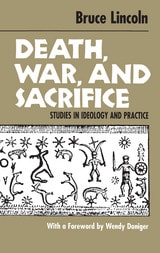
Death, War, and Sacrifice
Studies in Ideology & PracticeBruce Lincoln
University of Chicago Press, 1991
One of the world's leading specialists in Indo-European
religion and society, Bruce Lincoln expresses in these essays
his severe doubts about the existence of a much-hypothesized
prototypical Indo-European religion.
Written over fifteen years, the essays—six of them
previously unpublished—fall into three parts. Part I deals
with matters "Indo-European" in a relatively unproblematized
way, exploring a set of haunting images that recur in
descriptions of the Otherworld from many cultures. While
Lincoln later rejects this methodology, these chapters remain
the best available source of data for the topics they
address.
In Part II, Lincoln takes the data for each essay from a
single culture area and shifts from the topic of dying to
that of killing. Of particular interest are the chapters
connecting sacrifice to physiology, a master discourse of
antiquity that brought the cosmos, the human body, and human
society into an ideologically charged correlation.
Part III presents Lincoln's most controversial case
against a hypothetical Indo-European protoculture.
Reconsidering the work of the prominent Indo-Europeanist
Georges Dumézil, Lincoln argues that Dumézil's writings
were informed and inflected by covert political concerns
characteristic of French fascism. This collection is an
invaluable resource for students of myth, ritual, ancient
societies, anthropology, and the history of religions.
Bruce Lincoln is professor of humanities and religious
studies at the University of Minnesota.
[more]
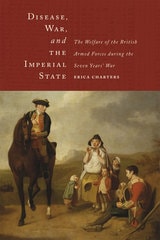
Disease, War, and the Imperial State
The Welfare of the British Armed Forces during the Seven Years' WarErica Charters
University of Chicago Press, 2014
The Seven Years’ War, often called the first global war, spanned North America, the West Indies, Europe, and India. In these locations diseases such as scurvy, smallpox, and yellow fever killed far more than combat did, stretching the resources of European states.
In Disease, War, and the Imperial State, Erica Charters demonstrates how disease played a vital role in shaping strategy and campaigning, British state policy, and imperial relations during the Seven Years’ War. Military medicine was a crucial component of the British war effort; it was central to both eighteenth-century scientific innovation and the moral authority of the British state. Looking beyond the traditional focus of the British state as a fiscal war-making machine, Charters uncovers an imperial state conspicuously attending to the welfare of its armed forces, investing in medical research, and responding to local public opinion. Charters shows military medicine to be a credible scientific endeavor that was similarly responsive to local conditions and demands.
Disease, War, and the Imperial State is an engaging study of early modern warfare and statecraft, one focused on the endless and laborious task of managing manpower in the face of virulent disease in the field, political opposition at home, and the clamor of public opinion in both Britain and its colonies.
[more]

Don't Mention the War
Northern Ireland, Propaganda and the MediaDavid Miller
Pluto Press, 1994
[more]
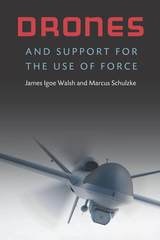
Drones and Support for the Use of Force
James Igoe Walsh and Marcus Schulzke
University of Michigan Press, 2018
Combat drones are transforming attitudes about the use of military force. Military casualties and the costs of conflict sap public support for war and for political and military leaders. Combat drones offer an unprecedented ability to reduce these costs by increasing accuracy, reducing the risks to civilians, and protecting military personnel from harm. These advantages should make drone strikes more popular than operations involving ground troops. Yet many critics believe drone warfare will make political leaders too willing to authorize wars, weakening constraints on the use of force. Because combat drones are relatively new, these arguments have been based on anecdotes, a handful of public opinion polls, or theoretical speculation.
Drones and Support for the Use of Force uses experimental research to analyze the effects of combat drones on Americans’ support for the use of force. The authors’ findings—that drones have had important but nuanced effects on support for the use of force—have implications for democratic control of military action and civil-military relations and provide insight into how the proliferation of military technologies influences foreign policy.
Drones and Support for the Use of Force uses experimental research to analyze the effects of combat drones on Americans’ support for the use of force. The authors’ findings—that drones have had important but nuanced effects on support for the use of force—have implications for democratic control of military action and civil-military relations and provide insight into how the proliferation of military technologies influences foreign policy.
[more]