Results by title
54 books match the query 'Washington (D.C.)' and 4 start with d
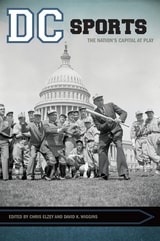
DC Sports
The Nation's Capital at PlayChris Elzey
University of Arkansas Press, 2015
A southern city at heart, Washington drew a strong color line in every facet of people’s lives. Race informed how sport was played, written about, and watched in the city. In 1962, the Redskins became the final National Football League team to integrate. That same year, a race riot marred the city’s high-school championship game in football. A generation later, race as an issue resurfaced after Georgetown’s African American head coach John Thompson Jr. led the Hoyas to national prominence in basketball.
DC Sports takes a hard look at how sports in one city has shaped culture and history, and how culture and history inform sports. This informative and engaging collection will appeal to fans and students of sports and those interested in the rich history of the nation’s capital.
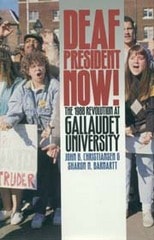
Deaf President Now!
The 1988 Revolution at Gallaudet UniversityJohn B. Christiansen
Gallaudet University Press, 1995
Deaf President Now! reveals the groundswell leading up to the history-making week in 1988 when the students at Gallaudet University seized the campus and closed it down until their demands were met. To research this probing study, the authors interviewed in-depth more than 50 of the principal players.
This telling book reveals the critical role played by a little-known group called the "Ducks," a tight-knit band of six alumni determined to see a deaf president at Gallaudet. Deaf President Now! details how they urged the student leaders to ultimate success, including an analysis of the reasons for their achievement in light of the failure of many other student movements. This fascinating study also scrutinizes the lasting effects of this remarkable episode in "the civil rights movement of the deaf." Deaf President Now! tells the full story of the insurrection at Gallaudet University, an exciting study of how deaf people won social change for themselves and all disabled people everywhere through a peaceful revolution.
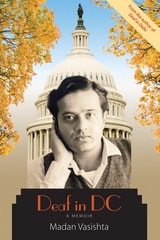
Deaf in DC
A MemoirMadan Vasishta
Gallaudet University Press, 2011
In his first memoir, Madan Vasishta described being a deaf boy in his homeland India, where “deaf” meant someone who is not human. After rising from herding cattle to being a respected photographer in Delhi, his first memoir concluded with his acceptance at Gallaudet College far away in America. Vasishta’s new memoir begins with his arrival in Washington, DC in 1967 with $40.00 in his pocket and very little knowledge of the new worlds he was entering.
Vasishta faced myriad challenges from the outset— he knew no American Sign Language and could not speech read, yet he found himself thrust into classes at Gallaudet two weeks into the semester. Cultural differences mystified him, such as how all American car accidents were someone else’s fault even when one’s car hits a stationary object. He was amazed that his fellow students did not deride him for his mistakes, unlike in India where he would have been scorned for his weakness. After five years, he returned home to India for a visit and was stunned to learn that he no longer fit in, that “even if you do not have an American Dream, the American Dream will have you.”
Deaf in DC follows Vasishta through half a century living in America. He witnessed the transformation from facing bias as a deaf, foreign man of color who could not get a job despite having a Ph.D., to receiving five offers as a school superintendent in the wake of the Civil Rights movement and Deaf President Now. His new memoir reflects a genuine worldview informed by the sage perceptions of a person who has lived widely in many worlds.
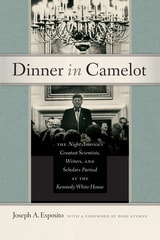
Dinner in Camelot
The Night America's Greatest Scientists, Writers, and Scholars Partied at the Kennedy White HouseJoseph A. Esposito
University Press of New England, 2018