Results by title
107 books match the query 'Water' and 3 start with d
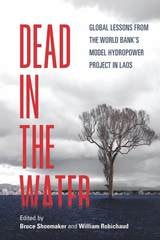
Dead in the Water
Global Lessons from the World Bank's Model Hydropower Project in LaosEdited by Bruce Shoemaker and William Robichaud; foreword by Yos Santasombat; afterword by Philip Hirsch
University of Wisconsin Press, 2019
For decades, large dam projects have been undertaken by both nations and international agencies with the aim of doing good: preventing floods, bringing electricity to rural populations, producing revenues for poor countries, and more. But time after time, the social, economic, and environmental costs have outweighed the benefits of the dams, sometimes to a disastrous degree. In this volume, a diverse group of experts—involved for years with the Nam Theun 2 dam in Laos—issue an urgent call for critical reassessment of the approach to, and rationale for, these kinds of large infrastructure projects in developing countries.
In the 2000s, as the World Bank was reeling from revelations of past hydropower failures, it nonetheless promoted the enormous Nam Theun 2 project. NT2, the Bank believed, offered a new, wiser model of dam development that would alleviate poverty, protect the environment, engage locally affected people in a transparent fashion, and stimulate political transformation. This was a tall order. For the first time, this book shows in detail why, despite assertions of success from the World Bank and other agencies involved in the project, the dam's true story has been one of substantial loss for affected villagers and the regional environment. Nam Theun 2 is an important case study that illustrates much broader problems of global development policy.
In the 2000s, as the World Bank was reeling from revelations of past hydropower failures, it nonetheless promoted the enormous Nam Theun 2 project. NT2, the Bank believed, offered a new, wiser model of dam development that would alleviate poverty, protect the environment, engage locally affected people in a transparent fashion, and stimulate political transformation. This was a tall order. For the first time, this book shows in detail why, despite assertions of success from the World Bank and other agencies involved in the project, the dam's true story has been one of substantial loss for affected villagers and the regional environment. Nam Theun 2 is an important case study that illustrates much broader problems of global development policy.
[more]
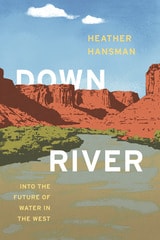
Downriver
Into the Future of Water in the WestHeather Hansman
University of Chicago Press, 2019
Award-winning journalist rafts down the Green River, revealing a multifaceted look at the present and future of water in the American West.
The Green River, the most significant tributary of the Colorado River, runs 730 miles from the glaciers of Wyoming to the desert canyons of Utah. Over its course, it meanders through ranches, cities, national parks, endangered fish habitats, and some of the most significant natural gas fields in the country, as it provides water for 33 million people. Stopped up by dams, slaked off by irrigation, and dried up by cities, the Green is crucial, overused, and at-risk, now more than ever.
Fights over the river’s water, and what’s going to happen to it in the future, are longstanding, intractable, and only getting worse as the West gets hotter and drier and more people depend on the river with each passing year. As a former raft guide and an environmental reporter, Heather Hansman knew these fights were happening, but she felt driven to see them from a different perspective—from the river itself. So she set out on a journey, in a one-person inflatable pack raft, to paddle the river from source to confluence and see what the experience might teach her. Mixing lyrical accounts of quiet paddling through breathtaking beauty with nights spent camping solo and lively discussions with farmers, city officials, and other people met along the way, Downriver is the story of that journey, a foray into the present—and future—of water in the West.
[more]
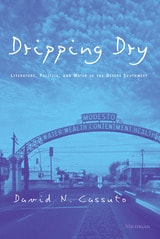
Dripping Dry
Literature, Politics and Water in the Desert SouthwestDavid N. Cassuto
University of Michigan Press, 2001
More than any other single characteristic, aridity defines the American West. Water scarcity and its biologically critical function have also molded the regional literature of the region. Using novels by Barbara Kingsolver, Edward Abbey, John Steinbeck and Mary Austin, Dripping Dry combines literary analysis with environmental criticism to demonstrate how the myths that have pervaded the regional literature of the West have interacted with the myths that have shaped water policy throughout the twentieth century.
The four works selected (Animal Dreams, The Monkey Wrench Gang, The Grapes of Wrath, and The Ford) present a composite portrait of reclamation, which the author argues is one of the most important cultural and ecological phenomena in the nation's history. The tensions and contradictions presented by the novels underscore the compelling need for an ecocritique of the relationship between literature and politics. David N. Cassuto deciphers the myths of reclamation and restoration and presents a third alternative--sustainability--in their stead. The challenge is a large one, because of the size and complexity of the region and because nature continues to evolve and create itself, a process involving language, ideology, and the land.
The book is designed to be an interdisciplinary contribution both to the emerging field of literature and the environment, as well as to environmental studies. It will be welcomed by scholars as well as general readers interested in new approaches to literature and environmental issues, and by those interested in the geography and literature of the western United States.
David N. Cassuto, formerly of the English Department of the University of Missouri-Rolla, is a practicing attorney in San Francisco, specializing in environmental issues.
[more]