52 books match the query 'Women in motion pictures' and 2 start with d
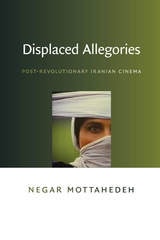
cover of Displaced Allegories: Post-Revolutionary Iranian Cinema

Displaced Allegories

Post-Revolutionary Iranian Cinema

Negar Mottahedeh

Duke University Press, 2008

Following the 1979 Iranian Revolution, Iran’s film industry, in conforming to the Islamic Republic’s system of modesty, had to ensure that women on-screen were veiled from the view of men. This prevented Iranian filmmakers from making use of the desiring gaze, a staple cinematic system of looking. In Displaced Allegories Negar Mottahedeh shows that post-Revolutionary Iranian filmmakers were forced to create a new visual language for conveying meaning to audiences. She argues that the Iranian film industry found creative ground not in the negation of government regulations but in the camera’s adoption of the modest, averted gaze. In the process, the filmic techniques and cinematic technologies were gendered as feminine and the national cinema was produced as a woman’s cinema.

Mottahedeh asserts that, in response to the prohibitions against the desiring look, a new narrative cinema emerged as the displaced allegory of the constraints on the post-Revolutionary Iranian film industry. Allegorical commentary was not developed in the explicit content of cinematic narratives but through formal innovations. Offering close readings of the work of the nationally popular and internationally renowned Iranian auteurs Bahram Bayza’i, Abbas Kiarostami, and Mohsen Makhmalbaf, Mottahedeh illuminates the formal codes and conventions of post-Revolutionary Iranian films. She insists that such analyses of cinema’s visual codes and conventions are crucial to the study of international film. As Mottahedeh points out, the discipline of film studies has traditionally seen film as a medium that communicates globally because of its dependence on a (Hollywood) visual language assumed to be universal and legible across national boundaries. Displaced Allegories demonstrates that visual language is not necessarily universal; it is sometimes deeply informed by national culture and politics.
[more]
cover of Doing Women's Film History: Reframing Cinemas, Past and Future

Doing Women's Film History

Reframing Cinemas, Past and Future

Edited by Christine Gledhill and Julia Knight

University of Illinois Press, 2015

Research into and around women's participation in cinematic history has enjoyed dynamic growth over the past decade. A broadening of scope and interests encompasses not only different kinds of filmmaking--mainstream fiction, experimental, and documentary--but also practices--publicity, journalism, distribution and exhibition--seldom explored in the past. Cutting-edge and inclusive, Doing Women's Film History ventures into topics in the United States and Europe while also moving beyond to explore the influence of women on the cinemas of India, Chile, Turkey, Russia, and Australia. Contributors grapple with historiographic questions that cover film history from the pioneering era to the present day. Yet the writers also address the very mission of practicing scholarship. Essays explore essential issues like identifying women's participation in their cinema cultures, locating previously unconsidered sources of evidence, developing methodologies and analytical concepts to reveal the impact of gender on film production, distribution and reception, and reframing film history to accommodate new questions and approaches. Contributors include: Kay Armatage, Eylem Atakav, Karina Aveyard, Canan Balan, Cécile Chich, Monica Dall'Asta, Eliza Anna Delveroudi, Jane M. Gaines, Christine Gledhill, Julia Knight, Neepa Majumdar, Michele Leigh, Luke McKernan, Debashree Mukherjee, Giuliana Muscio, Katarzyna Paszkiewicz, Rashmi Sawhney, Elizabeth Ramirez Soto, Sarah Street, and Kimberly Tomadjoglou.
[more]