Results by title
77 books match the query 'Words' and 3 start with d
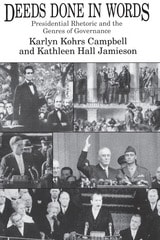
Deeds Done in Words
Presidential Rhetoric and the Genres of GovernanceKarlyn Kohrs Campbell and Kathleen Hall Jamieson
University of Chicago Press, 1990
"Deeds Done in Words is an impressive piece of work. It is the first attempt to identify and assess the principal genres of rhetoric, and to interpret the panoply of those genres in terms of the needs of, and the needs for, ritual in American politics."—Jeffrey Tulis, author of The Rhetorical Presidency
"Deeds Done in Words is a thoughtful survey of how a democracy uses language to transact its business. Based on an enlivened understanding of genre theory and on numerous pieces of original criticism, Campbell and Jamieson vividly show how central public discourse has become the lifeblood of the American polity."—Roderick Hart, author of The Sound of Leadership
"The rhetoric that issues from the White House is becoming an ever more salient part of what the presidency means and does. This acute inquiry provides a great many insights into the forms, meanings, and functions of presidential discourse. It is an enlightening contribution to our understanding of American politics."—Murray Edelman, author of Constructing the Political Spectacle
[more]
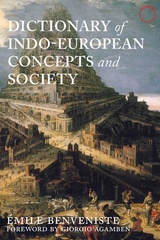
Dictionary of Indo-European Concepts and Society
Émile Benveniste
HAU, 2016
Since its publication in 1969, Émile Benveniste’s Vocabulaire—here in a new translation as the Dictionary of Indo-European Concepts and Society—has been the classic reference for tracing the institutional and conceptual genealogy of the sociocultural worlds of gifts, contracts, sacrifice, hospitality, authority, freedom, ancient economy, and kinship. A comprehensive and comparative history of words with analyses of their underlying neglected genealogies and structures of signification—and this via a masterful journey through Germanic, Romance, Indo-Iranian, Latin, and Greek languages—Benveniste’s dictionary is a must-read for anthropologists, linguists, literary theorists, classicists, and philosophers alike.
This book has famously inspired a wealth of thinkers, including Roland Barthes, Claude Lévi-Strauss, Pierre Bourdieu, Jacques Derrida, Umberto Eco, Giorgio Agamben, François Jullien, and many others. In this new volume, Benveniste’s masterpiece on the study of language and society finds new life for a new generation of scholars. As political fictions continue to separate and reify differences between European, Middle Eastern, and South Asian societies, Benveniste reminds us just how historically deep their interconnections are and that understanding the way our institutions are evoked through the words that describe them is more necessary than ever.
This book has famously inspired a wealth of thinkers, including Roland Barthes, Claude Lévi-Strauss, Pierre Bourdieu, Jacques Derrida, Umberto Eco, Giorgio Agamben, François Jullien, and many others. In this new volume, Benveniste’s masterpiece on the study of language and society finds new life for a new generation of scholars. As political fictions continue to separate and reify differences between European, Middle Eastern, and South Asian societies, Benveniste reminds us just how historically deep their interconnections are and that understanding the way our institutions are evoked through the words that describe them is more necessary than ever.
[more]
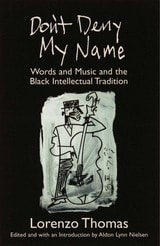
Don't Deny My Name
Words and Music and the Black Intellectual TraditionLorenzo Thomas; Edited and with an Introduction by Aldon Lynn Nielsen
University of Michigan Press, 2008
Black musical forms profoundly influenced the work of American poet and leading literary figure Lorenzo Thomas, and he wrote about them with keen insight---and obvious pleasure. This book, begun by Thomas before his death in 2005, collects more than a dozen of his savvy yet engagingly personal essays that probe the links between African American music, literature, and popular culture, from the Harlem Renaissance to the present. Don't Deny My Name (which takes its title from a blues song by Jelly Roll Morton) begins by laying out the case that the blues is a body of literature that captured the experience of African American migrants to the urban North and newer territories to the West. The essays that follow collectively provide a tour of the movement through classic jazz, bop, and the explosions of the free jazz era, followed by a section on R&B and soul. The penultimate essay is a meditation on rap music that attempts to bring together the extremes of emotion that hip hop elicits, and the collection ends with an unfinished preface to the volume.
[more]