Results by title
28164 books match the query 'History' and 908 start with d
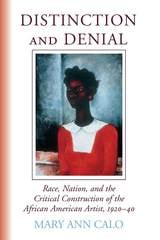
Distinction and Denial
Race, Nation, and the Critical Construction of the African American Artist, 1920-40Mary Ann Calo
University of Michigan Press, 2007
Distinctionand Denial challenges conventional theories of race and art by examining the role early twentieth-century art critics played in marginalizing African American artists. Mary Ann Calo dispels the myth of a unified African American artistic tradition through an engaging study of the germinal writing of Alain Locke and other significant critics of the era, who argued that African American artists were both a diverse group and a constituent element of America’s cultural center. By documenting the effects of the “Negro aesthetic” on African American artists working in the interwar years, Distinctionand Denial shows that black artistic production existed between the claims of a distinctly African American tradition and full inclusion into American modernist culture—never fully inside or outside the mainstream.
“A major contribution to the scholarship of African American artists in the inter-war period. With scrupulous research and probing analyses, Calo’s study enables scholars, students, and those interested in the Harlem Renaissance to grasp the intellectual debates, institutional support, and art world promotion that advanced an emerging cohort of African American artists.”
—Patricia Hills, Boston University
“A careful, thorough, historically grounded study that builds a new and significant argument challenging conventional histories of African American art. Sure to become indispensable to any scholarly discussion of American art or African American cultural studies.”
—Helen Langa, American University
Mary Ann Calo is Professor of Art History and Director of the Institute for the Creative and Performing Arts at Colgate University. She is author of Bernard Berenson and the Twentieth Century and editor of Critical Issues in American Art: A Book of Readings.
Distinguishing the Righteous from the Roguish
The Arkansas Supreme Court, 1836–1874J.W. Looney
University of Arkansas Press, 2016
During the period from 1836 to 1874, the legal system in the new state of Arkansas developed amid huge social change. While the legislature could, and did, determine what issues were considered of importance to the populace, the Arkansas Supreme Court determined the efficacy of legislation in cases involving land titles, banks, transportation, slavery, family law, property, debt, contract, criminal law, and procedure.
Distinguishing the Righteous from the Roguish examines the court’s decisions in this era and shows how Arkansas, as a rural slave-holding state, did not follow the transformational patterns typical of some other states during the nineteenth century. Rather than using the law to promote broad economic growth and encourage social change, the Arkansas court attempted to accommodate the interests of the elite class by preserving the institution of slavery. The ideology of paternalism is reflected in the decisions of the court, and Looney shows how social and political stability—an emphasis on preserving the status quo of the so-called “righteous”—came at the expense of broader economic development.
Distorted Mirrors
Americans and Their Relations with Russia and China in the Twentieth CenturyDonald E. Davis & Eugene P. Trani
University of Missouri Press, 2009
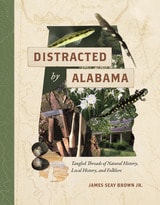
Distracted by Alabama
Tangled Threads of Natural History, Local History, and FolkloreJames Seay Brown Jr.
University of Alabama Press, 2022
Where rivers, railroads, and redhorse fish tell the story of Alabama’s soul.
A gateway to Alabama for the omnivorous mind, Distracted by Alabama is a collection of twelve captivating essays about Alabama and the South by Samford University writer and scholar Jim Brown, a former president of the Alabama Folklife Association.
During his decades living and teaching in Alabama, Brown followed his curiosity down myriad pathways about Alabama and the region, including the state’s majestic landscape, plants and animals found nowhere else, history, and rich folkways. In the tapestry of Alabama culture, Brown traces the threads of Native American, African slave, and European settler influences, woven over the centuries into novel patterns that surprise and fascinate.
Writing in the voice of a learned companion, Brown reveals insights and stories about unforgettable facets of Alabama culture, such as Sacred Harp singers and African American railroad callers, the use of handmade snares and stationary fishtraps to catch river redhorse and freshwater drum, white oak basketmaking and herbal medicine traditions, the evolution of the single-pen log cabin into the impressive two-story I-house, and a wealth of other engrossing stories.
An instant classic, Distracted by Alabama is a keepsake that readers who love, visit, or are curious about Alabama and Southern culture will return to again and again.
Disturbing Practices
History, Sexuality, and Women's Experience of Modern WarLaura Doan
University of Chicago Press, 2013
Disunion Among Ourselves
The Perilous Politics of the American RevolutionEli Merritt
University of Missouri Press, 2025
Winner of the 2024 Society of the Cincinnati Prize from the American Revolution Institute
Winner of the 2023 American Revolution Round Table of Philadelphia book award
In this eye-opening account, Eli Merritt reveals the deep political divisions that almost tore the Union apart during the American Revolution. So fractious were the founders’ political fights that they feared the War of Independence might end in disunion and civil war.
Instead of disbanding into separate regional confederacies, the founders managed to unite for the sake of liberty and self-preservation. In so doing, they succeeded in holding the young nation together. To achieve this, they forged grueling compromises, including Declaration of Independence in 1776, the Mississippi-Fisheries Compromise of 1779, and the ratification of the Articles of Confederation in 1781.
In addition to bringing new insights to the history of the American Revolution, Disunion Among Ourselves has inevitable resonances with our present era of political hyperpolarization and serves as a touchstone for contemporary politics, reminding us that the founders overcame far tougher times than our own through commitment to ethical constitutional democracy and compromise.
Divas in the Convent
Nuns, Music, and Defiance in Seventeenth-Century ItalyCraig A. Monson
University of Chicago Press, 2012
Divergent Modernities
Culture and Politics in Nineteenth-Century Latin AmericaJulio Ramos
Duke University Press, 2001
Since its first publication in Spanish nearly a decade ago, Julio Ramos’s Desenucuentros de la modernidad en America Latina por el siglo XIX has been recognized as one of the most important studies of modernity in the western hemisphere. Available for the first time in English—and now published with new material—Ramos’s study not only offers an analysis of the complex relationships between history, literature, and nation-building in the modern Latin American context but also takes crucial steps toward the development of a truly comparative inter-American cultural criticism.
With his focus on the nineteenth century, Ramos begins his genealogy of an emerging Latin Americanism with an examination of Argentinean Domingo Sarmiento and Chilean Andrés Bello, representing the “enlightened letrados” of tradition. In contrast to these “lettered men,” he turns to Cuban journalist, revolutionary, and poet José Martí, who, Ramos suggests, inaugurated a new kind of intellectual subject for the Americas. Though tracing Latin American modernity in general, it is the analysis of Martí—particularly his work in the United States—that becomes the focal point of Ramos’s study. Martí’s confrontation with the unequal modernization of the New World, the dependent status of Latin America, and the contrast between Latin America’s culture of elites and the northern mass culture of commodification are, for Ramos, key elements in understanding the complex Latin American experience of modernity.
Including two new chapters written for this edition, as well as translations of three of Martí’s most important works, Divergent Modernities will be indispensable for anyone seeking to understand development and modernity across the Americas.
Divergent Paths of the Restoration
An Encyclopedia of the Smith–Rigdon MovementSteven L. Shields
Signature Books, 2021
Divergent Paths of the Restoration
An Encyclopedia of the Smith–Rigdon Movement, Volume 1: Sections 1–4Steven L. Shields
Signature Books, 2022
Divergent Paths of the Restoration
An Encyclopedia of the Smith–Rigdon Movement, Volume 2: Sections 5–12 & AppendicesSteven L. Shields
Signature Books, 2022
Diversity and Disparities
America Enters a New CenturyJohn Logan is professor of sociology and director of the Research Initiative on Spatial Structures in the Social Sciences at Brown University and editor of Diversity and Disparities: America Enters a New Century.
Russell Sage Foundation, 2014

Diversity
Gender, Color, and CulturePhilomena Essed
University of Massachusetts Press, 1996
Essed examines these problems in a series of interrelated essays, urging us throughout the book to create a society in which diversity is accepted, encouraged, and made central to everyday life.
Diversity
The History of a Wandering ValueLorraine Daston
Central European University Press, 2026
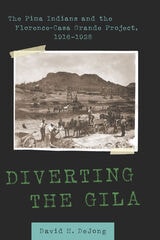
Diverting the Gila
The Pima Indians and the Florence-Casa Grande Project, 1916–1928David H. DeJong
University of Arizona Press, 2021
Diverting the Gila explores the complex web of tension, distrust, and political maneuvering to divide and divert the scarce waters of the Gila River. Residents of Florence, Casa Grande, and the Pima Reservation fought for vital access to water rights. Into this political foray stepped Arizona’s freshman congressman Carl Hayden, who not only united the farming communities but also used Pima water deprivation to the advantage of Florence-Casa Grande and Upper Gila Valley growers. The result was the federal Florence-Casa Grande Project that, as legislated, was intended to benefit Pima growers on the Gila River Indian Reservation first and foremost. As was often the case in the West, well-heeled, nontribal political interests manipulated the laws at the expense of the Indigenous community.
Diverting the Gila is the sequel to David H. DeJong’s 2009 Stealing the Gila, and it continues to tell the story of the forerunner to the San Carlos Irrigation Project and the Gila River Indian Community’s struggle to regain access to their water.
Divide, Provide and Rule
An Integrative History of Poverty Policy, Social Reform, and Social Policy in Hungary under the Habsburg MonarchySusan Zimmermann
Central European University Press, 2011
Divided Dominion
Social Conflict and Indian Hatred in Early VirginiaEthan A. Schmidt
University Press of Colorado, 2014
Myriad internal and external factors drove Virginians to interpret their disputes with one another increasingly along class lines. The decades-long tripartite struggle among elite whites, non-elite whites, and Native Americans resulted in the development of mutually beneficial economic and political relationships between elites and Native Americans. When these relationships culminated in the granting of rights—equal to those of non-elite white colonists—to Native Americans, the elites crossed a line and non-elite anger boiled over. A call for the annihilation of all Indians in Virginia united different non-elite white factions and molded them in widespread social rebellion.
The Divided Dominion places Indian policy at the heart of Bacon's Rebellion, revealing the complex mix of social, cultural, and racial forces that collided in Virginia in 1676. This new analysis will interest students and scholars of colonial and Native American history.
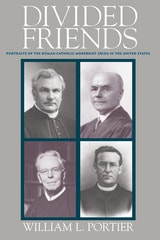
Divided Friends
William L. Portier
Catholic University of America Press, 2013

Divided Korea
Toward a Culture of ReconciliationRoland Bleiker
University of Minnesota Press, 2005
In 2002, North Korea precipitated a major international crisis when it revealed the existence of a secret nuclear weapons program and announced its withdrawal from the Nuclear Nonproliferation Treaty. Earlier in the year, George W. Bush had declared North Korea part of the “axis of evil,” and soon afterward his administration listed the country as a potential target of a preemptive nuclear strike. Pyongyang’s angry reaction ensured the complete deterioration of relations on the Korean peninsula, where only two years before the leaders of North and South Korea had come together in a historic summit meeting.
Few international conflicts are as volatile, protracted, or seemingly insoluble as the one in Korea, where mutual mistrust, hostile Cold War attitudes, and the possibility of a North Korean economic collapse threaten the security of the entire region. For Roland Bleiker, this persistently recurring pattern suggests profound structural problems within and between the two Koreas that have not been acknowledged until now. Expanding the discussion beyond geopolitics and ideology, Bleiker places peninsular tensions in the context of an ongoing struggle over competing forms of Korean identity. Divided Korea examines both domestic and international attitudes toward Korean identity, the legacy of war, and the possibilities for-and anxieties about-unification.
Divided Korea challenges the prevailing logic of confrontation and deterrence, embarking on a fundamental reassessment of both the roots of the conflict and the means to achieve a more stable political environment and, ultimately, peace. In order to realize a lasting solution, Bleiker concludes, the two Koreas and the international community must first show a willingness to accept difference and contemplate forgiveness as part of a broader reconciliation process.
Roland Bleiker is professor of international relations at the University of Queensland. From 1986 to 1988 he served as chief of office for the Swiss delegation to the Neutral Nations Supervisory Commission in Panmunjom.

Divided Loyalties
Young Somali Americans and the Lure of ExtremismJoseph Weber
Michigan State University Press, 2020
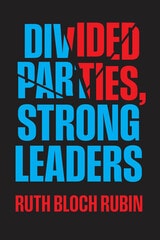
Divided Parties, Strong Leaders
Ruth Bloch Rubin
University of Chicago Press, 2025
Drawing on nearly a century of legislative history, this careful account invites readers to think anew about when, why, and how leaders of divided parties wield power in Congress.
For decades, legislative scholars have viewed party divisions as critical constraints on congressional leadership. The more a party’s rank and file disagree with one another, the weaker their leaders are predicted to be; as member preferences converge, leader power is thought to increase.
In a powerful corrective to this prevailing view, Ruth Bloch Rubin argues that party divisions are not inherently limiting. Divided Parties, Strong Leaders highlights and examines variation in how members of party factions choose to work together. She shows that leaders of divided parties are well positioned to overcome, and even draw strength from, their divided ranks when the collaborative efforts of their coalitions’ competing factions are evenly matched. By contrast, their capacity to get what they want is more limited when one faction has out-collaborated its competition. Presenting detailed case studies of some of the most storied leaders of the postwar Congress, including Speakers Sam Rayburn and Nancy Pelosi, Bloch Rubin analyzes the factional configuration each leader encountered and explains why it mattered for their exercise of power.
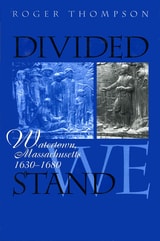
Divided We Stand
Watertown, Massachusetts, 1630-1680Roger Thompson
University of Massachusetts Press, 2001
Thompson describes Watertown's early government, its relations with Native Americans and neighboring communities, its religious and economic affairs, and the day-to-day experiences of its people. Conflict occurred over a wide variety of issues: land allocation, administrative accountability, religious orthodoxy and exclusivity, generational and gender differences, livestock and fencing, haves and have-nots.
Thompson brings these disputes to life through a series of vivid case studies drawn from the unpublished Middlesex County Court Records. Among others, we meet John Sawin, who despite his best efforts at subterfuge was convicted of stealing and selling a neighbor's horse; Susanna Woodward, whose pregnancy resulted in a fiercely contested paternity case; and Edward Sanders, whose punishment for child abuse was both a whipping and a ruling that when in public he must "wear a rope round his neck openly to be seen hanging down two feet."
Throughout the book, the same themes reappear: continuity and change, the persistent conflicts of the first two generations, and the countervailing forces of communal cohesion.
Divided Worlds? Challenges in Classics and New Testament Studies
Caroline Johnson Hodge
SBL Press, 2023
This volume brings together scholars from New Testament studies and classics, whose fields of study have much in common but are not often in in conversation. The contributors explore how the ancient works they study can be resources for thinking critically and creatively about issues that matter today. The essays address our obligation to take positive moral stands on divisive issues of both the past and the present, including empire, racial/ethnic and religious difference, economic inequality, gender and sexuality, slavery, and disability. Contributors include Douglas Boin, Denise Kimber Buell, Gay L. Byron, Allen Dwight Callahan, Joy Connolly, Jennifer A. Glancy, Shelley P. Haley, Caroline Johnson Hodge, Katherine Lu Hsu, Timothy Joseph, Tat-siong Benny Liew, Yii-Jan Lin, Dominic Machado, Joseph A. Marchal, Thomas R. Martin, Candida R. Moss, Laura Salah Nasrallah, Jorunn Økland, and Abraham Smith.
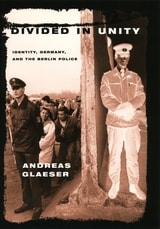
Divided in Unity
Identity, Germany, and the Berlin PoliceAndreas Glaeser
University of Chicago Press, 1999
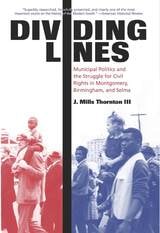
Dividing Lines
Municipal Politics and the Struggle for Civil Rights in Montgomery, Birmingham, and SelmaJ. Mills Thornton, III
University of Alabama Press, 2006
Presents the story of the civil rights movement from the perspective of community-municipal history at the grassroots level
Thornton demonstrates that the movement had powerful local sources in its three birth cities—Montgomery, Birmingham, and Selma. There, the arcane mechanisms of state and city governance and the missteps of municipal politicians and civic leaders—independent of emerging national trends in racial mores—led to the great swell of energy for change that became the civil rights movement.
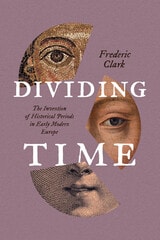
Dividing Time
The Invention of Historical Periods in Early Modern EuropeFrederic Clark
University of Chicago Press, 2027
A bold reconstruction of the origins of the “ancient, medieval, modern” trope used to define historical eras and the transitions between them.
We are used to dividing time, indicating the beginning or end of an era based on a year, a month, or even a specific day, after which (supposedly) “nothing was the same.” In this book, historian and classicist Frederic Clark looks at a particularly enduring form of dividing time—the tripartite distinction between antiquity, the Middle Ages, and modernity—in order to analyze the history of this division, how it has been constructed and deployed, and what its past and present implications are.
Clark argues that the study of the past has always depended on subdividing it into multiple parts, which tend to underpin any attempt to articulate a system of culture or value. After all, certain eras, ages, and epochs are celebrated as having ushered in a new, better time, whereas others are depicted as extended periods of decay and darkness. Clark provides an ingenious critique of the foundational assumptions underlying our narratives of periodization and the complex and messy process by which historical schemas develop, from the Renaissance through the early modern period to the Enlightenment and beyond. The result is an engaging and erudite tour through time and its many contested divisions, imagined and reimagined across history.
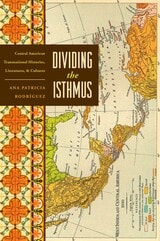
Dividing the Isthmus
Central American Transnational Histories, Literatures, and CulturesBy Ana Patricia Rodríguez
University of Texas Press, 2009
In 1899, the United Fruit Company (UFCO) was officially incorporated in Boston, Massachusetts, beginning an era of economic, diplomatic, and military interventions in Central America. This event marked the inception of the struggle for economic, political, and cultural autonomy in Central America as well as an era of homegrown inequities, injustices, and impunities to which Central Americans have responded in creative and critical ways. This juncture also set the conditions for the creation of the Transisthmus—a material, cultural, and symbolic site of vast intersections of people, products, and narratives.
Taking 1899 as her point of departure, Ana Patricia Rodríguez offers a comprehensive, comparative, and meticulously researched book covering more than one hundred years, between 1899 and 2007, of modern cultural and literary production and modern empire-building in Central America. She examines the grand narratives of (anti)imperialism, revolution, subalternity, globalization, impunity, transnational migration, and diaspora, as well as other discursive, historical, and material configurations of the region beyond its geophysical and political confines.
Focusing in particular on how the material productions and symbolic tropes of cacao, coffee, indigo, bananas, canals, waste, and transmigrant labor have shaped the transisthmian cultural and literary imaginaries, Rodríguez develops new methodological approaches for studying cultural production in Central America and its diasporas.
Monumental in scope and relentlessly impassioned, this work offers new critical readings of Central American narratives and contributes to the growing field of Central American studies.
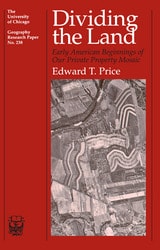
Dividing the Land
Early American Beginnings of Our Private Property MosaicEdward T. Price
University of Chicago Press, 1995
In this unprecedented study, Edward T. Price covers most areas of the United States in which the initial division of land was controlled by colonial governments—the original thirteen colonies, and Maine, Vermont, Kentucky, West Virginia, Tennessee, Louisiana, and Texas. By examining different land policies and the irregular pattern of property that resulted from them, Price chronicles the many ways colonies managed land to promote settlement, develop agriculture, defend frontiers, and attract investment. His analysis reveals as much about land planning techiniques carried to America from Europe as innovations spurred by the unique circumstances of the new world.
Price’s analysis draws on his thorough survey of property records from the first land plans in Virginia in 1607 to empresario grants in Texas in the 1820s. This breadth of data allows him to identify regional differences in allocating land, assess the impact of land planning by historical figures like William Penn of Pennsylvania and Lord Baltimore of Maryland, and trace changes in patterns of land division and ownership through transfers of power among Britain, the Netherlands, France, Spain, Mexico, and the Republic of Texas.
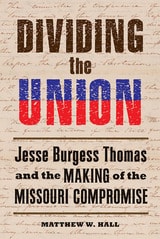
Dividing the Union
Jesse Burgess Thomas and the Making of the Missouri CompromiseMatthew W. Hall
Southern Illinois University Press, 2015
In 1820 the Missouri controversy erupted over the issue of slavery in the newly acquired lands of the Louisiana Purchase. It fell to Jesse Burgess Thomas (1777–1853), a junior U.S. senator from the new state of Illinois, to handle the delicate negotiations that led to the Missouri Compromise. Thomas’s maturity, good judgment, and restraint helped pull the country back from the brink of disunion and created a compromise that held for thirty-four years. In Dividing the Union, Matthew W. Hall examines the legal issues underlying the controversy and the legislative history of the Missouri Compromise while focusing on the aspects of Thomas’s life and character that gave him such influence. The first in-depth biography of Thomas, Hall’s work demonstrates how the legislative battle over the Compromise reflected the underlying nuances of the larger struggle over slavery.
The text of the Missouri Compromise originated from the Northwest Ordinance. Article VI of the Ordinance purported to prohibit slavery in the Northwest Territory, but paradoxically, a provision that assured property rights in another article was used to protect slavery. People in some parts of the Northwest sought to circumvent Article VI by formulating indenture laws and various state constitutional provisions addressing slavery. Pro- and antislavery activists eventually developed quite different interpretations of the relevant language in these documents, making negotiations over slavery in the new territory extremely complicated.
As Hall demonstrates, Thomas was perfectly situated geographically, politically, and ideologically to navigate the Missouri controversy. He was the first speaker of the Indiana Territorial General Assembly, one of the first territorial judges in the Illinois Territory, and the president of the Illinois State Constitutional Convention in 1818. Because the drive for statehood in Illinois was strong, the convention managed to skirt the divisive issue of slavery, due in large part to Thomas’s efforts. That he was never required to clearly articulate his own views on slavery allowed Thomas to maintain a degree of neutrality, and his varied political career gave him the experience necessary to craft a compromise.
Thomas’s final version of the Compromise included shrewdly worded ambiguities that supported opposing interests in the matter of slavery. These ambiguities secured the passage of the Compromise and its endurance until the Kansas-Nebraska Act of 1854. By weaving Thomas’s life story into the history of the Missouri Compromise, Hall offers new insight into both a pivotal piece of legislation and an important, previously overlooked figure in nineteenth-century American politics.
Divination Engines
Natural Language Processing, Artificial Intelligence, and the Making of Algorithmic CultureXiaochang Li
University of Chicago Press, 2026
A revealing and surprising origin story, showing how attempts to render human speech and language computable led from the era of big data to today’s AI.
Since the advent of computers, society has fantasized about conversing with machines. In this eye-opening book, technology expert Xiaochang Li shows readers how that dream both fueled the demand for data and set the stage for today’s generative AI. With original research and clear explanations, Li elucidates the origins of what’s known as natural language processing (NLP) and the heated twentieth-century debates between computer scientists, linguists, and communication engineers that shaped today’s technology. Starting with early devices that recorded, analyzed, and attempted to interpret human speech, she demonstrates how computer speech recognition, particularly efforts led by Bell Labs and IBM, advanced technology by deemphasizing linguistic meaning in favor of statistical prediction. In other words, researchers gradually abandoned systems that sought to understand human language, opting instead for work-arounds that simply predicted patterns in speech and text data. That solution became incredibly and surprisingly adaptable. As Li reveals, transforming linguistic questions into engineering ones ushered in the routine operation of search engines, spam filters, and the varied content sorting and recommendation mechanisms that regulate the access, circulation, and legitimacy of information across every platform. But this has all come at the cost of forever requiring copious and ever-growing amounts of new data.
At its core, Divination Engines illuminates how the artifacts of human communication—speech, text, and images—have become both the fodder for and products of computers. This connection between communication and computation, Li shows, has given rise to data-driven analytics, machine learning, and today’s algorithmic culture.
Divination, Politics, and Ancient Near Eastern Empires
Alan Lenzi
SBL Press, 2014
Advance your understanding of divination’s role in supporting or undermining imperial aspirations in the ancient Near East
This collection examines the ways that divinatory texts in the Hebrew Bible and the ancient Near East undermined and upheld the empires in which the texts were composed, edited, and read. Nine essays and an introduction engage biblical scholarship on the Prophets, Assyriology, the Dead Sea Scrolls, and the critical study of Ancient Empires.
Features:
- Interdisciplinary approaches include propaganda studies
- Essays examine how biblical and other ancient Near Eastern texts were shaped by political and theological empires
- Index of ancient sources
Divine Expectations
An American Woman In Nineteenth-Century PalestineBarbara Kreiger
Ohio University Press, 1999
Barbara Kreiger’s intriguing narrative presents the account of Clorinda Minor, a charismatic American Christian woman whose belief in the Second Coming prompted her to leave a comfortable life in Philadelphia in 1851 and take up agriculture in Palestine.
After her disappointment in a failed prophecy that the End of Days would take place in October 1844, Mrs. Minor determined that the Holy Land was not yet adequately prepared for such an event and decided that it would be her mission to teach the poverty-stricken Jews of Palestine to work the soil. In this very American story, Mrs. Minor, like so many other pioneers of her day, looked to the land as her future.
Even as her mission was distinctly religious, her daily efforts were in the social realm. And although her work brought Jews and Arabs together, and her small farm was a unique settlement where Christians, Muslims, and Jews labored alongside one another, the events detailed in Divine Expectations had dramatic and tragic diplomatic and international repercussions.
With the deft touch of a novelist, Barbara Kreiger weaves the little-known story of Clorinda Minor into the larger context of the region and its history, presenting it in its charming eccentricity and its gripping reality.

Divine Presence in Spain and Western Europe 1500–1960
Visions, Religious Images and PhotographsWilliam A. Christian Jr.
Central European University Press, 2012
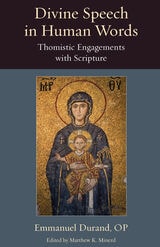
Divine Speech in Human Words
Thomistic Engagements with ScriptureEmmanuel Durand, OP
Catholic University of America Press, 2022
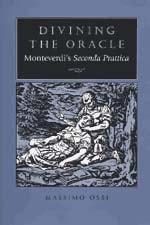
Divining the Oracle
Monteverdi's Seconda pratticaMassimo Ossi
University of Chicago Press, 2003
Challenged in print for the unconventional aspects of his music, Monteverdi found himself at the center of a debate between defenders of Renaissance principles and the newest musical currents of the time. The principles of the seconda prattica, Ossi argues in this sophisticated analysis of Monteverdi's writings, music, and approaches to text-setting, were in fact much more significant to the course of Monteverdi's career than previously thought by modern scholars-not only did Monteverdi continue to pursue their aesthetic and theoretical implications for the rest of his life, but they also affected his dramatic compositions as well as his chamber vocal music and sacred works.
Ossi "divines the oracle" of Monteverdi's ambiguous theoretical concepts in a clear way and in terms of pure music; his book will enhance our understanding of Monteverdi as one of the most significant figures in western music history.
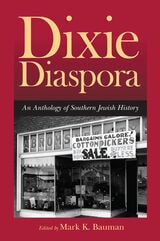
Dixie Diaspora
An Anthology of Southern Jewish HistoryMark K. Bauman
University of Alabama Press, 2006
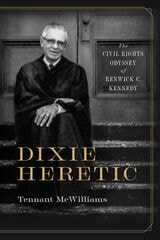
Dixie Heretic
The Civil Rights Odyssey of Renwick C. KennedyTennant McWilliams
University of Alabama Press, 2023
A life-and-times biography of the minister and social reformer Renwick C. Kennedy
Drawn from some 5,000 letters, six decades of daily-diary writings, and extensive interviews, Dixie Heretic: The Civil Rights Odyssey of Renwick C. Kennedy offers a life-and-times biography of the Alabama Black Belt minister, Renwick C. Kennedy (1900–1985). Here, Tennant McWilliams gives an unvarnished account of Kennedy’s tortuous efforts to make his congregants and other southern whites “better Christians.”
Kennedy came from “upcountry” South Carolina, a place rife with Scotch-Irish Associate Reformed Presbyterians—people of biblical infallibility and individual piety and salvation. In 1927, after a life-changing theology education at Princeton, he moved to Camden, Alabama, county seat of Wilcox County. There, he came to believe that God had a mandate for him: to change the “Half Christian” conservative, and the often violent, racial behaviors around him. As a neo-orthodox Protestant, Kennedy never rejected literal approaches to the Bible. Still, out of the “Full Christian” Social Gospel, he urged changed racial behavior. Ultimately this led him to publish confrontational short stories and essays in Christian Century and New Republic—most set in fictitious “Yaupon County.”
In World War II, Kennedy served as a chaplain with the famed 102nd Evacuation Hospital. He came home hoping the Allied victory would spur Americans to fight racial segregation just as they had fought racial fascism in Europe. The 1948 Dixiecrat movement dashed these hopes, turning much of his neo-orthodox optimism to cynicism. His hope found fleeting resurgence in the civil rights movement, and saw Kennedy quietly leading desegregation of Troy University, where he was an administrator. But the era’s assassinations, combined with George Wallace and the rise of southern white Republicans, regularly returned him to the frustrated hopes of 1948 and fostered a pessimism about truly changed hearts that he took to his grave in 1985.
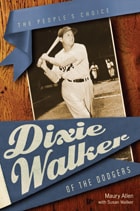
Dixie Walker of the Dodgers
The People's ChoiceMaury Allen and Susan Walker
University of Alabama Press, 2010
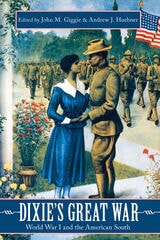
Dixie's Great War
World War I and the American SouthEdited by John M. Giggie and Andrew J. Huebner
University of Alabama Press, 2021
Examining the First World War through the lens of the American South
How did World War I affect the American South? Did southerners experience the war in a particular way? How did regional considerations and, more generally, southern values and culture impact the wider war effort? Was there a distinctive southern experience of WWI?
Scholars considered these questions during “Dixie’s Great War,” a symposium held at the University of Alabama in October 2017 to commemorate the centenary of the American intervention in the war. With the explicit intent of exploring iterations of the Great War as experienced in the American South and by its people, organizers John M. Giggie and Andrew J. Huebner also sought to use historical discourse as a form of civic engagement designed to facilitate a community conversation about the meanings of the war.
Giggie and Huebner structured the panels thematically around military, social, and political approaches to the war to encourage discussion and exchanges between panelists and the public alike. Drawn from transcriptions of the day’s discussions and lightly edited to preserve the conversational tone and mix of professional and public voices, Dixie’s Great War: World War I and the American South captures the process of historians at work with the public, pushing and probing general understandings of the past, uncovering and reflecting on the deeper truths and lessons of the Great War—this time, through the lens of the South.
This volume also includes an introduction featuring a survey of recent literature dealing with regional aspects of WWI and a discussion of the centenary commemorations of the war. An afterword by noted historian Jay Winter places “Dixie’s Great War”—the symposium and this book—within the larger framework of commemoration, emphasizing the vital role such forums perform in creating space and opportunity for scholars and the public alike to assess and understand the shifting ground between cultural memory and the historical record.
Dixiecrats and Democrats
Alabama PoliticsWilliam D. Barnard
University of Alabama Press, 1984
A pivotal in the study of history and politics, not only in Alabama but in the other states of the South
Barnard’s account is elegantly concise, the labor of conspicuous scholarship. In an effort to analyze Alabama’s political bedrock, the author has tapped virtually every source. What results is a cogent and harmonious theme.
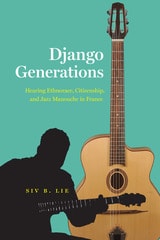
Django Generations
Hearing Ethnorace, Citizenship, and Jazz Manouche in FranceSiv B. Lie
University of Chicago Press, 2021
Jazz manouche—a genre known best for its energetic, guitar-centric swing tunes—is among France’s most celebrated musical practices of the twentieth and twenty-first centuries. It centers on the recorded work of famed guitarist Django Reinhardt and is named for the ethnoracial subgroup of Romanies (also known, often pejoratively, as “Gypsies”) to which Reinhardt belonged. French Manouches are publicly lauded as bearers of this jazz tradition, and many take pleasure and pride in the practice while at the same time facing pervasive discrimination. Jazz manouche uncovers a contradiction at the heart of France’s assimilationist republican ideals: the music is portrayed as quintessentially French even as Manouches themselves endure treatment as racial others.
In this book, Siv B. Lie explores how this music is used to construct divergent ethnoracial and national identities in a context where discussions of race are otherwise censured. Weaving together ethnographic and historical analysis, Lie shows that jazz manouche becomes a source of profound ambivalence as it generates ethnoracial difference and socioeconomic exclusion. As the first full-length ethnographic study of French jazz to be published in English, this book enriches anthropological, ethnomusicological, and historical scholarship on global jazz, race and ethnicity, and citizenship while showing how music can be an important but insufficient tool in struggles for racial and economic justice.

Do My Heart Good
My Odyssey Through Country Music, Medicine, and HistoryCleve Francis
University of Illinois Press, 2026
Francis’s account follows his “multidimensional life” through two milieus that rarely welcome Black men: country music and medicine. Merging rich storytelling with thoughtful insights, Francis shares the obstacles and triumphs he experienced through his lifelong love of performing music and writing songs, his abiding interest in science and medicine, and his determination to overcome racial barriers. He also offers an insider’s view of the 1990s country music world—the discipline of finding songs and recording in Nashville, the fight to get his music on the radio, and a whirlwind of shows and encounters with country music legends.
Engaging and inspiring, Do My Heart Good is the story of how resolve, hard work, and joy composed a uniquely American success story.
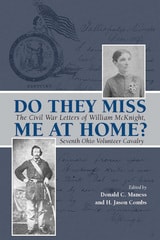
Do They Miss Me at Home?
The Civil War Letters of William McKnight, Seventh Ohio Volunteer CavalryDonald C. Maness
Ohio University Press, 2010
William McKnight was a member of the Seventh Ohio Volunteer Cavalry from September 1862 until his death in June of 1864. During his time of service, McKnight penned dozens of emotion-filled letters, primarily to his wife, Samaria, revealing the struggles of an entire family both before and during the war.
This collection of more than one hundred letters provides in-depth accounts of several battles in Kentucky and Tennessee, such as the Cumberland Gap and Knoxville campaigns that were pivotal events in the Western Theater. The letters also vividly respond to General John Hunt Morgan’s raid through Ohio and correct claims previously published that McKnight was part of the forces chasing Morgan. By all accounts Morgan did stay for a period of time at McKnight’s home in Langsville during his raid through Ohio, much to McKnight’s horror and humiliation, but McKnight was in Kentucky at the time. Tragically, McKnight was killed in action nearly a year later during an engagement with Morgan’s men near Cynthiana, Kentucky.
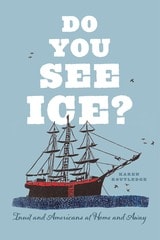
Do You See Ice?
Inuit and Americans at Home and AwayKaren Routledge
University of Chicago Press, 2018
Routledge vividly depicts the experiences of American whalers and explorers in Inuit homelands. Conversely, she relates stories of Inuit who traveled to the northeastern United States and were similarly challenged by the norms, practices, and weather they found there. Standing apart from earlier books of Arctic cultural research—which tend to focus on either Western expeditions or Inuit life—Do You See Ice? explores relationships between these two groups in a range of northern and temperate locations. Based on archival research and conversations with Inuit Elders and experts, Routledge’s book is grounded by ideas of home: how Inuit and Americans often experienced each other’s countries as dangerous and inhospitable, how they tried to feel at home in unfamiliar places, and why these feelings and experiences continue to resonate today.
The author intends to donate all royalties from this book to the Elders’ Room at the Angmarlik Center in Pangnirtung, Nunavut.

Doc
The Story of a Birmingham Jazz ManFrank "Doc" Adams and Burgin Mathews
University of Alabama Press, 2012
Autobiography of jazz elder statesman Frank “Doc” Adams, highlighting his role in Birmingham, Alabama’s, historic jazz scene and tracing his personal adventure that parallels, in many ways, the story and spirit of jazz itself.
Doc tells the story of an accomplished jazz master, from his musical apprenticeship under John T. “Fess” Whatley and his time touring with Sun Ra and Duke Ellington to his own inspiring work as an educator and bandleader.
Central to this narrative is the often-overlooked story of Birmingham’s unique jazz tradition and community. From the very beginnings of jazz, Birmingham was home to an active network of jazz practitioners and a remarkable system of jazz apprenticeship rooted in the city’s segregated schools. Birmingham musicians spread across the country to populate the sidelines of the nation’s bestknown bands. Local musicians, like Erskine Hawkins and members of his celebrated orchestra, returned home heroes. Frank “Doc” Adams explores, through first-hand experience, the history of this community, introducing readers to a large and colorful cast of characters—including “Fess” Whatley, the legendary “maker of musicians” who trained legions of Birmingham players and made a significant mark on the larger history of jazz. Adams’s interactions with the young Sun Ra, meanwhile, reveal life-changing lessons from one of American music’s most innovative personalities.
Along the way, Adams reflects on his notable family, including his father, Oscar, editor of the Birmingham Reporter and an outspoken civic leader in the African American community, and Adams’s brother, Oscar Jr., who would become Alabama’s first black supreme court justice. Adams’s story offers a valuable window into the world of Birmingham’s black middle class in the days before the civil rights movement and integration. Throughout, Adams demonstrates the ways in which jazz professionalism became a source of pride within this community, and he offers his thoughts on the continued relevance of jazz education in the twenty-first century.

Dockside Reading
Hydrocolonialism and the Custom HouseIsabel Hofmeyr
Duke University Press, 2022
Dockworker Power
Race and Activism in Durban and the San Francisco Bay AreaPeter Cole
University of Illinois Press, 2018
Philip Taft Labor History Book Award, Labor and Working-Class History Association (LAWCHA) and the Cornell ILR School, 2019
A Black Perspectives Best Black History Book of 2018
Dockworkers have power. Often missed in commentary on today's globalizing economy, workers in the world's ports can harness their role, at a strategic choke point, to promote their labor rights and social justice causes. Peter Cole brings such overlooked experiences to light in an eye-opening comparative study of Durban, South Africa, and the San Francisco Bay Area, California. Path-breaking research reveals how unions effected lasting change in some of the most far-reaching struggles of modern times. First, dockworkers in each city drew on longstanding radical traditions to promote racial equality. Second, they persevered when a new technology--container ships--sent a shockwave of layoffs through the industry. Finally, their commitment to black internationalism and leftist politics sparked transnational work stoppages to protest apartheid and authoritarianism. Dockworker Power not only brings to light surprising parallels in the experiences of dockers half a world away from each other. It also offers a new perspective on how workers can change their conditions and world.
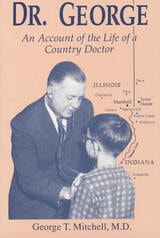
Doctor George
An Account of the Life of a Country DoctorGeorge T. Mitchell, M.D. Foreword by Glen W. Davidson
Southern Illinois University Press, 1993
Dr. George T. Mitchell of Marshall, Illinois, shares with humor and compassion stories and reflections about his medical practice of fifty years.
Having grown up in Marshall, Dr. Mitchell writes of his early experiences in midwestern America: basketball rivalries, school-boy pranks, and the traditions passed down through a family of doctors. Dr. Mitchell tells of his brief detour to obtain a degree in mechanical engineering, his decision to pursue a career in medicine, and his medical school experiences at the George Washington School of Medicine before the days of antibiotics and sophisticated medical technology. He vividly describes his subsequent service in World War II as a young surgeon at a military hospital helping injured soldiers resume normal lives while enduring the frustrations and occasional horrors of military life.
After the war, Dr. Mitchell joined his father’s practice in Marshall, where, he observes, he was among sixteen physicians in a rural county with a population of less than twenty thousand people. Within twenty-five years, the number of doctors had dropped to only four. In this memoir Dr. Mitchell conveys his unwillingness to just sit by and watch the health needs of his community increase while medical and other services decline. He, instead, became a community activist, representing rural concerns to the state medical society, organizing the first emergency medical technician teams in the county, masterminding the planning of a regional medical center, campaigning successfully for improved highway safety, and spurring the extension of reliable telephone service throughout his area.
As Dr. Mitchell recounts the house calls, farm accidents, emergency surgeries, and family counseling that comprised the life of this country doctor, he offers the keen insights of a clinician trained to look beyond what others only see.
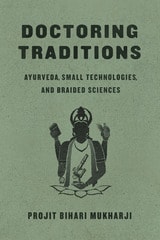
Doctoring Traditions
Ayurveda, Small Technologies, and Braided SciencesProjit Bihari Mukharji
University of Chicago Press, 2016
Rather, Mukharji reveals, what instigated those changes were a number of small technologies that were introduced in the period by Ayurvedic physicians, men who were simultaneously Victorian gentlemen and members of a particular Bengali caste. The introduction of these devices, including thermometers, watches, and microscopes, Mukharji shows, ultimately led to a dramatic reimagining of the body. By the 1930s, there emerged a new Ayurvedic body that was marked as distinct from a biomedical body. Despite the protestations of difference, this new Ayurvedic body was largely compatible with it. The more irreconcilable elements of the old Ayurvedic body were then rendered therapeutically indefensible and impossible to imagine in practice. The new Ayurvedic medicine was the product not of an embrace of Western approaches, but of a creative attempt to develop a viable alternative to the Western tradition by braiding together elements drawn from internally diverse traditions of the West and the East.

Doctoring the Novel
Medicine and Quackery from Shelley to DoyleSylvia A. Pamboukian
Ohio University Press, 2012
Doctoring the Novel explores the ways in which language constructs and stabilizes these slippery terms by examining medical quackery and orthodoxy in works such as Mary Shelley’s Frankenstein, Charles Dickens’s Bleak House and Little Dorrit, Charlotte Brontë’s Villette, Wilkie Collins’s Armadale, and Arthur Conan Doyle’s Stark Munro Letters. Contextualized in both medical and popular publishing, literary analysis reveals that even supposedly medico-scientific concepts such as orthodoxy and quackery evolve not in elite laboratories and bourgeois medical societies but in the rough-and-tumble of the public sphere, a view that acknowledges the considerable, and often underrated, influence of language on medical practices.