Results by title
28246 books match the query 'History' and 913 start with d
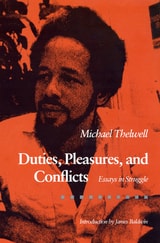
Duties, Pleasures, and Conflicts
Essays in StruggleMichael M. Thelwell
University of Massachusetts Press, 1987
This powerful collection of essays and short stories provides a unique perspective on the black civil rights movement over the past twenty-five years. A long-time activist, Michael Thelwell was a member of the Student Non-Violent Coordinating Committee (SNCC) and the Mississippi Freedom Democratic Party in the early 1960s, a founder of the W.E.B. Du Bois Department of Afro-American Studies at the University of Massachusetts in 1970, author of the widely praised novel The Harder They Come published in 1980, and an organizer for Jesse Jackson's presidential campaign in 1984. Thelwell is a writer of rare grace, integrity, and strong political convictions.
The collection begins with three stories. Set in the Mississippi Delta in the 1960s, the stories explore how individuals manage to preserve their dignity in a world of racism and violence. The next six essays, also written in the 1960s, are historical and journalistic. They discuss the March on Washington for Jobs and Freedom, the situation in the South as seen by SNCC workers, the political challenges in Mississippi, the articulation of the Black Power movement, the causes of the black student revolt at Cornell, and the need for Black Studies as the intellectual offensive in the struggle for black liberation.
The section that follows is composed of literary pieces: two appreciative essays on James Baldwin, two critical reviews of William Styron and his treatment of Nat Turner, an excoriating assessment of V. S. Naipaul, a profile of Amos Tutuola, and a thoughtful analysis of the social responsibility of the black writer.
The final essay examines the history of Jesse Jackson's presidential campaign and comments on the political climate of the 1980s.

Dutton's Dirty Diggers
Bertha P. Dutton and the Senior Girl Scout Archaeological Camps in the American Southwest, 1947–1957Catherine S. Fowler
University of Utah Press, 2020
Catherine Fowler chronicles a significant yet little-known program for Girl Scouts in post–WWII America. At a time when women were just beginning to enter fields traditionally dominated by men, these two-week camping caravans and archaeological excavations introduced teenage girls not only to the rich cultural and scientific heritage of the American Southwest but to new career possibilities. Dr. Bertha Dutton, curator at the Museum of New Mexico, served as trip leader.
While on the road and in camp, Dutton and other experts in anthropology, archaeology, geology, natural history, and more helped the campers appreciate what they were seeing and learning. This book details the history of the program, sharing trip itineraries and selected memories from the nearly three hundred girls who attended the camps. It also serves as a mini-biography and tribute to Bertha Dutton, who, through her knowledge, teaching, and strong persona, provided a role model for these young women, many of whom later pursued careers in anthropology and related fields.

Duty beyond the Battlefield
African American Soldiers Fight for Racial Uplift, Citizenship, and Manhood, 1870–1920Le'Trice D. Donaldson
Southern Illinois University Press, 2020
Through extensive research, Donaldson not only illuminates this evolution but also interrogates the association between masculinity and citizenship and the ways in which performing manhood through military service influenced how these men struggled for racial uplift. Following the Buffalo soldier units and two regular army infantry units from the frontier and the Mexican border to Mexico, Cuba, and the Philippines, Donaldson investigates how these locations and the wars therein provide windows into how the soldiers’ struggles influenced black life and status within the United States.
Continuing to probe the idea of what it meant to be a military race man—a man concerned with the uplift of the black race who followed the philosophy of progress—Donaldson contrasts the histories of officers Henry Flipper and Charles Young, two soldiers who saw their roles and responsibilities as black military officers very differently.
Duty beyond the Battlefield demonstrates that from the 1870s to 1920s military race men laid the foundation for the “New Negro” movement and the rise of Black Nationalism that influenced the future leaders of the twentieth century Civil Rights movement.

Duval County Tejanos
An Epic narrative of Liberty and DemocracyAlfredo Cardenas
University of North Texas Press, 2024

Dwan Gallery
Los Angeles to New York, 1959–1971James Meyer
University of Chicago Press, 2016
Alongside lush full-color images of one hundred leading artworks, the book deepens our understanding of the artistic exchanges Dwan facilitated during this age of mobility, when air travel and the interstate highway system linked the two coasts and transformed the making of art and the sites of its exhibition. James Meyer, the curator of the exhibition and the foremost authority on minimal art, contributes an essay that is a sophisticated and broad-ranging analysis of Dwan’s legacy.
Honoring Dwan’s significant influence and impact on postwar art, Dwan Gallery is a rich and informative collection that will be treasured by fans of contemporary art.
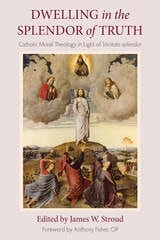
Dwelling in the Splendor of Truth
Catholic Moral Theology in Light of <i>Veritatis splendor</i>James W. Stroud
Catholic University of America Press, 2026

Dyed in Crimson
Football, Faith, and Remaking Harvard's AmericaZev Eleff
University of Illinois Press, 2023
Zev Eleff tells the story of two immigrants’ sons shaped by a vision of an America that rewarded any person of virtue. As a player, the Chicago-born Horween had led Harvard to its 1920 Rose Bowl victory. As a coach, he faced intractable opposition from powerful East Coast alumni because of his values and Midwestern, Jewish background. Eleff traces Bingham and Horween’s careers as student-athletes and their campaign to wrest control of the football program from alumni. He also looks at how Horween undermined stereotypes of Jewish masculinity and dealt with the resurgent antisemitism of the 1920s.
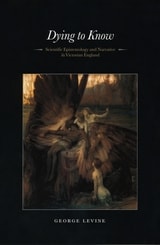
Dying to Know
Scientific Epistemology and Narrative in Victorian EnglandGeorge Levine
University of Chicago Press, 2002
In Dying to Know, eminent critic George Levine makes a landmark contribution to the history and theory of scientific knowledge. This long-awaited book explores the paradoxes of our modern ideal of objectivity, in particular its emphasis on the impersonality and disinterestedness of truth. How, asks Levine, did this idea of selfless knowledge come to be established and moralized in the nineteenth century?
Levine shows that for nineteenth-century scientists, novelists, poets, and philosophers, access to the truth depended on conditions of such profound self-abnegation that pursuit of it might be taken as tantamount to the pursuit of death. The Victorians, he argues, were dying to know in the sense that they could imagine achieving pure knowledge only in a condition where the body ceases to make its claims: to achieve enlightenment, virtue, and salvation, one must die.
Dying to Know is ultimately a study of this moral ideal of epistemology. But it is also something much more: a spirited defense of the difficult pursuit of objectivity, the ethical significance of sacrifice, and the importance of finding a shareable form of knowledge.

Dynamic Repetition
History and Messianism in Modern Jewish ThoughtGilad Sharvit
Brandeis University Press, 2022
Dynamic Repetition proposes a new understanding of modern Jewish theories of messianism across the disciplines of history, theology, and philosophy. The book explores how ideals of repetition, return, and the cyclical occasioned a new messianic impulse across an important swath of late nineteenth- and early twentieth-century German Jewish thought. To grasp the complexities of Jewish messianism in modernity, the book focuses on diverse notions of “dynamic repetition” in the works of Franz Rosenzweig, Walter Benjamin, Franz Kafka, and Sigmund Freud, and their interrelations with basic trajectories of twentieth-century philosophy and critical thought.
Dynamics of Class and Stratification in Poland
1945–2015Irina Tomescu-Dubrow
Central European University Press, 2018
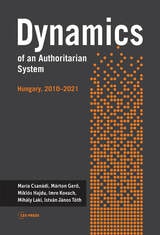
Dynamics of an Authoritarian System
Hungary, 2010–2021Mária Csanádi
Central European University Press, 2022
This conceptually synthetic and empirically rich book demonstrates the vulnerability of democratic settings to authoritarianism and populism. Six scholars from various professional fields explore here the metamorphosis of a political party into a centralized authoritarian system. Viktor Orbán and his Fidesz party needed less than ten years to accomplish this transformation in Hungary. In 2010, after winning a majority that could make changes in the constitution – two-thirds of the parliamentary seats, they evolved and stabilized the system, which produced again the two-thirds majority in 2014 and 2018.
The authors reveal how a democratic setting can be used as a device for political capture. They show how a political entity managed to penetrate almost all sub-fields of the economy to arrive at institutionalized corruption, and how the centralized power structure reproduces itself. With the help of a powerful empirical apparatus—among others analyses of more than 220,000 public tenders, redistributions of state subsidies, and the interconnectedness of those privileged with the political elite — the authors detail the functioning of a crony system and the network aspects of political connections in the rapid enrichment of politically-linked businesses. Their studies demonstrate the role of political capture in this redistribution and how this capture leads to a new social stratification.

Dynastic Democracy
Political Families of ThailandYoshinori Nishizaki
University of Wisconsin Press, 2022
Drawing extensively on Thai-language primary sources, including assets documents and cremation volumes for deceased politicians and their kin, Nishizaki traces the intricate blood and marriage connections among Thailand’s political families. These families may fall into two categories: influential commoner families that have held parliamentary seats since 1932 and form the core of Thailand’s dynastic democracy; and upper-class families that are kin to or aligned ideologically with the royal family and have repeatedly challenged dynastic democracy through coups, constitutional changes, and other political maneuvers. Nishizaki’s exploration of dynastic democracy illustrates how democratic pluralism in Thailand has been consistently stifled, to the detriment of ordinary citizens. Dynastic Democracy fleshes out a widely acknowledged yet heretofore empirically unsubstantiated facet of Thai political history—that in Thai politics, family matters.
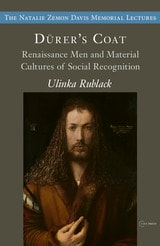
Dürer's Coats
Renaissance Men and Material Cultures of Social RecognitionUlinka Rublack
Central European University Press, 2025