Results by title
3703 books match the query '19th century' and 126 start with d
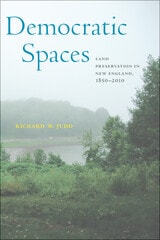
Democratic Spaces
Land Preservation in New England, 1850–2010Richard W. Judd
University of Massachusetts Press, 2023
Winner of the 2024 Forest History Society Charles A. Weyerhaeuser Book Award
A contemporary map of New England, scaled to the township level, brings to light a dense pattern of protected areas ringing almost every town and city in the region. Big and small, rural and urban, these green spaces represent more than a century of preservation efforts on the part of philanthropic foundations, planning professionals, state agencies, and most importantly, community-based conservation organizations. Taken together, they highlight one of the most significant advances in land stewardship in US history.
Democratic Spaces explains how these protected places came into being and what they represent for New Englanders and the nation at large. While early New Englanders worked to save local fish, timber, and game resources from outside exploitation, no land-stewardship organizations existed before the founding of the Trustees of Public Reservations in Boston in 1891. Across a century of dramatic change, New England preservationists through this and other, smaller community-based land trusts preserved open spaces for an ever-widening circle of citizens.
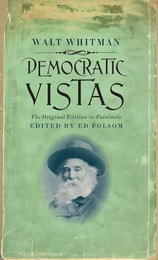
Democratic Vistas
The Original Edition in FacsimileWhitman, Walt
University of Iowa Press, 2010
Written in the aftermath of the American Civil War during the ferment of national Reconstruction, Walt Whitman’s Democratic Vistas remains one of the most penetrating analyses of democracy ever written. Diagnosing democracy’s failures as well as laying out its vast possibilities, Whitman offers an unflinching assessment of the ongoing social experiment known as the United States. Now available for the first time in a facsimile of the original 1870–1871 edition, with an introduction and annotations by noted Whitman scholar Ed Folsom that illuminate the essay’s historical and cultural context, this searing analysis of American culture offers readers today the opportunity to argue with Whitman over the nature of democracy and the future of the nation.
Living in Washington, D.C., where Congress granted male African Americans the right to vote nearly five years before the fifteenth amendment extended that right across the nation, and working for the office charged with enforcing the new civil rights amendments to the Constitution, Whitman was at the volatile center of his nation’s massive attempt to reconstruct and redefine itself after the tumultuous years of civil war. In the enduring cultural document that Democratic Vistas has become, the great poet of democracy analyzes the role that literature plays in the development of a culture, the inevitable tensions between the “democratic individual” and the “democratic nationality,” and the corrosive effects of materialism on the democratic spirit.
His own conflicting racial biases notwithstanding, Whitman in Democratic Vistas offers his most eloquent and extended articulation of the beckoning American democratic future. At a time when the nation has elected a president whom Whitman could never have imagined, his controversial and provocative book is a timely reminder of those occasions when we experience the expansion of America’s democratic dream.
Demographic Avant-Garde
Jews in Bohemia between the Enlightenment and the ShoahJana Vobecká
Central European University Press, 2013
Demonic History
From Goethe to the PresentKirk Wetters
Northwestern University Press, 2014
In this ambitious book, Kirk Wetters traces the genealogy of the demonic in German literature from its imbrications in Goethe to its varying legacies in the work of essential authors, both canonical and less well known, such as Gundolf, Spengler, Benjamin, Lukács, and Doderer. Wetters focuses especially on the philological and metaphorological resonances of the demonic from its core formations through its appropriations in the tumultuous twentieth century.
Propelled by equal parts theoretical and historical acumen, Wetters explores the ways in which the question of the demonic has been employed to multiple theoretical, literary, and historico-political ends. He thereby produces an intellectual history that will be consequential both to scholars of German literature and to comparatists.
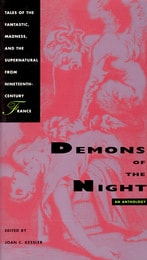
Demons of the Night
Tales of the Fantastic, Madness, and the Supernatural from Nineteenth-Century FranceEdited by Joan C. Kessler
University of Chicago Press, 1995
The anthology opens with "Smarra, or the Demons of the Night," Nodier's 1821 tale of nightmare, vampirism, and compulsion, acclaimed as the first work in French literature to explore in depth the realm of dream and the unconscious. Other stories include Balzac's "The Red Inn," in which a crime is committed by one person in thought and another in deed, and Mérimée's superbly crafted mystery, "The Venus of Ille," which dramatizes the demonic power of a vengeful goddess of love emerging out of the pagan past. Gautier's protagonist in "The Dead in Love" develops an obsessive passion for a woman who has returned from beyond the grave, while the narrator of Maupassant's "The Horla" imagines himself a victim of psychic vampirism.
Joan Kessler has prepared new translations of nine of the thirteen tales in the volume, including Gérard de Nerval's odyssey of madness, "Aurélia," as well as two tales that have never before appeared in English. Kessler's introduction sets the background of these tales—the impact of the French Revolution and the Terror, the Romantics' fascination with the subconscious, and the influence of contemporary psychological and spiritual currents. Her essay illuminates how each of the authors in this collection used the fantastic to articulate his own haunting obsessions as well as his broader vision of human experience.
Demos Rising
Democracy and the Popular Construction of Public Power in France, 1800–1850Stephen W. Sawyer
University of Chicago Press, 2025
In his previous book, Demos Assembled, historian Stephen W. Sawyer offered a transatlantic account of the birth and transformation of the modern democratic state. In Demos Rising, he presents readers of political history with a prequel whose ambitious claim is that a genuine demos became possible in France only with the development of government regulation and administration. Focusing on democracy as a form of administration rather than as a form of sovereignty allows Sawyer to explore urban planning, work and private enterprise, health administration, and much more as cornerstones of a self-governing society of equals.
Examining the period between 1800 and 1850, Sawyer studies a set of thinkers who debated at length over the material problems of everyday life, sparking calls for political action and social reform in the face of conflict wreaked by deforestation, urbanization, health crises, labor relations, industrial capitalism, religious tensions, and imperial expansion. The solutions to these problems, Sawyer argues, were sought—and sometimes found—not through elections, as one might assume, but rather through the “care for all” promised by modern administrative power, regulatory intervention, and social welfare programs. By studying this profound transformation in governance, the book wagers, we can better understand the origin and meaning of democracy—even when events in our own time have thrown the concept into doubt.
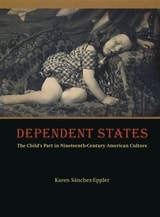
Dependent States
The Child's Part in Nineteenth-Century American CultureKaren Sánchez-Eppler
University of Chicago Press, 2005
Dependent States examines the ties between children's literacy training and the growing cultural prestige of the novel; the way children functioned rhetorically in reform literature to enforce social norms; the way the risks of death to children shored up emotional power in the home; how Sunday schools socialized children into racial, religious, and national identities; and how class identity was produced, not only in terms of work, but also in the way children played. For Sánchez-Eppler, nineteenth-century childhoods were nothing less than vehicles for national reform. Dependent on adults for their care, children did not conform to the ideals of enfranchisement and agency that we usually associate with historical actors. Yet through meticulously researched examples, Sánchez-Eppler reveals that children participated in the making of social meaning. Her focus on childhood as a dependent state thus offers a rewarding corrective to our notions of autonomous individualism and a new perspective on American culture itself.

Derzhavin
A BiographyVladislav Khodasevich, Translated and with an introduction by Angela Brintlinger
University of Wisconsin Press, 2007
“Khodasevich’s light narrative touch (as translated by Brintlinger) lends a novelistic quality to the biography, making it a genuine tour de force. All students and scholars – of history, literature, poetry, biography – will find something of interest here.”—Choice
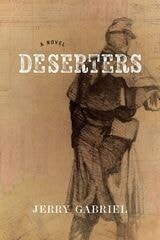
Deserters
A NovelJerry Gabriel
Acre Books, 2026
It is fall 1864, and Robert Riley has deserted his Army of the Potomac unit outside Petersburg, Virginia. Exhausted from years of war and worried about his motherless sons in Ohio, he returns to collect thirteen-year-old Michael and Sean, three years older, and flees to the Western territories. Along the way, he encounters Janey, an orphan at sixteen, who is also eager to go West. When Riley sees in her a quickness of mind, a brand of cunning that mirrors his own, he is persuaded to take her along.
Crossing the lower Midwest on horseback with little money and few possessions, the four are pursued by a wily private detective after the reward for turning in Riley. He manages to thwart the ragtag group, who abandon their plan of crossing the plains. They slip away by train to Chicago, and there, in that cold, stinking, dangerous metropolis, just before the 1864 election, they meet with problems beyond Riley’s ability to resolve. All four find themselves alone, at the mercy of fortune . . . and the fortune hunter, who finally gets the chance to face down his nemesis.
Deserters alternates between the perspectives of the four major characters as their relationships grow and shift, and as each of them strives to forge their way forward in the late war’s murky upheaval. A book whose antecedents include Charles Portis’s True Grit and Paulette Jiles’s News of the World, Gabriel’s immersive novel is an adventure story with psychological intricacy, emotional intensity, and historical heft.
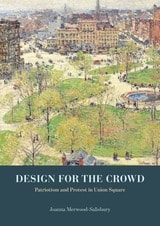
Design for the Crowd
Patriotism and Protest in Union SquareJoanna Merwood-Salisbury
University of Chicago Press, 2019
In this sweeping history of an iconic urban square, Merwood-Salisbury gives us a review of American political activism, philosophies of urban design, and the many ways in which a seemingly stable landmark can change through public engagement and design.
Published with the support of Furthermore: a program of the J. M. Kaplan Fund.
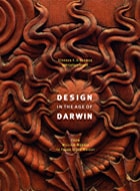
Design in the Age of Darwin
From William Morris to Frank Lloyd WrightStephen F Eisenman
Northwestern University Press, 2008
Charles Darwin’s monumental The Origin of Species, published in 1859, forever changed the landscape of natural science. The scientific world of the time had already established the principle of the “intelligent design” of a Creator; the art world had spent centuries devoting itself to the celebration of such a Designer’s creation. But the language of the book, and its implications, were stunning, and the ripples Darwin made when he rocked the boat spread outward: if he could question the Designer, what effect might there be on the art world, and on mortal designers’ renderings of Creation.
Published in partnership with the Mary and Leigh Block Museum of Art to accompany its exhibit, this catalog of essays and more than fifty color exhibition plates invokes these two senses of “intelligent design”—one from the debates between science and theology and the other from the world of art, particularly architecture and the decorative arts. The extensive exhibition includes furniture, metalware, glassware, textiles, and designs on loan from public and private collections in the United States and England. Among the artwork included are items from William Morris, C. R. Ashbee, Christopher Dresser, C. F. A. Voysey, Frank Lloyd Wright, and Louis Sullivan. Through these pieces and the accompanying examinations, the book explores how popular conceptions of the theory of evolution were used or rejected by British and American artists in the years that followed Darwin’s publication.
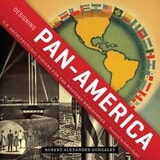
Designing Pan-America
U.S. Architectural Visions for the Western HemisphereBy Robert Alexander González
University of Texas Press, 2011
Coinciding with the centennial of the Pan American Union (now the Organization of American States), González explores how nineteenth- and twentieth-century U.S. architects and their clients built a visionary Pan-America to promote commerce and cultural exchange between United States and Latin America.
Late in the nineteenth century, U.S. commercial and political interests began eyeing the countries of Latin America as plantations, farms, and mines to be accessed by new shipping lines and railroads. As their desire to dominate commerce and trade in the Western Hemisphere grew, these U.S. interests promoted the concept of "Pan-Americanism" to link the United States and Latin America and called on U.S. architects to help set the stage for Pan-Americanism's development. Through international expositions, monuments, and institution building, U.S. architects translated the concept of a united Pan-American sensibility into architectural or built form. In the process, they also constructed an artificial ideological identity—a fictional Pan-America peopled with imaginary Pan-American citizens, the hemispheric loyalists who would support these projects and who were the presumed benefactors of this presumed architecture of unification.
Designing Pan-America presents the first examination of the architectural expressions of Pan-Americanism. Concentrating on U.S. architects and their clients, Robert Alexander González demonstrates how they proposed designs reflecting U.S. presumptions and projections about the relationship between the United States and Latin America. This forgotten chapter of American architecture unfolds over the course of a number of international expositions, ranging from the North, Central, and South American Exposition of 1885–1886 in New Orleans to Miami's unrealized Interama fair and San Antonio's HemisFair '68 and encompassing the Pan American Union headquarters building in Washington, D.C. and the creation of the Columbus Memorial Lighthouse in the Dominican Republic.
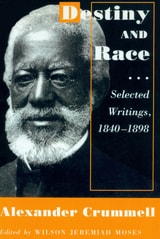
Destiny and Race
Selected Writings, 1840-1898Alexander Crummell
University of Massachusetts Press, 1992
A major reformer and intellectual, Alexander Crummell (1819–1898) was the first black American to graduate from Cambridge University. From 1858 to 1872, he lived in Liberia, where he worked as a farmer, educator, and Episcopal missionary. Returning to America, he established St. Luke’s Episcopal Church in Washington D.C., serving as its pastor until 1894. In 1897 he founded the American Negro Academy, which he intended as a challenge to the accommodationist philosophy of Booker T. Washington.
A prolific writer, Crummell produced pioneering works on black nationalism, black self-determination, and Pan Africanism that influenced W.E.B. Du Bois and other African-American leaders of the time. His surviving papers include over four hundred sermons and political essays and a voluminous correspondence.
Yet despite his importance to American and African-American history, Crummell is little known today, and there have been virtually no modern printings of his writing. This volume is intended to restore Crummell’s voice and to prompt a reevaluation of his work.

Detection and Its Designs
Narrative and Power in Nineteenth-Century Detective FictionPeter Thoms
Ohio University Press, 1998
In readings of Godwin's Caleb Williams, Poe's Dupin stories, Dickens's Bleak House, Collins's The Moonstone, and Doyle's The Hound of the Baskervilles, Thoms argues that the detective's figurative writing emerges out of a desire to exert control over others and sometimes over himself.
Detection and Its Designs demonstrates that, far from being a naïve form, early detective fiction grapples with the medium of storytelling itself. To pursue these inward-turning fictions is to uncover the detective's motives of controlling the representation of both himself and others, a discovery that in turn significantly undermines the authority of his solutions.
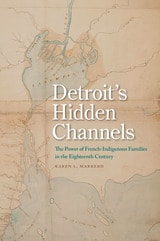
Detroit's Hidden Channels
The Power of French-Indigenous Families in the Eighteenth CenturyKaren L. Marrero
Michigan State University Press, 2020

Developing Animals
Wildlife and Early American PhotographyMatthew Brower
University of Minnesota Press, 2010
Developing Animals compellingly investigates the way photography changed our perception of animals. Brower analyzes how photographers created new ideas about animals as they moved from taking pictures of taxidermic specimens in so-called natural settings to the emergence of practices such as camera hunting, which made it possible to capture images of creatures in the wild.
By combining approaches in visual cultural studies and the history of photography, Developing Animals goes further to argue that photography has been essential not only to the understanding of wildlife but also to the conceptual separation of humans and animals.
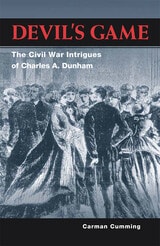
Devil's Game
The Civil War Intrigues of Charles A. DunhamCarman Cumming
University of Illinois Press, 2003
The first book-length study of one of the Civil War's most outlandish and mysterious characters
Devil's Game traces the amazing career of Charles A. Dunham, Civil War spy, forger, journalist, and master of dirty tricks. Writing for a variety of New York papers under alternate names, Dunham routinely faked stories, created new identities, and later boldly cast himself to play those roles. He achieved his greatest infamy when he was called to testify in Washington concerning Abraham Lincoln's assassination. Many parts of Dunham's career remain shadowy, but Cumming offers the first detailed tour of Dunham's convoluted, high-stakes, international deceits, including his effort to sell Lincoln on plans for a raid to capture Jefferson Davis.
Exhaustively researched and unprecedented in depth, this carefully crafted assessment of Dunham's motives, personality, and the complex effects of his schemes changes assumptions about covert operations during the Civil War.
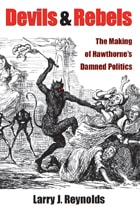
Devils and Rebels
The Making of Hawthorne's Damned PoliticsLarry J. Reynolds
University of Michigan Press, 2010
"An outstanding combination of literary interpretation and cultural and historical context that will be an important addition to the critical literature on Hawthorne."
---Nina Baym, University of Illinois
"It is difficult to imagine a more timely book than Devils and Rebels. Examining the role of the public intellectual and writer during a time of political conflict and war, Reynolds takes up his charges with great precision and historical finesse. What particularly distinguishes this book is its attention to the ways in which one of this country's most important authors struggled to resist the waves of political extremism and patriotic hysteria that swept around him."
---Jeffrey Steele, University of Wisconsin—Madison
Widely condemned even in his own time, Nathaniel Hawthorne's views on abolitionism and slavery are today frequently characterized by scholars as morally reprehensible. Devils and Rebels explores the historical and biographical record to reveal striking evidence of the author's true political values---values grounded in pacifism and resistant to the kind of binary thinking that could lead to violence and war.
The book offers fresh readings of not only Hawthorne's four major romances but also some of his less familiar works like "Legends of the Province House," The Whole History of Grandfather's Chair, Journal of an African Cruiser, The Life of Franklin Pierce, and "Septimius Felton." Reynolds argues that Hawthorne---whether in his politics or his art---drew upon racialized imagery from America's past revolution and war on witchcraft to create a politics of quiet imagination, alert to the ways in which New England righteousness could become totalitarian by imposing its narrow view of the world on others.
Meticulously researched and cogently argued, this groundbreaking work demonstrates the need to examine perspectives and values from beyond the New England region when studying the literary history of the American Renaissance and illuminates the difficulties faced by public intellectuals during times of political strife---an issue as relevant today as it was some one hundred and fifty years ago.
Larry J. Reynolds is Thomas Franklin Mayo Professor of Liberal Arts and Professor of English at Texas A&M University. His previous books include A Historical Guide to Nathaniel Hawthorne, National Imaginaries, American Identities: The Cultural Work of American Iconography, and European Revolutions and the American Literary Renaissance as well as an edition of the European writings of Margaret Fuller.
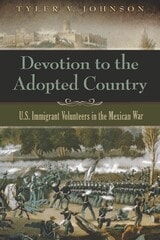
Devotion to the Adopted Country
U.S. Immigrant Volunteers in the Mexican WarTyler V. Johnson
University of Missouri Press, 2012
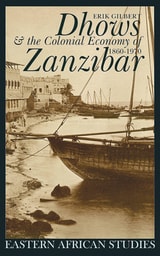
Dhows and the Colonial Economy of Zanzibar, 1860-1970
1860-1970Erik Gilbert
Ohio University Press, 2004
Conventional history assumes that the rise of the steamship trade killed off the Indian Ocean dhow trade in the twentieth century. Erik Gilbert argues that the dhow economy played a major role in shaping the economic and social life of colonial Zanzibar. Dhows, and the regional trade they fostered, allowed a class of indigenous entrepreneurs to thrive in Zanzibar. These entrepreneurs, whose economic interests stretched across continents and colonial boundaries, were able to thwart or shape many of the colonial state’s pet projects. Not only did steamships fail to drive out indigenous sailing craft, but in some cases dhows were able to drive the steamer out of specific market niches. In highlighting the role of East Africa’s commercial connections to the Middle East and India during the colonial period, Dhows and the Colonial Economy of Zanzibar, 1860-1970 makes a major contribution to African history as part of world history.
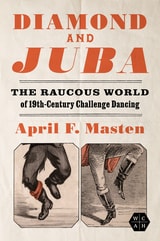
Diamond and Juba
The Raucous World of 19th-Century Challenge DancingApril F. Masten
University of Illinois Press, 2025
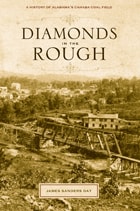
Diamonds in the Rough
A History of Alabama's Cahaba Coal FieldJames Sanders Day
University of Alabama Press, 2013
Winner of the 2014 Clinton Jackson Coley Award for Best Work on Alabama Local History from the Alabama Historical Association

Diary of Almon Harris Thompson
Explorations of the Colorado River of the West and Its Tributaries, 1871-1875Herbert E Gregory
University of Utah Press, 2009
Originally published in 1939 as volume seven of the Utah Historical Quarterly, Thompson’s journal is reprinted here for the first time in seventy years. Co-published with the Utah State Historical Society.
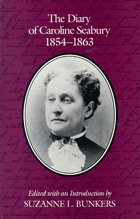
Diary of Caroline Seabury
Caroline Seabury
University of Wisconsin Press, 1991
In 1854 Caroline Seabury of Brooklyn, New York, set out for Columbus, Mississippi, to teach French at its Institute for Young Ladies. She lived in Columbus until 1863, through the years of mounting sectional bitterness that preceded the Civil War and through the turmoil and hardships of the war itself. During that time, her most intimate confidant was her diary. Discovered in the archives of the Minnesota State Historical Society, it is published here for the first time.
The diary is an illuminating account of southern plantation society and the “peculiar institution” of slavery on the eve of its destruction. Seabury also records her uneasy attempts to come to terms with her position as an unmarried, white, Northern woman whose job was to educate wealthy, white, Southern girls in a setting seemingly oblivious to the horrors of slavery. The diary is not simply a chronicle of daily happenings; Seabury concentrates on remarkable events and the memorable feelings and ideas they generate, shaping them into entries that reveal her as an accomplished writer. She frames her narrative with her journey south in 1854 and the hazardous and exhausting return north through battle lines in 1863.
Disapproving of slavery, yet deeply attached to friends and her life in Columbus and also painfully conscious of the fragility of her own economic and social position, Seabury condemned privately in her diary the evils that she endured silently in public. There are striking scenes of plantation life that depict the brutalities of slavery and benumbed responses to them. Seabury also successfully captures the mood of Mississippi as it changed from a fire-eating appetite to fight the Yankees to a grim apprehension of inexorable defeat. Most impressive of all is Seabury’s poignantly honest presentation of herself, caught in the middle.
Diaspora's Homeland
Modern China in the Age of Global MigrationShelly Chan
Duke University Press, 2018
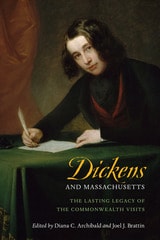
Dickens and Massachusetts
The Lasting Legacy of the Commonwealth VisitsDiana C. Archibald
University of Massachusetts Press, 2015
Charles Dickens traveled to North America twice, in 1842 and twenty-five years later in 1867–68, and on both trips Massachusetts was part of his itinerary. Although many aspects of his U.S. travels disappointed him, Massachusetts was the one state that met and even exceeded Dickens's expectations for “the republic of [his] imagination.” From the mills of Lowell to the Perkins School for the Blind, it offered an alternate vision of America that influenced his future writings, while the deep and lasting friendships he formed with Bostonians gave him enduring ties to the commonwealth.
This volume provides insight from leading scholars who have begun to reassess the significance of Massachusetts in the author's life and work. The collection begins with a broad biographical and historical overview taken from the full-length narrative of the award-winning exhibition Dickens and Massachusetts: A Tale of Power and Transformation, which attracted thousands of visitors while on display in Lowell. Abundant images from the exhibition, many of them difficult to find elsewhere, enhance the story of Dickens's relationship with the vibrant cultural and intellectual life of Massachusetts. The second section includes essays that consider the importance of Dickens's many connections to the commonwealth.
In addition to the volume editors, contributors include Chelsea Bray, Iain Crawford, Andre DeCuir, Natalie McKnight, Lillian Nayder, and Kit Polga.

Dickinson and the Boundaries of Feminist Theory
Mary Loeffelholz
University of Illinois Press, 1991
"Mary Loeffelholz has written a book that actually performs what it promises. . . . It illuminates our understanding of Emily Dickinson with readings both elegant and useful, and as importantly suggests modified direction for feminist-psychoanalytic theory."
-- Diana Hume George, author of Oedipus Anne: The Poetry of Anne Sexton
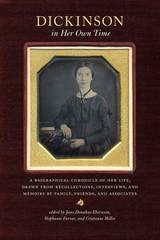
Dickinson in Her Own Time
A Biographical Chronicle of Her Life, Drawn from Recollections, Interviews, and Memoirs by Family, Friends, and AssociatesJane Donahue Eberwein, Stephanie Farrar, and Cristanne Miller
University of Iowa Press, 2015
In addition, promotional items, reviews, and correspondence relating to early publications are included, as well as some later documents that reveal the changing assessments of Dickinson’s poetry in response to evolving critical standards. These documents provide evidence that counters many popular conceptions of her life and reception, such as the belief that the writer best known for poems focused on loss, death, and immortality was herself a morose soul. In fact, those who knew her found her humorous, playful, and interested in other people.
Dickinson maintained literary and personal correspondence with major representatives of the national literary scene, developing a reputation as a remarkable writer even as she maintained extreme levels of privacy. Evidence compiled here also demonstrates that she herself made considerable provision for the survival of her poems and laid the groundwork for their eventual publication. Dickinson in Her Own Time reveals the poet as her contemporaries knew her, before her legend took hold.

Diet for a Large Planet
Industrial Britain, Food Systems, and World EcologyChris Otter
University of Chicago Press, 2020
We are facing a world food crisis of unparalleled proportions. Our reliance on unsustainable dietary choices and agricultural systems is causing problems both for human health and the health of our planet. Solutions from lab-grown food to vegan diets to strictly local food consumption are often discussed, but a central question remains: how did we get to this point?
In Diet for a Large Planet, Chris Otter goes back to the late eighteenth century in Britain, where the diet heavy in meat, wheat, and sugar was developing. As Britain underwent steady growth, urbanization, industrialization, and economic expansion, the nation altered its food choices, shifting away from locally produced plant-based nutrition. This new diet, rich in animal proteins and refined carbohydrates, made people taller and stronger, but it led to new types of health problems. Its production also relied on far greater acreage than Britain itself, forcing the nation to become more dependent on global resources. Otter shows how this issue expands beyond Britain, looking at the global effects of large agro-food systems that require more resources than our planet can sustain. This comprehensive history helps us understand how the British played a significant role in making red meat, white bread, and sugar the diet of choice—linked to wealth, luxury, and power—and shows how dietary choices connect to the pressing issues of climate change and food supply.
Dime Novel Desperadoes
The Notorious Maxwell BrothersJohn Hallwas
University of Illinois Press, 2011

Dime Novel Roundup
Annotated Index, 1931–1981Michael L. Cook
University of Wisconsin Press, 1983
This book includes a chronological listing of issues of the Dime Novel Roundup, which was published for over fifty years. It also features an index to the contents of the Dime Novel Roundup.
Disaffected
The Cultural Politics of Unfeeling in Nineteenth-Century AmericaXine Yao
Duke University Press, 2021
Duke University Press Scholars of Color First Book Award recipient

Disarming the Nation
Women's Writing and the American Civil WarElizabeth Young
University of Chicago Press, 1999
Combining literary analysis, cultural history, and feminist theory, Disarming the Nation argues that the Civil War functioned in women's writings to connect female bodies with the body politic. Women writers used the idea of "civil war" as a metaphor to represent struggles between and within women—including struggles against the cultural prescriptions of "civility." At the same time, these writers also reimagined the nation itself, foregrounding women in their visions of America at war and in peace. In a substantial afterword, Young shows how contemporary black and white women—including those who crossdress in Civil War reenactments—continue to reshape the meanings of the war in ways startlingly similar to their nineteenth-century counterparts.
Learned, witty, and accessible, Disarming the Nation provides fresh and compelling perspectives on the Civil War, women's writing, and the many unresolved "civil wars" within American culture today.
Disaster At The Colorado
Charles W. Baley
Utah State University Press, 2002
Across north-central New Mexico and Arizona, along the line of Route 66, now Interstate 40, there first ran a little-known wagon trail called Beale's Wagon Road, after Edward F. Beale, who surveyed it for the War Department in 1857. This survey became famous for employing camels. Not so well known is the fate of the first emigrants who the next year attempted to follow its tracks. The government considered the 1857 exploration a success and the road it opened a promising alternative route to California but expected such things as military posts and developed water supplies to be needed before it was ready for regular travel. Army representatives in New Mexico were more enthusiastic.
In 1858 there was a need for an alternative. Emigrants avoided the main California Trail because of a U.S. Army expedition to subdue Mormons in Utah. The Southern Route ran through Apache territory, was difficult for the army to guard, and was long. When a party of Missouri and Iowa emigrants known as the Rose-Baley wagon train arrived in Albuquerque, they were encouraged to be the first to try the new Beale road. Their journey became a rolling disaster. Beale's trail was more difficult to follow than expected; water sources and feed for livestock harder to find. Indians along the way had been described as peaceful, but the Hualapais persistently harassed the emigrants and shot their stock, and when the wagon train finally reached the Colorado River, a large party of Mojaves attacked them. Several of the emigrants were killed, and the remainder began a difficult retreat to Albuquerque. Their flight, with wounded companions and reduced supplies, became ever more arduous. Along the way they met other emigrant parties and convinced them to join the increasingly disorderly and distressed return journey.
Charles Baley tells this dramatic story and discusses its aftermath, for the emigrants, for Beale's Wagon Road, and for the Mojaves, against whom some of the emigrants pressed legal claims with the federal government.
Disciplining Statistics
Demography and Vital Statistics in France and England, 1830–1885Libby Schweber
Duke University Press, 2006
Tracing the introduction and promotion of vital statistics and demography, Schweber identifies the institutional conditions that account for the contrasting styles of reasoning. She shows that the different reactions to statistics stemmed from different criteria for what counted as scientific knowledge. The French wanted certain knowledge, a one-to-one correspondence between observations and numbers. The English adopted an instrumental approach, using the numbers to influence public opinion and evaluate and justify legislation.
Schweber recounts numerous attempts by vital statisticians and demographers to have their work recognized as legitimate scientific pursuits. While the British scientists had greater access to government policy makers, and were able to influence policy in a way that their French counterparts were not, ultimately neither the vital statisticians nor the demographers were able to institutionalize their endeavors. By 1885, both fields had been superseded by new forms of knowledge. Disciplining Statistics highlights how the development of “scientific” knowledge was shaped by interrelated epistemological, political, and institutional considerations.
Discriminating Sex
White Leisure and the Making of the American "Oriental"Amy Sueyoshi
University of Illinois Press, 2018
Amy Sueyoshi draws on everything from newspapers to felony case files to oral histories in order to examine how whites' pursuit of gender and sexual fulfillment gave rise to racial caricatures. As she reveals, white reporters, writers, artists, and others conflated Chinese and Japanese, previously seen as two races, into one. There emerged the Oriental—a single pan-Asian American stereotype weighted with sexual and gender meaning. Sueyoshi bridges feminist, queer, and ethnic studies to show how the white quest to forge new frontiers in gender and sexual freedom reinforced—and spawned—racial inequality through the ever evolving Oriental.
Informed and fascinating, Discriminating Sex reconsiders the origins and expression of racial stereotyping in an American city.
Disforming The American Canon
African-Arabic Slave Narratives and the VernacularRonald A.T. Judy
University of Minnesota Press, 1993
Dislocating the Orient
British Maps and the Making of the Middle East, 1854-1921Daniel Foliard
University of Chicago Press, 2017
Using a wide variety of primary texts and historical maps to show how the idea of the Middle East came into being, Dislocating the Orient will interest historians of the Middle East, the British empire, cultural geography, and cartography.
Disobedience, Slander, Seduction, and Assault
Women and Men in Cajamarca, Peru, 1862-1900By Tanja Christiansen
University of Texas Press, 2004
Though the law and courts of nineteenth-century Peru were institutions created by and for the ruling elite, women of all classes used the system to negotiate the complexities of property rights, childrearing, and marriage, and often to defend their very definitions of honor. Drawing on the trial transcripts of Cajamarca, a northern Peruvian province, from more than a century ago, this book shares eye-opening details about life among this community, in which reputation could determine a woman's chances of survival.
Exploring the processes of courtship, seduction, and familial duties revealed in these court records, historian Tanja Christiansen has unearthed a compelling panorama that includes marital strife, slander, disobedience, street brawls, and spousal abuse alongside documents that give evidence of affection and devotion. Her research also yields much new information about the protocols for conflict and cooperation among nineteenth-century Peruvian women from all social strata, and the prevalence of informal unions in an economy driven in large part by migratory male labor. Reviving a little-known aspect of Latin American history, Christiansen's book simultaneously brings to light an important microcosm of women's history during the nineteenth century.
Disruptive Acts
The New Woman in Fin-de-Siecle FranceMary Louise Roberts
University of Chicago Press, 2002
Mary Louise Roberts examines a constellation of famous new women active in journalism and the theater, including Marguerite Durand, founder of the women's newspaper La Fronde; the journalists Séverine and Gyp; and the actress Sarah Bernhardt. Roberts demonstrates how the tolerance for playacting in both these arenas allowed new women to stage acts that profoundly disrupted accepted gender roles. The existence of La Fronde itself was such an act, because it demonstrated that women could write just as well about the same subjects as men—even about the volatile Dreyfus Affair. When female reporters for La Fronde put on disguises to get a scoop or wrote under a pseudonym, and when actresses played men on stage, they demonstrated that gender identities were not fixed or natural, but inherently unstable. Thanks to the adventures of new women like these, conventional domestic femininity was exposed as a choice, not a destiny.
Lively, sophisticated, and persuasive, Disruptive Acts will be a major work not just for historians, but also for scholars of cultural studies, gender studies, and the theater.

Distant Cycles
Schubert and the Conceiving of SongRichard Kramer
University of Chicago Press, 1994
Returning the songs to their original keys, Kramer reveals linkages among songs which were often obscured as Schubert readied his compositions for publication. His analysis thus conveys even familiar songs in fresh contexts that will affect performance, interpretation, and criticism. After addressing problems of multiple settings and revisions, Kramer presents a series of briefs for the reconfiguring of sets of songs to poems by Goethe, Rellstab, and Heine. He deconstructs Winterreise, using its convoluted origins to illuminate its textual contradictions. Finally, Kramer scrutinizes settings from the Abendrote cycle (on poems by Friedrich Schlegel) for signs of cyclic process. Probing the farthest reaches of Schubert's engagement with the poetics of lieder, Distant Cycles exposes tensions between Schubert the composer and Schubert the merchant-entrepreneur.
Distinguishing the Righteous from the Roguish
The Arkansas Supreme Court, 1836–1874J.W. Looney
University of Arkansas Press, 2016
During the period from 1836 to 1874, the legal system in the new state of Arkansas developed amid huge social change. While the legislature could, and did, determine what issues were considered of importance to the populace, the Arkansas Supreme Court determined the efficacy of legislation in cases involving land titles, banks, transportation, slavery, family law, property, debt, contract, criminal law, and procedure.
Distinguishing the Righteous from the Roguish examines the court’s decisions in this era and shows how Arkansas, as a rural slave-holding state, did not follow the transformational patterns typical of some other states during the nineteenth century. Rather than using the law to promote broad economic growth and encourage social change, the Arkansas court attempted to accommodate the interests of the elite class by preserving the institution of slavery. The ideology of paternalism is reflected in the decisions of the court, and Looney shows how social and political stability—an emphasis on preserving the status quo of the so-called “righteous”—came at the expense of broader economic development.
Divergent Modernities
Culture and Politics in Nineteenth-Century Latin AmericaJulio Ramos
Duke University Press, 2001
Since its first publication in Spanish nearly a decade ago, Julio Ramos’s Desenucuentros de la modernidad en America Latina por el siglo XIX has been recognized as one of the most important studies of modernity in the western hemisphere. Available for the first time in English—and now published with new material—Ramos’s study not only offers an analysis of the complex relationships between history, literature, and nation-building in the modern Latin American context but also takes crucial steps toward the development of a truly comparative inter-American cultural criticism.
With his focus on the nineteenth century, Ramos begins his genealogy of an emerging Latin Americanism with an examination of Argentinean Domingo Sarmiento and Chilean Andrés Bello, representing the “enlightened letrados” of tradition. In contrast to these “lettered men,” he turns to Cuban journalist, revolutionary, and poet José Martí, who, Ramos suggests, inaugurated a new kind of intellectual subject for the Americas. Though tracing Latin American modernity in general, it is the analysis of Martí—particularly his work in the United States—that becomes the focal point of Ramos’s study. Martí’s confrontation with the unequal modernization of the New World, the dependent status of Latin America, and the contrast between Latin America’s culture of elites and the northern mass culture of commodification are, for Ramos, key elements in understanding the complex Latin American experience of modernity.
Including two new chapters written for this edition, as well as translations of three of Martí’s most important works, Divergent Modernities will be indispensable for anyone seeking to understand development and modernity across the Americas.

Divide, Provide and Rule
An Integrative History of Poverty Policy, Social Reform, and Social Policy in Hungary under the Habsburg MonarchySusan Zimmermann
Central European University Press, 2011
Dividing the Union
Jesse Burgess Thomas and the Making of the Missouri CompromiseMatthew W. Hall
Southern Illinois University Press, 2015
In 1820 the Missouri controversy erupted over the issue of slavery in the newly acquired lands of the Louisiana Purchase. It fell to Jesse Burgess Thomas (1777–1853), a junior U.S. senator from the new state of Illinois, to handle the delicate negotiations that led to the Missouri Compromise. Thomas’s maturity, good judgment, and restraint helped pull the country back from the brink of disunion and created a compromise that held for thirty-four years. In Dividing the Union, Matthew W. Hall examines the legal issues underlying the controversy and the legislative history of the Missouri Compromise while focusing on the aspects of Thomas’s life and character that gave him such influence. The first in-depth biography of Thomas, Hall’s work demonstrates how the legislative battle over the Compromise reflected the underlying nuances of the larger struggle over slavery.
The text of the Missouri Compromise originated from the Northwest Ordinance. Article VI of the Ordinance purported to prohibit slavery in the Northwest Territory, but paradoxically, a provision that assured property rights in another article was used to protect slavery. People in some parts of the Northwest sought to circumvent Article VI by formulating indenture laws and various state constitutional provisions addressing slavery. Pro- and antislavery activists eventually developed quite different interpretations of the relevant language in these documents, making negotiations over slavery in the new territory extremely complicated.
As Hall demonstrates, Thomas was perfectly situated geographically, politically, and ideologically to navigate the Missouri controversy. He was the first speaker of the Indiana Territorial General Assembly, one of the first territorial judges in the Illinois Territory, and the president of the Illinois State Constitutional Convention in 1818. Because the drive for statehood in Illinois was strong, the convention managed to skirt the divisive issue of slavery, due in large part to Thomas’s efforts. That he was never required to clearly articulate his own views on slavery allowed Thomas to maintain a degree of neutrality, and his varied political career gave him the experience necessary to craft a compromise.
Thomas’s final version of the Compromise included shrewdly worded ambiguities that supported opposing interests in the matter of slavery. These ambiguities secured the passage of the Compromise and its endurance until the Kansas-Nebraska Act of 1854. By weaving Thomas’s life story into the history of the Missouri Compromise, Hall offers new insight into both a pivotal piece of legislation and an important, previously overlooked figure in nineteenth-century American politics.

Doctoring the Novel
Medicine and Quackery from Shelley to DoyleSylvia A. Pamboukian
Ohio University Press, 2012
Doctoring the Novel explores the ways in which language constructs and stabilizes these slippery terms by examining medical quackery and orthodoxy in works such as Mary Shelley’s Frankenstein, Charles Dickens’s Bleak House and Little Dorrit, Charlotte Brontë’s Villette, Wilkie Collins’s Armadale, and Arthur Conan Doyle’s Stark Munro Letters. Contextualized in both medical and popular publishing, literary analysis reveals that even supposedly medico-scientific concepts such as orthodoxy and quackery evolve not in elite laboratories and bourgeois medical societies but in the rough-and-tumble of the public sphere, a view that acknowledges the considerable, and often underrated, influence of language on medical practices.
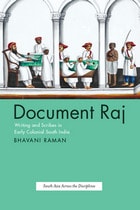
Document Raj
Writing and Scribes in Early Colonial South IndiaBhavani Raman
University of Chicago Press, 2012
Domesticity, Imperialism, and Emigration in the Victorian Novel
Diana C. Archibald
University of Missouri Press, 2002
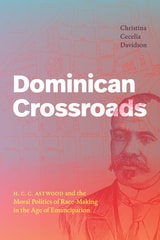
Dominican Crossroads
H. C. C. Astwood and the Moral Politics of Race-Making in the Age of EmancipationChristina Cecelia Davidson
Duke University Press, 2024

Don't Forget to Live
Goethe and the Tradition of Spiritual ExercisesPierre Hadot
University of Chicago Press, 2023
With a foreword by Arnold I. Davidson and Daniele Lorenzini.
In his final book, renowned philosopher Pierre Hadot explores Goethe’s relationship with ancient spiritual exercises—transformative acts of intellect, imagination, or will. Goethe sought both an intense experience of the present moment as well as a kind of cosmic consciousness, both of which are rooted in ancient philosophical practices. These practices shaped Goethe’s audacious contrast to the traditional maxim memento mori (Don’t forget that you will die) with the aim of transforming our ordinary consciousness. Ultimately, Hadot reveals how Goethe cultivated a deep love for life that brings to the forefront a new maxim: Don’t forget to live.