Results by title
8642 books match the query '20th Century' and 292 start with d
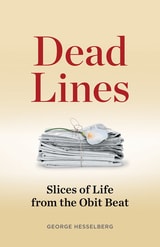
Dead Lines
Slices of Life from the Obit BeatGeorge Hesselberg
Wisconsin Historical Society Press, 2021
In more than forty years at the Wisconsin State Journal, Hesselberg frequently found himself writing about fatal accidents, crime investigations, and the deaths of the wealthy, famous, or notorious. But he was most drawn to the curious, the unknown, and the unsung—the deaths that normally wouldn’t make much of a splash, if any mention at all, in the news columns of a daily paper.
Digging deeper, he uncovered the extraordinary among the ordinary, memorializing the lives of a sword designer, a radio villain, a pioneering female detective, a homeless woman who spoke fluent French, a beloved classroom tarantula, and many more. Their stories are alternately amusing, sad, surprising, and profound. Together they speak to a shared human experience and inspire us to see the people around us with new eyes, valuing the lives while they are still being lived.

Dead Weight
A Memoir in EssaysRandall Horton
Northwestern University Press, 2022
The memoir begins with a conversation between Horton and Ralph Ellison’s Invisible Man statue in New York City. Their imagined dialogue examines the psychological impact of racism on Black men and boys, including Horton’s separation from his mother, immediately after his birth, in a segregated Alabama hospital. From his current life as a professor and prison reformer, Horton looks back on his experiences as a drug smuggler and trafficker during the 1980s–1990s as well as the many obstacles he faced after his release. He also examines the lasting impact of his drug activity on those around him, reflecting on the allure of economic freedom and the mental escapism that cocaine provided, an allure so strong that both sellers and users were willing to risk prison. Horton shares historical context and vivid details about people caught in the war on drugs who became unsuspecting protagonists in somebody else’s melodrama.
Lyrical and gripping, Dead Weight reveals the lifelong effects of one man’s incarceration on his psyche, his memories, and his daily experience of American society.

Deadline
200 Years of Violence Against Journalists in the United StatesElizabeth Atwood
University of Missouri Press, 2025
To help us understand these attacks, Atwood presents a framework for categorizing them, built on John Nerone’s studies on assaults on American media workers. Atwood categorizes attacks against journalists as attacks against individuals, ideas, and media institutions, and undertaken to suppress reporting on certain topics and in the context of wars and other international or conflicts. Crucially, Deadline utilizes this framework to offer possible solutions to the issue of violence against journalists.
Atwood was inspired to explore the pressing issue of violence against American journalists after the tragic death of one of her colleagues at the Baltimore Sun, Rob Hiaasen, in the Capital Gazette shooting in 2018. Throughout, she demonstrates that distrust of the media and violence against the press in the United States are hardly new developments. Her work examines how intimidation, violence, and censorship have, in fact, been used against the American press since both its and the nation’s founding.
Deadly Dust
Silicosis and the On-Going Struggle to Protect Workers' HealthDavid Rosner and Gerald Markowitz
University of Michigan Press, 2006

Deadly Excitements
Shadows PhantomsRobert Sampson
University of Wisconsin Press, 1989
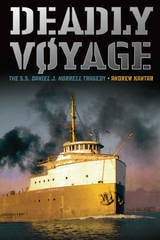
Deadly Voyage
The S.S. Daniel J. Morrell TragedyAndrew Kantar
Michigan State University Press, 2009
This is the harrowing story of one of the worst shipwrecks in Great Lakes history. In the early morning hours of November 29, 1966, the S.S. Daniel J. Morrell was caught in a deadly storm on Lake Huron. Waves higher than the ship crested over it, and winds exceeding sixty miles per hour whipped at its hull, splitting the 603-foot freighter into two giant pieces. Amazingly, after the bow went down, the stern blindly powered itself through the stormy seas for another five miles! Twenty-eight men drowned in the icy waters of Lake Huron, but one sailor—26-year-old Dennis Hale—miraculously survived the treacherous storm. Wearing only boxer shorts, a lifejacket, and a pea coat, Hale clung to a life raft in near-freezing temperatures for 38 hours until he was rescued late in the afternoon of the following day. Three of his fellow crewmates died in his raft.
In Deadly Voyage, Andrew Kantar recounts this tale of tragedy and triumph on Lake Huron. Informed by meticulous research and the eyewitness details provided by Hale, and illustrated with photographs from the Coast Guard search and rescue operation, Kantar depicts one of the most tragic shipwrecks in Great Lakes history.

Deaf American Prose, 1830-1930
Jennifer L. Nelson
Gallaudet University Press, 2013
This new anthology showcases the work of Deaf writers during a critical formative period in their history. From 1830 to 1930, these writers conveyed their impressions in autobiographies, travel narratives, romances, non-fiction short stories, editorials, descriptive pieces, and other forms of prose. The quick, often evocative snapshots and observations featured here, many explicitly addressing deafness and sign language, reflect their urgency to record Deaf American life at this pivotal time. Using sensory details, dialogue, characterization, narrative movement, and creative prose, these writers emphasized the capabilities of Deaf people to counter events that threatened their way of life.
The volume opens with “The Orphan Mute,” a sentimental description of the misfortune of deaf people written by John Robertson Burnet in 1835. Less than 50 years later, James Denison, the only Deaf delegate at the 1880 Convention of Instructors of the Deaf in Milan, published his “impressions” that questioned the majority’s passage of a strict oralism agenda. In 1908, Thomas Flowers wrote “I was a little human plant,” a paean to education without irony despite the concurrent policy banning African Americans from attending Gallaudet College. These and a host of other Deaf writers—Laurent Clerc, Kate Farlow, Edmund Booth, Laura Redden Searing, Freda W. Bauman, Vera Gammon, Isaac H. Benedict, James Nack, John Carlin, Joseph Mount and many more—reveal the vitality and resilience of Deaf writers in an era of wrenching change.

Deaf American Prose, 1980–2010
Kristen C. Harmon
Gallaudet University Press, 2012
In Deaf life, the personal narrative holds sway because most Deaf individuals recall their formative years as solitary struggles to understand and to be understood. Few deaf people in the past related their stories in written form, relying instead on a different kind of “oral” tradition, that of American Sign Language. During the last several decades, however, a burgeoning bilingual deaf experience has ignited an explosion of Deaf writing that has pushed the potential of ASL-influenced English to extraordinary creative heights. Deaf American Prose: 1980–2010 presents a diverse cross-section of stories, essays, memoirs, and novel excerpts by a remarkable cadre of Deaf writers that mines this rich, bilingual environment.
The works in Deaf American Prose frame the Deaf narrative in myriad forms: Tom Willard sends up hearing patronization in his wicked satire “What Exactly Am I Supposed to Overcome?” Terry Galloway injects humor in “Words,” her take on the identity issues of being hard of hearing rather than deaf or hearing. Other contributors relate familiar stories about familiar trials, such as Tonya Stremlau’s account of raising twins, and Joseph Santini’s short story of the impact on Deaf and hearing in-laws of the death of a son. The conflicts are well-known and heartfelt, but with wrinkles directly derived from the Deaf perspective.
Several of the contributors expand the Deaf affect through ASL glosses and visual/spatial elements. Sara Stallard emulates ASL on paper through its syntax and glosses, and by eliminating English elements, a technique used in dialogue by Kristen Ringman and others. Deaf American Prose features the work of other well-known contemporary Deaf writers, including co-editor Kristen Harmon, Christopher Jon Heuer, Raymond Luczak, and Willy Conley. The rising Deaf writers presented here further distinguish the first volume in this new series by thinking in terms of what they can bring to English, not what English can bring to them.

Deaf History and Culture in Spain
A Reader of Primary DocumentsBenjamin Fraser
Gallaudet University Press, 2009
In this landmark reader, Benjamin Fraser offers in five parts 44 Spanish documents dating from 1417 to the present, translated for the first time to trace the turbulent history of Deaf culture in Spain. Part I: The Birth of Oralism and Deafness as Metaphor illustrates the predominant impression of deafness as isolation, exemplified by Teresa de Cartagena writings in 1455-60 about deafness as an island. Part II: The Return to Deaf Education highlights writers who wished to restore “the Spanish ‘Art’” of educating deaf students. Lorenzo Hervás y Panduro wrote The Spanish School of Deafmutes, or Method of Teaching Them to Write and Speak the Spanish Language in 1795. Yet, Madrid’s Royal School for Deaf-Mutes, which opened in 1805, taught deaf students using methodical signs adopted from France’s Abbé de l’Epée.
Readings in Part III :The Contemporary Deaf Experience reveal considerations from the 1970s to the ‘90s of Deaf culture and linguistics similar to those in the United States, typified by the works of Inés Polo and Félix-Jesús Pinedo Peydró. The fourth part, The Recognition of Deaf Language and Culture, marks the expansion of academic research in Spain. María Angeles Rodríguez González spearheaded Spanish Sign Language (LSE) linguistics in 1992 with her publication Sign Language. The final part, A Selection of Deaf Poetry, concludes these documents with verse in Spanish spoken dialects rather than LSE, indicating that the evolution of the Deaf experience in Spain continues on its own path today.
Deaf People in Hitler's Europe
Donna F. Ryan
Gallaudet University Press, 2002
Inspired by the conference “Deaf People in Hitler’s Europe, 1933–1945,” hosted jointly by Gallaudet University and the United States Holocaust Memorial Museum in 1998, this extraordinary collection, organized into three parts, integrates key presentations and important postconference research.
Henry Friedlander begins “Part I: Racial Hygiene” by analyzing the assault on deaf people and people with disabilities as an integral element in the Nazi attempt to implement their theories of racial hygiene. Robert Proctor documents the role of medical professionals in deciding who should be sterilized or forbidden to marry, and whom the Nazi authorities would murder. In an essay written especially for this volume, Patricia Heberer details how Nazi manipulation of eugenics theory and practice facilitated the justification for the murder of those considered socially undesirable.
“Part II: The German Experience” commences with Jochen Muhs’s interviews of deaf Berliners who lived under Nazi rule, both those who suffered abuse and those who, as members of the Nazi Party, persecuted others, especially deaf Jews. John S. Schuchman describes the remarkable 1932 film Misjudged People, which so successfully portrayed the German deaf community as a vibrant contributor to society that the Nazis banned its showing when they came to power. Horst Biesold’s contribution confirms the complicity of teachers who denounced their own students, labeling them hereditarily deaf and thus exposing them to compulsory sterilization. The section also includes the reprint of a chilling 1934 article entitled “The Place of the School for the Deaf in the New Reich,” in which author Kurt Lietz rued the expense of educating deaf students, who could not become soldiers or bear “healthy children.”
In “Part III: The Jewish Deaf Experience,” John S. Schuchman discusses the plight of deaf Jews in Hungary. His historical analysis is complemented by a chapter containing excerpts from the testimony of six deaf Jewish survivors who describe their personal ordeals. Peter Black’s reflections on the need for more research conclude this vital study of a little-known chapter of the Holocaust.

Dear Denise
Letters to the Sister I Never KnewLisa McNair
University of Alabama Press, 2022
Poignant, honest, and heartfelt letters to a sister who perished in the 16th Street Baptist Church bombing.
Lisa McNair was born in 1964, one year after her older sister, Denise, was murdered in the bombing of the 16th Street Baptist Church in Birmingham, Alabama. Dear Denise is a collection of forty letters from Lisa addressed to the sister she never knew, but in whose shadow of sacrifice and lost youth she was raised. These letters offer an intimate look into the life of a family touched by one of the most heinous tragedies of the Civil Rights Movement.
Written in a genuine, accessible, familiar, and easy-to-read voice, Lisa’s letters apprise her late sister of all that has come to pass in the years since her death. Lisa considers her own challenges and accomplishments as a student in remarkably different—and very racially complex—schools; the birth of their baby sister, Kim; their father’s election to the Alabama legislature; her evolving sense of faith and place, and sometimes lack thereof, within the Black church; her college experiences; and her own sense of self as she’s matured into adulthood. She reveals some of the family’s difficulties and health challenges, and shares some of their joys and celebrations.
The letters are accompanied by 29 black-and-white photographs, most of them from the McNair family collection, many of them taken by her father, a professional photographer who documented the Civil Rights Movement in Alabama both before and after Denise’s murder. An unswervingly candid, gentle, and nuanced book, Dear Denise is a testament to one singular life lived bravely and truthfully (if sometimes confusedly or awkwardly), during decades of bewildering social change and in the shadow of one life never fully lived.

Dear Elizabeth
May Swenson
Utah State University Press, 2000

Dear Friend
Rainer Maria Rilke and Paula Modersohn-BeckerEric Torgersen
Northwestern University Press, 2000
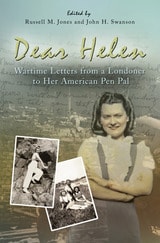
Dear Helen
Wartime Letters from a Londoner to Her American Pen PalEdited by Russell M. Jones & John H. Swanson
University of Missouri Press, 2009
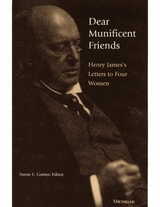
Dear Munificent Friends
Henry James's Letters to Four WomenSusan E. Gunter, Editor
University of Michigan Press, 2000

Dear Wizard
The Letters of Nicholas Delbanco and Jon Manchip Whiteedited by Nicholas Delbanco
University of Michigan Press, 2014

Dearly Beloved Friends
Henry James's Letters to Younger MenSusan E. Gunter and Steven H. Jobe, Editors
University of Michigan Press, 2004
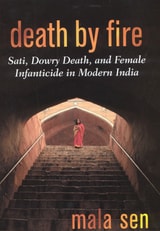
Death by Fire
Sati, Dowry Death, and Female Infanticide in Modern IndiaSen, Mala
Rutgers University Press, 2002
The Indian village of Deorala in Rajasthan, the northwestern Indian state that borders Pakistan, is neither remote nor feudal in the strictest sense. A tarmac road links the population of 10,000 to neighboring villages and towns, there is running water and electricity, and the villagers have had television for more than twenty years. On September 4, 1987, Deorala found itself in the center of a furor that awoke age-old conflicts in Indian society. Before a crowd of several thousand people, mostly men, a young woman dressed in her bridal finery was burned alive on her husband’s funeral pyre. The apparent revival of an ancient tradition opened old wounds in Indian society and focused world attention on the status and treatment of women in modern India.
The ancient practice of sati — the self-immolation of a woman on her husband’s funeral pyre — was outlawed by the British administration in India in 1829, and sati was widely believed to have died out. The fate of 18-year-old Roop Kanwar changed that perception. Mala Sen explores the reality of life and death for women in modern India in a study that is both illuminating and terrifying. The book is part journey through the India that the author knows and loves, and part exploration of the enigma that India still remains in the minds of many. Starting with Kanwar, Sen enters the worlds of three women: a goddess, a burned bride, and a woman accused of killing her daughter, and shows how, in this society in which ancient and modern apparently co-exist comfortably, there is increasingly cause for real alarm. She creates an image of a state in which political turmoil is constantly at the surface, and in which the role of women is constantly being redefined.

Death of Dignity
Angola's Civil WarVictoria Brittain
Pluto Press, 1998
Death of a Nation
American Culture and the End of ExceptionalismDavid W. Noble
University of Minnesota Press, 2002
A trenchant examination of epic shifts in American thought by a major scholar in the field.
In the 1940s, American thought experienced a cataclysmic paradigm shift. Before then, national ideology was shaped by American exceptionalism and bourgeois nationalism: elites saw themselves as the children of a homogeneous nation standing outside the history and culture of the Old World. This view repressed the cultures of those who did not fit the elite vision: people of color, Catholics, Jews, and immigrants. David W. Noble, a preeminent figure in American studies, inherited this ideology. However, like many who entered the field in the 1940s, he rejected the ideals of his intellectual predecessors and sought a new, multicultural, postnational scholarship. Throughout his career, Noble has examined this rupture in American intellectual life. In Death of a Nation, he presents the culmination of decades of thought in a sweeping treatise on the shaping of contemporary American studies and an eloquent summation of his distinguished career.
Exploring the roots of American exceptionalism, Noble demonstrates that it was a doomed ideology. Capitalists who believed in a bounded nationalism also depended on a boundless, international marketplace. This contradiction was inherently unstable, and the belief in a unified national landscape exploded in World War II. The rupture provided an opening for alternative narratives as class, ethnicity, race, and region were reclaimed as part of the nation’s history. Noble traces the effects of this shift among scholars and artists, and shows how even today they struggle to imagine an alternative postnational narrative and seek the meaning of local and national cultures in an increasingly transnational world. While Noble illustrates the challenges that the paradigm shift created, he also suggests solutions that will help scholars avoid romanticized and reductive approaches toward the study of American culture in the future.
Death of the Moguls
The End of Classical HollywoodWheeler Winston Dixon
Rutgers University Press, 2012
Death of the Moguls is a detailed assessment of the last days of the “rulers of film.” Wheeler Winston Dixon examines the careers of such moguls as Harry Cohn at Columbia, Louis B. Mayer at MGM, Jack L. Warner at Warner Brothers, Adolph Zukor at Paramount, and Herbert J. Yates at Republic in the dying days of their once-mighty empires. He asserts that the sheer force of personality and business acumen displayed by these moguls made the studios successful; their deaths or departures hastened the studios’ collapse. Almost none had a plan for leadership succession; they simply couldn't imagine a world in which they didn’t reign supreme.
Covering 20th Century-Fox, Selznick International Pictures, Metro-Goldwyn-Mayer, Paramount Pictures, RKO Radio Pictures, Warner Brothers, Universal Pictures, Republic Pictures, Monogram Pictures and Columbia Pictures, Dixon briefly introduces the studios and their respective bosses in the late 1940s, just before the collapse, then chronicles the last productions from the studios and their eventual demise in the late 1950s and early 1960s. He details such game-changing factors as the de Havilland decision, which made actors free agents; the Consent Decree, which forced the studios to get rid of their theaters; how the moguls dealt with their collapsing empires in the television era; and the end of the conventional studio assembly line, where producers had rosters of directors, writers, and actors under their command.
Complemented by rare, behind-the-scenes stills, Death of the Moguls is a compelling narrative of the end of the studio system at each of the Hollywood majors as television, the de Havilland decision, and the Consent Decree forced studios to slash payrolls, make the shift to color, 3D, and CinemaScope in desperate last-ditch efforts to save their kingdoms. The aftermath for some was the final switch to television production and, in some cases, the distribution of independent film.
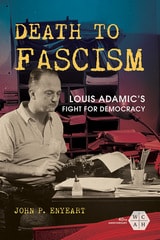
Death to Fascism
Louis Adamic's Fight for DemocracyJohn P. Enyeart
University of Illinois Press, 2019

Death to the Death of Poetry
Essays, Reviews, Notes, InterviewsDonald Hall
University of Michigan Press, 1994
Donald Hall believes that American poetry, at the present moment, thrives both in quality and in leadership. In his latest collection of essays, reviews, and interviews, Hall counters the increasingly publicized view that poetry has an ever-diminishing importance in contemporary American culture. He resents the endlessly repeated cliché that finds poetry unpopular and losing popularity. Thus: Death to the Death of Poetry.
Throughout the pages of this latest offering in the Poets on Poetry series, Hall returns again and again to the theme of poetry's health, and offers essays praising contemporary poets, who serve as examples of poetry's thriving condition. In addition, Death to the Death of Poetry collects interviews in which Hall discusses the work of poetry--revisions, standards, the psychology and sociology of the poet's life.
The collection will be warmly received by Donald Hall's large readership, enhanced in 1993 by publication of two exemplary volumes: The Museum of Clear Ideas, his eleventh book of poetry; and his essay Life Work, which brought him both new and returning readers.

Death's Futurity
The Visual Life of Black PowerSampada Aranke
Duke University Press, 2023
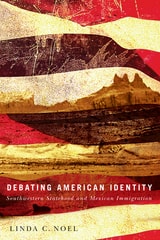
Debating American Identity
Southwestern Statehood and Mexican ImmigrationLinda C. Noel
University of Arizona Press, 2014
In Debating American Identity, Linda C. Noel examines several nation-defining events—the proposed statehood of Arizona and New Mexico, the creation of a temporary worker program during the First World War, immigration restriction in the 1920s, and the repatriation of immigrants in the early 1930s. Noel uncovers the differing ways in which Americans argued about how newcomers could fit within the nation-state, in terms of assimilation, pluralism, or marginalization, and the significance of class status, race, and culture in determining American identity.
Noel shows not only how the definition of American was contested, but also how the economic and political power of people of Mexican descent, their desire to incorporate as Americans or not, and the demand for their territory or labor by other Americans played an important part in shaping decisions about statehood and national immigration policies. Debating American Identity skillfully shows how early twentieth century debates over statehood influenced later ones concerning immigration; in doing so, it resonates with current discussions, resulting in a well-timed look at twentieth century citizenship.
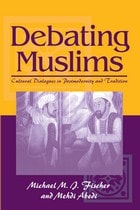
Debating Muslims
Cultural Dialogues in Postmodernity and TraditionMichael M. J. Fischer and Mehdi Abedi
University of Wisconsin Press, 1990
In a world of multinational commerce, satellite broadcasting, migration, terrorism, and global arms dealing, what is said and how it is said in one society can no longer be isolated from what is said and how it is said in another. Debating Muslims focuses on Iranian culture, Shi’ite Islam, and Iranians in the United States, offering an experiment in postmodern ethnography and an invitation to think in a multifaceted way about Islam in the contemporary world.
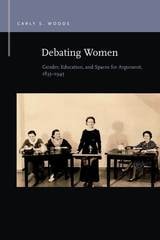
Debating Women
Gender, Education, and Spaces for Argument, 1835-1945Carly S. Woods
Michigan State University Press, 2018

Debt and Dispossession
Farm Loss in America's HeartlandKathryn Marie Dudley
University of Chicago Press, 2000
The farm crisis of the 1980s was the worst economic disaster to strike rural America since the Depression—thousands of farmers lost their land and homes, irrevocably altering their communities and, as Kathryn Marie Dudley shows, giving rise to devastating social trauma that continues to affect farmers today. Through interviews with residents of an agricultural county in western Minnesota, Dudley provides an incisive account of the moral dynamics of loss, dislocation, capitalism, and solidarity in farming communities.

Decade of Disaster
Ann Larabee
University of Illinois Press, 2000
Decade of Disaster gives voice to a diverse cast of disaster participants, including Bhopal widows, people with AIDS, Chernobyl tourists, NASA administrators, international nuclear power authorities, and corporate spokespeople. Integrating sources ranging from official reports and scientific studies to news stories, movies, and science fiction novels, Larabee explores the fierce debates that followed these disasters, as government agencies, corporations, public interest groups, academics, and local communities fought to control their meaning. An incisive commentary at the intersection of cultural history and cultural studies, Decade of Disaster peels away layers and screens of rhetoric to expose the underlying process of cultural negotiation.
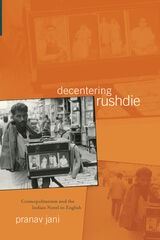
Decentering Rushdie
Cosmopolitanism and the Indian Novel in EnglishPranav Jani
The Ohio State University Press, 2010
Interrogating current theories of cosmopolitanism, nationalism, and aesthetics in Postcolonial Studies, Decentering Rushdie offers a new perspective on the Indian novel in English. Since Salman Rushdie’s Midnight’s Children won the Booker Prize in 1981, its postmodern style and postnational politics have dominated discussions of postcolonial literature. As a result, the rich variety of narrative forms and perspectives on the nation that constitute the field have been obscured, if not erased altogether.

Deckhand
Life on Freighters of the Great LakesNelson "Mickey" Haydamacker with Alan D. Millar
University of Michigan Press, 2009
Long before popular television shows such as Dirty Jobs and The Deadliest Catch, everyday men and women---the unsung heroes of the job world---toiled in important but mostly anonymous jobs. One of those jobs was deckhand on the ore boats.
With numerous photographs and engaging stories, Deckhand offers an insider's view of both the mundane and the intriguing duties performed by deckhands on these gritty cargo vessels. Boisterous port saloons, monster ice jams, near drownings, and the daily drudgery of soogeying---cleaning dirt and grime off the ships---are just a few of the experiences Mickey Haydamacker had as a young deckhand working on freighters of the Great Lakes in the early 1960s. Haydamacker sailed five Interlake Steamship Company boats, from the modern Elton Hoyt 2nd to the ancient coal-powered Colonel James Pickands with its backbreaking tarp-covered hatches.
Deckhand will appeal to shipping buffs and to anyone interested in Great Lakes shipping and maritime history as it chronicles the adventures of living on the lakes from the seldom-seen view of a deckhand.
Decolonisation and Criticism
The Construction of Irish LiteratureGerry Smyth
Pluto Press, 1998
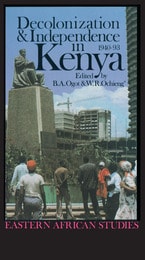
Decolonization and Independence in Kenya, 1940–1993
B. A. Ogot
Ohio University Press, 1995
This is a sharply observed assessment of the history of the last half century by a distinguished group of historians of Kenya. At the same time the book is a courageous reflection in the dilemmas of African nationhood.
Professor B. A. Ogot says:
“The main purpose of the book is to show that decolonization does not only mean the transfer of alien power to sovereign nationhood; it must also entail the liberation of the worlds of spirit and culture, as well as economics and politics.
“The book also raises a more fundamental question, that is: How much independence is available to any state, national economy or culture in today’s world? It asks how far are Africa’s miseries linked to the colonial past and to the process of decolonization?
“In particular the book raises the basic question of how far Kenya is avoidably neo-colonial? And what does neo-colonial dependence mean? The book answers these questions by discussing the dynamic between the politics of decolonization, the social history of class formation and the economics of dependence. The book ends with a provocative epilogue discussing the transformation of the post-colonial state from a single-party to a multi-party system.”
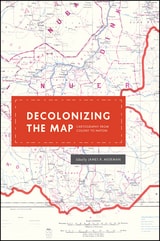
Decolonizing the Map
Cartography from Colony to NationEdited by James R. Akerman
University of Chicago Press, 2017
These essays, originally delivered as the 2010 Kenneth Nebenzahl, Jr., Lectures in the History of Cartography at the Newberry Library, encompass more than two centuries and three continents—Latin America, Africa, and Asia. Ranging from the late eighteenth century through the mid-twentieth, contributors study topics from mapping and national identity in late colonial Mexico to the enduring complications created by the partition of British India and the racialized organization of space in apartheid and post-apartheid South Africa. A vital contribution to studies of both colonization and cartography, Decolonizing the Map is the first book to systematically and comprehensively examine the engagement of mapping in the long—and clearly unfinished—parallel processes of decolonization and nation building in the modern world.
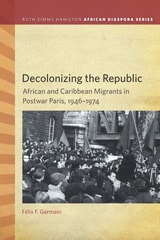
Decolonizing the Republic
African and Caribbean Migrants in Postwar Paris, 1946–1974Félix F. Germain
Michigan State University Press, 2016

Deconstructing the American Mosque
Space, Gender, and AestheticsBy Akel Ismail Kahera
University of Texas Press, 2002
From the avant-garde design of the Islamic Cultural Center in New York City to the simplicity of the Dar al-Islam Mosque in Abiquiu, New Mexico, the American mosque takes many forms of visual and architectural expression. The absence of a single, authoritative model and the plurality of design nuances reflect the heterogeneity of the American Muslim community itself, which embodies a whole spectrum of ethnic origins, traditions, and religious practices.
In this book, Akel Ismail Kahera explores the history and theory of Muslim religious aesthetics in the United States since 1950. Using a notion of deconstruction based on the concepts of "jamal" (beauty), "subject," and "object" found in the writings of Ibn Arabi (d. 1240), he interprets the forms and meanings of several American mosques from across the country. His analysis contributes to three debates within the formulation of a Muslim aesthetics in North America—first, over the meaning, purpose, and function of visual religious expression; second, over the spatial and visual affinities between American and non-American mosques, including the Prophet's mosque at Madinah, Arabia; and third, over the relevance of culture, place, and identity to the making of contemporary religious expression in North America.
Deconstructing the Monolith
The Microeconomics of the National Industrial Recovery ActJason E. Taylor
University of Chicago Press, 2019
The NIRA is generally viewed as a monolithic program, its dramatic and sweeping effects best measurable through a macroeconomic lens. In this pioneering book, however, Jason E. Taylor examines the act instead using microeconomic tools, probing the uneven implementation of the act’s codes and the radical heterogeneity of its impact across industries and time. Deconstructing the Monolith employs a mixture of archival and empirical research to enrich our understanding of how the program affected the behavior and well-being of workers and firms during the two years NIRA existed as well as in the period immediately following its demise.

Deconstruction
An American InstitutionGregory Jones-Katz
University of Chicago Press, 2021
Deconstruction begins well before Jacques Derrida’s initial American presentation of his deconstructive work in a famed lecture at Johns Hopkins University in 1966 and continues through several decades of theoretic growth and tumult. While much of the subsequent story remains focused, inevitably, on Yale University and the personalities and curriculum that came to be lumped under the “Yale school” umbrella, Deconstruction makes clear how crucial feminism, queer theory, and gender studies also were to the lifeblood of this mode of thought. Ultimately, Jones-Katz shows that deconstruction in the United States—so often caricatured as a French infection—was truly an American phenomenon, rooted in our preexisting political and intellectual tensions, that eventually came to influence unexpected corners of scholarship, politics, and culture.

Dedan Kimathi on Trial
Colonial Justice and Popular Memory in Kenya’s Mau Mau RebellionJulie MacArthur
Ohio University Press, 2017
The transcript from this historic trial, long thought destroyed or hidden, unearths a piece of the British colonial archive at a critical point in the Mau Mau Rebellion. Its discovery and landmark publication unsettles an already contentious Kenyan history and its reverberations in the postcolonial present.
Perhaps no figure embodied the ambiguities, colonial fears, and collective imaginations of Kenya’s decolonization era more than Dedan Kimathi, the self-proclaimed field marshal of the rebel forces that took to the forests to fight colonial rule in the 1950s. Kimathi personified many of the contradictions that the Mau Mau Rebellion represented: rebel statesman, literate peasant, modern traditionalist. His capture and trial in 1956, and subsequent execution, for many marked the end of the rebellion and turned Kimathi into a patriotic martyr.
Here, the entire trial transcript is available for the first time. This critical edition also includes provocative contributions from leading Mau Mau scholars reflecting on the meaning of the rich documents offered here and the figure of Kimathi in a much wider field of historical and contemporary concerns. These include the nature of colonial justice; the moral arguments over rebellion, nationalism, and the end of empire; and the complexities of memory and memorialization in contemporary Kenya.
Contributors: David Anderson, Simon Gikandi, Nicholas Githuku, Lotte Hughes, and John Lonsdale. Introductory note by Willy Mutunga.
Deep River
Music and Memory in Harlem Renaissance ThoughtPaul Allen Anderson
Duke University Press, 2001
Deep River elucidates how spirituals, African American concert music, the blues, and jazz became symbolic sites of social memory and anticipation during the Harlem Renaissance. Anderson traces the roots of this period’s debates about music to the American and European tours of the Fisk Jubilee Singers in the 1870s and to W. E. B. Du Bois’s influential writings at the turn of the century about folk culture and its bearing on racial progress and national identity. He details how musical idioms spoke to contrasting visions of New Negro art, folk authenticity, and modernist cosmopolitanism in the works of Du Bois, Alain Locke, Zora Neale Hurston, Langston Hughes, Jean Toomer, Sterling Brown, Roland Hayes, Paul Robeson, Carl Van Vechten, and others. In addition to revisiting the place of music in the culture wars of the 1920s, Deep River provides fresh perspectives on the aesthetics of race and the politics of music in Popular Front and Swing Era music criticism, African American critical theory, and contemporary musicology.
Deep River offers a sophisticated historical account of American racial ideologies and their function in music criticism and modernist thought. It will interest general readers as well as students of African American studies, American studies, intellectual history, musicology, and literature.

Deep'n as It Come
The 1927 Mississippi River FloodPete Daniel
University of Arkansas Press, 1998
Daniel weaves his narrative with newspaper and firsthand accounts, interviews and survivors, official reports, and over 140 contemporary photographs. The story of the common refugee who suffered most of the effects of the flood emerges alongside the details of the massive rescue and relief operation—one of the largest ever mounted in the United States. The title, Deep’n as It Come, is a phrase from Cora Lee Campbell’s early description of he approaching water, which, Daniel writes, “moved at a pace of some fourteen miles per day,” and in its movement and sound, “had the eeriness of a full eclipse of t he sun, unsettling, chilling.”
“The contradictions of sorrow and humor. . . death and salvation, despair and hope, calm and panic—all reveal the human dimension” in this compassionate and unforgettable portrait of common people confronting a great natural disaster.
Defectives in the Land
Disability and Immigration in the Age of EugenicsDouglas C. Baynton
University of Chicago Press, 2016
In the late nineteenth and early twentieth centuries, Baynton explains, immigration restriction in the United States was primarily intended to keep people with disabilities—known as “defectives”—out of the country. The list of those included is long: the deaf, blind, epileptic, and mobility impaired; people with curved spines, hernias, flat or club feet, missing limbs, and short limbs; those unusually short or tall; people with intellectual or psychiatric disabilities; intersexuals; men of “poor physique” and men diagnosed with “feminism.” Not only were disabled individuals excluded, but particular races and nationalities were also identified as undesirable based on their supposed susceptibility to mental, moral, and physical defects.
In this transformative book, Baynton argues that early immigration laws were a cohesive whole—a decades-long effort to find an effective method of excluding people considered to be defective. This effort was one aspect of a national culture that was increasingly fixated on competition and efficiency, anxious about physical appearance and difference, and haunted by a fear of hereditary defect and the degeneration of the American race.
Defending the American Way of Life
Sport, Culture, and the Cold WarToby C. Rider
University of Arkansas Press, 2018
The Cold War was fought in every corner of society, including in the sport and entertainment industries. Recognizing the importance of culture in the battle for hearts and minds, the United States, like the Soviet Union, attempted to win the favor of citizens in nonaligned states through the soft power of sport. Athletes became de facto ambassadors of US interests, their wins and losses serving as emblems of broader efforts to shield American culture—both at home and abroad—against communism.
In Defending the American Way of Life, leading sport historians present new perspectives on high-profile issues in this era of sport history alongside research drawn from previously untapped archival sources to highlight the ways that sports influenced and were influenced by Cold War politics. Surveying the significance of sports in Cold War America through lenses of race, gender, diplomacy, cultural infiltration, anti-communist hysteria, doping, state intervention, and more, this collection illustrates how this conflict remains relevant to US sporting institutions, organizations, and ideologies today.

Defending the Faith
William H. Marshner
Catholic University of America Press, 2016

Defending the Masses
A Progressive Lawyer's Battles for Free SpeechEric B. Easton
University of Wisconsin Press, 2018
Roe was the principal trial lawyer of the Free Speech League—a precursor of the American Civil Liberties Union. His cases involved such activists as Emma Goldman, Lincoln Steffens, Margaret Sanger, Max Eastman, Upton Sinclair, John Reed, and Eugene Debs, as well as the socialist magazine The Masses and the New York City Teachers Union. A friend of Wisconsin's progressive senator Robert La Follette since their law partnership as young men, Roe defended "Fighting Bob" when the Senate tried to expel him for opposing America's entry into World War I.
In articulating and upholding Americans' fundamental right to free expression against charges of obscenity, libel, espionage, sedition, or conspiracy during turbulent times, Roe was rarely successful in the courts. But his battles illuminate the evolution of free speech doctrine and practice in an era when it was under heavy assault. His greatest victory, including the 1917 decision by Judge Learned Hand in The Masses Publishing Co. v. Patten, is still influential today.

Defining Latvia
Recent Explorations in History, Culture, and PoliticsMatthew Kott
Central European University Press, 2022
In just over a century, Latvia has transitioned from imperial periphery to nation-state, then Soviet republic, and finally following the collapse of the Soviet Union to an independent republic. Defining Latvia brings together the latest research on the multiple social, political, and cultural contexts of Latvia throughout this turbulent period. Its ten chapters are written by leading political scientists, historians, and area studies specialists from across Europe and North America.
The volume moves beyond an exclusively political context to incorporate a variety of social and cultural perspectives, ranging from the experiences of Latvian mapmakers in the Russian Empire, to the participation of Latvians in the Wehrmacht and Red Army during World War II, Latvian national communism, and the development of extremist politics following Latvia’s accession to the European Union. Other chapters address developing trends in the fields of history and political science, including the history of antisemitism, memory, language politics, photography, and political extremism.
Based on the book’s temporal span from the nineteenth century to the present, the authors and editors of Defining Latvia understand the construction of Latvian identity as a continuous and interconnected process across significant political and ideological ruptures.
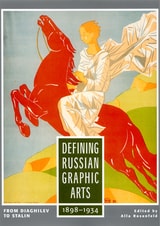
Defining Russian Graphic Arts
From Diaghilev to Stalin, 1898-1934Rosenfeld, Alla
Rutgers University Press, 1999
Defining Russian Graphic Arts explores the energy and innovation of Russian graphic arts during the period which began with the explosion of artistic creativity initiated by Serge Diaghilev at the end of the nineteenth century and which ended in the mid-1930s with Stalin's devastating control over the arts. This beautifully illustrated book represents the development of Russian graphic arts as a continuum during these forty years, and places Suprematism and Constructivism in the context of the other major, but lesser-known, manifestations of early twentieth-century Russian art.
The book includes such diverse categories of graphic arts as lubki (popular prints), posters and book designs, journals, music sheets, and ephemera. It features not only standard types of printed media and related studies and maquettes, but also a number of watercolor and gouache costume and stage designs.
About 100 works borrowed from the National Library of Russia and the Research Museum of the Academy of Fine Arts in St. Petersburg, Russia-many seen here for the first time outside of Russia-are featured in this book. Additional works have been drawn from the Zimmerli Art Museum, The New York Public Library, and from other public and private collections. Together they provide a rare opportunity to view and learn about a wide variety of artists, from the acclaimed to the lesser known.
This book is a companion volume to an exhibition appearing at the Jane Voorhees Zimmerli Art Museum at Rutgers University.

Deformative Fictions
Cruelty and Narrative Ethics in Twentieth-Century Latin American LiteratureAshley Hope Pérez
The Ohio State University Press, 2024

Degas at the Gas Station
EssaysThomas Beller
Duke University Press, 2025

Degrees of Allegiance
Harassment and Loyalty in Missouri’s German-American Community during World War IPetra DeWitt
Ohio University Press, 2012
Historians have long argued that the Great War eradicated German culture from American soil. Degrees of Allegiance examines the experiences of German-Americans living in Missouri during the First World War, evaluating the personal relationships at the local level that shaped their lives and the way that they were affected by national war effort guidelines. Spared from widespread hate crimes, German-Americans in Missouri did not have the same bleak experiences as other German-Americans in the Midwest or across America. But they were still subject to regular charges of disloyalty, sometimes because of conflicts within the German-American community itself.
Degrees of Allegiance updates traditional thinking about the German-American experience during the Great War, taking into account not just the war years but also the history of German settlement and the war’s impact on German-American culture.