Results by title
1882 books match the query 'Criticism and interpretation' and 60 start with d
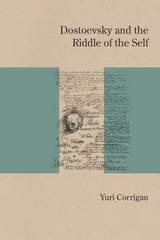
Dostoevsky and the Riddle of the Self
Yuri Corrigan
Northwestern University Press, 2017
Dostoevsky was hostile to the notion of individual autonomy, and yet, throughout his life and work, he vigorously advocated the freedom and inviolability of the self. This ambivalence has animated his diverse and often self-contradictory legacy: as precursor of psychoanalysis, forefather of existentialism, postmodernist avant la lettre, religious traditionalist, and Romantic mystic.
Dostoevsky and the Riddle of the Self charts a unifying path through Dostoevsky's artistic journey to solve the “mystery” of the human being. Starting from the unusual forms of intimacy shown by characters seeking to lose themselves within larger collective selves, Yuri Corrigan approaches the fictional works as a continuous experimental canvas on which Dostoevsky explored the problem of selfhood through recurring symbolic and narrative paradigms. Presenting new readings of such works as The Idiot, Demons, and The Brothers Karamazov, Corrigan tells the story of Dostoevsky’s career-long journey to overcome the pathology of collectivism by discovering a passage into the wounded, embattled, forbidding, revelatory landscape of the psyche.
Corrigan’s argument offers a fundamental shift in theories about Dostoevsky's work and will be of great interest to scholars of Russian literature, as well as to readers interested in the prehistory of psychoanalysis and trauma studies and in theories of selfhood and their cultural sources.
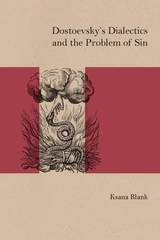
Dostoevsky's Dialectics and the Problem of Sin
Ksana Blank
Northwestern University Press, 2019
In Dostoevsky’s Dialectics and the Problem of Sin, Ksana Blank borrows from ancient Greek, Chinese, and Christian dialectical traditions to formulate a dynamic image of Dostoevsky’s dialectics—distinct from Hegelian dialectics—as a philosophy of “compatible contradictions.” Expanding on the classical triad of Goodness, Beauty, and Truth, Blank guides us through Dostoevsky’s most difficult paradoxes: goodness that begets evil, beautiful personalities that bring about grief, and criminality that brings about salvation.
Dostoevsky’s philosophy of contradictions, this book demonstrates, contributes to the development of antinomian thought in the writings of early twentieth-century Russian religious thinkers and to the development of Bakhtin’s dialogism. Dostoevsky’s Dialectics and the Problem of Sin marks an important and original intervention into the enduring debate over Dostoevsky’s spiritual philosophy.
Dostoevsky's Secrets
Reading Against the GrainCarol Apollonio
Northwestern University Press, 2009
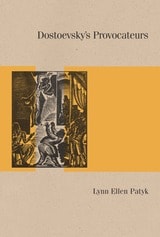
Dostoevsky’s Provocateurs
Lynn Ellen Patyk
Northwestern University Press, 2023
Confronting Bakhtin’s formative reading of Dostoevsky to recover the ways the novelist stokes conflict and engages readers—and to explore the reasons behind his adversarial approach
Like so many other elements of his work, Fyodor Dostoevsky’s deliberate deployment of provocation was both prescient and precocious. In this book, Lynn Ellen Patyk singles out these forms of incitement as a communicative strategy that drives his paradoxical art. Challenging, revising, and expanding on Mikhail Bakhtin’s foundational analysis in Problems of Dostoevsky’s Poetics, Patyk demonstrates that provocation is the moving mover of Dostoevsky’s poetics of conflict, and she identifies the literary devices he uses to propel plot conflict and capture our attention. Yet the full scope of Dostoevsky’s provocative authorial activity can only be grasped alongside an understanding of his key themes, which both probed and exploited the most divisive conflicts of his era. The ultimate stakes of such friction are, for him, nothing less than moral responsibility and the truth of identity.
Sober and strikingly original, compassionate but not uncritical, Dostoevsky’s Provocateurs exposes the charged current in the wiring of our modern selves. In an economy of attention and its spoils, provocation is an inexhaustibly renewable and often toxic resource.

Double Lives, Second Chances
The Cinema of Krzysztof KieslowskiAnnette Insdorf
Northwestern University Press, 2013
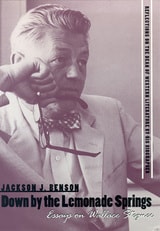
Down By The Lemonade Springs
Essays On Wallace StegnerJackson J. Benson
University of Nevada Press, 2001
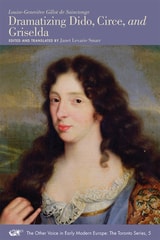
Dramatizing Dido, Circe, and Griselda
Louise-Geneviève Gillot de Sainctonge
Iter Press, 2010
—Perry Gethner
Norris Professor of French, Oklahoma State University
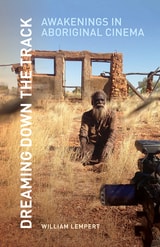
Dreaming Down the Track
Awakenings in Aboriginal CinemaWilliam Lempert
University of Minnesota Press, 2025
What can Aboriginal filmmaking reveal about Indigenous presence and futures?
The product of years of embedded fieldwork within Indigenous film crews in Northwestern Australia, Dreaming Down the Track delves deeply into Aboriginal cinema as a transformative community process. It follows the social lives of projects throughout their production cycles, from planning and editing to screening, broadcasting, and after-images. Across its narrative sweep, this ethnography engages the film career of Kukatja elder Mark Moora to demonstrate the impact of filmmaking on how Aboriginal futures are collectively imagined and called forth.
William Lempert highlights a series of awakenings through which Moora ultimately came to view cinema as a process for catalyzing his family’s return to their home country of Mangkayi. This biographical media journey paints an intimate portrait of the inspiring possibilities and sobering limitations of Indigenous envisioning within settler states. Lempert traces how Moora’s life and films convey a multiplicity of Aboriginal experiences across time and space, from colonial contact to contemporary life in communities like Balgo, including the continued governmental attempts to undermine them.
Amid ongoing negotiations to establish the first treaties between Indigenous nations and Australian states, Dreaming Down the Track illustrates what is at stake in how Aboriginal–State relations are represented and understood, both within communities and for the broader public. Lempert stays true to Moora’s insight that film can preserve community stories for generations to come, toward the aim of enacting sovereign futures.
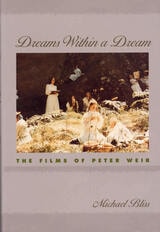
Dreams Within a Dream
The Films of Peter WeirMichael Bliss
Southern Illinois University Press, 2000
"What we see, and what we seem, are but a dream, a dream within a dream." Michael Bliss views Miranda's voice-over at the beginning of Picnic at Hanging Rock as so pivotal in explaining the films of Peter Weir that he borrows her words to create the title of his own study of the Australian filmmaker's work.
Bliss views Weir as an artist whose values are rooted in the realm of the dream, of the unconscious. Surrealistic in technique, Weir avoids the pedestrian assurances of a material realm in favor of an irresolution that, while potentially frustrating, is nonetheless for him a more truthful representation of what he considers reality. For Weir, as for Plato, Bliss demonstrates, "empirical reality is nothing more than a shadow of what is real."
Bliss also considers Weir's heritage. Australian cinema, Bliss explains, is characterized by melodramatic narratives born of a desire to see good and evil portrayed in striking opposition. Weir, for example, dramatizes the contradictory forces of light versus darkness, reason versus mystery, and rationality versus magic in such films as Picnic at Hanging Rock and The Last Wave. This melodramatic emphasis is evident as well in the polarized characterizations in such films as Witness, Dead Poets Society, and The Truman Show.
Bliss also discusses Weir's use of another staple of Australian cinema— "mateship," the celebration of the bond between male companions. But by making self-knowledge dependent on action involving one's friends, Weir gives mateship a new meaning. Moreover, like other Australian filmmakers, Weir emphasizes the starkness of the Australian landscape, which functions either as a hazard or a deadly challenge, at least until American mythology caused him to see nature in a more positive light. Also prominent in Weir's films is an Australian spirit of rebellion coupled with the Aussie ambivalence toward all aspects of British culture.
To help explain Weir's films, Bliss looks to Freud and Jung, whom Weir has studied, and also to two other prominent purveyors of myth and archetype, Northrop Frye and Joseph Campbell. Virtually all Weir characters struggle toward a new mode of awareness, a psychological awareness based on archetypal truths. Many of his films involve archetypal journeys heading through conflict to spiritual unity. Weir's quest is to find out what we really know and how we know what we know.
Dystopias of Infamy
Insult and Collective Identity in Early Modern SpainJavier Irigoyen-García
Bucknell University Press, 2022