289 books match the query 'Dance' and 55 start with d
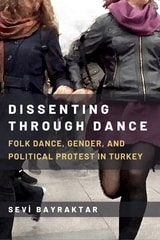
cover of Dissenting Through Dance: Folk Dance, Gender, and Political Protest in Turkey

Dissenting Through Dance

Folk Dance, Gender, and Political Protest in Turkey

Sevi Bayraktar

University of Michigan Press, 2026

Dissenting Through Dance examines how femme activists in contemporary Turkey deploy folk dance as a powerful tool of political resistance and collective solidarity. Drawing on extensive ethnographic fieldwork, choreographic analysis, and archival research, the book examines how traditional dances, particularly those rooted in marginalized cultures such as Kurdish, Roma, Alevi, Laz, and Hemşin communities, are reimagined to contest misogyny, cultural erasure, and oppressive gender politics. Sevi Bayraktar brings to life the stories of feminist, LGBTQ+, and grassroots activists occupying public spaces with dance as a form of protest when conventional forms of assembly are suppressed or criminalized in Turkey.

Working outward from these femmes’ stories, protests, and dances, Bayraktar argues that by reconfiguring Turkey’s folk-dance heritage for their contemporary political aims, dissenting femmes rechoreograph national space in opposition to the state as a way to reclaim the public sphere for pluralist democracy and to subvert hegemonic discourses about Turkish national identity, neoliberal economic development, and female and ethnic bodies. By moving together, activists subvert patriarchal norms, embody new visions of community, and create moments of hope, joy, and resistance even under conditions of surveillance and fear. 
[more]
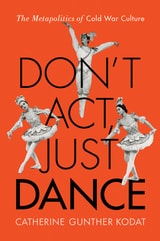
cover of Don't Act, Just Dance: The Metapolitics of Cold War Culture

Don't Act, Just Dance

The Metapolitics of Cold War Culture

Catherine Gunther Kodat

Rutgers University Press, 2014
At some point in their career, nearly all the dancers who worked with George Balanchine were told “don’t act, dear; just dance.” The dancers understood this as a warning against melodramatic over-interpretation and an assurance that they had all the tools they needed to do justice to the steps—but its implication that to dance is already to act in a manner both complete and sufficient resonates beyond stage and studio. 

Drawing on fresh archival material, Don’t Act, Just Dance places dance at the center of the story of the relationship between Cold War art and politics. Catherine Gunther Kodat takes Balanchine’s catch phrase as an invitation to explore the politics of Cold War culture—in particular, to examine the assumptions underlying the role of “apolitical” modernism in U.S. cultural diplomacy. Through close, theoretically informed readings of selected important works—Marianne Moore’s “Combat Cultural,” dances by George Balanchine, Merce Cunningham, and Yuri Grigorovich, Stanley Kubrick’s Spartacus, and John Adams’s Nixon in China—Kodat questions several commonly-held beliefs about the purpose and meaning of modernist cultural productions during the Cold War. 

Rather than read the dance through a received understanding of Cold War culture, Don’t Act, Just Dance reads Cold War culture through the dance, and in doing so establishes a new understanding of the politics of modernism in the arts of the period. 
[more]
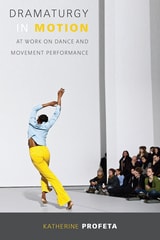
cover of Dramaturgy in Motion: At Work on Dance and Movement Performance

Dramaturgy in Motion

At Work on Dance and Movement Performance

Katherine Profeta

University of Wisconsin Press, 2015

Dramaturgy in Motion innovatively examines the work of the dramaturg in contemporary dance and movement performance. Katherine Profeta, a working dramaturg for more than fifteen years, shifts the focus from asking “Who is the dramaturg?” to “What does the dramaturg think about?”
            Profeta explores five arenas for the dramaturg’s attention—text and language, research, audience, movement, and interculturalism. Drawing on her extended collaboration with choreographer and visual artist Ralph Lemon, she grounds her thinking in actual rehearsal-room examples and situates practice within theoretical discourse about contemporary dramaturgy. Moving between theory and practice, word and movement, question and answer until these distinctions blur, she develops the foundational concept of dramaturgical labor as a quality of motion.
            Dramaturgy in Motion will be invaluable to practitioners and scholars interested in the processes of creating contemporary dance and movement performance—particularly artists wondering what it might be like to collaborate with a dramaturg and dramaturgs wondering what it might be like to collaborate on movement performance. The book will also appeal to those intrigued by the work of Lemon and his collaborators, to which Profeta turns repeatedly to unfold the thorny questions and rich benefits of dramaturgical labor.
[more]
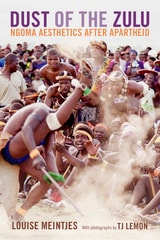
cover of Dust of the Zulu: Ngoma Aesthetics after Apartheid

Dust of the Zulu

Ngoma Aesthetics after Apartheid

Louise Meintjes

Duke University Press, 2017
In Dust of the Zulu Louise Meintjes traces the political and aesthetic significance of ngoma, a competitive form of dance and music that emerged out of the legacies of colonialism and apartheid in South Africa. Contextualizing ngoma within South Africa's history of violence, migrant labor, the HIV epidemic, and the world music market, Meintjes follows a community ngoma team and its professional subgroup during the twenty years after apartheid's end. She intricately ties aesthetics to politics, embodiment to the voice, and masculine anger to eloquence and virtuosity, relating the visceral experience of ngoma performances as they embody the expanse of South African history. Meintjes also shows how ngoma helps build community, cultivate responsible manhood, and provide its participants with a means to reconcile South Africa's past with its postapartheid future. Dust of the Zulu includes over one hundred photographs of ngoma performances, the majority taken by award-winning photojournalist TJ Lemon.
[more]
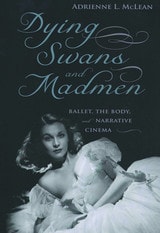
cover of Dying Swans and Madmen: Ballet, the Body, and Narrative Cinema

Dying Swans and Madmen

Ballet, the Body, and Narrative Cinema

McLean, Adrienne L

Rutgers University Press, 2008

From mid-twentieth-century films such as Grand Hotel, Waterloo Bridge, and The Red Shoes to recent box-office hits including Billy Elliot, Save the Last Dance, and The Company, ballet has found its way, time and again, onto the silver screen and into the hearts of many otherwise unlikely audiences. In Dying Swans and Madmen, Adrienne L. McLean explores the curious pairing of classical and contemporary, art and entertainment, high culture and popular culture to reveal the ambivalent place that this art form occupies in American life.

Drawing on examples that range from musicals to tragic melodramas, she shows how commercial films have produced an image of ballet and its artists that is associated both with joy, fulfillment, fame, and power and with sexual and mental perversity, melancholy, and death. Although ballet is still received by many with a lack of interest or outright suspicion, McLean argues that these attitudes as well as ballet's popularity and its acceptability as a way of life and a profession have often depended on what audiences first learned about it from the movies.


[more]