Results by title
1049 books match the query 'English, Irish, Scottish, Welsh' and 53 start with d

Dreaming in Books
The Making of the Bibliographic Imagination in the Romantic AgeAndrew Piper
University of Chicago Press, 2009
At the turn of the nineteenth century, publishing houses in London, New York, Paris, Stuttgart, and Berlin produced books in ever greater numbers. But it was not just the advent of mass printing that created the era’s “bookish” culture. According to Andrew Piper, romantic writing and romantic writers played a crucial role in adjusting readers to this increasingly international and overflowing literary environment. Learning how to use and to want books occurred through more than the technological, commercial, or legal conditions that made the growing proliferation of books possible; the making of such bibliographic fantasies was importantly a product of the symbolic operations contained within books as well.
Examining novels, critical editions, gift books, translations, and illustrated books, as well as the communities who made them, Dreaming in Books tells a wide-ranging story of the book’s identity at the turn of the nineteenth century. In so doing, it shows how many of the most pressing modern communicative concerns are not unique to the digital age but emerged with a particular sense of urgency during the bookish upheavals of the romantic era. In revisiting the book’s rise through the prism of romantic literature, Piper aims to revise our assumptions about romanticism, the medium of the printed book, and, ultimately, the future of the book in our so-called digital age.
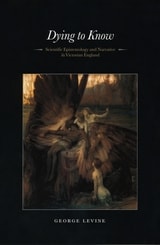
Dying to Know
Scientific Epistemology and Narrative in Victorian EnglandGeorge Levine
University of Chicago Press, 2002
In Dying to Know, eminent critic George Levine makes a landmark contribution to the history and theory of scientific knowledge. This long-awaited book explores the paradoxes of our modern ideal of objectivity, in particular its emphasis on the impersonality and disinterestedness of truth. How, asks Levine, did this idea of selfless knowledge come to be established and moralized in the nineteenth century?
Levine shows that for nineteenth-century scientists, novelists, poets, and philosophers, access to the truth depended on conditions of such profound self-abnegation that pursuit of it might be taken as tantamount to the pursuit of death. The Victorians, he argues, were dying to know in the sense that they could imagine achieving pure knowledge only in a condition where the body ceases to make its claims: to achieve enlightenment, virtue, and salvation, one must die.
Dying to Know is ultimately a study of this moral ideal of epistemology. But it is also something much more: a spirited defense of the difficult pursuit of objectivity, the ethical significance of sacrifice, and the importance of finding a shareable form of knowledge.
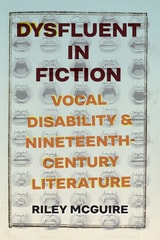
Dysfluent in Fiction
Vocal Disability and Nineteenth-Century LiteratureRiley McGuire
The Ohio State University Press, 2025
Honorable Mention, 2025 Victorian Popular Fiction Association First Book Prize
In Dysfluent in Fiction, Riley McGuire unspools a literary history of vocal disability in the nineteenth century, arguing that this underexamined literary trope helps us to understand vocal hierarchies that still structure our present. Adopting the term “dysfluency” to show departure from normative expectations of pace, pitch, and fluency, McGuire reveals how dysfluent speech populates an enormous number of nineteenth-century texts and played a formative role in the lives of some of the period’s most influential writers.
Dysfluent in Fiction examines anglophone literature during the long nineteenth century in both England and America by authors such as William Makepeace Thackeray, Charlotte Brontë, Lewis Carroll, Mary Elizabeth Braddon, and Frederick Douglass. Examples of dysfluencies across genres include lisping lovers, a baby-talking fairy, a mute detective, various disabilities in narratives of enslavement, and more. These representations show how disabled speech was both stigmatized and celebrated in ways that clarify our contemporary response to the spectrum of human articulation and that are a vocal corollary to current notions of neurodiversity. Dysfluency’s power, McGuire contends, lies in its denial that a single mode of articulation is possible, let alone desirable.