Results by title
1104 books match the query 'Gender Studies' and 52 start with d
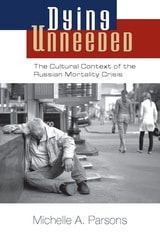
Dying Unneeded
The Cultural Context of the Russian Mortality CrisisMichelle A. Parsons
Vanderbilt University Press, 2014
Middle-aged Muscovites talk about being unneeded (ne nuzhny), or having little to give others. Considering this concept of "being unneeded" reveals how political economic transformation undermined the logic of social relations whereby individuals used their position within the Soviet state to give things to other people. Being unneeded is also gendered--while women are still needed by their families, men are often unneeded by state or family. Western literature on the mortality crisis focuses on a lack of social capital, often assuming that what individuals receive is most important, but being needed is more about what individuals give. Social connections--and their influence on health--are culturally specific.
In Soviet times, needed people helped friends and acquaintances push against the limits of the state, crafting a sense of space and freedom. When the state collapsed, this sense of bounded freedom was compromised, and another freedom became deadly.
This book is a recipient of the annual Norman L. and Roselea J. Goldberg Prize for the best project in the area of medicine.
Dépossession
Athena Athanasiou and Judith Butler
Diaphanes, 2016
Les soulèvements révolutionnaires au Moyen-Orient et au Maghreb, comme les manifestations sur la place Puerta del Sol, la place Syntagma et le parc Zucotti établissent une nouvelle économie politique et affective du corps dans l’espace public. La rue est l’endroit par excellence des expropriés — de ceux qui défient les forces de police et qui se regroupent spontanément dans des collectifs pour lever la voix, pour être vus et entendus. Le livre offre une introduction à la complexité des nouvelles formes de privation de droits, de dépossession et de contestation politique. Une réflexion sur la puissance du perfomatif ainsi que sur la perte de pouvoir du sujet souverain et moral classique.