1441 books match the query 'Great Britain' and 57 start with d
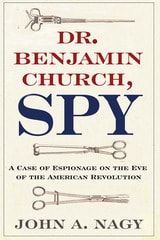
cover of Dr. Benjamin Church, Spy: A Case of Espionage on the Eve of the American Revolution

Dr. Benjamin Church, Spy

A Case of Espionage on the Eve of the American Revolution

John A. Nagy

Westholme Publishing, 2013

Newly Discovered Evidence Against a Man Who Has Long Been Suspected as Being a British Agent and America’s First Traitor 
“John Nagy has devoted his astonishing research skills to unearthing the truth about the least known and most dangerous spy in American history.”—Thomas Fleming, author of Liberty! The American Revolution
Dr. Benjamin Church, Jr. (1734–1778) was a respected medical man and civic leader in colonial Boston who was accused of being an agent for the British in the 1770s, providing compromising intelligence about the plans of the provincial leadership in Massachusetts as well as important information from the meetings of the First Continental Congress in Philadelphia. Despite his eminence as a surgeon—he conducted an autopsy on one of the victims of the Boston Massacre—and his own correspondence and the numbers of references to him from contemporaries, no known image of him exists and many aspects of his life remain obscure. What we do know is that George Washington accused him of being a traitor to the colonial cause and had him arrested and tried; after first being jailed in Connecticut and then Massachusetts, during which he continued to profess his innocence, he was allowed to leave America on a British vessel in 1778, but it foundered in the Atlantic with all hands lost. The question of whether Dr. Benjamin Church was working for the British has never been conclusively demonstrated, and remains among the mysteries of the American Revolution.
In Dr. Benjamin Church, Spy: A Case of Espionage on the Eve of the American Revolution, noted authority John A. Nagy has scoured original documents to establish the best case against Church, identifying previously unacknowledged correspondence and reports as containing references to the doctor and his activities, and noting an incriminating letter in the possession of the Library of Congress that is a coded communication composed by Church to his British contact. Nagy shows that at the cusp of the revolution, when the possibility—let alone the outcome—of an American colonial rebellion was far from assured, Church sought to align himself with the side he thought would emerge victorious—the British crown—and thus line his pockets with money that he desperately needed. A fascinating investigation into a centuries-old intrigue, this well-researched volume is an important contribution to American Revolution scholarship.
 
[more]
cover of Drawing the Line: The Irish Border in British Politics

Drawing the Line

The Irish Border in British Politics

Ivan Gibbons

Haus Publishing, 2017

Though once a source of violent conflict, the border dividing the Republic of Ireland from Northern Ireland has been relatively stable in recent years. The border’s creation in 1921 exacerbated hostile relations between Ireland and Britain in the subsequent decades, hostility that frequently broke out into violent conflict until the breakthrough Good Friday Agreement of 1998. That landmark policy declared that there will be no change in the status of the border unless there is a majority decision in Northern Ireland in favor, and the relaxation in tensions it brought has been hailed as one of the great breakthroughs for peace in our era. Now, however, as the UK prepares to leave the European Union in 2019, the Irish border is once again a hot-button issue and pivotal to any settlement reached. To enable a fuller understanding of this open question, Drawing the Line provides a concise explanation of the current controversy by sketching it in its full historical context.
[more]
cover of Dreamer of the Ghetto: The Life and Works of Israel Zangwill

Dreamer of the Ghetto

The Life and Works of Israel Zangwill

Joseph H. Udelson

University of Alabama Press, 1990

"An impressive achievement. . . . Udelson provides a trenchant analysis of Zangwill's works set within a historical context, i.e., Jewish emancipation and the dilemma of how one might remain fully Jewish while becoming fully modern, that helps to illuminate Zangwill's life as well as his writings."

—Jewish Book News

"By carefully following the threads of Zangwill's own divided self through the labyrinths of his life and writings, Udelson convinces us not only of the author's startling political prescience, but that he embodies attitudes now shared by almost all secular Jews as a result of events Zangwill did not witness—Nazism and the founding of Israel."

—Shofar

[more]
cover of Dreams, Questions, Struggles: South Asian Women in Britain

Dreams, Questions, Struggles

South Asian Women in Britain

Amrit Wilson

Pluto Press, 2006

From schoolgirls to matriarchs, single mothers to extended families, and businesswomen to factory workers, the experience of Asian women in Britain today is polarised by class and religion.

This book explores the lives and struggles of two generations of British Asian women to present a political account of their experiences: personal and public, individual and collective, their struggles take on power structures within the family, the community and, on occasion, the British state.

Combining their personal testimony within a theoretical framework, Amrit Wilson locates their experiences in the wider context of global and regional politics. She examines what impact the feminist movement has had on their lives, and explores issues such as domestic violence, Asian marriages, representations of Asian women, mental disturbance and suicide.
[more]
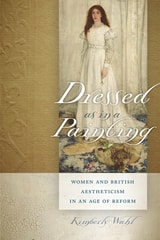
cover of Dressed as in a Painting: Women and British Aestheticism in an Age of Reform

Dressed as in a Painting

Women and British Aestheticism in an Age of Reform

Kimberly Wahl

University of New Hampshire Press, 2013
In Dressed as in a Painting, Kimberly Wahl provides a lucid exploration of the interrelations between fashion, art, and Aestheticism during the latter half of the nineteenth century. Although artistic forms of dress have been the subject of short studies before, no book has focused exclusively on Aesthetic dress and its various expressions in the visual cultures of Victorian Britain. More important, no book has attempted to investigate the gap between the material facts of artistic clothing as it was embodied on the wearer, and its presence as an idealized sartorial trope in the visual and textual print culture of the period.
[more]
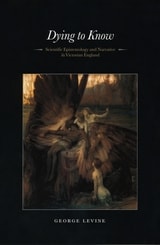
cover of Dying to Know: Scientific Epistemology and Narrative in Victorian England

Dying to Know

Scientific Epistemology and Narrative in Victorian England

George Levine

University of Chicago Press, 2002

"Dying to Know is the work of a distinguished scholar, at the peak of his powers, who is intimately familiar with his materials, and whose knowledge of Victorian fiction and scientific thought is remarkable. This elegant and evocative look at the move toward objectivity first pioneered by Descartes sheds new light on some old and still perplexing problems in modern science." Bernard Lightman, York University, Canada

In Dying to Know, eminent critic George Levine makes a landmark contribution to the history and theory of scientific knowledge. This long-awaited book explores the paradoxes of our modern ideal of objectivity, in particular its emphasis on the impersonality and disinterestedness of truth. How, asks Levine, did this idea of selfless knowledge come to be established and moralized in the nineteenth century?

Levine shows that for nineteenth-century scientists, novelists, poets, and philosophers, access to the truth depended on conditions of such profound self-abnegation that pursuit of it might be taken as tantamount to the pursuit of death. The Victorians, he argues, were dying to know in the sense that they could imagine achieving pure knowledge only in a condition where the body ceases to make its claims: to achieve enlightenment, virtue, and salvation, one must die.

Dying to Know is ultimately a study of this moral ideal of epistemology. But it is also something much more: a spirited defense of the difficult pursuit of objectivity, the ethical significance of sacrifice, and the importance of finding a shareable form of knowledge.
[more]
cover of Dynamic Partisanship: How and Why Voter Loyalties Change

Dynamic Partisanship

How and Why Voter Loyalties Change

Ken Kollman and John E. Jackson

University of Chicago Press, 2021

Why do people identify with political parties? How stable are those identifications? Stable party systems, with a limited number of parties and mostly stable voter identification with a party, are normally considered significant signals of a steady democracy. In Dynamic Partisanship, Ken Kollman and John E. Jackson study changing patterns of partisanship in the United States, the United Kingdom, Canada, and Australia over the last fifty years in order to disentangle possible reasons for shifting partisanship and party identification. The authors argue that changes in partisanship can be explained by adjustments in voters’ attitudes toward issues or parties; the success or failure of policies advocated by parties; or alterations in parties’ positions on key issues. They contend that, while all three factors contribute, it is the latter, a party changing positions on a chief concern, that most consistently leads voters to or from a particular party. Their approach provides a deeper knowledge of the critical moving parts in democratic politics. 
[more]