Results by title
2646 books match the query 'History & Criticism' and 101 start with d
Difficult Rhythm
Music and the Word in E.M. ForsterMichelle Fillion
University of Illinois Press, 2013
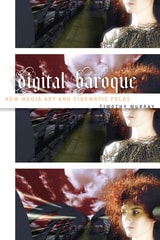
Digital Baroque
New Media Art and Cinematic FoldsTimothy Murray
University of Minnesota Press, 2008
A surprising and original application of theories of new media art
In this intellectually groundbreaking work, Timothy Murray investigates a paradox embodied in the book’s title: What is the relationship between digital, in the form of new media art, and baroque, a highly developed early modern philosophy of art? Making an exquisite and unexpected connection between the old and the new, Digital Baroque analyzes the philosophical paradigms that inform contemporary screen arts.
Examining a wide range of art forms, Murray reflects on the rhetorical, emotive, and social forces inherent in the screen arts’ dialogue with early modern concepts. Among the works discussed are digitally oriented films by Peter Greenaway, Jean-Luc Godard, and Chris Marker; video installations by Thierry Kuntzel, Keith Piper, and Renate Ferro; and interactive media works by Toni Dove, David Rokeby, and Jill Scott. Sophisticated readings reveal the electronic psychosocial webs and digital representations that link text, film, and computer. Murray puts forth an innovative Deleuzian psychophilosophical approach—one that argues that understanding new media art requires a fundamental conceptual shift from linear visual projection to nonlinear temporal folds intrinsic to the digital form.
Digital Music Videos
Shaviro, Steven
Rutgers University Press, 2017
As these videos have proliferated online, they have become more widely accessible than ever before. In Digital Music Videos, Steven Shaviro examines the ways that music videos interact with and change older media like movies and gallery art; the use of technologies like compositing, motion control, morphing software, and other digital special effects in order to create a new organization of time and space; how artists use music videos to project their personas; and how less well known musicians use music videos to extend their range and attract attention.
Surveying a wide range of music videos, Shaviro highlights some of their most striking innovations while illustrating how these videos are creating a whole new digital world for the music industry.
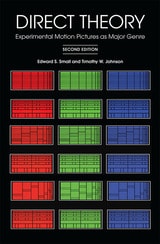
Direct Theory
Experimental Motion Pictures as Major GenreEdward S. Small and Timothy W. Johnson
Southern Illinois University Press, 2013
Making the case for the significance of experimental motion pictures
Undulating water patterns; designs etched or painted directly onto clear or black film leader; computer-generated, pulsating, multihued light tapestries—the visual images that often constitute experimental motion pictures are unlike anything found in either fictive narratives or documentary works. Thus, Direct Theory provides an historical and theoretical survey of this overlooked and misunderstood body of international films, videos, and digital productions that offers a strong case for the understanding of experimental motion pictures as a separate, major motion picture genre.
In a radical revision of film-theory that incorporates Ferdinand de Saussure's semiotic system, and adds to it historian Raymond Fielding’s technological determinism, Edward S. Small and Timothy W. Johnson argue that experimental moviemaking constitutes a special mode of theory that bypasses written and spoken words. By exploring the development of experimental motion pictures over nine decades, they trace the practice from its beginnings in the European avant-garde movement in the 1920s, through American underground productions, into international structuralist works that marked the experimental films of the 1970’s, and finally the digital experimental innovations of the twenty-first century.
To demonstrate that the aesthetic of experimental motion pictures is best understood separately from other major film genres such as fictive narrative and documentary, Small and Johnson highlight eight defining technical and structural characteristics of experimental productions, including the autonomy of the artist, economic independence, brevity, and the use of dreams, reveries, hallucinations, and other mental imagery. They also highlight a number of films, including Ralph Steiner’s 1929 H2Oand Bruce Conner’s 1958 A Movie,and provide a sampling of frames from them to demonstrate that the heightened reflexivity of these films transmit meaning through images rather than words.
A deft historical interweaving of experimental production and scholarly discourse, this thought-provoking work firmly establishes the importance of experimental motion pictures in the discipline of film studies (theory and history) and production.
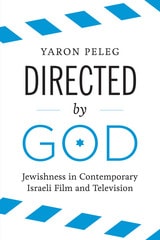
Directed by God
Jewishness in Contemporary Israeli Film and TelevisionBy Yaron Peleg
University of Texas Press, 2016
As part of its effort to forge a new secular Jewish nation, the nascent Israeli state tried to limit Jewish religiosity. However, with the steady growth of the ultraorthodox community and the expansion of the settler community, Israeli society is becoming increasingly religious. Although the arrival of religious discourse in Israeli politics has long been noticed, its cultural development has rarely been addressed. Directed by God explores how the country’s popular media, principally film and television, reflect this transformation. In doing so, it examines the changing nature of Zionism and the place of Judaism within it.
Once the purview of secular culture, Israel’s media initially promoted alternatives to traditional religious expression; however, using films such as Kadosh, Waltz with Bashir, and Eyes Wide Open, Yaron Peleg shows how Israel’s contemporary film and television programs have been shaped by new religious trends and how secular Israeli culture has processed and reflected on its religious heritage. He investigates how shifting cinematic visions of Jewish masculinity and gender track transformations in the nation’s religious discourse. Moving beyond the secular/religious divide, Directed by God explores changing film and television representations of different Jewish religious groups, assessing what these representations may mean for the future of Israeli society.
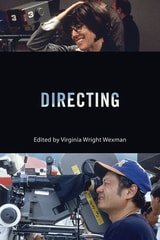
Directing
Virginia Wright Wexman
Rutgers University Press, 2017
The latest volume in the Behind the Silver Screen series, this collection provides the first comprehensive overview of how directing, as both an art and profession, has evolved in tandem with changing film industry practices. Each chapter is written by an expert on a different period of Hollywood, from the silent film era to today’s digital filmmaking, providing in-depth examinations of key trends like the emergence of independent production after World War II and the rise of auteurism in the 1970s. Challenging the myth of the lone director, these studies demonstrate how directors work with a multitude of other talented creative professionals, including actors, writers, producers, editors, and cinematographers.
Directing examines a diverse range of classic and contemporary directors, including Orson Welles, Tim Burton, Cecil B. DeMille, Steven Soderbergh, Spike Lee, and Ida Lupino, offering a rich composite picture of how they have negotiated industry constraints, utilized new technologies, and harnessed the creative contributions of their many collaborators throughout a century of Hollywood filmmaking.

Directing Shakespeare
A Scholar OnstageSidney Homan
Ohio University Press, 2004
An impossible question from a Chinese actor—“Why is Shakespeare eternal?”—drove Sidney Homan after fifty years in the theater to ponder just what makes Shakespeare…well, Shakespeare. The result, Directing Shakespeare, reflects the two worlds in which Homan operates—as a scholar and teacher on campus, and as a director and actor in professional and university theaters. His concern is the entire process, beginning in the lonely period when the director develops a concept, and moving into increasingly larger realms: interaction with stage designers; rehearsals; and performances in which the audience’s response further shapes the play.
Homan recounts the experience of staging King Lear accompanied by a musical score for piano, violin, and cello played live onstage. He discusses the challenge of making and trying to justify cuts in Hamlet. A casual remark from an actress leads to a feminist production of A Midsummer Night’s Dream. He describes the delicate collaboration between director and performer as he works with actors preparing for The Merchant of Venice, King Lear, and Hamlet. Other chapters treat a set designer’s bold red drapes that influenced the director’s concept for Julius Caesar, and the cross-influence of back-to-back runs of Stoppard’s Rosencrantz and Guildenstsern Are Dead and Hamlet.
In a highly personal concluding chapter, Homan tells of joyously working with a spontaneous young actor playing Puck and with an audience of unruly teenagers who wept at a performance of Lear.
Delightfully written, and filled with practical insights, Directing Shakespeare draws together scholars, critics, and those who work in the theater to bring the written word to life.
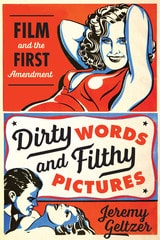
Dirty Words and Filthy Pictures
Film and the First AmendmentBy Jeremy Geltzer
University of Texas Press, 2015
From the earliest days of cinema, scandalous films such as The Kiss (1896) attracted audiences eager to see provocative images on screen. With controversial content, motion pictures challenged social norms and prevailing laws at the intersection of art and entertainment. Today, the First Amendment protects a wide range of free speech, but this wasn’t always the case. For the first fifty years, movies could be censored and banned by city and state officials charged with protecting the moral fabric of their communities. Once film was embraced under the First Amendment by the Supreme Court’s Miracle decision in 1952, new problems pushed notions of acceptable content even further.
Dirty Words & Filthy Pictures explores movies that changed the law and resulted in greater creative freedom for all. Relying on primary sources that include court decisions, contemporary periodicals, state censorship ordinances, and studio production codes, Jeremy Geltzer offers a comprehensive and fascinating history of cinema and free speech, from the earliest films of Thomas Edison to the impact of pornography and the Internet. With incisive case studies of risqué pictures, subversive foreign films, and banned B-movies, he reveals how the legal battles over film content changed long-held interpretations of the Constitution, expanded personal freedoms, and opened a new era of free speech. An important contribution to film studies and media law, Geltzer’s work presents the history of film and the First Amendment with an unprecedented level of detail.
Disappearing Acts
Spectacles of Gender and Nationalism in Argentina's "Dirty War"Diana Taylor
Duke University Press, 1997
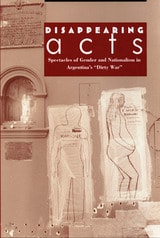
Taylor uses performance theory to explore how public spectacle both builds and dismantles a sense of national and gender identity. Here, nation is understood as a product of communal "imaginings" that are rehearsed, written, and staged—and spectacle is the desiring machine at work in those imaginings. Taylor argues that the founding scenario of Argentineness stages the struggle for national identity as a battle between men—fought on, over, and through the feminine body of the Motherland. She shows how the military’s representations of itself as the model of national authenticity established the parameters of the conflict in the 70s and 80s, feminized the enemy, and positioned the public—limiting its ability to respond. Those who challenged the dictatorship, from the Mothers of the Plaza de Mayo to progressive theater practitioners, found themselves in what Taylor describes as "bad scripts." Describing the images, myths, performances, and explanatory narratives that have informed Argentina’s national drama, Disappearing Acts offers a telling analysis of the aesthetics of violence and the disappearance of civil society during Argentina’s spectacle of terror.
Disappearing Acts
Spectacles of Gender and Nationalism in Argentina's "Dirty War"Diana Taylor
Duke University Press, 0
Taylor uses performance theory to explore how public spectacle both builds and dismantles a sense of national and gender identity. Here, nation is understood as a product of communal "imaginings" that are rehearsed, written, and staged—and spectacle is the desiring machine at work in those imaginings. Taylor argues that the founding scenario of Argentineness stages the struggle for national identity as a battle between men—fought on, over, and through the feminine body of the Motherland. She shows how the military’s representations of itself as the model of national authenticity established the parameters of the conflict in the 70s and 80s, feminized the enemy, and positioned the public—limiting its ability to respond. Those who challenged the dictatorship, from the Mothers of the Plaza de Mayo to progressive theater practitioners, found themselves in what Taylor describes as "bad scripts." Describing the images, myths, performances, and explanatory narratives that have informed Argentina’s national drama, Disappearing Acts offers a telling analysis of the aesthetics of violence and the disappearance of civil society during Argentina’s spectacle of terror.
Disappearing Tricks
Silent Film, Houdini, and the New Magic of the Twentieth CenturyMatthew Solomon
University of Illinois Press, 2010
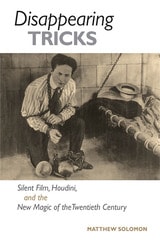
Disappearing Tricks revisits the golden age of theatrical magic and silent film to reveal how professional magicians shaped the early history of cinema. Where others have called upon magic as merely an evocative metaphor for the wonders of cinema, Matthew Solomon focuses on the work of the professional illusionists who actually made magic with moving pictures between 1895 and 1929.
The first to reveal fully how powerfully magic impacted the development of cinema, the book combines film and theater history to uncover new evidence of the exchanges between magic and filmmaking in the United States and France during the silent period. Chapters detailing the stage and screen work of Harry Houdini and Georges Méliès show how each transformed theatrical magic to create innovative cinematic effects and thrilling new exploits for twentieth-century mass audiences. The book also considers the previously overlooked roles of anti-spiritualism and presentational performance in silent film.
Highlighting early cinema's relationship to the performing body, visual deception, storytelling, and the occult, Solomon treats cinema and stage magic as overlapping practices that together revise our understanding of the origins of motion pictures and cinematic spectacle.
Discorrelated Images
Shane Denson
Duke University Press, 2020
Disintegrating the Musical
Black Performance and American Musical FilmArthur Knight
Duke University Press, 2002
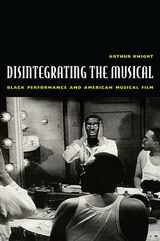
Arthur Knight focuses on American film’s classic sound era, when Hollywood studios made eight all-black-cast musicals—a focus on Afro-America unparalleled in any other genre. It was during this same period that the first black film stars—Paul Robeson, Louis Armstrong, Lena Horne, Harry Belafonte, Dorothy Dandridge—emerged, not coincidentally, from the ranks of musical performers. That these films made so much of the connection between African Americans and musicality was somewhat ironic, Knight points out, because they did so in a form (song) and a genre (the musical) celebrating American social integration, community, and the marriage of opposites—even as the films themselves were segregated and played before even more strictly segregated audiences.
Disintegrating the Musical covers territory both familiar—Show Boat, Stormy Weather, Porgy and Bess—and obscure—musical films by pioneer black director Oscar Micheaux, Lena Horne’s first film The Duke Is Tops, specialty numbers tucked into better-known features, and lost classics like the short Jammin’ the Blues. It considers the social and cultural contexts from which these films arose and how African American critics and audiences responded to them. Finally, Disintegrating the Musical shows how this history connects with the present practices of contemporary musical films like O Brother, Where Art Thou? and Bamboozled.
Disney Culture
Wills, John
Rutgers University Press, 2017
Disney Culture proposes that there is still a unifying Disney ethos, one that can be traced back to the corporate philosophy that Walt Disney himself developed back in the 1920s. Yet, as cultural historian John Wills demonstrates, Disney’s values have also adapted to changing social climates. At the same time, the world of Disney has profoundly shaped how Americans view the world.
Wills offers a nuanced take on the corporate ideologies running through animated and live-action Disney movies from Frozen to Fantasia, from Mary Poppins to Star Wars: The Force Awakens. But Disney Culture encompasses much more than just movies as it explores the intersections between Disney’s business practices and its cultural mythmaking. Welcome to “the Disney Way.”
Disney's Most Notorious Film
Race, Convergence, and the Hidden Histories of Song of the SouthBy Jason Sperb
University of Texas Press, 2012
The Walt Disney Company offers a vast universe of movies, television shows, theme parks, and merchandise, all carefully crafted to present an image of wholesome family entertainment. Yet Disney also produced one of the most infamous Hollywood films, Song of the South. Using cartoon characters and live actors to retell the stories of Joel Chandler Harris, SotS portrays a kindly black Uncle Remus who tells tales of Brer Rabbit, Brer Fox, and the “Tar Baby” to adoring white children. Audiences and critics alike found its depiction of African Americans condescending and outdated when the film opened in 1946, but it grew in popularity—and controversy—with subsequent releases. Although Disney has withheld the film from American audiences since the late 1980s, SotS has an enthusiastic fan following, and pieces of the film—such as the Oscar-winning “Zip-a-Dee-Doo-Dah”—remain throughout Disney’s media universe.
Disney’s Most Notorious Film examines the racial and convergence histories of Song of the South to offer new insights into how audiences and Disney have negotiated the film’s controversies over the last seven decades. Jason Sperb skillfully traces the film’s reception history, showing how audience perceptions of SotS have reflected debates over race in the larger society. He also explores why and how Disney, while embargoing the film as a whole, has repurposed and repackaged elements of SotS so extensively that they linger throughout American culture, serving as everything from cultural metaphors to consumer products.
Displaced Allegories
Post-Revolutionary Iranian CinemaNegar Mottahedeh
Duke University Press, 2008
Mottahedeh asserts that, in response to the prohibitions against the desiring look, a new narrative cinema emerged as the displaced allegory of the constraints on the post-Revolutionary Iranian film industry. Allegorical commentary was not developed in the explicit content of cinematic narratives but through formal innovations. Offering close readings of the work of the nationally popular and internationally renowned Iranian auteurs Bahram Bayza’i, Abbas Kiarostami, and Mohsen Makhmalbaf, Mottahedeh illuminates the formal codes and conventions of post-Revolutionary Iranian films. She insists that such analyses of cinema’s visual codes and conventions are crucial to the study of international film. As Mottahedeh points out, the discipline of film studies has traditionally seen film as a medium that communicates globally because of its dependence on a (Hollywood) visual language assumed to be universal and legible across national boundaries. Displaced Allegories demonstrates that visual language is not necessarily universal; it is sometimes deeply informed by national culture and politics.
Distant Cycles
Schubert and the Conceiving of SongRichard Kramer
University of Chicago Press, 1994
Returning the songs to their original keys, Kramer reveals linkages among songs which were often obscured as Schubert readied his compositions for publication. His analysis thus conveys even familiar songs in fresh contexts that will affect performance, interpretation, and criticism. After addressing problems of multiple settings and revisions, Kramer presents a series of briefs for the reconfiguring of sets of songs to poems by Goethe, Rellstab, and Heine. He deconstructs Winterreise, using its convoluted origins to illuminate its textual contradictions. Finally, Kramer scrutinizes settings from the Abendrote cycle (on poems by Friedrich Schlegel) for signs of cyclic process. Probing the farthest reaches of Schubert's engagement with the poetics of lieder, Distant Cycles exposes tensions between Schubert the composer and Schubert the merchant-entrepreneur.
Distant Melodies
Music in Search of HomeEdward Dusinberre
University of Chicago Press, 2022
How does music played and heard over many years inform one’s sense of home? Writing during the COVID-19 pandemic, when travel is forbidden and distance felt anew, Edward Dusinberre, first violinist of the world-renowned Takács Quartet, searches for answers in the music of composers whose relationships to home shaped the pursuit of their craft—Antonín Dvořák, Edward Elgar, Béla Bartók, and Benjamin Britten.
Dusinberre has lived abroad for three decades. At the age of 21, he left his native England to pursue music studies at the Juilliard School in New York. Three years later he moved to Boulder, Colorado. Drawn to the stories of Dvořák’s, Bartók’s, and Britten’s American sojourns as they tried to reconcile their new surroundings with nostalgia for their homelands, Dusinberre reflects on his own evolving relationship to England and the idea of home. As he visits and imagines some of the places crucial to these composers’ creative inspiration, Dusinberre also reflects on Elgar’s unusual Piano Quintet and the landscapes that inspired it.
Combining travel writing with revealing insights into the working lives of string quartet musicians, Distant Melodies is a moving and humorous meditation on the relationship between music and home.
Divas and Scholars
Performing Italian OperaPhilip Gossett
University of Chicago Press, 2006
Winner of the 2007 Otto Kinkeldey Award from the American Musicological Society and the 2007 Deems Taylor Award from the American Society of Composers, Authors, and Publishers.
Divas and Scholars is a dazzling and beguiling account of how opera comes to the stage, filled with Philip Gossett’s personal experiences of triumphant—and even failed—performances and suffused with his towering and tonic passion for music. Writing as a fan, a musician, and a scholar, Gossett, the world's leading authority on the performance of Italian opera, brings colorfully to life the problems, and occasionally the scandals, that attend the production of some of our most favorite operas.
Gossett begins by tracing the social history of nineteenth-century Italian theaters in order to explain the nature of the musical scores from which performers have long worked. He then illuminates the often hidden but crucial negotiations opera scholars and opera conductors and performers: What does it mean to talk about performing from a critical edition? How does one determine what music to perform when multiple versions of an opera exist? What are the implications of omitting passages from an opera in a performance? In addition to vexing questions such as these, Gossett also tackles issues of ornamentation and transposition in vocal style, the matters of translation and adaptation, and even aspects of stage direction and set design.
Throughout this extensive and passionate work, Gossett enlivens his history with reports from his own experiences with major opera companies at venues ranging from the Metropolitan and Santa Fe operas to the Rossini Opera Festival at Pesaro. The result is a book that will enthrall both aficionados of Italian opera and newcomers seeking a reliable introduction to it—in all its incomparable grandeur and timeless allure.
Divas on Screen
Black Women in American FilmMia Mask
University of Illinois Press, 2008
This insightful study places African American women's stardom in historical and industrial contexts by examining the star personae of five African American women: Dorothy Dandridge, Pam Grier, Whoopi Goldberg, Oprah Winfrey, and Halle Berry. Interpreting each woman's celebrity as predicated on a brand of charismatic authority, Mia Mask shows how these female stars have ultimately complicated the conventional discursive practices through which blackness and womanhood have been represented in commercial cinema, independent film, and network television.
Mask examines the function of these stars in seminal yet underanalyzed films. She considers Dandridge's status as a sexual commodity in films such as Tamango, revealing the contradictory discourses regarding race and sexuality in segregation-era American culture. Grier's feminist-camp performances in sexploitation pictures Women in Cages and The Big Doll House and her subsequent blaxploitation vehicles Coffy and Foxy Brown highlight a similar tension between representing African American women as both objectified stereotypes and powerful, self-defining icons. Mask reads Goldberg's transforming habits in Sister Act and The Associate as representative of her unruly comedic routines, while Winfrey's daily television performance as self-made, self-help guru echoes Horatio Alger narratives of success. Finally, Mask analyzes Berry's meteoric success by acknowledging the ways in which Dandridge's career made Berry's possible.
Documentary Time
Film and PhenomenologyMalin Wahlberg
University of Minnesota Press, 2008
Finding the theoretical space where cinema and philosophy meet, Malin Wahlberg’s sophisticated approach to the experience of documentary film aligns with attempts to reconsider the premises of existential phenomenology. The configuration of time is crucial in organizing the sensory affects of film in general but, as Wahlberg adroitly demonstrates, in nonfiction films the problem of managing time is writ large by the moving image’s interaction with social memory and historical figures.
Wahlberg discusses a thought-provoking corpus of classical and recent experiments in film and video (including Andy Warhol’s films) in which creative approaches to the time of the image and the potential archive memory of filmic representation illuminates meanings of temporality and time experience. She also offers a methodological account of film and brings Deleuze and Ricoeur into dialogue with Bazin and Mitry on the subject of cinema and phenomenology.
Drawing attention to the cultural significance of the images’ imprint as a trace of the past, Documentary Time brings to bear phenomenological inquiry on nonfiction film while at the same time reconsidering the existential dimensions of time that have always puzzled humans.
Malin Wahlberg is a research fellow in cinema studies at Stockholm University.
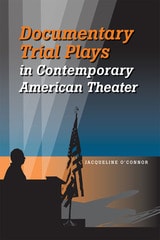
Documentary Trial Plays in Contemporary American Theater
Jacqueline O’Connor
Southern Illinois University Press, 2013
From the Chicago Conspiracy Trial and the O. J. Simpson trial to the Clarence Thomas/Anita Hill congressional hearings, legal and legislative proceedings in the latter part of the twentieth-century kept Americans spellbound. Situated on the shifting border between imagination and the law, trial plays edit, arrange, and reproduce court records, media coverage, and first-person interviews, transforming these elements into a performance. In this first book-length critical study of contemporary American documentary theater, Jacqueline O’Connor examines in depth ten such plays, all written and staged since 1970, and considers the role of the genre in re-creating and revising narratives of significant conflicts in contemporary history.
Documentary theater, she shows, is a particularly appropriate and widely utilized theatrical form for engaging in debate about tensions between civil rights and institutional power, the inconsistency of justice, and challenges to gender norms. For each of the plays discussed, including The Trial of the Catonsville Nine, Unquestioned Integrity: The Hill/Thomas Hearings, and The Laramie Project, O'Connor provides historical context and a brief production history before considering the trial the play focuses on. Grouping plays historically and thematically, she demonstrates how dramatic representation advances our understanding of the law's power while revealing the complexities that hinder society's pursuit of justice.
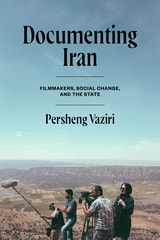
Documenting Iran
Filmmakers and Social ChangePersheng Vaziri
University of Texas Press, 2026
An ethnographic study of how Iranian documentary filmmakers navigate censorship and creativity to shape civic discourse.
Iranian filmmakers have overcome significant obstacles to create a distinctive, globally renowned cinema. Filmmaker and educator Persheng Vaziri explores how documentarians, in particular, have developed a dynamic and creative environment by negotiating limited resources and official constraints. Through their films, they share hard truths—and artful narratives—with fellow Iranians and viewers the world over.
Documenting Iran introduces key historical foundations of documentary filmmaking amid generations of political change—first under the shah and later the Islamic government—with a focus on contemporary filmmakers between 2000 and 2022. Drawing on interviews and ethnographic encounters, Vaziri describes the creative practices and pragmatic choices that provide documentarians relative independence from state censorship and other restrictions on artistic production. Relying on poetic aesthetics, observational filmmaking, international connections, and the accumulated knowledge of a tight-knit local community, filmmakers engage with controversial topics like women’s rights, marriage and divorce laws, environmental degradation, and encounters with Western culture. Documentarians have thus created an activist cinema both subtle and persuasive enough to challenge dogmatic rule and uphold progressive elements of Iranian society.
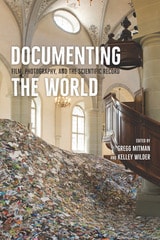
Documenting the World
Film, Photography, and the Scientific RecordEdited by Gregg Mitman and Kelley Wilder
University of Chicago Press, 2016
Documenting the World is about the material and social life of photographs and film made in the scientific quest to document the world. Drawing on scholars from the fields of art history, visual anthropology, and science and technology studies, the chapters in this book explore how this documentation—from the initial recording of images, to their acquisition and storage, to their circulation—has altered our lives, our ways of knowing, our social and economic relationships, and even our surroundings. Far beyond mere illustration, photography and film have become an integral, transformative part of the world they seek to show us.
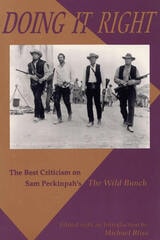
Doing It Right
The Best Criticism on Sam Peckinpah's The Wild BunchEdited with an Introduction by Michael Bliss
Southern Illinois University Press, 1994
Doing It Right brings together the very finest in reviews and criticism of The Wild Bunch since its release in 1969.
Often misinterpreted because of its graphic violence, the film initially generated considerable controversy. Sam Peckinpah, who made the film after a four-year forced hiatus in his career (he had been blacklisted), created it as a depiction of the savage behavior possible in the post– World War I era. However, the ensuing controversy was not restricted only to the explicit story and images. Producer Phil Feldman’s withdrawal of Peckinpah’s cut of the film drew tremendous sympathy for Peckinpah from American and European film critics alike.
This casebook should be read as a supplement to a viewing of the film, which is now available in its uncut form in video. Edited and with an introduction by Michael Bliss, the book explores the film’s production history, giving an overview of its release problems and highlighting its stylistic characteristics, classic structure, use of the widescreen frame, and innovative editing techniques. It also discusses in detail the film’s underlying moral message and its representation of camaraderie and loyalty. In addition to Bliss, essayists include Robert Culp, Paul Schrader, Stephen Farber, Paul Seydor, Jim Kitses, Cordell Strug, John L. Simons, Aljean Harmetz, and Michael Sragow. The book concludes with an appendix and an extensive bibliography.
Doing Women's Film History
Reframing Cinemas, Past and FutureEdited by Christine Gledhill and Julia Knight
University of Illinois Press, 2015
Don't Act, Just Dance
The Metapolitics of Cold War CultureCatherine Gunther Kodat
Rutgers University Press, 2014

Doomed by Hope
Essays on Arab TheatreEdited by Eyad Houssami and Elias Khoury
Pluto Press, 2012
Doomed by Hope is a beautifully presented collection of essays by writers and artists which traces the history of contemporary Arab theatre and its relationship to social change.
With contributors from Syria, Egypt, Lebanon, Palestine, Kuwait and Yemen, this book includes both academic discussions and personal narratives, alongside a number of specially commissioned portraits of contemporary Arab theatre artists. The essays revolve around the legacy of the late Syrian dramatist Saadallah Wannous, whose monumental plays incited audiences to rise up against tyranny decades ago.
This unique book is one of the first English language volumes on Arab theatre. In a highly topical manner following the Arab Spring, it explores cultural practices – from reading plays in a classroom to performing in a security state and directing in theatres, prisons, and international festivals – in times of revolt.
Double Exposure
How Social Psychology Fell in Love with the MoviesKathryn Millard
Rutgers University Press, 2022
Double Lives, Second Chances
The Cinema of Krzysztof KieslowskiAnnette Insdorf
Northwestern University Press, 2013
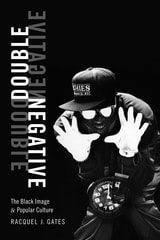
Double Negative
The Black Image and Popular CultureRacquel J. Gates
Duke University Press, 2018
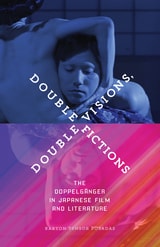
Double Visions, Double Fictions
The Doppelgänger in Japanese Film and LiteratureBaryon Tensor Posadas
University of Minnesota Press, 2018
A fresh take on the dopplegänger and its place in Japanese film and literature—past and present
Since its earliest known use in German Romanticism in the late 1700s, the word Doppelgänger (double-walker) can be found throughout a vast array of literature, culture, and media. This motif of doubling can also be seen traversing historical and cultural boundaries. Double Visions, Double Fictions analyzes the myriad manifestations of the doppelgänger in Japanese literary and cinematic texts at two historical junctures: the interwar period of the 1920s and 1930s and the present day.
According to author Baryon Tensor Posadas, the doppelgänger marks the intersection of the historical impact of psychoanalytic theory, the genre of detective fiction in Japan, early Japanese cinema, and the cultural production of Japanese colonialism. He examines the doppelgänger’s appearance in the works of Edogawa Rampo, Tanizaki Jun’ichiro, and Akutagawa Ryunosuke, as well as the films of Tsukamoto Shin’ya and Kurosawa Kiyoshi, not only as a recurrent motif but also as a critical practice of concepts. Following these explorations, Posadas asks: What were the social, political, and material conditions that mobilized the desire for the doppelgänger? And how does the dopplegänger capture social transformations taking place at these historical moments?
Double Visions, Double Fictions ultimately reveals how the doppelgänger motif provides a fascinating new backdrop for understanding the enmeshment of past and present.
Dramatists in Revolt
The New Latin American TheaterEdited by Leon F. Lyday and George W. Woodyard
University of Texas Press, 1976
Dramatists in Revolt, through studies of the major playwrights, explores significant movements in Latin American theater. Playwrights discussed are those who have made outstanding contributions to Latin American theater during the post–World War II period and who have been particularly sensitive to world currents in literature and drama, while being acutely responsive to the problems of their own areas. They express concern about communication, isolation, and solitude. On a more basic level, they concern themselves with the political and socioeconomic problems that figure importantly in the Third World.
The fifteen essays deal with the playwrights Antón Arrufat and José Triana (Cuba); Emilio Carballido and Luisa Josefina Hernández (Mexico); Agustín Cuzzani, Osvaldo Dragún, Griselda Gambaro, and Carlos Gorostiza (Argentina); Jorge Díaz, Egon Wolff, and Luis Alberto Heiremans (Chile); René Marqués (Puerto Rico); and Jorge Andrade, Alfredo Dias Gomes, and Plínio Marcos (Brazil). These are dramatists in revolt, sometimes in a thematic sense, not only in protesting the indignities that various systems impose on modern man, but also in a dramatic configuration. They dare to experiment with techniques in the constant search for viable theatrical forms.
Each essay is written by a specialist familiar with the works of the playwright under consideration. In addition to the essays, the book includes a listing of source materials on Latin American theater.
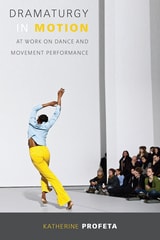
Dramaturgy in Motion
At Work on Dance and Movement PerformanceKatherine Profeta
University of Wisconsin Press, 2015
Profeta explores five arenas for the dramaturg’s attention—text and language, research, audience, movement, and interculturalism. Drawing on her extended collaboration with choreographer and visual artist Ralph Lemon, she grounds her thinking in actual rehearsal-room examples and situates practice within theoretical discourse about contemporary dramaturgy. Moving between theory and practice, word and movement, question and answer until these distinctions blur, she develops the foundational concept of dramaturgical labor as a quality of motion.
Dramaturgy in Motion will be invaluable to practitioners and scholars interested in the processes of creating contemporary dance and movement performance—particularly artists wondering what it might be like to collaborate with a dramaturg and dramaturgs wondering what it might be like to collaborate on movement performance. The book will also appeal to those intrigued by the work of Lemon and his collaborators, to which Profeta turns repeatedly to unfold the thorny questions and rich benefits of dramaturgical labor.

Drawing in the Design Process
Characterising Industrial and Educational PracticePamela Schenk
Intellect Books, 2016
It soon became apparent, however, that technological progress had not obviated the inherent value of drawing, and that, in fact, it opened up new avenues for convergent and hybrid drawing practices. This book traces the evolution of design-based drawing through analysis of a series of research projects from the 1980s to recent years that have sought to characterize the changing practices of design within various industries. Built on more than three hundred interviews with designers, academics, and design students, and an exhaustive analysis of thousands of drawings, it aims to generate discussion around historical and contemporary models of the design process.
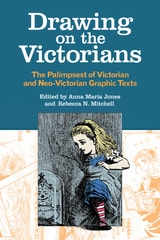
Drawing on the Victorians
The Palimpsest of Victorian and Neo-Victorian Graphic TextsAnna Maria Jones
Ohio University Press, 2017
Late nineteenth-century Britain experienced an unprecedented explosion of visual print culture and a simultaneous rise in literacy across social classes. New printing technologies facilitated quick and cheap dissemination of images—illustrated books, periodicals, cartoons, comics, and ephemera—to a mass readership. This Victorian visual turn prefigured the present-day impact of the Internet on how images are produced and shared, both driving and reflecting the visual culture of its time.
From this starting point, Drawing on the Victorians sets out to explore the relationship between Victorian graphic texts and today’s steampunk, manga, and other neo-Victorian genres that emulate and reinterpret their predecessors. Neo-Victorianism is a flourishing worldwide phenomenon, but one whose relationship with the texts from which it takes its inspiration remains underexplored.
In this collection, scholars from literary studies, cultural studies, and art history consider contemporary works—Alan Moore’s League of Extraordinary Gentlemen, Moto Naoko’s Lady Victorian, and Edward Gorey’s Gashlycrumb Tinies, among others—alongside their antecedents, from Punch’s 1897 Jubilee issue to Alice in Wonderland and more. They build on previous work on neo-Victorianism to affirm that the past not only influences but converses with the present.
Contributors: Christine Ferguson, Kate Flint, Anna Maria Jones, Linda K. Hughes, Heidi Kaufman, Brian Maidment, Rebecca N. Mitchell, Jennifer Phegley, Monika Pietrzak-Franger, Peter W. Sinnema, Jessica Straley
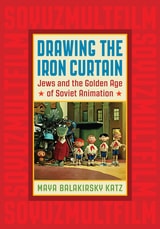
Drawing the Iron Curtain
Jews and the Golden Age of Soviet AnimationMaya Balakirsky Katz
Rutgers University Press, 2016

Dream Factories of a Former Colony
American Fantasies, Philippine CinemaJosé B. Capino
University of Minnesota Press, 2010
By tracking American fantasies in Philippine movies from the postindependence period to the present, José B. Capino offers an innovative account of cinema's cultural work in decolonization and globalization. Capino examines how a third world nation's daydreams both articulate empire and mobilize against it, provide imaginary maps and fables of identity for its migrant workers and diasporan subjects, pose challenges to the alibis of patriarchy and nationalism, and open up paths for participating in the cultures of globality.
Through close readings of more than twenty Philippine movies, Capino demonstrates the postcolonial imagination's vital role in generating pragmatic and utopian visions of living with empire. Illuminating an important but understudied cinema, he creates a model for understanding the U.S. image in the third world.
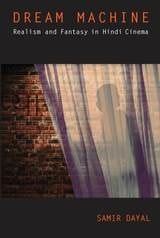
Dream Machine
Realism and Fantasy in Hindi CinemaSamir Dayal
Temple University Press, 2015
Popular Hindi films offer varied cinematic representations ranging from realistic portraits of patriotic heroes to complex fantasies that go beyond escapism. In Dream Machine, Samir Dayal provides a history of Hindi cinema starting with films made after India’s independence in 1947. He constructs a decade-by-decade consideration of Hindi cinema’s role as a site for the construction of “Indianness.”
Dayal suggests that Hindi cinema functions as both mirror and lamp, reflecting and illuminating new and possible representations of national and personal identity, beginning with early postcolonial films including Awaara and Mother India, a classic of the Golden Age. More recent films address critical social issues, such as My Name is Khan and Fire, which concern terrorism and sexuality, respectively. Dayalalso chronicles changes in the industry and in audience reception, and the influence of globalization, considering such films as Slumdog Millionaire.
Dream Machine analyzes the social and aesthetic realism of these films concerning poverty and work, the emergence of the middle class, crime, violence, and the law while arguing for their sustained and critical attention to forms of fantasy.
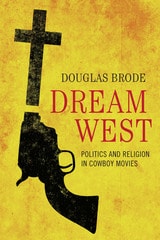
Dream West
Politics and Religion in Cowboy MoviesBy Douglas Brode
University of Texas Press, 2013
While political liberals celebrated the end of “cowboy politics” with the election of Barack Obama to the presidency, political conservatives in the Tea Party and other like-minded groups still vociferously support “cowboy” values such as small government, low taxes, free-market capitalism, and the right to bear arms. Yet, as Douglas Brode argues in this paradigm-shifting book, these supposedly cowboy or “Old West” values hail not so much from the actual American frontier of the nineteenth century as from Hollywood’s portrayal of it in the twentieth century. And a close reading of Western films and TV shows reveals a much more complex picture than the romanticized, simplistic vision espoused by the conservative right.
Examining dozens of Westerns, including Gunfight at the O.K. Corral, Red River, 3:10 to Yuma (old and new), The Wild Ones, High Noon, My Darling Clementine, The Alamo, and No Country for Old Men, Brode demonstrates that the genre (with notable exceptions that he fully covers) was the product of Hollywood liberals who used it to project a progressive agenda on issues such as gun control, environmental protection, respect for non-Christian belief systems, and community cohesion versus rugged individualism. Challenging us to rethink everything we thought we knew about the genre, Brode argues that the Western stands for precisely the opposite of what most people today—whether they love it or hate it—believe to be the essential premise of “the only truly, authentically, and uniquely American narrative form.”
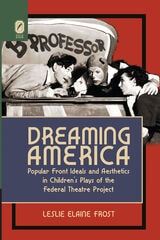
Dreaming America
Popular Front Ideals and Aesthetics in Children's Plays of the Federal Theatre ProjectLeslie Elaine Frost
The Ohio State University Press, 2013
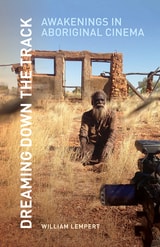
Dreaming Down the Track
Awakenings in Aboriginal CinemaWilliam Lempert
University of Minnesota Press, 2025
What can Aboriginal filmmaking reveal about Indigenous presence and futures?
The product of years of embedded fieldwork within Indigenous film crews in Northwestern Australia, Dreaming Down the Track delves deeply into Aboriginal cinema as a transformative community process. It follows the social lives of projects throughout their production cycles, from planning and editing to screening, broadcasting, and after-images. Across its narrative sweep, this ethnography engages the film career of Kukatja elder Mark Moora to demonstrate the impact of filmmaking on how Aboriginal futures are collectively imagined and called forth.
William Lempert highlights a series of awakenings through which Moora ultimately came to view cinema as a process for catalyzing his family’s return to their home country of Mangkayi. This biographical media journey paints an intimate portrait of the inspiring possibilities and sobering limitations of Indigenous envisioning within settler states. Lempert traces how Moora’s life and films convey a multiplicity of Aboriginal experiences across time and space, from colonial contact to contemporary life in communities like Balgo, including the continued governmental attempts to undermine them.
Amid ongoing negotiations to establish the first treaties between Indigenous nations and Australian states, Dreaming Down the Track illustrates what is at stake in how Aboriginal–State relations are represented and understood, both within communities and for the broader public. Lempert stays true to Moora’s insight that film can preserve community stories for generations to come, toward the aim of enacting sovereign futures.
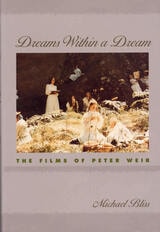
Dreams Within a Dream
The Films of Peter WeirMichael Bliss
Southern Illinois University Press, 2000
"What we see, and what we seem, are but a dream, a dream within a dream." Michael Bliss views Miranda's voice-over at the beginning of Picnic at Hanging Rock as so pivotal in explaining the films of Peter Weir that he borrows her words to create the title of his own study of the Australian filmmaker's work.
Bliss views Weir as an artist whose values are rooted in the realm of the dream, of the unconscious. Surrealistic in technique, Weir avoids the pedestrian assurances of a material realm in favor of an irresolution that, while potentially frustrating, is nonetheless for him a more truthful representation of what he considers reality. For Weir, as for Plato, Bliss demonstrates, "empirical reality is nothing more than a shadow of what is real."
Bliss also considers Weir's heritage. Australian cinema, Bliss explains, is characterized by melodramatic narratives born of a desire to see good and evil portrayed in striking opposition. Weir, for example, dramatizes the contradictory forces of light versus darkness, reason versus mystery, and rationality versus magic in such films as Picnic at Hanging Rock and The Last Wave. This melodramatic emphasis is evident as well in the polarized characterizations in such films as Witness, Dead Poets Society, and The Truman Show.
Bliss also discusses Weir's use of another staple of Australian cinema— "mateship," the celebration of the bond between male companions. But by making self-knowledge dependent on action involving one's friends, Weir gives mateship a new meaning. Moreover, like other Australian filmmakers, Weir emphasizes the starkness of the Australian landscape, which functions either as a hazard or a deadly challenge, at least until American mythology caused him to see nature in a more positive light. Also prominent in Weir's films is an Australian spirit of rebellion coupled with the Aussie ambivalence toward all aspects of British culture.
To help explain Weir's films, Bliss looks to Freud and Jung, whom Weir has studied, and also to two other prominent purveyors of myth and archetype, Northrop Frye and Joseph Campbell. Virtually all Weir characters struggle toward a new mode of awareness, a psychological awareness based on archetypal truths. Many of his films involve archetypal journeys heading through conflict to spiritual unity. Weir's quest is to find out what we really know and how we know what we know.
Dreams of Difference, Songs of the Same
The Musical Moment in FilmAmy Herzog
University of Minnesota Press, 2009
Musical spectacles are excessive and abstract, reconfiguring time and space and creating intense bodily responses. Amy Herzog's engaging work examines those instances where music and movement erupt from within more linear narrative frameworks. The representational strategies found in these films are often formulaic, repeating familiar story lines and stereotypical depictions of race, gender, and class. Yet she finds the musical moment contains a powerful disruptive potential.
Dreams of Difference, Songs of the Same investigates the tension and the fusion of difference and repetition in films to ask, How does the musical moment work? Herzog looks at an eclectic mix of works, including the Soundie and Scopitone jukebox films, the musicals of French director Jacques Demy, the synchronized swimming spectacles of Esther Williams, and an apocalyptic musical by Taiwanese director Tsai Ming-liang. Several refrains circulate among these texts: their reliance on clichés, their rewriting of cultural narratives, and their hallucinatory treatment of memory and history.
Drawing on the philosophical work of Gilles Deleuze, she explores all of these dissonances as productive forces, and in doing so demonstrates the transformative power of the unexpected.
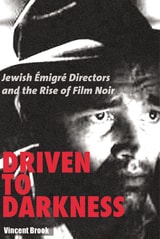
Driven to Darkness
Jewish Emigre Directors and the Rise of Film NoirBrook, Vincent
Rutgers University Press, 2009
Driven to Darkness explores the influence of Jewish TmigrT directors and the development of this genre. While filmmakers such as Fritz Lang, Billy Wilder, Otto Preminger, and Edward G. Ulmer have been acknowledged as crucial to the noir canon, the impact of their Jewishness on their work has remained largely unexamined until now. Through lively and original analyses of key films, Vincent Brook penetrates the darkness, shedding new light on this popular film form and the artists who helped create it.

Drop Dead
Performance in Crisis, 1970s New YorkHillary Miller
Northwestern University Press, 2016
Winner, 2017 American Theater and Drama Society John W. Frick Book Award
Winner, 2017 ASTR Barnard Hewitt Award for Outstanding Research in Theater History
Hillary Miller’s Drop Dead: Performance in Crisis, 1970s New York offers a fascinating and comprehensive exploration of how the city’s financial crisis shaped theater and performance practices in this turbulent decade and beyond.
New York City’s performing arts community suffered greatly from a severe reduction in grants in the mid-1970s. A scholar and playwright, Miller skillfully synthesizes economics, urban planning, tourism, and immigration to create a map of the interconnected urban landscape and to contextualize the struggle for resources. She reviews how numerous theater professionals, including Ellen Stewart of La MaMa E.T.C. and Julie Bovasso, Vinnette Carroll, and Joseph Papp of The Public Theater, developed innovative responses to survive the crisis.
Combining theater history and close readings of productions, each of Miller’s chapters is a case study focusing on a company, a production, or an element of New York’s theater infrastructure. Her expansive survey visits Broadway, Off-, Off-Off-, Coney Island, the Brooklyn Academy of Music, community theater, and other locations to bring into focus the large-scale changes wrought by the financial realignments of the day.
Nuanced, multifaceted, and engaging, Miller’s lively account of the financial crisis and resulting transformation of the performing arts community offers an essential chronicle of the decade and demonstrates its importance in understanding our present moment.
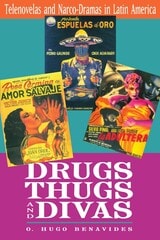
Drugs, Thugs, and Divas
Telenovelas and Narco-Dramas in Latin AmericaBy O. Hugo Benavides
University of Texas Press, 2008
Soap opera speaks a universal language, presenting characters and plots that resonate far beyond the culture that creates them. Latin American soap operas—telenovelas—have found enthusiastic audiences throughout the Americas and Europe, as well as in Egypt, Russia, and China, while Mexican narco-dramas have become highly popular among Latinos in the United States. In this first comprehensive analysis of telenovelas and narco-dramas, Hugo Benavides assesses the dynamic role of melodrama in creating meaningful cultural images to explain why these genres have become so successful while more elite cultural productions are declining in popularity.
Benavides offers close readings of the Colombian telenovelas Betty la fea (along with its Mexican and U.S. reincarnations La fea más bella and Ugly Betty), Adrián está de visita, and Pasión de gavilanes; the Brazilian historical telenovela Xica; and a variety of Mexican narco-drama films. Situating these melodramas within concrete historical developments in Latin America, he shows how telenovelas and narco-dramas serve to unite peoples of various countries and provide a voice of rebellion against often-oppressive governmental systems. Indeed, Benavides concludes that as one of the most effective and lucrative industries in Latin America, telenovelas and narco-dramas play a key role in the ongoing reconfiguration of social identities and popular culture.
Dubious Spectacle
Extremities of Theater, 1976-2000Herbert Blau
University of Minnesota Press, 2002
Spanning a quarter of a century, the essays in this book rehearse, in the movement of memory and cross-reflection, an extensive career in theater. The work of Herbert Blau-his directing, writing, and criticism-has been a determining force during this period as theater encounters theory.
Blau’s struggle to bring a critical intelligence to the American stage goes back half a century, to the quiescent postwar years (which he has eloquently described in The Impossible Theater: A Manifesto). His innovations in performance began with early productions of now-canonical plays that were hardly known at that time (works by Brecht, Beckett, Genet, Pinter, Duerrenmatt, and others). His experience is as distinctive as his versatile habits of mind and conceptual urgency of style.
If the impossible takes a little time (as the title of one essay states), Blau’s struggle now continues in a theoretical vein. Performance-and his own compelling writing- has moved across other genres and disciplines into fashion, politics, sexuality, and theory. His diversity of thought is demonstrated here in commentaries about the newer modes of performance (including conceptual and body art), various American playwrights, Renaissance drama, new music and theater, voice, the senses and the baroque, and the photographic image. As the essays reflect upon each other, a kind of cultural history, with inflections of autobiography, develops-which is what readers of Blau’s previous books have come to expect.
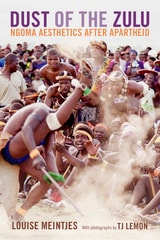
Dust of the Zulu
Ngoma Aesthetics after ApartheidLouise Meintjes
Duke University Press, 2017
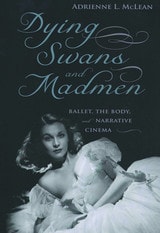
Dying Swans and Madmen
Ballet, the Body, and Narrative CinemaMcLean, Adrienne L
Rutgers University Press, 2008
Drawing on examples that range from musicals to tragic melodramas, she shows how commercial films have produced an image of ballet and its artists that is associated both with joy, fulfillment, fame, and power and with sexual and mental perversity, melancholy, and death. Although ballet is still received by many with a lack of interest or outright suspicion, McLean argues that these attitudes as well as ballet's popularity and its acceptability as a way of life and a profession have often depended on what audiences first learned about it from the movies.