Results by title
1947 books match the query 'Music' and 57 start with d

Drama, Poetry and Music in Late-Renaissance Italy
The Life and Works of Leonora BernardiVirginia Cox and Lisa Sampson
University College London, 2023
Leonora Bernardi (1559–1616), a gentlewoman of Lucca, was a highly regarded poet, dramatist, and singer. She was active in the brilliant courts of Ferrara and Florence at a time when creative women enjoyed exceptional visibility in Italy. Like many such figures, she has since suffered historical neglect. Drama, Poetry and Music in Late-Renaissance Italy presents the first-ever study of Bernardi’s life along with a modern edition of her recently discovered literary corpus, which mostly exists in manuscripts. Her writings are presented in the original Italian with new English translations, scholarly notes, and critical essays. Based on new archival research, the substantial opening section reconstructs Bernardi’s unusually colorful life. The second major section presents her pastoral tragicomedy Clorilli, one of the earliest secular dramatic works by a woman. The third section presents Bernardi’s secular and religious verse, which engaged with new trends in lyric and poetry for music, and was set by various key composers across Italy. The volume thus firmly positions Leonora Bernardi as a distinctive voice and dynamic player in the extraordinarily rich social, cultural, and geo-political networks of late-Renaissance Italy.
Dreams in Double Time
On Race, Freedom, and BebopJonathan Leal
Duke University Press, 2023

Dreams of Difference, Songs of the Same
The Musical Moment in FilmAmy Herzog
University of Minnesota Press, 2009
Musical spectacles are excessive and abstract, reconfiguring time and space and creating intense bodily responses. Amy Herzog's engaging work examines those instances where music and movement erupt from within more linear narrative frameworks. The representational strategies found in these films are often formulaic, repeating familiar story lines and stereotypical depictions of race, gender, and class. Yet she finds the musical moment contains a powerful disruptive potential.
Dreams of Difference, Songs of the Same investigates the tension and the fusion of difference and repetition in films to ask, How does the musical moment work? Herzog looks at an eclectic mix of works, including the Soundie and Scopitone jukebox films, the musicals of French director Jacques Demy, the synchronized swimming spectacles of Esther Williams, and an apocalyptic musical by Taiwanese director Tsai Ming-liang. Several refrains circulate among these texts: their reliance on clichés, their rewriting of cultural narratives, and their hallucinatory treatment of memory and history.
Drawing on the philosophical work of Gilles Deleuze, she explores all of these dissonances as productive forces, and in doing so demonstrates the transformative power of the unexpected.
Drones, Tones, and Timbres
Sounding Place among Nomads of the Inner Asian Mountain-SteppesCarole Pegg
University of Illinois Press, 2024
Based on more than twenty years of collaborative research, Carole Pegg’s long-awaited participatory ethnography explores how Indigenous nomadic peoples of Russia’s southern Siberian republics (Altai, Khakassia, Tyva) sound multiphonies of place in a post-Soviet global world. Inspired by the mountain-steppe ecology and pathways of nomadism, soundscapes created in performative ritual events cross political and multiple-world boundaries in a shamanic-animist universe, enabling human and spirit actor interactions in a series of sensuous worlds. As with the “throat-singing” for which Indigenous Altai-Sayan peoples are famous, senses of place involve sonic relations, rootedness, movement, and plurality. Pegg echoes their drone-partials musical and ontological models in an innovative theoretical entwinement. Three strands form the book’s multivocal drone, the partials of which sound in each chapter: ontological sonicality and musicality that enables emplacement and movement; the importance of shamanism-animism--at the core of Indigenous spiritual practices--for personhood and community; and the agency of sonic performances. Sounding place, Pegg demonstrates, is essential to the identities, ways of life, and very senses of being of Indigenous Altai-Sayan peoples.
Duke Ellington's America
Harvey G. Cohen
University of Chicago Press, 2010
Few American artists in any medium have enjoyed the international and lasting cultural impact of Duke Ellington. From jazz standards such as “Mood Indigo” and “Don’t Get Around Much Anymore,” to his longer, more orchestral suites, to his leadership of the stellar big band he toured and performed with for decades after most big bands folded, Ellington represented a singular, pathbreaking force in music over the course of a half-century. At the same time, as one of the most prominent black public figures in history, Ellington demonstrated leadership on questions of civil rights, equality, and America’s role in the world.
With Duke Ellington’s America, Harvey G. Cohen paints a vivid picture of Ellington’s life and times, taking him from his youth in the black middle class enclave of Washington, D.C., to the heights of worldwide acclaim. Mining extensive archives, many never before available, plus new interviews with Ellington’s friends, family, band members, and business associates, Cohen illuminates his constantly evolving approach to composition, performance, and the music business—as well as issues of race, equality and religion. Ellington’s own voice, meanwhile, animates the book throughout, giving Duke Ellington’s America an intimacy and immediacy unmatched by any previous account.
By far the most thorough and nuanced portrait yet of this towering figure, Duke Ellington’s America highlights Ellington’s importance as a figure in American history as well as in American music.
Dust of the Zulu
Ngoma Aesthetics after ApartheidLouise Meintjes
Duke University Press, 2017
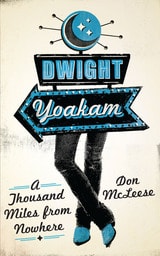
Dwight Yoakam
A Thousand Miles from NowhereBy Don McLeese
University of Texas Press, 2012
From his formative years playing pure, hardcore honky-tonk for mid-’80s Los Angeles punk rockers through his subsequent surge to the top of the country charts, Dwight Yoakam has enjoyed a singular career. An electrifying live performer, superb writer, and virtuosic vocalist, he has successfully bridged two musical worlds that usually have little use for each other—commercial country and its alternative/Americana/roots-rocking counterpart. Defying the label “too country for rock, too rock for country,” Yoakam has triumphed while many of his peers have had to settle for cult acceptance. Four decades into his career, he has sold more than 25 million records and continues to tour regularly, with an extremely loyal fan base.
In Dwight Yoakam, award-winning music journalist Don McLeese offers the first musical biography of this acclaimed artist. Tracing the seemingly disparate influences in Yoakam’s music, McLeese shows how he has combined rock and roll, rockabilly, country, blues, and gospel into a seamless whole. In particular, McLeese explores the essential issue of “authenticity” and how it applies to Yoakam, as well as to country music and popular culture in general. Drawing on wide-ranging interviews with Yoakam and his management, while also benefitting from the perspectives of others closely associated with his musical success (including producer-guitarist Pete Anderson, Yoakam’s partner throughout his most popular and creative decades), Dwight Yoakam pays tribute to the musician who has established himself as a visionary beyond time, an artist who could title an album Tomorrow’s Sounds Today and deliver it.