Results by title
3785 books match the query 'Poetry' and 128 start with d
Denise Levertov
Selected CriticismEdited with an Introduction by Albert Gelpi
University of Michigan Press, 1993

Des
Sati Mookherjee
Tupelo Press, 2027
In this formally inventive poetry collection, Sati Mookherjee resurrects a shared precolonial pan-South Asian identity, history, and culture in joyful defiance of the nationalist and sectarian movements of today.
This unusual poetry collection emerged from the author’s interviews of her Indian, Pakistani, and Bangladeshi immigrant family and friends in her native Pacific Northwest about their personal histories: of partition and childhood, immigration experiences, and religious and metaphysical beliefs. The resulting poems reflect the kaleidoscopic identity of the South Asian (“desi”) diaspora—the world’s largest diaspora. At this ugly historic moment, desi-ness offers a real-world model of a joyful, plural community, even as such tolerance is under grave threat from both today’s American right-wing anti-immigrant movement and the toxic nationalism and sectarianism of South Asian geopolitics. The poems themselves are a diaspora of forms: hybrid cross-pollinations of American tradition (Frost, Penn Warren), ancient Indo-Persian-Arabic forms, and self-invention. In a time when hatred of the other is normalized, this book holds love, celebrating a kinship tradition and shared homeland—a Des—that is both precolonial and extant, borderless, found not on any map, but held in the collective un/consciousness of the desi diaspora. In defiance of nationalist rhetoric that would see us divided by language, religion, and country of origin, Des joins the decentralized global movement of scholars, artists, activists, and young people reclaiming the beauty of a shared, precolonial composite culture.
Descartes' Nightmare
Susan McCabe
University of Utah Press, 2008
Descartes’ Nightmare is the 2007 prizewinning volume selected by this year’s judge, Cole Swenson, of the Iowa Writers’ Workshop.
Desert Sorrows
Poems by Tayseer al-SboulTayseer Al-Sboul
Michigan State University Press, 2015
Designed for Flight
PoemsGregory Fraser
Northwestern University Press, 2014
Designed for Flight both continues and enlarges the exploration of the rhythms of our emotional lives undertaken in Gregory Fraser’s first two collections. A master of metaphor, Fraser works magic within tightly controlled forms, loading lines with surprising juxtapositions and changes of direction. Taken together, the poems trace the sometimes instant, sometimes decades-long movement from incomprehensible loss and grief to rueful reflection and, if we’re lucky, uneasy accommodation. Casting a sharply observant eye on past selves, always steering clear of simple sentiment, the speaker in this collection looks back with bitter irony and forgiveness in equal measure. Against the fears and frustrations of childhood, the dissolution of a doomed relationship, and the distance between the hoped for and the actual, Fraser’s poems offer the imagination’s capacity for endless invention and the compensatory pleasures of art.
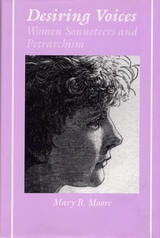
Desiring Voices
Women Sonneteers and PetrarchismMary B. Moore
Southern Illinois University Press, 2000
“How do I love thee? Let me count the ways,” wrote Elizabeth Barrett Browning in her Sonnets from the Portuguese.Desiring Voices: Women Sonneteers and Petrarchism proposes that we attend to the ways that women poets from the sixteenth through the twentieth centuries have both echoed and transformed the literary and erotic conventions that strongly influenced their fates as women, wives, and lovers.
Mary B. Moore analyzes and provides context for love sonnet sequences by Italian, French, English, and American women poets in the light of current knowledge concerning attitudes towards women at the time they wrote. Through close readings of the poems combined with theory and criticism about constructs of women, historical events, and biographical contexts, Moore reveals patterns of revision among women poets that shed further light on the poets themselves, on Petrarchism as a convention, and on ideas about women. She focuses on Petrarchan sonnet sequences by women because the poems serve both as works of art and as documents that illuminate the range and limitations of female roles as erotic subjects (agents of speech, action, knowledge, and desire) as well as their more usual roles as erotic objects.
Combining theory with close reading, Moore enhances the value of many generally neglected poems by women. After a thorough discussion of the Petrarchan sonnet tradition, she analyzes the work of Gaspara Stampa, Louise Labé, Lady Mary Wroth, Charlotte Smith, Elizabeth Barrett Browning, and Edna St. Vincent Millay.
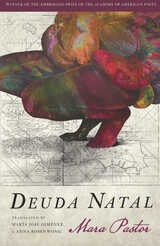
Deuda Natal
Mara Pastor, Translated by María José Giménez and Anna Rosenwong
University of Arizona Press, 2021
The poems in Deuda Natal reckon with the stark environmental degradation in Puerto Rico and the larger impacts of global climate change as they navigate our changing world through a feminist lens. Pastor’s work asserts a feminist objection to our society’s obsession with production and the accumulation of wealth, offering readers an opportunity for collective vulnerability within these pages. For this remarkable work, Pastor has found unique allies in María José Giménez and Anna Rosenwong, the translators of Deuda Natal. Winner of the 2020 Ambroggio Prize of the Academy of American Poets, this collection showcases masterfully crafted and translated poems that are politically urgent and emotionally striking.
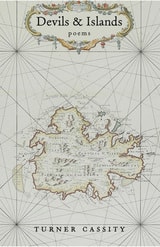
Devils & Islands
PoemsTurner Cassity
Ohio University Press, 2007
As he approaches eighty, Turner Cassity may finally be out of control. His hatchet has never fallen more lethally, meaning if you have the stomach for him he is more enjoyable than ever. Under the blade come Martha Graham, Johann Sebastian Bach, musicologists, tree huggers, Frank Gehry, folk music, folk art of all times and all places, folk… . There are, however, his unpredictable sympathies: Edith Wilson, skyscrapers, Pontius Pilate, Pilate’s legionnaires. He obviously has a soft spot for Pop Culture, although he cannot avoid seeingit de haut en bas.
As usual, he is all over the place geographically. One feels he would slash his wrists before he would write a poem about any city on the traditional Grand Tour. Manaus, Campeche, Trieste, Budapest (as destroyed by Godzilla)—these are his places. He has a disturbing willingness to write on both sides of an issue, resembling in this Bernard Shaw. You have to read very carefully to see whether he tips his hand.
One looks forward to Mr. Cassity’s posthumous poems, when he is beyond the reach of libel. For now, at least, we have Devils & Islands.

Devonte Travels the Sorry Route
T.J. Anderson III
Omnidawn, 2019
As fantastical as this account seems, in these poems, T.J. Anderson III captures a critical aspect of the ways identity is formed through community and collective memory, particularly among the peoples of the African diaspora. The way the words expand across the page enacts this polyvocal coalescing, and the blank space in between evokes the vast oceans that first separated and continue to resonate in the collective imagination of the Black community. At the same time that he relates the difficulty of crossing vast expanses of time and space to connect with our history, in these gripping poems Anderson proposes that the past is never far off—in fact, like Devonte, it lives in our own personalities and experiences today.
Devotions
Bruce Smith
University of Chicago Press, 2011
In the hands of Bruce Smith, devotions are momentary stops to listen to the motor of history. They are meditations and provocations. They are messages received from the chatter of the street and from transmissions as distant as Memphis and al-Mansur. Bulletins and interruptions come from brutal elsewheres and from the interior where music puts electrodes on the body to take an EKG. These poems visit high schools, laundromats, motels, films, and dreams in order to measure the American hunger and thirst. They are interested in the things we profess to hold most dear as well as what’s unspoken and unbidden. While we’re driving, while riding a bus, while receiving a call, while passing through an X-ray machine, the personal is intersected—sometimes violently, sometimes tenderly—with the hum and buzz of the culture. The culture, whether New York or Tuscaloosa, Seattle or Philadelphia, past or present, carries the burden of race and “someone’s idea of beauty.” The poems fluctuate between the two poles of “lullaby and homicide” before taking a vow to remain on earth, to look right and left, to wait and to witness.
Dialectical Imaginaries
Materialist Approaches to U.S. Latino/a Literature in the Age of NeoliberalismMarcial González and Carlos Gallego, editors
University of Michigan Press, 2018
Diary of Our Fatal Illness
Charles Bardes
University of Chicago Press, 2017
Diary of Small Discontents
New & Selected Poems 1974–2024John Yau
Omnidawn, 2025
This collection brings together work from half a century of writing by John Yau. Preoccupied with forms and musical structures, Yau’s work includes sestinas, sonnets, pantoums, and lists, as well as invented forms. Employing both strict and open-ended frameworks, Yau creates multi-faceted poems that can shift abruptly from humor to outrage and consider topics including Chinese American identity, school shootings, invented countries, and haunted memories. Some poems are grounded in an autobiographical voice, while others take on the voices of other characters, including contemporary artists and a fictional Chinese private eye.
Spanning the vast diversity of Yau’s forms and subjects, the poems in Diary of Small Discontents add up to an unapologetically original collection.
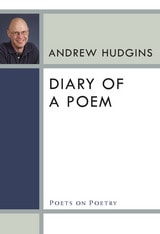
Diary of a Poem
Andrew Hudgins
University of Michigan Press, 2011
Praise for Andrew Hudgins
"Hudgins . . . [is] one of the few poets of the American South who can be both solemn and sidesplitting in a single poem."
---Publishers Weekly
"Andrew Hudgins is a natural storyteller . . . The surface[s] of Hudgins's poems---their quirky economy, the sheer music of his prosody---are so right because he goes so deep."
---Washington Post
A volume in the Poets on Poetry series, which collects critical works by contemporary poets, gathering together the articles, interviews, and book reviews by which they have articulated the poetics of a new generation.
Andrew Hudgins's Diary of a Poem is an engaging collection of essays that offers pleasure and profit to its readers. The title essay discusses the author's amusing travails as he attempts to write an ode about intestines, while other pieces explore the poetry of James Agee, Donald Justice, Allen Tate, and other poets, as well as the musician Johnny Winter, who is the subject of a rollicking segment about rock 'n' roll. More seriously, Hudgins writes with lively good humor about his tomato garden, the unread books piled up precipitously around his bed, and the emotional problems that led to an embarrassingly intimate, yet funny encounter with his father-in-law.
Diary of a Poem is lively, charming, often humorous, and a pleasurable read for the general reader and the poetry specialist alike.
Author photo by Jo McCulty

Dickinson's Fascicles
A Spectrum of PossibilitiesPaul Crumbley and Eleanor Elson Heginbotham
The Ohio State University Press, 2014
The collection opens with a central portion of Sharon Cameron’s 1992 book that was the first to abandon the until-then popular search for a single unifying narrative to explain the fascicles, inaugurating a new era of fascicle scholarship. Eight prominent Dickinson scholars contribute essays to this volume and respond vigorously and variously to Cameron's argument, proposing, for instance, that the fascicles represent Dickinson's engagement with the world around her, particularly with the Civil War, and that they demonstrate her continued experimentation with poetic form.
Dickinson’s Fascicles is edited by Paul Crumbley and Eleanor Elson Heginbotham. Other contributors include Paula Bernat Bennett, Martha Nell Smith, Domhnall Mitchell, Ellen Louise Hart, Melanie Hubbard, and Alexandra Socarides who assess what constitutes a vast final frontier in the Dickinson literary landscape. Susan Howe provides a coda.
Didactic Poetries
Philippe Beck
University of Minnesota Press, 2016
Complex, haunting, imaginative and profoundly literary, Didactic Poetries is Beck’s response to Schiller’s statement: “We are still waiting for a didactic poem where thought itself would be and would remain poetic,” and Hegel’s claim that, “strictly speaking, didactic poetry isn’t poetry.”
For the acclaimed French poet, Philippe Beck, Schiller’s task of attempting a didactic poetry remains as vital today as it was for Schiller’s time. Is there a way to construct a poetry built and chiseled, hammered and stitched, from out of past narratives and poetries, condensed in such a manner as to make new poetic verses sing new truths? Forging a singular attempt to echo the poets and tales of a bygone age, Beck’s didactic poetries perhaps carve out the path for renewing a poetic thought as a quasi-musical atmosphere where the reader can glimpse “A small country “sculpted” as spiritual, supposed to be so at home in the Bygone Country. Alluvial layers so light, that weather disappeared, weary of variety a priori.” Beck’s deftly textured poems interweave contemporary commentary with cultural, historical, literary, and philosophical allusions, drawing the reader into a world of lived poetic experience.
Differential Diagnosis
PoemsCavar
Northwestern University Press, 2026
Undoing traditional psychiatric narratives in this innovative and bold first collection
Drawing from queer, trans, disabled, and Mad poetic traditions, Differential Diagnosis introduces a deeply entangled transMad approach, investigating ways of knowing, loving, and living not legible to the normative eye. This collection challenges the architecture of institutional psychiatry and its popular “wellness” analogues, offering instead a counternarrative of forced institutionalization, disorderly embodiment, and transMad self-determination.
At once jarring and joyful, Differential Diagnosis interrogates psychiatric power and locates capacities for disabled and/or transMad resistance in the oblique, the speculative, and the “nonsensical.” Cavar’s inventive full-length debut defamiliarizes cis, sane, abled existence through linguistic play and speculative imagery, offering Madness not only as poetic content, but also as craft technique and, ultimately, as a new way of being in the normative world.
Differentials
Poetry, Poetics, PedagogyMarjorie Perloff
University of Alabama Press, 2004
A new collection of essays from a distinguished critic of contemporary poetry
Marjorie Perloff is one of the foremost critics of contemporary American poetry writing today. Her works are credited by many with creating and sustaining new critical interest not only in the work of major modernist poets such as Yeats, Pound, Eliot, and Williams but also in the postwar tradition of American poetic innovation that ranges from the Black Mountain poets, through the New York School and concrete poetry, to the Language Poets of the 1980s and '90s.
In Differentials, Perloff explores and defends her belief in the power of close reading, a strategy often maligned as reactionary in today's critical climate but which, when construed differentially, is vital, she believes, to any true understanding of a literary or poetic work, irrespective of how traditional or experimental it is. Perloff also examines key issues in modernism, from Eliot's conservative poetics and Pound's nominalism to translation theory (Wittgenstein, Eugene Jolas, Haroldo de Campos), and the contemporary avant garde, as represented by writers like Susan Howe, Tom Raworth, Rae Armantrout, Ron Silliman, Ronald Johnson, Caroline Bergvall, and Kenneth Goldsmith.
Ultimately, Perloff's most important offerings in Differentials are her remarkably original reflections on the aesthetic process: on how poetry works, and what it means, in and for our time.
Digenis Akritas
The Two-Blood Border Lord—The Grottaferrata VersionDenison B. Hull
Ohio University Press, 1986
Before The Song of Roland, before El Cid, and centuries before today's fascination with warrior legends and frontier worlds, there was Digenis Akritas: the great epic of Byzantium and one of the earliest masterpieces of medieval Greek literature. Rooted in the turbulent borderlands between the Byzantine Empire and the Arab world, this remarkable poem brings to life a society where cultures met, clashed, and transformed one another. Based on traditions that emerged from the Byzantine eastern frontier and preserved in medieval manuscripts, Digenis Akritas remains the most celebrated surviving heroic epic of the Byzantine world.
At its center stands Basil, known as Digenis Akritas, the “two-blood border lord.” Born of a union between an Arab emir and a Byzantine noblewoman, he embodies the complex cultural landscape of the medieval eastern Mediterranean. Gifted with extraordinary strength and courage, Digenis grows into an unparalleled warrior, defending the empire's frontier against raiders, outlaws, and rival champions while forging his own legend along the banks of the Euphrates.
Blending action, romance, folklore, and faith, the poem follows Digenis through daring adventures, dramatic combats, encounters with marvels, and a passionate love story. Yet beyond its heroic exploits lies a vivid portrait of frontier life in the medieval Byzantine world, where Christian and Muslim, Greek and Arab, imperial power and local tradition intersected in unexpected ways. The result is an epic that is at once a thrilling tale of adventure and a window into a fascinating civilization.
This acclaimed English verse translation restores a foundational work of medieval literature for modern readers. Supported by scholarly commentary, a bibliography, and maps, it offers an accessible introduction to one of history's great heroic traditions and to the legendary figure who became the archetypal hero of Byzantine folklore.
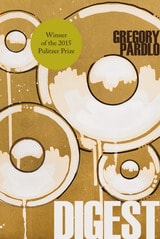
Digest
Gregory Pardlo
Four Way Books, 2014
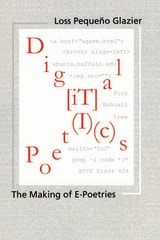
Digital Poetics
Hypertext, Visual-Kinetic Text and Writing in Programmable MediaLoss Pequeño Glazier
University of Alabama Press, 2001
Glazier investigates the ways in which computer technology has influenced and transformed the writing and dissemination of poetry.
In Digital Poetics, Loss Pequeño Glazier argues that the increase in computer technology and accessibility, specifically the World Wide Web, has created a new and viable place for the writing and dissemination of poetry. Glazier’s work not only introduces the reader to the current state of electronic writing but also outlines the historical and technical contexts out of which electronic poetry has emerged and demonstrates some of the possibilities of the new medium.
Glazier examines three principal forms of electronic textuality: hypertext, visual/kinetic text, and works in programmable media. He considers avant-garde poetics and its relationship to the on-line age, the relationship between web “pages” and book technology, and the way in which certain kinds of web constructions are in and of themselves a type of writing. With convincing alacrity, Glazier argues that the materiality of electronic writing has changed the idea of writing itself. He concludes that electronic space is the true home of poetry and, in the 20th century, has become the ultimate “space of poesis.”
Digital Poetics will attract a readership of scholars and students interested in contemporary creative writing and the potential of electronic media for imaginative expression.
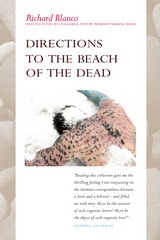
Directions to the Beach of the Dead
Richard Blanco
University of Arizona Press, 2005
The words are redolent with his Cuban heritage: Marina making mole sauce; Tía Ida bitter over the revolution, missing the sisters who fled to Miami; his father, especially, “his hair once as black as the black of his oxfords…” Yet this is a volume for all who have longed for enveloping arms and words, and for that sanctuary called home. “So much of my life spent like this-suspended, moving toward unknown places and names or returning to those I know, corresponding with the paradox of crossing, being nowhere yet here.” Blanco embraces juxtaposition. There is the Cuban Blanco, the American Richard, the engineer by day, the poet by heart, the rhythms of Spanish, the percussion of English, the first-world professional, the immigrant, the gay man, the straight world. There is the ennui behind the question: why cannot I not just live where I live? Too, there is the precious, fleeting relief when he can write "…I am, for a moment, not afraid of being no more than what I hear and see, no more than this:..." It is what we all hope for, too.
Dirt Eaters
Eliza Rotterman
Tupelo Press, 2018

Dirt Road Home
Cheryl Savageau
Northwestern University Press, 1995
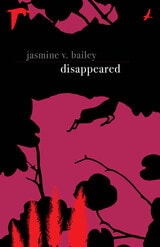
Disappeared
Jasmine V. Bailey
Carnegie Mellon University Press, 2017
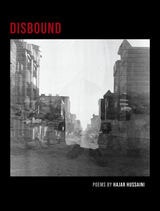
Disbound
PoemsHajar Hussaini
University of Iowa Press, 2022
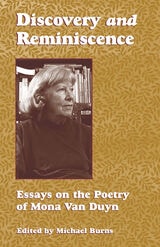
Discovery and Reminiscence
Essays on the Poetry of Mona Van DuynMichael Burns
University of Arkansas Press, 1999
A former United States Poet Laureate, winner of a Pulitzer Prize, and recipient of numerous grants and awards, Mona Van Duyn has been hailed as one of our greatest living American poets. To help broaden and uniquely inform our understanding of Van Duyn’s work, editor Michael Burns has gathered ten essays, a poem, a succinct biographical sketch, and Van Duyn’s own laureate address to the Library of Congress.
In the first section of this collection, poets Maxine Kumin and Carolyn Kizer provide tributes that elucidate the special effect Van Duyn’s poetry has had on their work and thought. Pulitzer Prize–winner Richard Howard contributes a poem that both extols the qualities of Van Duyn’s poems and lyrically places those qualities within her contemporary scene.
The second section contains eight essays exploring aspects as varied as Van Duyn’s penchant for particularity, her remarkable ability to rediscover for us the strangeness of everyday living, and her elegant style, fluid in both free verse and form. Included are contributions from Stephen Yenser, Rachel Hadas, Emily Grosholz, Sidney Burris, Ann Townsend, Michael Bugeja, Wyatt Prunty, and Jane Hoogestraat.
The final section opens with Van Duyn’s witty and incisive overview of the state of poetry in America at the close of the twentieth century. Also included is a short narrative history of Van Duyn’s literary career. Filled with keen prose by distinguished poets and critics, this collection is not only a resounding tribute to one poet’s body of work, but also a timely pulse-taking of the literary scene surrounding Van Duyn’s poetry.
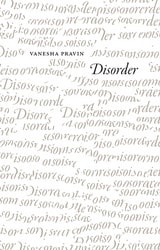
Disorder
Vanesha Pravin
University of Chicago Press, 2015
Cambridge, MA, 2008
Midsummer. Finally, you are used to disappointment.
A baby touches phlox. Many failures, many botched attempts,
A little success in unexpected forms. This is how the rest will go:
The gravel raked, bricks ashen, bees fattened–honey not for babes.
All at once, a rustling, whole trees in shudder, clouds pulled
Westward. You are neither here nor there, neither right nor
Wrong. The world is indifferent, tired of your insistence.
Garter snakes swallow frogs. The earthworms coil.
On your fingers, the residue of red pistils. What have you made?
What have you kept alive? Green, a secret, occult,
Grass veining the hands. Someone’s baby toddling.
And the phlox white. For now. Midsummer.
A remarkable first book, Disorder tells the story, by turns poignant and outrageous, of a family’s dislocation over four continents during the course of a hundred years. In short lyrics and longer narrative poems, Vanesha Pravin takes readers on a kaleidoscopic trek, from Bombay to Uganda, from England to Massachusetts and North Carolina, tracing the path of familial love, obsession, and the passage of time as filtered through the perceptions of family members and a host of supporting characters, including ubiquitous paparazzi, amorous vicars, and a dubious polygamist. We experience throughout a speaker forged by a deep awareness of intergenerational, multicontinental consciousness. At once global and personal, crossing ethnic, linguistic, and national boundaries in ways that few books of poetry do, Disorder bristles with quiet authority backed by a skeptical intelligence.
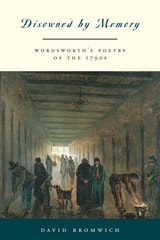
Disowned by Memory
Wordsworth's Poetry of the 1790sDavid Bromwich
University of Chicago Press, 1998
"This very Wordsworthian combination of apparently low subjects with extraordinary 'high argument' makes for very rewarding, though often challenging reading."—Kenneth R. Johnston, Washington Times
"Wordsworth emerges from this short and finely written book as even stranger than we had thought, and even more urgently our contemporary."—Grevel Lindop, Times Literary Supplement
"[Bromwich's] critical interpretations of the poetry itself offer readers unusual insights into Wordworth's life and work."—Library Journal
"An added benefit of this book is that it restores our faith that criticism can actually speak to our needs. Bromwich is a rigorous critic, but he is a general one whose insights are broadly applicable. It's an intellectual pleasure to rise to his complexities."—Vijay Seshadri, New York Times Book Review
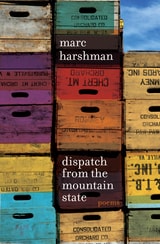
Dispatch from the Mountain State
PoemsMarc Harshman
West Virginia University Press, 2025
This collection of over forty poems sings with a fluid voice and dazzles with imagery that surprises and rings true, often underlain by and intertwined with the darker threads of our common living and dying as contemporary Appalachians. It is rare to find a poet like Harshman, who is deeply connected to the life of rural America and yet writes poetry untouched by any sentiment for the old ways found there.
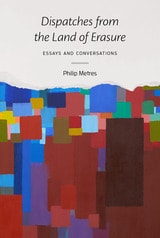
Dispatches from the Land of Erasure
Essays and ConversationsPhilip Metres
University of Michigan Press, 2025
With keen insight into the lived experience of Arab Americans and other historically marginalized communities, the book explores the struggle for a just peace through reading Palestinian Arab and Israeli Jewish writers of conscience who contend with the wall of silence around the issue of Palestine. Further, Dispatches illuminates how to write a poetry of peace and justice, and how poetic activism and activist poets situate themselves in communities seeking change. Divided into four sections—Erasing the Erasures: Writing While Arab, The Poetics of Palestine, The Poetics of Justice, and The Poetics of Peacebuilding—Dispatches weaves personal essays, cultural criticism, group chats, interviews, literary analysis, reviews, and roundtables that include luminaries like Mosab Abu Toha, Hayan Charara, Sahar Khalifeh, Marwa Helal, Erika Meitner, Naomi Shihab Nye, Craig Santos Perez, and M. NourbeSe Philip. Together, the book models the crucial need for robust dialogue to overcome the echo chamber that limits the growth and reach of social movements and to dream of a future beyond the land of erasure.
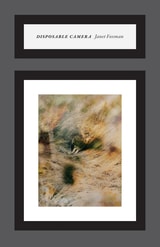
Disposable Camera
Janet Foxman
University of Chicago Press, 2012
Although Disposable Camera is Janet Foxman’s first book-length collection, one would not know it given the wry sophistication of the poems found within. The notion of the disposable camera permeates the entire book, where Foxman considers the instabilities in even our deepest attachments. Here gulfs expand, for instance, between twins, between the musician and his instrument, between the recluse and his inconsolable solitude. Whether a hermit; a twin; a filmgoer utterly taken with Triumph of the Will; or Masaccio, just after he’s painted the Expulsion—the poems’ speakers share a nagging anxiety that satisfaction may not exist outside the effort to imagine it, and that efforts at art and making, however compulsory to their executor, are probably regrettable from the start. A formally inventive and daring book, and one that displays a sophistication well beyond the poet’s years, Disposable Camera will be a valuable addition to American poetry.
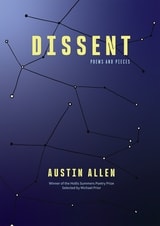
Dissent
Poems and PiecesAustin Allen
Ohio University Press, 2027
Winner of the Hollis Summers Poetry Prize, selected by Michael Prior
Dissent, the third book of poems by Austin Allen, explores division, resistance, and exile in a variety of settings, from nineteenth-century New England to distant solar systems. Here readers will find snapshots of warring planets and pandemic-era France, revelations from government servers and Frank Capra’s Bedford Falls, and a testimonial from a fringe religious sect in the New Mexico desert.
The poems capture the dignity of eccentricity and the uncertainties of protest (“I speak out. I feel that I must. / I hear my own spiel with disgust”). Featured along the way are many lively dissenters and outsiders: Yoko Ono, a reclusive mathematician, a brain in a jar. Futuristic scenarios mingle with personal elegies and love lyrics—efforts to preserve bonds and memories threatened by an age of schisms.
Avoiding allegiance to any one school or style, the collection serves up apocalyptic limericks, a “high-octane blockbuster sonnet,” a catalog of items cleared out of a parent’s home, and instruction pieces in the style of Ono’s Grapefruit. Whether depicting a visionary mailman or happy thieves on Christmas, Dissent probes the unorthodox corners of a world where poetry itself can feel heretical.
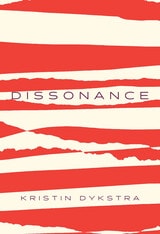
Dissonance
Kristin Dykstra
University of Chicago Press, 2025
In Dissonance, translator Kristin Dykstra’s first book of original poetry, the author leads us to inner worlds shaped partly by the New England countryside, tracking shifts in the region’s nature, infrastructure, and people, while sharing observations on borders and climate catastrophe that reverberate globally. Dykstra condenses signs of urban expansion, economic division, and battles over democracy into an innovative meditation. With a dynamic approach to form, musicality, and scope, Dissonance explores ways of experiencing regional landscapes and imagined communities in the twenty-first century.
Through her extended sequence of prose poems, photographs, and lyric fragments, Dykstra merges clips from documents and dialogues with observations drawn from two local libraries and her daily walks down a dirt road through Vermont’s foothills. As she moves down this public road, which lies within the nation’s federally designated hundred-mile border zone, she finds a daily convergence of tensions. Dissonance asks how poetry can unsettle impressions of a place, and how that process, in turn, disturbs impressions of self, of others, and of time itself.
Dissonance is the recipient of the third annual Phoenix Emerging Poet Book Prize.
Dissonance (if you are interested)
Rosmarie Waldrop
University of Alabama Press, 2005
Incisive essays on modern poetry and translation by a noted poet, translator, and critic.
In this comprehensive collection of her essays, Waldrop addresses considerations central to her life’s work: typical genres and ways of countering the conventions of genre; how concrete poets have made syntax spatial rather than grammatical; and the move away from metaphor in poetry toward contiguity and metonymy. Three essays on translation struggle with the sources and targets of translation, of the degree of strangeness or foreignness a translator should allow into any English translation. Finally, other essays examine the two-way traffic between reading and writing, and Waldrop’s notion of reading as experience.
Dissonant Voices
Race, Jazz, and Innovative Poetics in Midcentury AmericaJoseph Pizza
University of Iowa Press, 2023
Distant Reading
Performance, Readership, and Consumption in Contemporary PoetryPeter Middleton
University of Alabama Press, 2005
A dynamic account of the history, practice, and theory of poetry as performance.
Distant Reading considers poetry as performance, offers new insights into its popularity, and proposes a new history of its origins. It also explores related issues concerning the reception of poetry, the impact of the computer on how we read poetry, the persistence of the letter "I" in poems by avant-garde poets, the strangeness of the line-break as a demand on the reader's attention, and the idea of the reader as consumer. These themes are connected by a historically contextualized and theoretically sophisticated discussion of contemporary American and British poets continuing to work in the modernist tradition.
The introductory essay establishes a new methodology that transforms close reading into what Middleton calls "distant reading," interpretive reading that acknowledges the distances that texts travel from their point of composition to readers in other geographical and historical locations. It indicates that poetic innovation is often driven by a desire on the part of the poet to make this distance do cultural work in the meanings that the poem generates.
Ultimately, Distant Reading treats poetry as a cultural practice that is always situated within specific sites of performance—recited on stage, displayed in magazines, laid out on a page, scrolled on the computer screen—rather than as a transcendent cloud of meaning tethered only to its words.
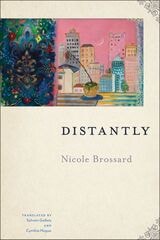
Distantly
Nicole Brossard
Omnidawn, 2022
This bilingual edition of Nicole Brossard’s lyrical poetry is a sequence of lush, taut cityscapes. Known for her elliptical and materially grounded poetics, Brossard creates an intimate series of poems drawn loosely from urban experience. The poems comprise an evocative distillation of postmodern urban life with a sharp sense of cultural and gendered histories of violence and beauty and struggles for survival and intimacy. The poems capture the emotional and ecological surroundings of each city and its people. The cities in Brossard’s poems feel surreal and in them dwell survivors of “misfortunes,” living in urban landscapes with their “gleaming debris” and “bridges, ghats, / rivers in a time of peace and torture.” These poems gesture toward a transmuted social context and toward a quest “to meet the horizon the day after the horizon.”
Disturbing the Light
Samuel Green
Carnegie Mellon University Press, 2020

Ditch Memory
New and Selected PoemsTodd Davis
Michigan State University Press, 2024
Diurne
Kristin George Bagdanov
Tupelo Press, 2019

Diva
Rafael Campo
Duke University Press, 1999
At once relishing and resisting the poetic traditions of formal English verse, Diva showcases Campo moving deftly between received forms and free verse. In each poem the sound of words is transformed into the highest of arts, the act of performance into the exercise of power, and the most profound abjection into the sweet promise of divinity. Culminating with his new and daring translations of Federico García Lorca's sonetos—the great Spanish poet's most homoerotically explicit and formally accomplished poems—Campo's music instills in the reader an exalted understanding of beauty, suffering, and, ultimately, the human capacity for empathy.
From reviews of Campo's previous poetry:
“Extraordinary meditations on illness and the healing power of words.”—Lambda Literary Foundation
“Read Campo to enter the bloodstream of a man who, with a haunting clarity of vision, shares his memories, his anguish, his healing love.”—Cortney Davis, Literature and Medicine
“Riveting, provocative, and refreshing—[this volume] is a gift to the clinician who is trying to re-invoke in his or her students the humility, compassion, and deep caring that brought us all into medicine in the first place.”—Dr. Sandra L. Bertman, Annals of Internal Medicine
“[Campo] listens to the sounds the body makes, but what he hears is poetry.”—Zoë Ingalls, Chronicle of Higher Education
“Powerful and accessible.”—Jonathan Jackson, Washington Blade
“Bemused, indelible, and heartbreaking.”—Marilyn Hacker, Out
“[Campo’s] private corral of disparate words twist, torque, collide with gorgeous creative imperative.”—Nomi Eve, Independent Weekly
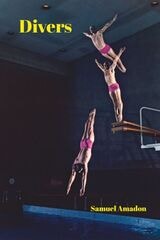
Divers
Samuel Amadon
Omnidawn, 2026
Marking a formal reinvention for the poet, this collection addresses the strangeness of time, blending writers and images from the past with contemporary scenes.
This book-length sequence of turbulent sonnets follows their speaker's impulses and imagination through the seasons of their composition. Written between 2016 and 2022, Divers is a collection shaped by contradiction and marks a new period of lyric experimentation for poet Sam Amadon. These poems are rigorously constrained while also making space for improvisation. They hold to a decasyllabic line while moving in and out of meter. They sing of time, and struggle to understand it. They find words for our moment in the pages of old books. Lines from great writers of the past—including Gerard Manley Hopkins, Thomas Wyatt, and Michael Drayton—echo through Amadon's poems of contemporary menace and wonder. Here we see both the owls lining our fences and the black SUVs rolling down our streets. Out of these conflicts, Amadon’s sonnets step up, lift off, and dive into themselves.

Dodging
Charles Bernstein
University of Chicago Press, 0
A new, expansive collection by one of the most provocative and inventive poets of our time.
In Dodging, Charles Bernstein pushes his poetics toward new kinds of formal and tonal attentions. This multifaceted work brings together comic velocity, pointed political critique, and passages of lyric intensity. Bernstein calls these poems “too late”: written late in life as irreversibility presses against reflection, regret, and renewed resistance—a situation in which dodging is not evasion but survival, a way of moving through political catastrophe and personal loss without being silenced by either.
The collection unfolds in three interrelated “fits”—a term suggesting bursts of composition, rhythmic surges, and formal groupings—titled “Dodging,” “Struggle,” and “Reflection.” These sections move from a series of flashes and fragments, then to assembled riffs and collaborations with poet Tracie Morris, and finally turn to refractions and aphorisms that embrace active contradiction. Together they trace a shifting field of contrasts: between satire and elegy, volatility and concentration, comedy and grief.
Both fundamentally true to Bernstein’s voice and radically radiant in its range, Dodging is a work that moves restlessly across forms and tones—by turns sly, searching, and unguarded, where humor and grief occupy the same ground.
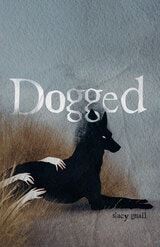
Dogged
Stacy Gnall
University of Massachusetts Press, 2022
Looking to a wide range of high and low visual media, from Steven Spielberg’s Jaws and Animal Planet’s Fatal Attractions to Peter Paul Rubens’s painting of Hercules’s dog discovering Tyrian purple, Stacy Gnall ponders human-animal connections and divisions, exploring those moments when human voices blend with “silent” beasts to exceed the limits of language. In Dogged, animals emerge as the highest aspiration of poetry.
Around the bend it was reckoned
we would never grow old
because there were no words for it.
I placed my arms soft
around the neck of a fawn
and she felt no alarm. Speech
is where we went wrong.
(From “The Wood in Which Things Have No Name”)
Dogged Hearts
Ellen Doré Watson
Tupelo Press, 2010
In Dogged Hearts Ellen Doré Watson demonstrates a capacious talent for invention and empathy and, with her incomparable linguistic brio, gives us an unforgettable look at how loss and disconnection can usher in chance-to-change reverie and unexpected veerings towards life.
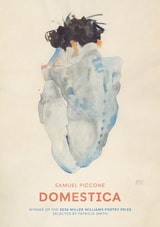
Domestica
Samuel Piccone
University of Arkansas Press, 2026
Samuel Piccone’s Domestica firmly plants its feet at the fraught intersection of inheritance and the escape from it. Across these interrogative poems, the routines of marriage, parenthood, and faith reside in a place where “every garden is erased / by the thrum of impermanence.” If “silence is the earth’s way of embracing us / in whatever loneliness we think we deserve,” Piccone seeks whatever answers are held in the deepest recesses of that silence. At once aphoristic and vulnerable, these poems insist that “the stars are there to ache us into asking whatever we haven’t / brought ourselves to ask.” To startle us into paying attention to the world.
Don't Ask
Philip Levine
University of Michigan Press, 1981
Don't Explain
Betsy Sholl
University of Wisconsin Press, 1997
Don't Leave Hungry
Fifty Years of Southern Poetry ReviewJames Smith
University of Arkansas Press, 2009