Results by title
3388 books match the query 'Fiction' and 125 start with d
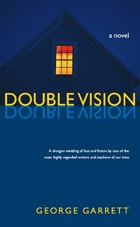
Double Vision
A NovelGeorge Garrett
University of Alabama Press, 2007
A shotgun marriage of fact and fiction by one of the most highly regarded writers and teachers of our time
A writer named George Garrett, suffering from double vision as a result of a neurological disorder, is asked to review a recent, first biography of the late Peter Taylor, a renowned writer who has been his long-time friend and neighbor in Charlottesville. Reflecting on their relationship, Garrett conceives of a character—not unlike himself—a writer in his early 70s, ill and suffering from double vision, named Frank Toomer. He gives Toomer a neighbor, a distinguished short story writer named Aubrey Carver.
As the real George Garrett and Peter Taylor are replaced by two very different and imaginary writers, the story becomes a wise and insightful exploration of American literary life, the art of biography, the comical rivalries among writers and academics, notions of success, and the knotty relationship of art to life, fact to fiction, and life to death. Double Vision is a witty tour de force and an elegy for a gifted generation of writers.
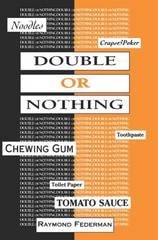
Double or Nothing
Raymond Federman
University of Alabama Press, 1999
Madly transfixing details—noodles, toilet paper, toothpaste, a first subway ride, a sock full of dollars—become milestones in a discovery of America. These details, combined with Federman's feel for the desperation of his characters, create a book that is simultaneously hilarious and frightening. The concrete play of its language, its use of found materials, give the viewer/reader a sense of constant and strange discovery. To turn these pages is to turn the corners of a world of words as full as any novel of literary discourse ever presented. Double or Nothing challenges the way we read fiction and the way we see words, and in the process, gives us back more of our own world and our real dilemmas than we are used to getting.
Picked for American Book Review's 100 Best First Lines from Novels
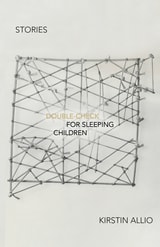
Double-Check for Sleeping Children
StoriesKirstin Allio
University of Alabama Press, 2024
WINNER OF THE FC2 CATHERINE DOCTOROW INNOVATIVE FICTION PRIZE
Double-Check for Sleeping Children is the newest work by award-winning writer Kirstin Allio
At once formal and tidal, damning and dreaming, Kirstin Allio’s Double-Check for Sleeping Children is charged with prayer, curse, redemption and abasement. Does truth come from reason, or beauty, or suffering? It takes the inner lives of outsiders, dark mirrors, and false ceilings to find an answer.
Families split by social class, a wealthy young widow, addicts, hunters, poor whites, a green card bride and a nursing mother: in twenty poetically and morally propulsive short stories, Allio disquiets the sublimated and palpates shadows. She leads us through the sometimes flooded, other times flood-lit halls of the human soul.
Part menacing, macabre Mary Gaitskill, part Denis Johnson in Jesus’ Son, and with the taut, wry, tell-all detail of Elizabeth Hardwick, Double-Check for Sleeping Children deals in codedness and transgression. The stories explore coming of age in middle age, anxiety about time and technology, inverted revelation. “What was I supposed to do with Basho and Mosie?” Sheila asks herself about her children in “Uncollected Territories.” “Be my real self? Hand myself over, do what you will with me, plant your strange selves in my private soil?”

Down the River
or Practical Lessons Under The Code DuelloGeorge W Hooper
University of Alabama Press, 2007
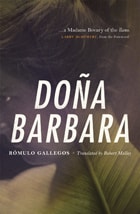
Doña Barbara
A NovelRómulo Gallegos
University of Chicago Press, 2012
Rómulo Gallegos is best known for being Venezuela’s first democratically elected president. But in his native land he is equally famous as a writer responsible for one of Venezuela’s literary treasures, the novel Doña Barbara. Published in 1929 and all but forgotten by Anglophone readers, Doña Barbara is one of the first examples of magical realism, laying the groundwork for later authors such as Gabriel García Márquez and Mario Vargas Llosa.
Following the epic struggle between two cousins for an estate in Venezuela, Doña Barbara is an examination of the conflict between town and country, violence and intellect, male and female. Doña Barbara is a beautiful and mysterious woman—rumored to be a witch—with a ferocious power over men. When her cousin Santos Luzardo returns to the plains in order to reclaim his land and cattle, he reluctantly faces off against Doña Barbara, and their battle becomes simultaneously one of violence and seduction. All of the action is set against the stunning backdrop of the Venezuelan prairie, described in loving detail. Gallegos’s plains are filled with dangerous ranchers, intrepid cowboys, and damsels in distress, all broadly and vividly drawn. A masterful novel with an important role in the inception of magical realism, Doña Barbara is a suspenseful tale that blends fantasy, adventure, and romance.
Hailed as “the Bovary of the llano” by Larry McMurtry in his new foreword to this book, Doña Barbarais a magnetic and memorable heroine, who has inspired numerous adaptations on the big and small screens, including a recent television show that aired on Telemundo.
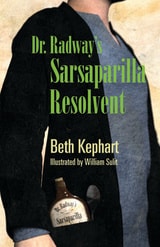
Dr. Radway's Sarsaparilla Resolvent
Beth Kephart
Temple University Press, 2013
Flavored by the oddities of historic personalities and facts, Dr. Radway’s Sarsaparilla Resolvent is set in Bush Hill, Philadelphia, 1871—home to the Baldwin Locomotive Works and a massive, gothic prison. Acclaimed writer Beth Kephart captures the rhythms and smells of an extraordinary era as William Quinn and his Ma, Essie, grapple with life among terrible accidents, miraculous escapes, and shams masquerading as truth.
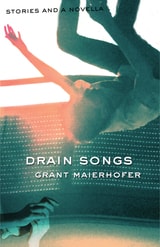
Drain Songs
Stories and a NovellaGrant Maierhofer
University of Alabama Press, 2019
Drain Songs gathers five stories and a novella focused on the many trials of modern life—addiction and depression, mania and disorder, attempts and failure at keeping the worst at bay. Grant Maierhofer’s stories focus on characters in varying states of disarray and stuckness, continuing his literary project of analyzing lives on the fringes of sanity and society. The novella “Drain Songs” is a harrowing narrative focused squarely on addiction and recovery, twelve-step programs, and codependency.
In all of these tales, Maierhofer takes a bee’s-eye view of protagonists from all walks of life, from the working class to the academy, from janitors to professors, embodying the commonalities of men and women struggling with very fundamental elements of survival, perspective, and identity—attempts formal and informal to contend with the trials that forever engage and perplex humanity.
His evocative prose conveys both despair and resignation as well as stultifying, brain-deadening routine and repetition. Still, these stories transcend angst and tilt toward agony and ecstasy and the hope of redemption.
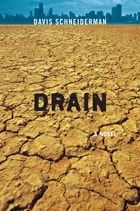
Drain
A NovelDavis Schneiderman
Northwestern University Press, 2010
It’s the year 2039, and Lake Michigan is mysteriously emptied of water. The planet’s atmosphere and magnetic field are failing, and fires burn ominously throughout the empty lake bed. In this seemingly endless desert east of Chicago, three factions are locked in conflict: the original end-of-times cultist settlers who follow religious visionary Fulcrum Maneuvers and worship a giant World Worm they deem responsible for the drained lake; the megacorporation Quadrilateral, a mega-consumerist, planned-community combine of bourgeois city planners developing what is now called the Wildland-Urban Interface; and the Blackout Angels, landlocked punk pirates raised in Quadrilateral cities, who oppose everything and everyone.
In Davis Schneiderman’s shocking novel, Drain, freedom, creativity, and transgression wage war with forces of control, censorship, and conformity. The wordscapes of William S. Burroughs and Thomas Pynchon, the dystopic nightmares of Philip K. Dick, and the transgressive punch of Chuck Palahniuk and Georges Bataille together convene in this stunning and thrilling work.
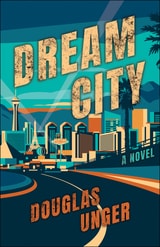
Dream City
A NovelDouglas Unger
University of Nevada Press, 2024
As the story progresses, C. D. comes to understand how his personal losses and the losses of his cohort of hard driving executives on the make—especially the tragic life of his work partner, Greta Olsson, the only woman to break through into their male dominated world—are a result of the make-believe environment he has helped to create, a world where representation replaces reality. Hoping to piece together his faltering marriage and family relationships, C. D. must find a new path as he struggles to hold onto his dreams.
In this fictionalized version of the city of glittering lights, author Douglas Unger pits the ideologies of marketing and consumerism in the casino economy of America against the erosion of individual and humane values that success in that world demands. Unger reveals the hard truth that Las Vegas, a blue-collar town considered by many to be “the most honest city,” can be a temple for self-deceptions, emblematic of a service economy that knows the price of everything and too often the value of little else. Dream City becomes both a love song and an elegy for Las Vegas that sets it apart from any other literary novel previously written about this global entertainment attraction that in so many ways represents postmodern America. Sooner or later, the challenge that faces everyone is to discover what matters most, and to learn how to bet on the better angels of our natures.
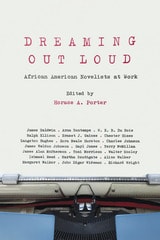
Dreaming Out Loud
African American Novelists at WorkHorace Porter
University of Iowa Press, 2015
Some essays explore the challenges of being an African American writer in the United States, broadly addressing aesthetic and racial prejudice in American publishing and literature and its changing face over the decades. Others are more specific and personal, recounting how the authors came to be a reader and writer in a culture that did not always encourage them to do so. Some are more general and focus on practice and craft, while still other essays offer detailed behind-the-scenes accounts of how famous novels, such as Native Son, Invisible Man, The Autobiography of Miss Jane Pittman, and The Color Purple, came to life. Ranging from the Harlem Renaissance, through the Civil Rights movement, and into the twenty-first century, this anthology explores what it has meant to be an African American novelist over the past hundred years.
Found within are essays by twenty-one African American novelists, including Nobel Prize-winner Toni Morrison, National Book Award-winners Ralph Ellison and Charles Johnson, Pulitzer Prize-winners Alice Walker and James Alan McPherson, and well-known canonical writers such as W. E. B. Du Bois, James Weldon Johnson, Langston Hughes, Richard Wright, Zora Neale Hurston, and Margaret Walker. Dreaming Out Loud seeks to inspire writers and readers alike, while offering a fascinating and important portrait of novelists at work in their own words.
CONTRIBUTORS
James Baldwin, Arna Bontemps, W. E. B. Du Bois, Ralph Ellison, Ernest Gaines, Chester Himes, Langston Hughes, Zora Neale Hurston, Charles Johnson, James Weldon Johnson, Gayl Jones, Terry McMillan, James Alan McPherson, Toni Morrison, Walter Mosley, Ishmael Reed, Martha Southgate, Alice Walker, Margaret Walker, John Edgar Wideman, Richard Wright
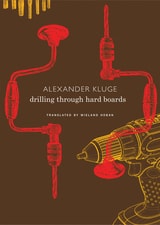
Drilling through Hard Boards
133 Political StoriesAlexander Kluge
Seagull Books, 2019
In the book, Kluge masterfully unspools more than one hundred vignettes, through which it becomes clear that the political is more often than not personal. Politics are everywhere in our everyday lives, so along with the stories of major political figures, we also find here the small, mostly unknown ones: Elfriede Eilers alongside Pericles, Chilean miners next to Napoleon, a three-month-old baby beside Alexander the Great. Drilling through Hard Boards is not just Kluge’s newest fiction, it is a masterpiece of political thought.
Driscoe
Greg Mulcahy
University of Alabama Press, 2026
A stark, hypnotic exploration of memory, identity, and the fractured stories we inherit, and invent, to survive
Driscoe is a stylistically daring novel that plunges deep into the unstable terrain of memory, identity, and the stories we tell to endure collapse. Hypnotic and recursive, it moves through contradiction as both method and meaning, tracing how belief hardens, fractures, and reforms under pressure. The prose hums with unease, balancing precision and disorientation as certainty dissolves into overlapping versions of the same events.
At its center is Jouska, a man suspended between narratives of success and failure, loyalty and betrayal, progress and ruin. He is pursued by obsessive memories of his ex-wife, his brother, and the elusive figure of Driscoe, by turns entrepreneur, fraud, chemist, builder, trickster. Everyone claims a story about Driscoe. None align, yet all insist on their authority. Entangled in familial conflict and his own faltering recollections, Jouska can neither trust nor abandon any version of the truth.
When Jouska receives an email announcing the death of his superior, the already fragile architecture of his life splinters further. What follows is a journey through a bureaucratic labyrinth where death is both confirmed and denied, and where greed, doubt, presence, and absence pulse relentlessly. Driscoe emerges as a narrative dirge for a collapsing American middle class and the myths that sustained it, tracing the impossibility of aligning personal loss with cultural unraveling. This novel will resonate with readers drawn to literary fiction that is intellectually demanding, formally inventive, and attuned to the psychic costs of living amid social and economic decay.
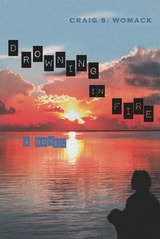
Drowning in Fire
Craig S. Womack
University of Arizona Press, 2001
Josh Henneha has always been a traveler, drowning in dreams, burning with desires.
As a young boy growing up within the Muskogee Creek Nation in rural Oklahoma, Josh experiences a yearning for something he cannot tame. Quiet and skinny and shy, he feels out of place, at once inflamed and ashamed by his attraction to other boys. Driven by a need to understand himself and his history, Josh struggles to reconcile the conflicting voices he hears—from the messages of sin and scorn of the non-Indian Christian churches his parents attend in order to assimilate, to the powerful stories of his older Creek relatives, which have been the center of his upbringing, memory, and ongoing experience.
In his fevered and passionate dreams, Josh catches a glimpse of something that makes the Muskogee Creek world come alive. Lifted by his great-aunt Lucille’s tales of her own wild girlhood, Josh learns to fly back through time, to relive his people’s history, and uncover a hidden legacy of triumphs and betrayals, ceremonies and secrets he can forge into a new sense of himself.
When as a man, Josh rediscovers the boyhood friend who first stirred his desires, he realizes a transcendent love that helps take him even deeper into the Creek world he has explored all along in his imagination.
Interweaving past and present, history and story, explicit realism and dreamlike visions, Craig Womack’s Drowning in Fire explores a young man’s journey to understand his cultural and sexual identity within a framework drawn from the community of his origins. A groundbreaking and provocative coming-of-age story, Drowning in Fire is a vividly realized novel by an impressive literary talent.
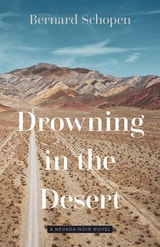
Drowning in the Desert
A Nevada Noir NovelBernard Schopen
University of Nevada Press, 2023
Norman “Fats” Rangle, an ex–deputy sheriff, operates a horse stabling and excursion business with his brother and sister-in-law on their family ranch in the small rural community of Blue Lake, a few hours outside of Las Vegas. But fate has other plans for him when, high on a southern Nevada mountain range, Fats discovers the wreckage of a plane that crashed two years earlier. Although he reports his find to the sheriff, he does not disclose that someone had already been to the crash site—evidence that Fats deliberately destroyed.
Soon, Fats is tracking back and forth between Las Vegas and Blue Lake in a search for a missing cousin, a briefcase full of cash, and, finally, for a killer. Along the way, Fats also begins to understand that he’s searching for himself and his place in a rapidly changing West.
Angry and alienated, Fats distrusts everyone he meets, from sleaze-merchants and political power brokers to two women: one he wants to believe in, a retired judge; and the other, a police sergeant, he can’t quite believe isn’t deceiving him. After all, in this Nevada, corruption is a given. Everybody lies. Much is uncertain—motives, loyalties, affections. But in Drowning in the Desert, one thing is certain: water is a precious resource that can both kill and be killed for.
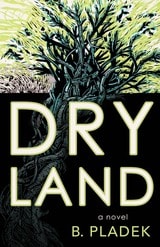
Dry Land
B. Pladek
University of Wisconsin Press, 2023
While at camp, Rand also realizes the true price of his gift: everything he grows withers and dies, leaving the soil empty of all living matter. Horrified, he throws himself into ever more self-destructive trials, buckling under the pressure of so many secrets. In order to survive, he must confront the terrifying possibility that his gift is actually a curse, upending everything he believes about nature, love, and himself.
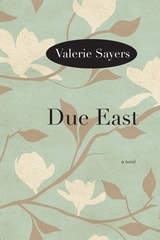
Due East
A NovelValerie Sayers
Northwestern University Press, 2013
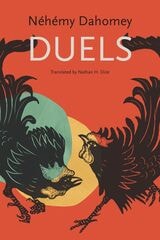
Duels
Néhémy Dahomey
Seagull Books, 2025
Set in 1842, this novel foregrounds a Haiti that is grappling with the weight of an onerous debt imposed by France, forcing its citizens to pay reparations to French colonists in exchange for diplomatic recognition of the first Black republic of the Americas. In the town of Boën, a prosperous notary, Ludovic Possible, decides to take a bold step to secure the future of his community. He opens a schoolhouse where local children can learn both artisanal skills and the essential ability to read and write. For Ludovic, education represents the best chance for the people of Boën to rise above their hardships and build a prosperous future—especially for Aïda, a quiet and enigmatic girl whose mother’s marvelous stories captivate him.
The tranquility of Boën is soon shattered, however, by a series of duels that pit families, neighbors, and even animals against each other. As tensions rise, Ludovic’s vision for a better future is threatened by the escalating violence. In Duels, Néhémy Pierre-Dahomey introduces readers to a rich and unforgettable cast of characters—Aïda, Ludovic, Balthazar Possible, Pépé the Tempest, and many others—who find themselves at the crossroads of a nation on the brink of transformative change.
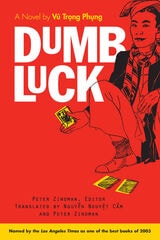
Dumb Luck
A Novel by Vu Trong PhungPeter Zinoman, Editor
University of Michigan Press, 2002
Dumb Luck is the first translation of a major work by Vu Trong Phung, arguably the greatest Vietnamese writer of the twentieth century. The novel's clever plot, richly drawn characters and humorous tone and its preoccupation with sex, fashion and capitalism will appeal to a wide audience. It will appeal to students and scholars of Vietnam, comparative literature, colonial and postcolonial studies, and Southeast Asian civilization.
Vu Trong Phung died in Hanoi, in 1939 at the age of twenty-seven. He is the author of at least eight novels, seven plays, and several other works of fiction in addition to Dumb Luck.
Peter Zinoman is Associate Professor of Southeast Asian History, University of California, Berkeley. Nguyen Nguyet Cam is Vietnamese Language Instructor, University of California, Berkeley.
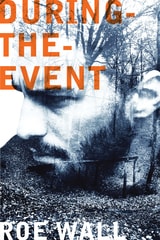
During-the-Event
Roger Wall
University of Alaska Press, 2019
Once taught that strangers are only sources of pain, D.E. must learn to trust the people he meets on his journey. During-the-Event is a soaring coming-of-age story that grapples with achingly familiar issues: coming to terms with loss and loneliness, finding what our identities really mean, and searching for love in an often strange and bewildering world.
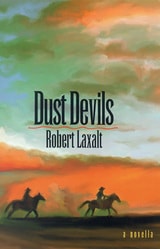
Dust Devils
A NovellaRobert Laxalt
University of Nevada Press, 1997
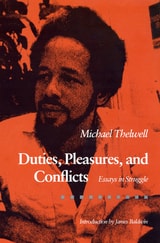
Duties, Pleasures, and Conflicts
Essays in StruggleMichael M. Thelwell
University of Massachusetts Press, 1987
This powerful collection of essays and short stories provides a unique perspective on the black civil rights movement over the past twenty-five years. A long-time activist, Michael Thelwell was a member of the Student Non-Violent Coordinating Committee (SNCC) and the Mississippi Freedom Democratic Party in the early 1960s, a founder of the W.E.B. Du Bois Department of Afro-American Studies at the University of Massachusetts in 1970, author of the widely praised novel The Harder They Come published in 1980, and an organizer for Jesse Jackson's presidential campaign in 1984. Thelwell is a writer of rare grace, integrity, and strong political convictions.
The collection begins with three stories. Set in the Mississippi Delta in the 1960s, the stories explore how individuals manage to preserve their dignity in a world of racism and violence. The next six essays, also written in the 1960s, are historical and journalistic. They discuss the March on Washington for Jobs and Freedom, the situation in the South as seen by SNCC workers, the political challenges in Mississippi, the articulation of the Black Power movement, the causes of the black student revolt at Cornell, and the need for Black Studies as the intellectual offensive in the struggle for black liberation.
The section that follows is composed of literary pieces: two appreciative essays on James Baldwin, two critical reviews of William Styron and his treatment of Nat Turner, an excoriating assessment of V. S. Naipaul, a profile of Amos Tutuola, and a thoughtful analysis of the social responsibility of the black writer.
The final essay examines the history of Jesse Jackson's presidential campaign and comments on the political climate of the 1980s.
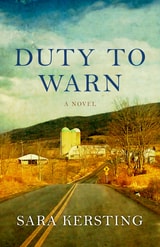
Duty To Warn
A NovelSara Kersting
Acre Books, 2018
To aid him in the chase, Malden calls on his colleague, the awkward, remote, intimidatingly tall Sonja Nielsen. She reluctantly agrees to help, either because of or despite her previous entanglements with Malden.
Told from the perspectives of these three characters, the story swerves and jolts and switches back, much like Percy’s recollections of his upbringing. Kersting presents the interior struggles of her characters in a searingly spare style, all the while drawing the reader through an escalating series of events as Percy hitches rides and takes buses, searching the small towns of central Michigan, alternately helped and hindered by both old and new acquaintances.
While following disparate leads toward Percy’s final, surprising destination, all three conflicted souls are compelled to examine their loyalties, test their convictions, admit their frailties, and confront the ghosts lurking in their pasts, resulting in a revelatory climax.
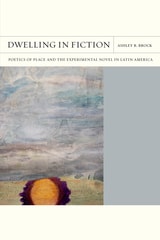
Dwelling in Fiction
Poetics of Place and the Experimental Novel in Latin AmericaAshley R. Brock
Northwestern University Press, 2023
The radical formal experiments undertaken by writers across Latin America in the mid-twentieth century introduced friction, opacity, and self-reflexivity to the very act of reading. Dwelling in Fiction: Poetics of Place and the Experimental Novel in Latin America explores the limitations and the possibilities of literature for conveying place-specific forms of life. Focusing on authors such as José María Arguedas, João Guimarães Rosa, and Juan José Saer, who are often celebrated for universalizing regional themes, Ashley R. Brock brings a new critical lens to Latin American writers who were ambivalent toward their era’s “boom.”
Beyond mere resistance to or critique of the commodification and political instrumentalization of rural topics and types, this countertrend of critical regionalism positions readers themselves as outsiders, pushing them to engage their senses, to train their attention, and to learn to dwell in unknown textual landscapes. Dwelling in Fiction draws on a transnational community of thinkers and writers to show how their midcentury aesthetic practices of sensorial pedagogy anticipate contemporary turns toward affect, embodiment, decoloniality, and ecological thought.
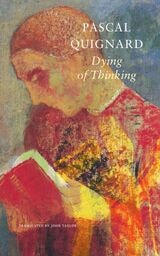
Dying of Thinking
The Last Kingdom IXPascal Quignard
Seagull Books, 2023
Dying of Thinking is the ninth volume of Pascal Quignard’s Last Kingdom series. It explores three themes: how thought and death coincide, how thought is close to melancholy, and how thought takes shelter near traumatism. One who thinks, Quignard shows us, “compensates” for a very ancient abandonment. Even as a dream is a meaning whose disorderly, condensed, paradoxical images intuit something which has preceded sleep and which returns in them, thought is a meaning which uses words that are written, re-transcribed, dissected, etymologized and neologized. Throughout the Last Kingdom series, Quignard has sought to experience another way of thinking, one that has nothing to do with philosophy, a way of attaching himself “literally” to texts and of progressing by decomposing the imagery of dreams. Dying of Thinking is the heart of this quest.
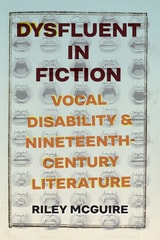
Dysfluent in Fiction
Vocal Disability and Nineteenth-Century LiteratureRiley McGuire
The Ohio State University Press, 2025
Honorable Mention, 2025 Victorian Popular Fiction Association First Book Prize
In Dysfluent in Fiction, Riley McGuire unspools a literary history of vocal disability in the nineteenth century, arguing that this underexamined literary trope helps us to understand vocal hierarchies that still structure our present. Adopting the term “dysfluency” to show departure from normative expectations of pace, pitch, and fluency, McGuire reveals how dysfluent speech populates an enormous number of nineteenth-century texts and played a formative role in the lives of some of the period’s most influential writers.
Dysfluent in Fiction examines anglophone literature during the long nineteenth century in both England and America by authors such as William Makepeace Thackeray, Charlotte Brontë, Lewis Carroll, Mary Elizabeth Braddon, and Frederick Douglass. Examples of dysfluencies across genres include lisping lovers, a baby-talking fairy, a mute detective, various disabilities in narratives of enslavement, and more. These representations show how disabled speech was both stigmatized and celebrated in ways that clarify our contemporary response to the spectrum of human articulation and that are a vocal corollary to current notions of neurodiversity. Dysfluency’s power, McGuire contends, lies in its denial that a single mode of articulation is possible, let alone desirable.