Results by title
3064 books match the query 'Social conditions' and 127 start with d
Divorce Portals
The Postdivorce in Asian ContextsShalini Grover
Rutgers University Press, 2027
Across Asia and its global diasporas, marriage remains a dominant and public institution, and divorce generates widespread comment and concern. Breaking new ground, Divorce Portals reveals divorce to be generative of transformations in individual intimate lives and wider societies. Through compelling, sensitive ethnographic accounts inviting readers into the lives of people undergoing separation and divorce, chapters capture the antecedent-lives of uncoupling – the imaginary, anticipatory, and cautionary – and the afterlives of divorce, in the immediate aftermath and across life courses and generations. Chapters explore the vivid and bold new selves that divorcees are fashioning for themselves and highlight the intersecting inequalities that shape postdivorce predicaments, sometimes belying the hoped-for freedoms of divorce and remarriage. Together, chapters chart nascent and haltering accommodations of the single, repartnered, and queer. Across cases drawn from diverse geographic contexts, this book unlocks new, expansive, and accessible ways to think about divorce and its aftermath.
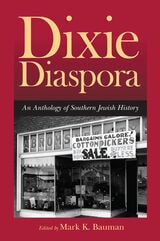
Dixie Diaspora
An Anthology of Southern Jewish HistoryMark K. Bauman
University of Alabama Press, 2006
Documenting Desegregation
Racial and Gender Segregation in Private Sector Employment Since the Civil Rights ActKevin Stainback
Russell Sage Foundation, 2013
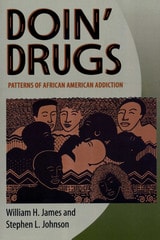
Doin’ Drugs
Patterns of African American AddictionBy William H. James and Stephen L. Johnson
University of Texas Press, 1996
Throughout the African American community, individuals and organizations ranging from churches to schools to drug treatment centers are fighting the widespread use of crack cocaine. To put that fight in a larger cultural context, Doin' Drugs explores historical patterns of alcohol and drug use from pre-slavery Africa to present-day urban America.
William Henry James and Stephen Lloyd Johnson document the role of alcohol and other drugs in traditional African cultures, among African slaves before the American Civil War, and in contemporary African American society, which has experienced the epidemics of marijuana, heroin, crack cocaine, and gangs since the beginning of this century. The authors zero in on the interplay of addiction and race to uncover the social and psychological factors that underlie addiction.
James and Johnson also highlight many culturally informed programs, particularly those sponsored by African American churches, that are successfully breaking the patterns of addiction. The authors hope that the information in this book will be used to train a new generation of counselors, ministers, social workers, nurses, and physicians to be better prepared to face the epidemic of drug addiction in African American communities.
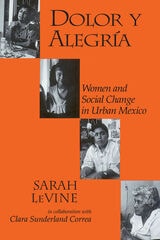
Dolor y Alegria
Women and Social Change in Urban MexicoSarah LeVine; In Collaboration with Clara Sunderland Correa
University of Wisconsin Press, 1993
While many earlier publications have focused on the poor of Latin America who live at the margins of urban life, Dolor y Alegría explores the experiences of ordinary working and lower-middle class women, most of them transplants from villages and small towns to a densely populated city neighborhood. In their early years, many experienced family disruption, emotional deprivation, and economic hardship; but steadily increasing educational opportunities, improved health care, and easily available contraception have significantly altered how the younger women relate to their families and the larger society.
Today’s Mexican schoolgirl, LeVine shows, is encouraged to apply herself to her studies for her own benefit, and the longer she remains in school, the greater the self-confidence she will carry with her into the world of work and later into marriage and motherhood. Hard economic times have forced many married women into the workplace where their sense of personal efficacy is enhanced; at the same time, in the domestic sphere, their earnings allow them greater negotiating power with husbands and male relatives. Changes are not confined to the younger generation. Older women are enjoying better health and living longer; but with adult children either less able or willing to accept responsibility for aged parents than they were in the past, anxiety runs high and family relations are often strained.
Dolor y Alegría takes a close look at the efforts of three generations of Mexican women to redefine themselves in both family and workplace; it shows that today’s young woman has very different expectations of herself and others from those that her grandmother or even her mother had.
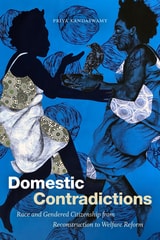
Domestic Contradictions
Race and Gendered Citizenship from Reconstruction to Welfare ReformPriya Kandaswamy
Duke University Press, 2021
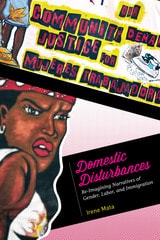
Domestic Disturbances
Re-Imagining Narratives of Gender, Labor, and ImmigrationBy Irene Mata
University of Texas Press, 2014
The issue of immigration is one of the most hotly debated topics in the national arena, with everyone from right-wing pundits like Sarah Palin to alternative rockers like Zack de la Rocha offering their opinion. The traditional immigrant narrative that gained popularity in the nineteenth and twentieth centuries continues to be used today in describing the process of the “Americanization” of immigrants. Yet rather than acting as an accurate representation of immigrant experiences, this common narrative of the “American Dream” attempts to ideologically contain those experiences within a story line that promotes the idea of achieving success through hard work and perseverance.
In Domestic Disturbances, Irene Mata dispels the myth of the “shining city on the hill” and reveals the central truth of hidden exploitation that underlies the great majority of Chicana/Latina immigrant stories. Influenced by the works of Latina cultural producers and the growing interdisciplinary field of scholarship on gender, immigration, and labor, Domestic Disturbances suggests a new framework for looking at these immigrant and migrant stories, not as a continuation of a literary tradition, but instead as a specific Latina genealogy of immigrant narratives that more closely engage with the contemporary conditions of immigration. Through examination of multiple genres including film, theatre, and art, as well as current civil rights movements such as the mobilization around the DREAM Act, Mata illustrates the prevalence of the immigrant narrative in popular culture and the oppositional possibilities of alternative stories.
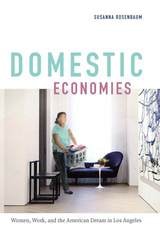
Domestic Economies
Women, Work, and the American Dream in Los AngelesSusanna Rosenbaum
Duke University Press, 2017
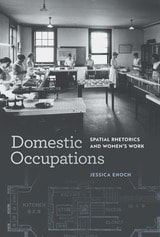
Domestic Occupations
Spatial Rhetorics and Women’s WorkJessica Enoch
Southern Illinois University Press, 2019
Enoch explores how three different groups of women workers—teachers, domestic scientists, and World War II factory employees—contended with the physical and ideological space of the home, examining how this everyday yet powerful space thwarted or enabled their financial and familial security as well as their intellectual engagements and work-related opportunities.
Domestic Occupations demonstrates a multimodal and multigenre research method for conducting spatio-rhetorical analysis that serves as a model for new kinds of thinking and new kinds of scholarship. This study adds historical depth and exigency to an important contemporary conversation in the public sphere about how women’s ties to the home inflect their access to work and professional advancement.
Dos Mundos
Rural Mexican Americans, Another AmericaRichard Baker
Utah State University Press, 1995
Mexican Americans make up the largest minority in Idaho, yet they seemingly live in a different world from the dominant Anglo population, and because of pervasive stereotypes and exclusive policies, their participation in the community's social, economic, and political life is continually impeded.
This unique ethnographic study of a small Idaho community with a large Hispanic population examines many dimensions of the impact race relations have on everyday life for rural Mexican Americans.
Double Cross
Japanese Americans In Black And White ChicagoJacalyn D. Harden
University of Minnesota Press, 2003
Examines relations between peoples of color to offer a compelling new approach to understanding race in America
Since the Great Migration of the early twentieth century, Chicago has been a cauldron of race relations, symbolizing the tenacity of discrimination and segregation. But as in other cities with significant populations of Latinos and Asians, Arabs and Jews, this image belies complex racial dynamics. In Double Cross, Jacalyn D. Harden provides an essential rethinking of the ways we understand and talk about race, using an examination of the Japanese American community of Chicago’s Far North Side to form an innovative new framework for looking at race, identity, and political change.
The Japanese American community in Chicago rapidly expanded between 1940 and 1950 in the aftermath of wartime internment and government relocation programs. Harden tells their story through archival research and interviews with some of the first Japanese Americans who were relocated to Chicago in the 1940s, incorporating her own experiences as an African American scholar who has lived in Japan. The result is a compelling and surprising account of racial interactions, one that clarifies the complex interweaving between black and Asian lives and reclaims a lost history of solidarity between the two groups.Moving from the Great Migration to the “great relocation” to gentrification, Harden explores the shared history of civil rights struggles that firmly links Japanese and African Americans, most importantly the issue of reparations (for internment during World War II and slavery, respectively). She describes the efforts of Japanese Americans to “double-cross the color line” by building coalitions across race, age, and class boundaries, and their vexed position as sometimes “colored,” sometimes white (for example, the Japanese American soldier who was instructed to use the white washrooms at boot camp in Alabama during World War II, while thousands were being relocated to internment camps).Double Cross is a major contribution to our thought about race relations, challenging orthodoxy and shedding new light on the complex identities, conflicting interests, and external forces that have defined the concept of race in the United States.
Downed by Friendly Fire
Black Girls, White Girls, and Suburban SchoolingSignithia Fordham
University of Minnesota Press, 2016
Most Americans would never willingly revisit their high school experiences; the nation’s school systems reflect the broader society’s hierarchical emphasis on race, class, and gender. While schools purport to provide equal opportunities for all students, this rarely happens in actuality—particularly for girls.
In Downed by Friendly Fire, Signithia Fordham unmasks and examines female-centered bullying in schools, arguing that it is essential to unmask female aggression, bullying, and competition, all of which directly relate to the structural violence embedded in the racialized and gendered social order. For two and a half years, Fordham conducted field research at “Underground Railroad High School,” a suburban high school in upstate New York. Through a series of composite student profiles, she examines the girls’ relationships to academic achievement, social competition, and aggression toward one another. Fordham argues that girls academically “compete to lose,” which only perpetuates their subordination through the misrecognition of their own competitive behaviors. She goes further to expand the meaning of violence to include what is seen as normal, including suffering, humiliation, and social and economic abuse.
Using the concept “symbolic violence,” Fordham theorizes the psychological and social damage suffered especially by black girls in schools. The five narratives in Downed by Friendly Fire ultimately highlight the pain and suffering this violence produces as well as the ways in which it promotes inequality, exclusion, and marginalization among girls.
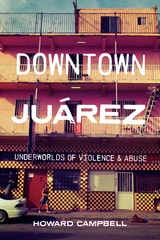
Downtown Juárez
Underworlds of Violence and AbuseHoward Campbell
University of Texas Press, 2021
At least 200,000 people have died in Mexico’s so-called drug war, and the worst suffering has been in Ciudad Juárez, across the border from El Paso, Texas. How did it get so bad? After three decades studying that question, Howard Campbell doesn’t believe there is any one answer. Misguided policies, corruption, criminality, and the borderland economy are all factors. But none of these reasons explain how violence in downtown Juárez has become heartbreakingly “normal.”
A rigorous yet moving account, Downtown Juárez is informed by the sex workers, addicts, hustlers, bar owners, human smugglers, migrants, and down-and-out workers struggling to survive in an underworld where horrifying abuses have come to seem like the natural way of things. Even as Juárez’s elite northeast section thrives on the profits of multinational corporations, and law-abiding citizens across the city mobilize against crime and official malfeasance, downtown’s cantinas, barrios, and brothels are tyrannized by misery.
Campbell’s is a chilling perspective, suggesting that, over time, violent acts feed off each other, losing their connection to any specific cause. Downtown Juárez documents this banality of evil—and confronts it—with the stories of those most affected.

Doña Barbara
A NovelRómulo Gallegos
University of Chicago Press, 2012
Rómulo Gallegos is best known for being Venezuela’s first democratically elected president. But in his native land he is equally famous as a writer responsible for one of Venezuela’s literary treasures, the novel Doña Barbara. Published in 1929 and all but forgotten by Anglophone readers, Doña Barbara is one of the first examples of magical realism, laying the groundwork for later authors such as Gabriel García Márquez and Mario Vargas Llosa.
Following the epic struggle between two cousins for an estate in Venezuela, Doña Barbara is an examination of the conflict between town and country, violence and intellect, male and female. Doña Barbara is a beautiful and mysterious woman—rumored to be a witch—with a ferocious power over men. When her cousin Santos Luzardo returns to the plains in order to reclaim his land and cattle, he reluctantly faces off against Doña Barbara, and their battle becomes simultaneously one of violence and seduction. All of the action is set against the stunning backdrop of the Venezuelan prairie, described in loving detail. Gallegos’s plains are filled with dangerous ranchers, intrepid cowboys, and damsels in distress, all broadly and vividly drawn. A masterful novel with an important role in the inception of magical realism, Doña Barbara is a suspenseful tale that blends fantasy, adventure, and romance.
Hailed as “the Bovary of the llano” by Larry McMurtry in his new foreword to this book, Doña Barbarais a magnetic and memorable heroine, who has inspired numerous adaptations on the big and small screens, including a recent television show that aired on Telemundo.
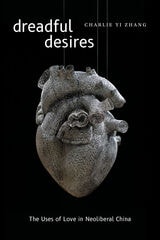
Dreadful Desires
The Uses of Love in Neoliberal ChinaCharlie Yi Zhang
Duke University Press, 2022
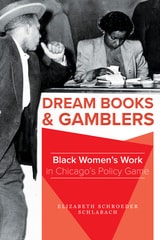
Dream Books and Gamblers
Black Women's Work in Chicago's Policy GameElizabeth Schroeder Schlabach
University of Illinois Press, 2022
Elizabeth Schroeder Schlabach examines the complexities of Black women’s work in policy gambling. Policy provided Black women with a livelihood for themselves and their families. At the same time, navigating gender expectations, aggressive policing, and other hazards of the infromal economy led them to refashion ideas about Black womanhood and respectability. Policy earnings also funded above-board enterprises ranging from neighborhood businesses to philanthropic institutions, and Schlabach delves into the various ways Black women straddled the illegal policy business and reputable community involvement.
Vivid and revealing, Dream Books and Gamblers tells the stories of Black women in the underground economy and how they used their work to balance the demands of living and laboring in Black Chicago.
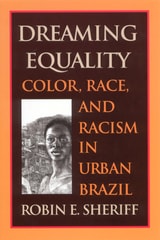
Dreaming Equality
Color, Race, and Racism in Urban BrazilSheriff, Robin E.
Rutgers University Press, 2001
This myth contrasts starkly with the realities of a pernicious racial inequality that permeates every aspect of Brazilian life. To study the grip of this myth on African Brazilians’ views of themselves and their nation, Robin E. Sheriff spent twenty months in a primarily black shantytown in Rio de Janeiro, studying the inhabitants’s views of race and racism. How, she asks, do poor African Brazilians experience and interpret racism in a country where its very existence tends to be publicly denied? How is racism talked about privately in the family and publicly in the community—or is it talked about at all?
Sheriff’s analysis is particularly important because most Brazilians live in urban settings, and her examination of their views of race and racism sheds light on common but underarticulated racial attitudes. This book is the first to demonstrate that urban African Brazilians do not subscribe to the racial democracy myth and recognize racism as a central factor shaping their lives.

Dreaming of a Mail-Order Husband
Russian-American Internet RomanceEricka Johnson
Duke University Press, 2007
Each chapter presents one woman’s story and then links it to a discussion of gender roles, the mail-order bride industry, and the severe economic and social constraints of life in Russia. The transitional economy has often left people, after a month’s work, either unpaid or paid unexpectedly with a supply of sunflower oil or toilet paper. Women over twenty-three are considered virtually unmarriageable in Russian society. Russia has a large population of women who are single, divorced, or widowed, who would like to be married yet feel that they have no chance finding a Russian husband. Grim realities such as these motivate women to seek better lives abroad. For many of those seeking a mail-order husband, children or parents play significant roles in the search for better lives, and they play a role in Johnson’s account as well. In addition to her research in the former Soviet Union, Johnson conducted interviews in the United States, and she shares the insights—about dating, marriage, and cross-cultural communication—of a Russian-American married couple who met via the Internet.
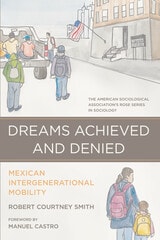
Dreams Achieved and Denied
Mexican Intergenerational MobilityRobert Courtney Smith
Russell Sage Foundation, 2024
For over twenty years, Smith followed the lives and mobility of nearly one hundred children of Mexican immigrants in New York City. Smith’s longitudinal, ethnographic data enabled him to intimately describe how specific mechanisms blocked or promoted mobility for years as his participants moved from adolescence through early adulthood and into established adulthood. Smith documents how having or gaining legal status made certain New York City or New York State policies and practices more efficacious in supporting individual and family efforts and strategies for mobility. Such immigrant-inclusive and mobility-promoting measures include enabling undocumented people to attend public colleges at in-state tuition rates, and later to get driver’s licenses, offering healthcare to all in New York City, and the City’s subway and school choice systems, which enabled students to attend better schools or take opportunities outside their neighborhoods.
Smith finds that keeping the immigrant bargain – whereby children of immigrants redeem their parents’ sacrifice by doing well in school, helping their parents and siblings, and becoming “good” people (in their parents’ words) – helped them towards better adult outcomes and lives. Having mentors, picking academically stronger schools and friends, and using second chance mechanisms also promoted more adult mobility. However, lacking legal status blocked mobility, by preventing them from benefiting from these same mobility-promoting city and state policies, from mentors, or from working hard and keeping the immigrant bargain.
Dreams Achieved and Denied deeply analyzes the historic upward mobility of U.S.-born Mexicans in New York City. Itcounters the dominant story research and public discourse tell about Mexican mobility in the U.S. and shows how thoughtful public policy can improve the lives of young immigrants and families.

Dreams, Questions, Struggles
South Asian Women in BritainAmrit Wilson
Pluto Press, 2006
This book explores the lives and struggles of two generations of British Asian women to present a political account of their experiences: personal and public, individual and collective, their struggles take on power structures within the family, the community and, on occasion, the British state.
Combining their personal testimony within a theoretical framework, Amrit Wilson locates their experiences in the wider context of global and regional politics. She examines what impact the feminist movement has had on their lives, and explores issues such as domestic violence, Asian marriages, representations of Asian women, mental disturbance and suicide.
Drift and Mastery
An Attempt to Diagnose the Current UnrestWalter Lippmann, Introduction and notes by William E. Leuchtenburg, Foreword by Ganesh Sitaraman
University of Wisconsin Press, 2015
Lippman’s Drift and Mastery became one of the most important and influential documents of the Progressive Movement. It remains a valuable text for understanding the political thought of early twentieth-century America and a lucid exploration of timeless themes in American government and politics. Distinguished historian Walter Leuchtenberg’s 1986 introduction and notes are retained in this edition.
Dual City
Restructuring New YorkJohn H. Mollenkopf
Russell Sage Foundation, 1991
Dubuque's Forgotten Cemetery
Excavating a Nineteenth-Century Burial Ground in a Twenty-first Century CityRobin M. Lillie and Jennifer E. Mack
University of Iowa Press, 2015
The excavation fieldwork was just the beginning. Once the digging was done each summer, skeletal biologist Robin M. Lillie and archaeologist Jennifer E. Mack still faced the enormous task of teasing out life histories from fragile bones, disintegrating artifacts, and the decaying wooden coffins the families had chosen for the deceased. Poring over scant documents and sifting through old newspapers, they pieced together the story of the cemetery and its residents, a story often surprising and poignant. Weaving together science, history, and local mythology, the tale of the Third Street Cemetery provides a fascinating glimpse into Dubuque’s early years, the hardships its settlers endured, and the difficulties they did not survive.
While they worked, Lillie and Mack also grappled with the legal and ethical obligations of the living to the dead. These issues are increasingly urgent as more and more of America’s unmarked (and marked) cemeteries are removed in the name of progress. Fans of forensic crime shows and novels will find here a real-world example of what can be learned from the fragments left in time’s wake.
Duty beyond the Battlefield
African American Soldiers Fight for Racial Uplift, Citizenship, and Manhood, 1870–1920Le'Trice D. Donaldson
Southern Illinois University Press, 2020
Through extensive research, Donaldson not only illuminates this evolution but also interrogates the association between masculinity and citizenship and the ways in which performing manhood through military service influenced how these men struggled for racial uplift. Following the Buffalo soldier units and two regular army infantry units from the frontier and the Mexican border to Mexico, Cuba, and the Philippines, Donaldson investigates how these locations and the wars therein provide windows into how the soldiers’ struggles influenced black life and status within the United States.
Continuing to probe the idea of what it meant to be a military race man—a man concerned with the uplift of the black race who followed the philosophy of progress—Donaldson contrasts the histories of officers Henry Flipper and Charles Young, two soldiers who saw their roles and responsibilities as black military officers very differently.
Duty beyond the Battlefield demonstrates that from the 1870s to 1920s military race men laid the foundation for the “New Negro” movement and the rise of Black Nationalism that influenced the future leaders of the twentieth century Civil Rights movement.

Duval County Tejanos
An Epic narrative of Liberty and DemocracyAlfredo Cardenas
University of North Texas Press, 2024
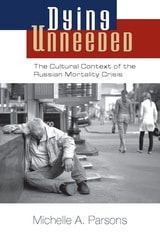
Dying Unneeded
The Cultural Context of the Russian Mortality CrisisMichelle A. Parsons
Vanderbilt University Press, 2014
Middle-aged Muscovites talk about being unneeded (ne nuzhny), or having little to give others. Considering this concept of "being unneeded" reveals how political economic transformation undermined the logic of social relations whereby individuals used their position within the Soviet state to give things to other people. Being unneeded is also gendered--while women are still needed by their families, men are often unneeded by state or family. Western literature on the mortality crisis focuses on a lack of social capital, often assuming that what individuals receive is most important, but being needed is more about what individuals give. Social connections--and their influence on health--are culturally specific.
In Soviet times, needed people helped friends and acquaintances push against the limits of the state, crafting a sense of space and freedom. When the state collapsed, this sense of bounded freedom was compromised, and another freedom became deadly.
This book is a recipient of the annual Norman L. and Roselea J. Goldberg Prize for the best project in the area of medicine.
dear elia
Letters from the Asian American AbyssMimi Khúc
Duke University Press, 2024