Results by title
3027 books match the query 'Sociology' and 132 start with d

Divided in Unity
Identity, Germany, and the Berlin PoliceAndreas Glaeser
University of Chicago Press, 1999
Divine Signs
Connecting Spirit to CommunityH. L. Goodall, Jr.
Southern Illinois University Press, 1996
Divine Signs is the concluding volume of the ethnographic trilogy about the communicative tensions in everyday American cultural life H. L. Goodall, Jr., began with Casing a Promised Land and continued with Living in the Rock n Roll Mystery.
In this final work, the terms for understanding these tensions are found in a historical and mythological drama featuring Power (as the embodiment of the modern), Other (as the embodiment of the postmodern), and Spirit (as the unifying power capable of connecting disparate selves to dangerously fragmented communities). For this study, the localized site of interpretation is in and around Pickens and Oconee Counties, South Carolina, where every day street signs, business advertisements on billboards, signs that announce church themes, Internet postings, and other forms of public communication that invite private meanings are read as rhetorical invitations to participate in these myths and mysteries.
Using themes discoverable in such public forms of communication, Goodall deconstructs a variety of communal experiences—from annual community celebrations to weekly therapy sessions in local beauty salons to the fall audience rituals of Clemson University football games—to gain a deeper appreciation of the unifying symbolic orders that enrich the interpretive possibilities of our lives and that serve as signs of our deeply spiritual connections to each other and to the planet.
In the last sections of the book, the interplays of Power, Other, and Spirit are read into and against a wide variety of everyday interpretive contexts, from Rush Limbaugh and talk radio to narratives about angels and stories about the transformative powers of spiritual practices in organizations. Goodall then asks the important question: Where are the themes of this mythological drama leading us? In the stunning conclusion, Goodall creates communicative, cultural, and spiritual challenges for us all.

Divorce Portals
The Postdivorce in Asian ContextsShalini Grover
Rutgers University Press, 2027
Across Asia and its global diasporas, marriage remains a dominant and public institution, and divorce generates widespread comment and concern. Breaking new ground, Divorce Portals reveals divorce to be generative of transformations in individual intimate lives and wider societies. Through compelling, sensitive ethnographic accounts inviting readers into the lives of people undergoing separation and divorce, chapters capture the antecedent-lives of uncoupling – the imaginary, anticipatory, and cautionary – and the afterlives of divorce, in the immediate aftermath and across life courses and generations. Chapters explore the vivid and bold new selves that divorcees are fashioning for themselves and highlight the intersecting inequalities that shape postdivorce predicaments, sometimes belying the hoped-for freedoms of divorce and remarriage. Together, chapters chart nascent and haltering accommodations of the single, repartnered, and queer. Across cases drawn from diverse geographic contexts, this book unlocks new, expansive, and accessible ways to think about divorce and its aftermath.

Do Babies Matter?
Gender and Family in the Ivory TowerMason, Mary Ann
Rutgers University Press, 2013
Do Babies Matter? is the first comprehensive examination of the relationship between family formation and the academic careers of men and women. The book begins with graduate students and postdoctoral fellows, moves on to early and mid-career years, and ends with retirement. Individual chapters examine graduate school, how recent PhD recipients get into the academic game, the tenure process, and life after tenure. The authors explore the family sacrifices women often have to make to get ahead in academia and consider how gender and family interact to affect promotion to full professor, salaries, and retirement. Concrete strategies are suggested for transforming the university into a family-friendly environment at every career stage.
The book draws on over a decade of research using unprecedented data resources, including the Survey of Doctorate Recipients, a nationally representative panel survey of PhDs in America, and multiple surveys of faculty and graduate students at the ten-campus University of California system..

Doctor Jim
A Community, a Commune, and a Clinic in the Oregon WoodsJim Shames
Oregon State University Press, 2027
In 1973 Jim Shames, a young doctor questioning life in a country divided by the Vietnam War, learned of a counterculture community in Southern Oregon interested in establishing its own medical clinic. A recent graduate from medical school, with limited hands-on experience as a doctor, Jim found the promise and opportunity of a community in the woods, far from the turmoil of the times, appealing. In a leap of faith, he joined the back-to-the-earth movement and became a country doctor.
In the impoverished Illinois River Valley of Southern Oregon, Shames moved to Takilma and the Mystic Mountain commune. There Shames found a home, family, and fulfilling work at the Takilma People’s Clinic. It was a different world, offering an alternative journey and self-reflection. Surrounded by uninhibited friendliness, joy, and music, Doctor Jim cared for the patients of the community. Collectively the clinic treated rattlesnake bites, gunshot wounds, obstetrical complications, meningitis, cancer, and more for the residents of Southern Oregon.
Doctor Jim offers a window into communal life and the challenges of healthcare in rural Oregon. Shames highlights the struggles and rewards to be found in simple daily activities with like-minded souls sharing emotional and physical work. In reflecting on his unique medical career, Shames teaches that healing is about the intimate interaction between the patient and the doctor rather than medications or procedures. What started as an experiment evolved into a medical practice caring for a broader community beyond its counterculture brethren.
Doctors and Demonstrators
How Political Institutions Shape Abortion Law in the United States, Britain, and CanadaDrew Halfmann
University of Chicago Press, 2011
Doing Good
Racial Tensions and Workplace Inequalities at a Community Clinic in El Nuevo SouthNatalia Deeb-Sossa
University of Arizona Press, 2013
Deeb-Sossa argues persuasively that “moral identities” have been constructed by clinic staff. The high-status staff—nearly all of whom are white—see themselves as heroic workers. Mid- and lower-status Latina staff feel like they are guardians of people who are especially needy and deserving of protection. In contrast, the moral identity of African American staffers had previously been established in response to serving “their people.” Their response to the evolving clientele has been to create a self-image of superiority by characterizing Latina/o clients as “immoral,” “lazy,” “working the system,” having no regard for rules or discipline, and being irresponsible parents.
All of the health-care workers want to be seen as “doing good.” But they fail to see how, in constructing and maintaining their own moral identity in response to their personal views and stereotypes, they have come to treat each other and their clients in ways that contradict their ideals.
Doing Time Together
Love and Family in the Shadow of the PrisonMegan Comfort
University of Chicago Press, 2008
Megan Comfort spent years getting to know women visiting men at San Quentin State Prison, observing how their romantic relationships drew them into contact with the penitentiary. Tangling with the prison’s intrusive scrutiny and rigid rules turns these women into “quasi-inmates,” eroding the boundary between home and prison and altering their sense of intimacy, love, and justice. Yet Comfort also finds that with social welfare weakened, prisons are the most powerful public institutions available to women struggling to overcome untreated social ills and sustain relationships with marginalized men. As a result, they express great ambivalence about the prison and the control it exerts over their daily lives.
An illuminating analysis of women caught in the shadow of America’s massive prison system, Comfort’s book will be essential for anyone concerned with the consequences of our punitive culture.
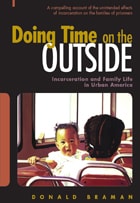
Doing Time on the Outside
Incarceration and Family Life in Urban AmericaDonald Braman
University of Michigan Press, 2004
-Katherine S. Newman
"Doing Time on the Outside brings to life in a compelling way the human drama, and tragedy, of our incarceration policies. Donald Braman documents the profound economic and social consequences of the American policy of massive imprisonment of young African American males. He shows us the link between the broad-scale policy changes of recent decades and the isolation and stigma that these bring to family members who have a loved one in prison. If we want to understand fully the impact of current criminal justice policies, this book should be required reading."
-Mark Mauer, Assistant Director, The Sentencing Project
"Through compelling stories and thoughtful analysis, this book describes how our nation's punishment policies have caused incalculable damage to the fabric of family and community life. Anyone concerned about the future of urban America should read this book."
-Jeremy Travis, The Urban Institute
In the tradition of Elijah Anderson's Code of the Street and Katherine Newman's No Shame in My Game, this startling new ethnography by Donald Braman uncovers the other side of the incarceration saga: the little-told story of the effects of imprisonment on the prisoners' families.
Since 1970 the incarceration rate in the United States has more than tripled, and in many cities-urban centers such as Washington, D.C.-it has increased over five-fold. Today, one out of every ten adult black men in the District is in prison and three out of every four can expect to spend some time behind bars. But the numbers don't reveal what it's like for the children, wives, and parents of prisoners, or the subtle and not-so-subtle effects mass incarceration is having on life in the inner city.
Author Donald Braman shows that those doing time on the inside are having a ripple effect on the outside-reaching deep into the family and community life of urban America. Braman gives us the personal stories of what happens to the families and communities that prisoners are taken from and return to. Carefully documenting the effects of incarceration on the material and emotional lives of families, this groundbreaking ethnography reveals how criminal justice policies are furthering rather than abating the problem of social disorder. Braman also delivers a number of genuinely new arguments.
Among these is the compelling assertion that incarceration is holding offenders unaccountable to victims, communities, and families. The author gives the first detailed account of incarceration's corrosive effect on social capital in the inner city and describes in poignant detail how the stigma of prison pits family and community members against one another. Drawing on a series of powerful family portraits supported by extensive empirical data, Braman shines a light on the darker side of a system that is failing the very families and communities it seeks to protect.
Dolor y Alegria
Women and Social Change in Urban MexicoSarah LeVine; In Collaboration with Clara Sunderland Correa
University of Wisconsin Press, 1993
While many earlier publications have focused on the poor of Latin America who live at the margins of urban life, Dolor y Alegría explores the experiences of ordinary working and lower-middle class women, most of them transplants from villages and small towns to a densely populated city neighborhood. In their early years, many experienced family disruption, emotional deprivation, and economic hardship; but steadily increasing educational opportunities, improved health care, and easily available contraception have significantly altered how the younger women relate to their families and the larger society.
Today’s Mexican schoolgirl, LeVine shows, is encouraged to apply herself to her studies for her own benefit, and the longer she remains in school, the greater the self-confidence she will carry with her into the world of work and later into marriage and motherhood. Hard economic times have forced many married women into the workplace where their sense of personal efficacy is enhanced; at the same time, in the domestic sphere, their earnings allow them greater negotiating power with husbands and male relatives. Changes are not confined to the younger generation. Older women are enjoying better health and living longer; but with adult children either less able or willing to accept responsibility for aged parents than they were in the past, anxiety runs high and family relations are often strained.
Dolor y Alegría takes a close look at the efforts of three generations of Mexican women to redefine themselves in both family and workplace; it shows that today’s young woman has very different expectations of herself and others from those that her grandmother or even her mother had.

Domestic Broils
Shakers, Antebellum Marriage, and the Narratives of Mary and Joseph DyerElizabeth De Wolfe
University of Massachusetts Press, 2010
Domestic Violence at the Margins
Readings on Race, Class, Gender, and CultureSokoloff, Natalie J.
Rutgers University Press, 2005
"An exciting and powerful collection that eloquently critiques some of the current thinking in domestic violence and raises key concerns for advocates and scholars working in the area."—Sujata Warrier, president, board of directors, Manavi: An organization for South Asian women
"Sokoloff has assembled an impressive array of authors who challenge us to ‘think outside of our contemporary domestic violence box.’"—Angela M. Moore Parmley, chief, violence and victimization research division, National Institute of Justice
This groundbreaking anthology reorients the field of domestic violence research by bringing long-overdue attention to the structural forms of oppression in communities marginalized by race, ethnicity, religion, sexuality, or social class.
Reprints of the most influential recent work in the field as well as more than a dozen newly commissioned essays explore theoretical issues, current research, service provision, and activism among Latinos, African Americans, Asian Americans, Jewish Americans, and lesbians. The volume rejects simplistic analyses of the role of culture in domestic violence by elucidating the support systems available to battered women within different cultures, while at the same time addressing the distinct problems generated by that culture. Together, the essays pose a compelling challenge to stereotypical images of battered women that are racist, homophobic, and xenophobic.
The most up-to-date and comprehensive picture of domestic violence available, this anthology is an essential text for courses in sociology, criminology, social work, and women’s studies. Beyond the classroom, it provides critical information and resources for professionals working in domestic violence services, advocacy, social work, and law enforcement.

Dominatrix
Gender, Eroticism, and Control in the DungeonDanielle J. Lindemann
University of Chicago Press, 2012

Doormen
Peter Bearman
University of Chicago Press, 2005
Combining observation, interviews, and survey information, Doormen provides a deep and enduring ethnography of the occupational role of doormen, the dynamics of the residential lobby, and the mundane features of highly consequential social exchanges between doormen and tenants. Here, Bearman explains why doormen find their jobs both boring and stressful, why tenants feel anxious about how much of a Christmas bonus their neighbors give, and how everyday transactions small and large affect tenants' professional and informal relationships with doormen.
In the daily life of the doorman resides the profound, and this book provides a brilliant account of how tenants and doormen interact within the complex world of the lobby.

Doormen
Peter Bearman
University of Chicago Press, 2005
This is an auto-narrated audiobook edition of this book.
Combining observation, interviews, and survey information, Doormen provides a deep and enduring ethnography of the occupational role of doormen, the dynamics of the residential lobby, and the mundane features of highly consequential social exchanges between doormen and tenants. Here, Bearman explains why doormen find their jobs both boring and stressful, why tenants feel anxious about how much of a Christmas bonus their neighbors give, and how everyday transactions small and large affect tenants' professional and informal relationships with doormen.
In the daily life of the doorman resides the profound, and this book provides a brilliant account of how tenants and doormen interact within the complex world of the lobby.
Down and Out in America
The Origins of HomelessnessPeter H. Rossi
University of Chicago Press, 1990
Down and Out in Los Angeles and Berlin
The Sociospatial Exclusion of Homeless PeopleJurgen von Mahs
Temple University Press, 2015
Drawing on fascinating ethnographic insights, von Mahs shows how homeless people in both cities face sociospatial exclusion-legal displacement for criminal activities, poor shelters in impoverished neighborhoods, as well as market barriers that restrict reintegration. Providing a necessary wake-up call, Down and Out in Los Angeles and Berlin addresses the critical public policy issues that can produce effective services to improve homeless people's chances for a lasting exit.
Down and Out in the New Economy
How People Find (or Don’t Find) Work TodayIlana Gershon
University of Chicago Press, 2017
Finding a job used to be simple. Now . . . well, it’s complicated. In today’s economy, you can’t just be an employee looking to get hired—you have to market yourself as a business, one that can help another business achieve its goals.
That’s a radical transformation in how we think about work and employment, says Ilana Gershon. And with Down and Out in the New Economy, she digs deep into that change and what it means, not just for job seekers, but for businesses and our very culture. In telling this story, Gershon covers all parts of the employment spectrum: she interviews hiring managers about how they assess candidates; attends personal branding seminars; talks with managers at companies around the United States to suss out regional differences—like how Silicon Valley firms look askance at the lengthier employment tenures of applicants from the Midwest. And she finds that not everything has changed: though the technological trappings may be glitzier, in a lot of cases, who you know remains more important than what you know.
Rich in the voices of people deeply involved with all parts of the employment process, Down and Out in the New Economy offers a snapshot of the quest for work today—and a pointed analysis of its larger meaning.
Down, Out, and Under Arrest
Policing and Everyday Life in Skid RowForrest Stuart
University of Chicago Press, 2016
Juliette, a woman he met during that time, has been stopped by police well over one hundred times, arrested upward of sixty times, and has given up more than a year of her life serving week-long jail sentences. Her most common crime? Simply sitting on the sidewalk—an arrestable offense in LA.
Why? What purpose did those arrests serve, for society or for Juliette? How did we reach a point where we’ve cut support for our poorest citizens, yet are spending ever more on policing and prisons? That’s the complicated, maddening story that Stuart tells in Down, Out and Under Arrest, a close-up look at the hows and whys of policing poverty in the contemporary United States. What emerges from Stuart’s years of fieldwork—not only with Skid Row residents, but with the police charged with managing them—is a tragedy built on mistakes and misplaced priorities more than on heroes and villains. He reveals a situation where a lot of people on both sides of this issue are genuinely trying to do the right thing, yet often come up short. Sometimes, in ways that do serious harm.
At a time when distrust between police and the residents of disadvantaged neighborhoods has never been higher, Stuart’s book helps us see where we’ve gone wrong, and what steps we could take to begin to change the lives of our poorest citizens—and ultimately our society itself—for the better.
Downtown America
A History of the Place and the People Who Made ItAlison Isenberg
University of Chicago Press, 2005
Downtown America cuts beneath the archetypal story of downtown's rise and fall and offers a dynamic new story of urban development in the United States. Moving beyond conventional narratives, Alison Isenberg shows that downtown's trajectory was not dictated by inevitable free market forces or natural life-and-death cycles. Instead, it was the product of human actors—the contested creation of retailers, developers, government leaders, architects, and planners, as well as political activists, consumers, civic clubs, real estate appraisers, even postcard artists. Throughout the twentieth century, conflicts over downtown's mundane conditions—what it should look like and who should walk its streets—pointed to fundamental disagreements over American values.
Isenberg reveals how the innovative efforts of these participants infused Main Street with its resonant symbolism, while still accounting for pervasive uncertainty and fears of decline. Readers of this work will find anything but a story of inevitability. Even some of the downtown's darkest moments—the Great Depression's collapse in land values, the rioting and looting of the 1960s, or abandonment and vacancy during the 1970s—illuminate how core cultural values have animated and intertwined with economic investment to reinvent the physical form and social experiences of urban commerce. Downtown America—its empty stores, revitalized marketplaces, and romanticized past—will never look quite the same again.
A book that does away with our most clichéd approaches to urban studies, Downtown America will appeal to readers interested in the history of the United States and the mythology surrounding its most cherished institutions.
A Choice Oustanding Academic Title.
Winner of the 2005 Ellis W. Hawley Prize from the Organization of American Historians.
Winner of the 2005 Lewis Mumford Prize for Best Book in American
Planning History.
Winner of the 2005 Historic Preservation Book Price from the University of Mary Washington Center for Historic Preservation.
Named 2005 Honor Book from the New Jersey Council for the Humanities.

Dreaming in Russian
The Cuban Soviet ImaginaryBy Jacqueline Loss
University of Texas Press, 2013
The specter of the Soviet Union lingers in Cuba, yet until now there has been no book-length work on the ways Cubans process their country’s relationship with the Soviet bloc. Dreaming in Russian at last brings into the light the reality that for nearly three decades, the Soviet Union subsidized the island economically, intervened in military matters, and exported distinct pedagogical and cultural models to Cuba. Drawing on interviews with Cuban artists and intellectuals, as well as treasures from cinematographic and bibliographic archives, Jacqueline Loss delivers the first book to show that Cuba remembers and retains many aspects of the Soviet era, far from shedding those cultural facets as relics of the Cold War.
Weaving together intriguing, seldom-seen images, Dreaming in Russian showcases the ways in which Cuba’s relationship to its Soviet benefactors lingered after the disintegration of the U.S.S.R. in 1991. Analyzing numerous literary texts and works of visual art, Loss also incorporates aspects of architecture, popular culture, the space race, and other strands to create a captivating new perspective on Cuban society. Among the luminaries featured are poet Reina María Rodríguez, writer Antonio José Ponte, visual artist Tonel, and novelist Wendy Guerra. A departure from traditional cultural history, Loss’s approach instead presents a kaleidoscopic series of facets, reflecting the hybrid nature of the self-images that emerged in the aftermath of the Soviet aegis. As speculations about Cuba’s future under Fidel Castro’s heir apparent continue, the portrait that emerges in Dreaming in Russian is both timely and mesmerizing.

Dreaming of a Mail-Order Husband
Russian-American Internet RomanceEricka Johnson
Duke University Press, 2007
Each chapter presents one woman’s story and then links it to a discussion of gender roles, the mail-order bride industry, and the severe economic and social constraints of life in Russia. The transitional economy has often left people, after a month’s work, either unpaid or paid unexpectedly with a supply of sunflower oil or toilet paper. Women over twenty-three are considered virtually unmarriageable in Russian society. Russia has a large population of women who are single, divorced, or widowed, who would like to be married yet feel that they have no chance finding a Russian husband. Grim realities such as these motivate women to seek better lives abroad. For many of those seeking a mail-order husband, children or parents play significant roles in the search for better lives, and they play a role in Johnson’s account as well. In addition to her research in the former Soviet Union, Johnson conducted interviews in the United States, and she shares the insights—about dating, marriage, and cross-cultural communication—of a Russian-American married couple who met via the Internet.
Dreams Achieved and Denied
Mexican Intergenerational MobilityRobert Courtney Smith
Russell Sage Foundation, 2024
For over twenty years, Smith followed the lives and mobility of nearly one hundred children of Mexican immigrants in New York City. Smith’s longitudinal, ethnographic data enabled him to intimately describe how specific mechanisms blocked or promoted mobility for years as his participants moved from adolescence through early adulthood and into established adulthood. Smith documents how having or gaining legal status made certain New York City or New York State policies and practices more efficacious in supporting individual and family efforts and strategies for mobility. Such immigrant-inclusive and mobility-promoting measures include enabling undocumented people to attend public colleges at in-state tuition rates, and later to get driver’s licenses, offering healthcare to all in New York City, and the City’s subway and school choice systems, which enabled students to attend better schools or take opportunities outside their neighborhoods.
Smith finds that keeping the immigrant bargain – whereby children of immigrants redeem their parents’ sacrifice by doing well in school, helping their parents and siblings, and becoming “good” people (in their parents’ words) – helped them towards better adult outcomes and lives. Having mentors, picking academically stronger schools and friends, and using second chance mechanisms also promoted more adult mobility. However, lacking legal status blocked mobility, by preventing them from benefiting from these same mobility-promoting city and state policies, from mentors, or from working hard and keeping the immigrant bargain.
Dreams Achieved and Denied deeply analyzes the historic upward mobility of U.S.-born Mexicans in New York City. Itcounters the dominant story research and public discourse tell about Mexican mobility in the U.S. and shows how thoughtful public policy can improve the lives of young immigrants and families.
Dreamscapes of Modernity
Sociotechnical Imaginaries and the Fabrication of PowerEdited by Sheila Jasanoff and Sang-Hyun Kim
University of Chicago Press, 2015

Dreamworlds of Alabama
Allen Shelton
University of Minnesota Press, 2007
“I speak in what others often hear as a strange accent. My past can’t be located. I live in Buffalo, New York, an exile from the South. But these aren’t Yankee dreams, even though my past seems like a fabrication, a dreamworld in which I’m a paper character and not a historical participant, with scars from barbed wire ripping under the pressure and flying through the air like a swarm of bees, or a horse rearing up and banging its head into mine from within, exploding my forehead.” —from the Preface
Wisteria draped on a soldier’s coffin, sent home to Alabama from a Virginia battlefield. The oldest standing house in the county, painted gray and flanked by a pecan orchard. A black steel fence tool, now perched atop a pile of books like a prehistoric bird of prey. In Dreamworlds of Alabama, Allen Shelton explores physical, historical, and social landscapes of northeastern Alabama. His homeplace near the Appalachian foothills provides the setting for a rich examination of cultural practices, a place where the language of place and things resonates with as much vitality and emotional urgency as the language of humans.
Throughout the book, Shelton demonstrates how deeply culture is inscribed in the land and in the most intimate spaces of the person—places of belonging and loss, insight and memory.
Born and raised in Jacksonville, Alabama, Allen Shelton is associate professor of sociology at Buffalo State College.
Driven from New Orleans
How Nonprofits Betray Public Housing and Promote PrivatizationJohn Arena
University of Minnesota Press, 2012
In the early 1980s the tenant leaders of the New Orleans St. Thomas public housing development and their activist allies were militant, uncompromising defenders of the city’s public housing communities. Yet ten years later these same leaders became actively involved in a planning effort to privatize and downsize their community—an effort that would drastically reduce the number of affordable apartments. What happened? John Arena—a longtime community and labor activist in New Orleans—explores this drastic change in Driven from New Orleans, exposing the social disaster visited on the city’s black urban poor long before the natural disaster of Katrina magnified their plight.
Arena argues that the key to understanding New Orleans’s public housing transformation from public to private is the co-optation of grassroots activists into a government and foundation-funded nonprofit complex. He shows how the nonprofit model created new political allegiances and financial benefits for activists, moving them into a strategy of insider negotiations that put the profit-making agenda of real estate interests above the material needs of black public housing residents. In their turn, white developers and the city’s black political elite embraced this newfound political “realism” because it legitimized the regressive policies of removing poor people and massively downsizing public housing, all in the guise of creating a new racially integrated, “mixed-income” community.
In tracing how this shift occurred, Driven from New Orleans reveals the true nature, and the true cost, of reforms promoted by an alliance of a neoliberal government, nonprofits, community activists, and powerful real estate interests.
Dual City
Restructuring New YorkJohn H. Mollenkopf
Russell Sage Foundation, 1991

Dubai, the City as Corporation
Ahmed Kanna
University of Minnesota Press, 2010
Exposing local struggles over power and meaning in the making and representation of Dubai, Kanna examines the core questions of what gets built and for whom. His work, unique in its view of the interconnectedness of cultural identity, the built environment, and politics, offers an instructive picture of how different factions—from local and non-Arab residents and expatriate South Asians to the cultural and economic elites of the city—have all participated in the creation and marketing of Dubai. The result is an unparalleled account of the ways in which the built environment shapes and is shaped by the experience of globalization and neoliberalism in a diverse, multinational city.

Duels and the Roots of Violence in Missouri
Dick Steward
University of Missouri Press, 2000
In early-nineteenth-century Missouri, the duel was a rite of passage for many young gentlemen seeking prestige and power. In time, however, other social groups, influenced by the ruling class, engaged in a variety of violent acts and symbolic challenges under the rubric of the code duello. In Duels and the Roots of Violence in Missouri, Dick Steward takes an in-depth look at the evolution of dueling, tracing the origins, course, consequences, and ultimate demise of one of the most deadly art forms in Missouri history. By focusing on the history of dueling in Missouri, Steward details an important part of our culture and the long-reaching impact this form of violence has had on our society.
Drawing upon accounts of at least a hundred duels—from little-known encounters to those involving celebrated figures such as Senator Thomas Hart Benton, Charles Lucas, Thomas Biddle, Spencer Pettis, and John Smith T—Steward shows how the roots of violence have penetrated our modern culture. He traces the social and cultural changes in the nature of the duel from its earliest form as a defense of honor to its use as a means of revenge. By the latter part of the nineteenth century, the formal southern duel had for the most part given way to the improvised western duel, better known as the gunfight. Involving such gunslingers as Wild Bill Hickok and Jesse James, these violent acts captivated people not only in the state but also across the nation. Although the violence entailed different methods of killing, its allure remained as strong as ever.
Steward re-creates the human drama and tragedy in many of these hostile encounters, revealing how different groups operating under the code duello justified family and clan feuds, vigilante justice, and revenge killings. This often-glamorized violence, Steward argues, was viewed as a symbol of honor and courage throughout the century and greatly influenced behavior and attitudes toward violence well into the twentieth century.
While this work centers mainly on Missouri and the history of dueling in the state, its inferences extend well past the region itself. Well-written and thoroughly researched, Duels and the Roots of Violence in Missouri provides valuable insight into the violent social climate of yesterday.

Durkheim
A Critical IntroductionKieran Allen and Brian O'Boyle
Pluto Press, 2017
This critical introduction argues that Durkheim's defence of Republican France in the 1890s had a considerable influence on his sociology, which cannot be fully understood when removed from its historical and political context. His dismissal of economic factors in suicide rates, the influence of his anti-feminist position on his findings on marriage rates, and the idealism behind his claim that religion is the key determinant in shaping society are all discussed.
Through analysing his writings, including The Division of Labour in Society, Suicide and The Elementary Forms of Religious Life, this book provides a fascinating, critical counterpoint to the existing works on this key figure of sociology.

Dwelling in Resistance
Living with Alternative Technologies in AmericaSchelly, Chelsea
Rutgers University Press, 2017
Schelly portrays a wide range of residential living alternatives utilizing renewable, small-scale, de-centralized technologies. These technologies considerably change how individuals and communities interact with the material world, their natural environment, and one another. Using in depth interviews and compelling ethnographic observations, the book offers an insightful look at different communities’ practices and principles and their successful endeavors in sustainability and self-sufficiency.

Dynamics of Class and Stratification in Poland
1945–2015Irina Tomescu-Dubrow
Central European University Press, 2018