Results by title
8128 books match the query 'Literary Criticism' and 287 start with d
Digital Fiction and the Unnatural
Transmedial Narrative Theory, Method, and AnalysisAstrid Ensslin and Alice Bell
The Ohio State University Press, 2021

Digital Methods and Traditional Chinese Literary Studies
Thomas Mazanec, Jeffrey Tharsen, and Jing Chen, special issue editors
Duke University Press, 0
Contributors. Jing Chen, Timothy Clifford, Yi-long Huang, Chao-lin Liu, Thomas Mazanec, Evan Nicoll-Johnson, Qiao Junjun, Donald Sturgeon, Jeffrey Tharsen, Wang Zhaopeng, Bingyu Zheng, Mariana Zorkina
Digital Pedagogy in Early Modern Studies
Method and PraxisEdited by Andie Silva and Scott Schofield
Iter Press, 2023
This collection of essays focuses on teaching at the intersection of early modern literature, book history, and digital media. It considers how teaching different fields and methods of study can be enhanced and facilitated by digital technologies. The volume provides a snapshot of current thinking on digital pedagogy as practiced by leading scholars in the field and offers a series of models that may be adapted, personalized, and repurposed by future teachers seeking to bring digital methodologies to their classrooms. Supplementary materials for this title are available on the Iter Press website (iterpress.org): see under Books/Supplementary Materials.
Digital Poetics
Hypertext, Visual-Kinetic Text and Writing in Programmable MediaLoss Pequeño Glazier
University of Alabama Press, 2001
Glazier investigates the ways in which computer technology has influenced and transformed the writing and dissemination of poetry.
In Digital Poetics, Loss Pequeño Glazier argues that the increase in computer technology and accessibility, specifically the World Wide Web, has created a new and viable place for the writing and dissemination of poetry. Glazier’s work not only introduces the reader to the current state of electronic writing but also outlines the historical and technical contexts out of which electronic poetry has emerged and demonstrates some of the possibilities of the new medium.
Glazier examines three principal forms of electronic textuality: hypertext, visual/kinetic text, and works in programmable media. He considers avant-garde poetics and its relationship to the on-line age, the relationship between web “pages” and book technology, and the way in which certain kinds of web constructions are in and of themselves a type of writing. With convincing alacrity, Glazier argues that the materiality of electronic writing has changed the idea of writing itself. He concludes that electronic space is the true home of poetry and, in the 20th century, has become the ultimate “space of poesis.”
Digital Poetics will attract a readership of scholars and students interested in contemporary creative writing and the potential of electronic media for imaginative expression.
Dimitry's Shade
A Reading of Alexander Pushkin's Boris GodunovJ. Douglas Clayton
Northwestern University Press, 2004
In an ambitious reinterpretation of the premier work of Russia's national poet, J. Douglas Clayton reads Boris Godunov as the expression of Alexander Pushkin's thinking about the Russian state, especially the Russian state of his own time (some two hundred years distant from the events of the play), and even his own place within that state. Here we see how the play marks a sharp break with the Decembrists and Pushkin's own youthful liberalism, signaling its author's emergence as a Russian conservative. Boris Godunov, Clayton argues, can be best understood as an ideologically conservative defense of autocracy.
Sure to shock readers even as it persuades them, Dimitry's Shade reveals, incarnated in Boris Godunov, those three elements that were to become the slogan of Nicholas's Russia in the 1830s: autocracy, orthodoxy, and nationality.

Dinarchus, Hyperides, and Lycurgus
Translated by Ian Worthington, Craig Cooper, and Edward M. Harris
University of Texas Press, 2001
This is the fifth volume in the Oratory of Classical Greece. This series presents all of the surviving speeches from the late fifth and fourth centuries B.C. in new translations prepared by classical scholars who are at the forefront of the discipline. These translations are especially designed for the needs and interests of today's undergraduates, Greekless scholars in other disciplines, and the general public.
Classical oratory is an invaluable resource for the study of ancient Greek life and culture. The speeches offer evidence on Greek moral views, social and economic conditions, political and social ideology, law and legal procedure, and other aspects of Athenian culture that have been largely ignored: women and family life, slavery, and religion, to name just a few.
This volume combines the surviving speeches of three orators who stand at the end of the classical period. Dinarchus was not an Athenian, but he was called on to write speeches in connection with a corruption scandal (the Harpalus affair) that put an end to the career of Demosthenes. His speeches thus raise many of the vital issues surrounding the Macedonian conquest of Athens and the final years of Athenian democracy. Hyperides was an important public figure who was involved in many of the events described by Dinarchus and Lycurgus. His speeches open a window into many interesting facets of Athenian life. Lycurgus was one of the leading politicians in Athens during the reign of Alexander the Great and put Athenian public finances on a more secure footing. He was also a deeply religious man, who tried to revive Athenian patriotism after the crushing defeat at Chaeronea.
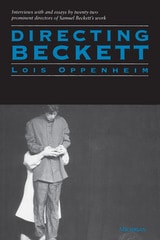
Directing Beckett
Lois Oppenheim
University of Michigan Press, 1997
In exploring this key figure in the history of theater, Oppenheim's interviews--with such directors as JoAnne Akalaitis, Edward Albee, Herbert Blau, Joseph Chaikin, and Carey Perloff--also address many of the complexities of the director's role, such as the meaning of directorial integrity and fidelity to the playwright's vision--an issue of particular relevance to a playwright whose exactitude, with respect to stage directions, is well documented. Additional highlights include photographs from many of the productions; the unpublished text of a lecture by the late Alan Schneider, Beckett's most accomplished American director; and an interview with the late Roger Blin, the very first director of Beckett's work.
"Directing Beckett is a rare thing--a book both pleasant to read and useful to have . . . it is like listening to the ideal panel, everyone who should be there there and all at their articulate best." --Toby Silverman Zinman, Theatre Journal
"Anyone intending to direct or act in a work by Beckett, or to write about his work, must read this book." --Choice
Lois Oppenheim is Professor of French, Montclair State University
Dirshuni
Contemporary Women’s MidrashEdited by Tamar Biala
Brandeis University Press, 2022
Dirshuni: Contemporary Women’s Midrash, is the first-ever English edition of a historic collection of midrashim composed by Israeli women, which has been long-anticipated by multiple American audiences, including synagogues, rabbinical seminaries, adult learning programs, Jewish educators, and scholars of gender and religion. Using the classical forms developed by the ancient rabbis, the contributors express their religious and moral thought and experience through innovative interpretations of scripture. The women writers, from all denominations and beyond, of all political stripes and ethnic backgrounds, contribute their Torah to fill the missing half of the sacred Jewish bookshelf. This book reflects dramatic changes in the agency of women in the world of religious writings. The volume features a comprehensive introduction to Midrash for the uninitiated reader by the distinguished scholar Tamar Kadari and extensive annotation and commentary by Tamar Biala.
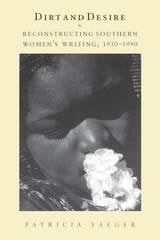
Dirt and Desire
Reconstructing Southern Women's Writing, 1930-1990Patricia Yaeger
University of Chicago Press, 2000
For Yaeger, works by black and white southern women writers reveal a shared obsession with monstrosity and the grotesque and with the strange zones of contact between black and white, such as the daily trauma of underpaid labor and the workings of racial and gender politics in the unnoticed yet all too familiar everyday. Yaeger also excavates a southern fascination with dirt—who owns it, who cleans it, and whose bodies are buried in it.
Yaeger's brilliant, theoretically informed readings of Zora Neale Hurston, Harper Lee, Carson McCullers, Toni Morrison, Flannery O'Connor, Alice Walker, and Eudora Welty (among many others) explode the mystifications of southern literary tradition and forge a new path for southern studies.
The book won the Barbara Perkins and George Perkins Award given by the Society for the Study of Narrative Literature.
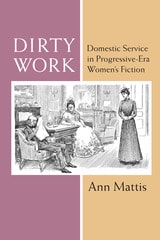
Dirty Work
Domestic Service in Progressive-Era Women’s FictionAnn Mattis
University of Michigan Press, 2019
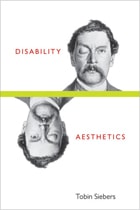
Disability Aesthetics
Tobin Siebers
University of Michigan Press, 2010
"Disability Aesthetics ambitiously redefines both 'disability' and 'aesthetics,' showing us that disability is central not only to modern art but also to the way we apprehend (and interact with) bodies and buildings. Along the way, Tobin Siebers revisits the beautiful and the sublime, 'degenerate' art and 'disqualified' bodies, culture wars and condemned neighborhoods, the art of Marc Quinn and the fiction of Junot Díaz---and much, much more. Disability Aesthetics is a stunning achievement, a must-read for anyone interested in how to understand the world we half create and half perceive."
---Michael Bérubé, Paterno Family Professor in Literature, Pennsylvania State University
"Rich with examples of the disabled body in both historical and modern art, Tobin Siebers's new book explores how disability problematizes commonly accepted ideas about aesthetics and beauty. For Siebers, disability is not a pejorative condition as much as it is a form of embodied difference. He is as comfortable discussing the Venus de Milo as he is discussing Andy Warhol. Disability Aesthetics is a prescient and much-needed contribution to visual & critical studies."
---Joseph Grigely, Professor of Visual and Critical Studies, The School of the Art Institute of Chicago
Disability Aesthetics is the first attempt to theorize the representation of disability in modern art and visual culture. It claims that the modern in art is perceived as disability, and that disability is evolving into an aesthetic value in itself. It argues that the essential arguments at the heart of the American culture wars in the late twentieth century involved the rejection of disability both by targeting certain artworks as "sick" and by characterizing these artworks as representative of a sick culture. The book also tracks the seminal role of National Socialism in perceiving the powerful connection between modern art and disability. It probes a variety of central aesthetic questions, producing a new understanding of art vandalism, an argument about the centrality of wounded bodies to global communication, and a systematic reading of the use put to aesthetics to justify the oppression of disabled people. In this richly illustrated and accessibly written book, Tobin Siebers masterfully demonstrates the crucial roles that the disabled mind and disabled body have played in the evolution of modern aesthetics, unveiling disability as a unique resource discovered by modern art and then embraced by it as a defining concept.
Tobin Siebers is V. L. Parrington Collegiate Professor of English Language and Literature and Art and Design at the University of Michigan. His many books include Disability Theory and The Subject and Other Subjects: On Ethical, Aesthetic, and Political Identity.
A volume in the series Corporealities: Discourses of Disability
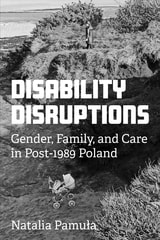
Disability Disruptions
Gender, Family, and Care in Post-1989 PolandNatalia Pamula
University of Illinois Press, 2026
Polish politicians regularly idealize the family. But, as Pamula illustrates such rhetoric coerces people into a state of violent intimacy that forces the burden of care onto family members bound by love, dependence, and responsibility. As the narratives show, disability destabilizes national myths, challenges heteronormative and patriarchal family ideals, and exposes continuities between socialist and capitalist regimes in their treatment of disabled citizens.
A rich blend of activism and analysis, Disability Disruptions ventures outside Anglophone notions of disability to highlight how Poland’s disabled people and caregivers overcome lack of recognition, resist social death, and rewrite public memory.
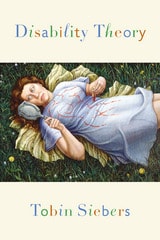
Disability Theory
Tobin Siebers
University of Michigan Press, 2008
"Disability Theory is just the book we've been waiting for. Clear, cogent, compelling analyses of the tension between the 'social model' of disability and the material details of impairment; of identity politics and unstable identities; of capability rights and human interdependence; of disability and law, disability as masquerade, disability and sexuality, disability and democracy---they're all here, in beautifully crafted and intellectually startling essays. Disability Theory is a field-defining book: and if you're curious about what 'disability' has to do with 'theory,' it's just the book you've been waiting for, too."
---Michael Bérubé, Pennsylvania State University
"Disability Theory is magisterially written, thoroughly researched, and polemically powerful. It will be controversial in a number of areas and will probably ruffle feathers both in disability studies as well as in realms of cultural theory. And that's all to the good."
---Michael Davidson, University of California, San Diego
"Not only is Disability Theory a groundbreaking contribution to disability studies, it is also a bold, ambitious and much needed revision to a number of adjacent and overlapping fields including cultural studies, literary theory, queer theory, and critical race studies. Siebers has written a powerful manifesto that calls theory to account and forces readers to think beyond our comfort zones."
---Helen Deutsch, University of California, Los Angeles
Intelligent, provocative, and challenging, Disability Theory revolutionizes the terrain of theory by providing indisputable evidence of the value and utility that a disability studies perspective can bring to key critical and cultural questions. Tobin Siebers persuasively argues that disability studies transfigures basic assumptions about identity, ideology, language, politics, social oppression, and the body. At the same time, he advances the emerging field of disability studies by putting its core issues into contact with signal thinkers in cultural studies, literary theory, queer theory, gender studies, and critical race theory.
Tobin Siebers is V. L. Parrington Collegiate Professor, Professor of English Language and Literature, and Professor of Art and Design at the University of Michigan.
A volume in the series Corporealities: Discourses of Disability
Illustration: Pattern by Riva Lehrer, acrylic on panel, 18" X 24", 1995
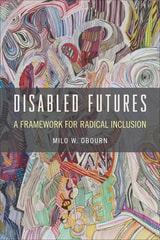
Disabled Futures
A Framework for Radical InclusionMilo W. Obourn
Temple University Press, 2020
Disabled Futures makes an important intervention in disability studies by taking an intersectional approach to race, gender, and disability. Milo Obourn reads disability studies, gender and sexuality studies, and critical race studies to develop a framework for addressing inequity. They theorize the concept of “racialized disgender”—to describe the ways in which racialization and gendering are social processes with disabling effects—thereby offering a new avenue for understanding race, gender, and disability as mutually constitutive.
Obourn uses readings of literature and popular culture from Lost and Avatar to Octavia Butler’s Xenogenesis trilogy to explore and unpack specific ways that race and gender construct—and are constructed by—historical notions of ability and disability, sickness and health, and successful recovery versus damaged lives. What emerges is not only a more complex and deeper understanding of the intersections between ableism, racism, and (cis)sexism, but also possibilities for imagining alternate and more radically inclusive futures in which all of our identities, experiences, freedoms, and oppressions are understood as interdependent and intertwined.
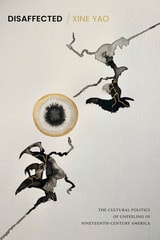
Disaffected
The Cultural Politics of Unfeeling in Nineteenth-Century AmericaXine Yao
Duke University Press, 2021
Duke University Press Scholars of Color First Book Award recipient
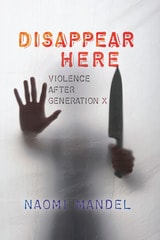
Disappear Here
Violence after Generation XNaomi Mandel
The Ohio State University Press, 2015
Examining developments in media, philosophy, literature, and politics in the years Xers were coming of age, Mandel demonstrates that Generation X’s unique attitude toward violence was formed by developments in home media, personal computing, and reality TV. This attitude, Mandel contends, is key to understanding our current world of media ubiquity, online activism, simulated sensation, and jihad. With chapters addressing both fictional and filmic representations of violence, Mandel studies the work of Bret Easton Ellis, Chuck Palahniuk, Claire Messud, Jess Walter, and Jonathan Safran Foer. A critical and conceptual tour de force, Disappear Here sets forth a new, and necessary, approach to violence, the real, and real violence for the twenty-first century.

Disarming the Nation
Women's Writing and the American Civil WarElizabeth Young
University of Chicago Press, 1999
Combining literary analysis, cultural history, and feminist theory, Disarming the Nation argues that the Civil War functioned in women's writings to connect female bodies with the body politic. Women writers used the idea of "civil war" as a metaphor to represent struggles between and within women—including struggles against the cultural prescriptions of "civility." At the same time, these writers also reimagined the nation itself, foregrounding women in their visions of America at war and in peace. In a substantial afterword, Young shows how contemporary black and white women—including those who crossdress in Civil War reenactments—continue to reshape the meanings of the war in ways startlingly similar to their nineteenth-century counterparts.
Learned, witty, and accessible, Disarming the Nation provides fresh and compelling perspectives on the Civil War, women's writing, and the many unresolved "civil wars" within American culture today.
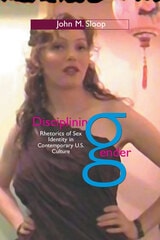
Disciplining Gender
Rhetorics of Sex Identity in Contemporary U.S. CultureJohn M. Sloop
University of Massachusetts Press, 2004
An expert on the rhetoric of the mass media, John M. Sloop has written several books on how the spoken and written word can influence political and cultural debate. In Disciplining Gender, he turns his attention to a topic that has attracted widespread public discussion—the treatment of gender ambiguity in American culture. He offers critical readings of five cases, showing the extent to which, in each instance, public discourse and media representations have served to reinforce dominant norms and constrain or “discipline” any behavior that blurs or subverts conventional gender boundaries.
The five cases include John/Joan or David Reimer, Brandon Teena, k.d. lang, Janet Reno, and Barry Winchell/Calpernia Addams. Sloop draws on queer theory and research in the field of critical rhetoric to examine representations of “gender trouble” in these much-publicized stories. In each case, he provides a comprehensive analysis of the public discussions of their significance. In short, rather than simply study the people and circumstances involved in each case, he examines the public meanings attached to them and the implications of those meanings for how contemporary culture comes to understand what “man” and “woman” mean and which sexual behaviors are appropriate and inappropriate.
In highlighting the ideological constraints imposed by our society, Sloop also suggests the ways that these constraints might be loosened and understandings of gender and sexuality diversified.
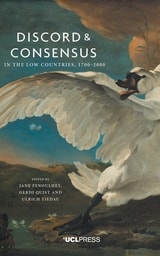
Discord and Consensus in the Low Countries, 1700-2000
Edited by Jane Fenoulhet, Gerdi Quist, and Ulrich Tiedau
University College London, 2016
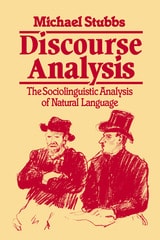
Discourse Analysis
The Sociolinguistic Analysis of Natural LanguageMichael Stubbs
University of Chicago Press, 1983
Discourse and the Other
The Production of the Afro-American TextW. Lawrence Hogue
Duke University Press, 1986
Hogue presents an illuminating discussion of the publication and review history of "major" and neglected texts. He illustrates the acceptance of texts as exotica, as sociological documents, or as carriers of sufficient literary conventions to receive approbation. Although the sixties movement allowed the text to move to the periphery of the dominant ideology, providing some new myths about the Afro-American historical past, this marginal position was subsequently sabotaged, co-opted, or appropriated (Afros became a fad; presidents gave the soul handshake; the hip-talking black was dressing one style and talking another.)
This study includes extended discussion of four works; Ernest J. Gaines's The Autobiography of Miss Jane Pittman, Alice Walker's The Third Life of Grange Copeland, Albert Murray's Train Whistle Guitar, and Toni Morrison's Sula. Hogue assesses the informing worldviews of each and the extent and nature of their acceptance by the dominant American cultural apparatus.

Discourse on the Origins of Inequality (Second Discourse), Polemics, and Political Economy
Jean-Jacques Rousseau
Dartmouth College Press, 1993
Discourse on the Sciences and Arts (First Discourse) and Polemics
Jean-Jacques Rousseau
Dartmouth College Press, 1992
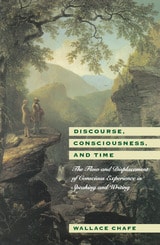
Discourse, Consciousness, and Time
The Flow and Displacement of Conscious Experience in Speaking and WritingWallace Chafe
University of Chicago Press, 1994
Chafe draws on several decades of research to demonstrate that understanding the nature of consciousness is essential to understanding many linguistic phenomena, such as pronouns, tense, clause structure, and intonation, as well as stylistic usages, such as the historical present and the free indirect style. While the book focuses on English, there are also discussions of the North American Indian language Seneca and the music of Mozart and of the Seneca people.
This work offers a comprehensive picture of the dynamic natures of language and consciousness that will interest linguists, psychologists, literary scholars, computer scientists, anthropologists, and philosophers.
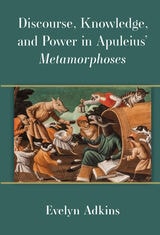
Discourse, Knowledge, and Power in Apuleius’ Metamorphoses
Evelyn Adkins
University of Michigan Press, 2022
In ancient Rome, where literacy was limited and speech was the main medium used to communicate status and identity face-to-face in daily life, an education in rhetoric was a valuable form of cultural capital and a key signifier of elite male identity. To lose the ability to speak would have caused one to be viewed as no longer elite, no longer a man, and perhaps even no longer human. We see such a fantasy horror story played out in the Metamorphoses or The Golden Ass, written by Roman North African author, orator, and philosopher Apuleius of Madauros—the only novel in Latin to survive in its entirety from antiquity. In the novel’s first-person narrative as well as its famous inset tales such as the Tale of Cupid and Psyche, the Metamorphoses is invested in questions of power and powerlessness, truth and knowledge, and communication and interpretation within the pluralistic but hierarchical world of the High Roman Empire (ca. 100–200 CE).
Discourse, Knowledge, and Power presents a new approach to the Metamorphoses: it is the first in-depth investigation of the use of speech and discourse as tools of characterization in Apuleius’ novel. It argues that discourse, broadly defined to include speech, silence, written text, and nonverbal communication, is the primary tool for negotiating identity, status, and power in the Metamorphoses. Although it takes as its starting point the role of discourse in the characterization of literary figures, it contends that the process we see in the Metamorphoses reflects the real world of the second century CE Roman Empire. Previous scholarship on Apuleius’ novel has read it as either a literary puzzle or a source-text for social, philosophical, or religious history. In contrast, this book uses a framework of discourse analysis, an umbrella term for various methods of studying the social political functions of discourse, to bring Latin literary studies into dialogue with Roman rhetoric, social and cultural history, religion, and philosophy as well as approaches to language and power from the fields of sociology, linguistics, and linguistic anthropology. Discourse, Knowledge, and Power argues that a fictional account of a man who becomes an animal has much to tell us not only about ancient Roman society and culture, but also about the dynamics of human and gendered communication, the anxieties of the privileged, and their implications for swiftly shifting configurations of status and power whether in the second or twenty-first centuries.
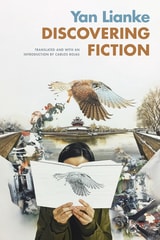
Discovering Fiction
Yan Lianke
Duke University Press, 2022
Discovering Sexuality in Dostoevsky
Susanne Fusso
Northwestern University Press, 2008
Some of the topics Fusso considers are Dostoevsky's search for an appropriate artistic language for sexuality, a young narrator's experimentation with homoerotic desire and unconventional narrative in A Raw Youth; and Dostoevsky's approach to a young man's sexual development in A Raw Youth and The Brothers Karamazov. She also explores his complex treatment of a child's secret sexuality in his account of the Kroneberg child abuse case in A Writer's Diary; and his conception of the ideal family, a type of family that appears in his works mainly by negative example. Focusing mainly on sexual practices considered "deviant" in Dostoevsky's time--both because these are the practices that his young characters confront and because they offer the most intriguing interpretive problems--Fusso decodes the author's texts and their social contexts. In doing so, she highlights one thread in the intricate thematic weave of Dostoevsky's novels and newly illuminates his artistic process.
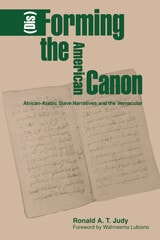
Disforming The American Canon
African-Arabic Slave Narratives and the VernacularRonald A.T. Judy
University of Minnesota Press, 1993
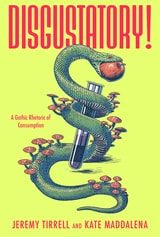
Disgustatory!
A Gothic Rhetoric of ConsumptionJeremy Tirrell and Kate Maddalena
University of Alabama Press, 2026
A critical exploration of how Gothic tropes infiltrate wellness discourse, revealing the rhetorical forces behind our cultural obsession with food, health, and bodily control.
Disgustatory! A Gothic Rhetoric of Consumption unearths the darkness behind modern obsessions with food, health, and bodily optimization. In this provocative and richly interdisciplinary work, Jeremy Tirrell and Kate Maddalena argue that contemporary discourses around food, medicine, and the body are steeped in Gothic rhetoric—where the promise of purity and control is shadowed by monstrosity, abjection, and the uncanny.
From Soylent and nootropics to probiotics and lab-grown meat, Tirrell and Maddalena show how wellness discourse is haunted by Gothic tropes: body horror, hybridity, and existential dread. Wellness culture, they argue, is not merely pseudoscience or fraud but a complex, persuasive rhetoric that blurs science and myth, purity and decay, medicine and mysticism.
Disgustatory! offers a fresh framework: a “Gothic rhetoric of consumption” that explains why we are drawn to weird diets, digital detoxes, and miracle cures. Through case studies of strange substances and stranger practices—Reddit fasting rituals, magic dirt supplements, fecal transplants— Tirrell and Maddalena reveal how fear, fascination, and the fantasy of bodily control animate our health choices. Each chapter explores a rhetorical element—quantification, hybridity, abjection, optimization, and regulation—to show how food becomes a site of cultural anxiety and existential longing. This book will appeal to rhetoricians, scholars of science and technology studies, cultural theorists, and anyone interested in the strange intersections of health, horror, and persuasion.
Dislocalism
The Crisis of Globalization and the Remobilizing of AmericanismSarika Chandra
The Ohio State University Press, 2011
Notwithstanding its now extensive, trans-disciplinary bibliography, the full reality of globalization remains less well understood than commonly thought. As an objective, secular phenomenon, globalization has continued to be obscured by ideological and rhetorical strategies that travel under the same name but posit it as simply the abstract-universal other of the local. Dislocalism: The Crisis of Globalization and the Remobilizing of Americanism makes such strategies and the global/local binary they reinforce into objects of critical analysis.
Dismembering the American Dream
The Life and Fiction of Richard YatesKate Charlton-Jones
University of Alabama Press, 2014
Since his death in Alabama in 1992, the work of American writer Richard Yates has enjoyed a renaissance, culminating in director Sam Mendes’s adaption of the novel Revolutionary Road (starring Leonardo DiCaprio and Kate Winslet). Dismembering the American Dream is the first book-length critical study of Yates’s fiction.
Kate Charlton-Jones argues that to read Yates’s tales of disordered lives is to uncover not misery, though the lives he describes are sad ones, but a profound, enriching, and humorous understanding of human weakness and vulnerability. Yates’s narratives absorb his readers so entirely, mirroring their own emotional highs and lows with such skill, that reading becomes recognition. Yates demonstrates his ability to tease powerful human drama out of the most ordinary, quotidian moments. At the same time, Yates’s fiction displays an object lesson in the art of fine prose writing, so it is no surprise that many early fans of Yates were also established writers.
Charlton-Jones explores how Yates extends the realist form and investigates three main recurring themes of his fiction: observations about performative behavior, which are at the heart of all his fictions; his conception of the writer’s role in society; and how he envisages the development of social and sexual relationships. Furthermore, Charlton-Jones illustrates how Yates incorporates some of the concerns and methods of postmodernist writers but how, nevertheless, he resists their ontological challenges.
Drawing on the author’s personal papers and with a foreword by DeWitt Henry and an afterword by Richard Yates’s daughter Monica, Dismembering the American Dream provides an extended critical examination of the often neglected but important work of this gifted and accomplished author.
Disney Culture
Wills, John
Rutgers University Press, 2017
Disney Culture proposes that there is still a unifying Disney ethos, one that can be traced back to the corporate philosophy that Walt Disney himself developed back in the 1920s. Yet, as cultural historian John Wills demonstrates, Disney’s values have also adapted to changing social climates. At the same time, the world of Disney has profoundly shaped how Americans view the world.
Wills offers a nuanced take on the corporate ideologies running through animated and live-action Disney movies from Frozen to Fantasia, from Mary Poppins to Star Wars: The Force Awakens. But Disney Culture encompasses much more than just movies as it explores the intersections between Disney’s business practices and its cultural mythmaking. Welcome to “the Disney Way.”
Disoriented Disciplines
China, Latin America, and the Shape of World LiteratureRosario Hubert
Northwestern University Press, 2024
In the absence of specialized programs of study, abstract discussions of China in Latin America took shape in contingent critical infrastructures built at the crossroads of the literary market, cultural diplomacy, and commerce. As Rosario Hubert reveals, modernism flourishes comparatively, in contexts where cultural criticism is a creative and cosmopolitan practice.
Disoriented Disciplines: China, Latin America, and the Shape of World Literature understands translation as a material act of transfer, decentering the authority of the text and connecting seemingly untranslatable cultural traditions. In this book, chinoiserie, “coolie” testimonies, Maoist prints, visual poetry, and Cold War memoirs compose a massive archive of primary sources that cannot be read or deciphered with the conventional tools of literary criticism. As Hubert demonstrates, even canonical Latin American authors, including Jorge Luis Borges, Octavio Paz, and Haroldo de Campos, write about China from the edges of philology, mediating the concrete as well as the sensorial.
Advocating for indiscipline as a core method of comparative literary studies, Disoriented Disciplines challenges us to interrogate the traditional contours of the archives and approaches that define the geopolitics of knowledge.
Disowned by Memory
Wordsworth's Poetry of the 1790sDavid Bromwich
University of Chicago Press, 1998
"This very Wordsworthian combination of apparently low subjects with extraordinary 'high argument' makes for very rewarding, though often challenging reading."—Kenneth R. Johnston, Washington Times
"Wordsworth emerges from this short and finely written book as even stranger than we had thought, and even more urgently our contemporary."—Grevel Lindop, Times Literary Supplement
"[Bromwich's] critical interpretations of the poetry itself offer readers unusual insights into Wordworth's life and work."—Library Journal
"An added benefit of this book is that it restores our faith that criticism can actually speak to our needs. Bromwich is a rigorous critic, but he is a general one whose insights are broadly applicable. It's an intellectual pleasure to rise to his complexities."—Vijay Seshadri, New York Times Book Review
Dispatches from the Land of Erasure
Essays and ConversationsPhilip Metres
University of Michigan Press, 2025
With keen insight into the lived experience of Arab Americans and other historically marginalized communities, the book explores the struggle for a just peace through reading Palestinian Arab and Israeli Jewish writers of conscience who contend with the wall of silence around the issue of Palestine. Further, Dispatches illuminates how to write a poetry of peace and justice, and how poetic activism and activist poets situate themselves in communities seeking change. Divided into four sections—Erasing the Erasures: Writing While Arab, The Poetics of Palestine, The Poetics of Justice, and The Poetics of Peacebuilding—Dispatches weaves personal essays, cultural criticism, group chats, interviews, literary analysis, reviews, and roundtables that include luminaries like Mosab Abu Toha, Hayan Charara, Sahar Khalifeh, Marwa Helal, Erika Meitner, Naomi Shihab Nye, Craig Santos Perez, and M. NourbeSe Philip. Together, the book models the crucial need for robust dialogue to overcome the echo chamber that limits the growth and reach of social movements and to dream of a future beyond the land of erasure.
Dispelling Fantasies
Authors of Color Reimagine a GenreJoy Sanchez-Taylor
The Ohio State University Press, 2025
In Dispelling Fantasies, Joy Sanchez-Taylor examines how authors of color, such as R. F. Kuang, N. K. Jemisin, Nnedi Okorafor, Tomi Adeyemi, Tasha Suri, Aiden Thomas, Nghi Vo, and Marlon James, among others, offer critical counterpoints to the history of white-dominated, Eurocentric fantasy. The traditional fantasy that these authors are writing against reinforces Christian virtues and colonial, white supremacist structures; Sanchez-Taylor argues that its racial tropes are tied to a history of colonization and Christian missionary practices, with popular fantasy narratives often depicting Indigenous groups as primitive, deviant peoples in need of salvation. Such representations are based on a Western binary of rational versus magical and are influenced by tenets of Christianity, ultimately contributing to depictions of “the dark fantastic” or fantasy worlds where dark and othered characters are implicitly portrayed as evil and irredeemable. Organized around four Christian ideals that appear frequently in Western fantasy texts—virtue, envy, patriarchy, and salvation—Dispelling Fantasies demonstrates how non-Eurocentric fantasy worlds offer alternative versions of morality, race, gender, and sexuality and make space for authors to move away from hierarchical, binary systems of good and evil.
Displacement and the Somatics of Postcolonial Culture
Douglas Robinson
The Ohio State University Press, 2013
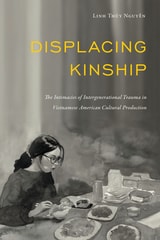
Displacing Kinship
The Intimacies of Intergenerational Trauma in Vietnamese American Cultural ProductionLinh Thuy Nguyen
Temple University Press, 2024
Second-generation texts illustrate how the children of refugees from Vietnam are haunted by trauma and a violent, ever-present, but mostly unarticulated past. Linh Thủy Nguyễn's analysis reveals that present experiences of economic insecurity and racism also shape these narratives of familial loss.
Developing a theory of intergenerational trauma, Nguyễn rethinks how U.S. imperialism, the discourse of communism, and assimilation impacted families across generations. Through ethnic studies and feminist and queer-of-color critique, Displacing Kinship offers a critical approach for reading family tensions and interpersonal conflict as affective investments informed by the material, structural conditions of white supremacy and racial capitalism.
Disrupting Narrative Rhetoric
Experimental Fictionality on Digital PlatformsStefan Iversen
The Ohio State University Press, 2026
Dissecting Stephen King
From the Gothic to Literary NaturalismHeidi Strengell
University of Wisconsin Press, 2005
Ultimately, Strengell shows how King shatters our illusions of safety and control: "King places his decent and basically good characters at the mercy of indifferent forces, survival depending on their moral strength and the responsibility they may take for their fellow men."
Dissemination
Jacques Derrida
University of Chicago Press, 1981
Dissemination
Jacques Derrida
University of Chicago Press, 1981
Dissensual Subjects
Memory, Human Rights, and Postdictatorship in Argentina, Brazil, and UruguayAndrew C. Rajca
Northwestern University Press, 2018
Through an engaging exploration of the concept of “never again” (nunca más/nunca mais) and close analysis of photography exhibits, audiovisual installations, and other art forms in spaces of cultural memory, the book explores how aesthetic interventions can suggest alternative ways of framing human rights subjectivity beyond the rhetoric of liberal humanitarianism. The book visits sites of memory, two of which functioned as detention and torture centers during dictatorships, to highlight the tensions between the testimonial tenor of permanent exhibits and the aesthetic interventions of temporary installations there. Rajca thus introduces perspectives that both undo common understandings of authoritarian violence and its effects as well as reconfigure who or what are made visible as subjects of memory and human rights in postdictatorship countries.
Dissensual Subjects offers much to those concerned with numerous interlocking fields: memory, human rights, political subjectivity, aesthetics, cultural studies, visual culture, Southern Cone studies, postdictatorship studies, and sites of memory.
Dissonance (if you are interested)
Rosmarie Waldrop
University of Alabama Press, 2005
Incisive essays on modern poetry and translation by a noted poet, translator, and critic.
In this comprehensive collection of her essays, Waldrop addresses considerations central to her life’s work: typical genres and ways of countering the conventions of genre; how concrete poets have made syntax spatial rather than grammatical; and the move away from metaphor in poetry toward contiguity and metonymy. Three essays on translation struggle with the sources and targets of translation, of the degree of strangeness or foreignness a translator should allow into any English translation. Finally, other essays examine the two-way traffic between reading and writing, and Waldrop’s notion of reading as experience.
Dissonant Voices
Race, Jazz, and Innovative Poetics in Midcentury AmericaJoseph Pizza
University of Iowa Press, 2023
Distance Manipulation
The Russian Modernist Search for a New DramaJoanna Kot
Northwestern University Press, 1999
Kot studies experimental dramas by Gippius, Sologub, Blok, and Ivanov, but the centerpiece of the book is Chekhov's Cherry Orchard his last and greatest play. Kot argues that it presents a subtle balance of distancing and emotive techniques.
An invaluable guide to the often bewildering nature of so-called "innovative" twentieth-century works, this book will appeal to anyone interested in modern theater.
Distancing English
A Chapter in the History of the InexpressiblePage Richards
The Ohio State University Press, 2009
Distant Horizons
Digital Evidence and Literary ChangeTed Underwood
University of Chicago Press, 2019
Distant Reading
Performance, Readership, and Consumption in Contemporary PoetryPeter Middleton
University of Alabama Press, 2005
A dynamic account of the history, practice, and theory of poetry as performance.
Distant Reading considers poetry as performance, offers new insights into its popularity, and proposes a new history of its origins. It also explores related issues concerning the reception of poetry, the impact of the computer on how we read poetry, the persistence of the letter "I" in poems by avant-garde poets, the strangeness of the line-break as a demand on the reader's attention, and the idea of the reader as consumer. These themes are connected by a historically contextualized and theoretically sophisticated discussion of contemporary American and British poets continuing to work in the modernist tradition.
The introductory essay establishes a new methodology that transforms close reading into what Middleton calls "distant reading," interpretive reading that acknowledges the distances that texts travel from their point of composition to readers in other geographical and historical locations. It indicates that poetic innovation is often driven by a desire on the part of the poet to make this distance do cultural work in the meanings that the poem generates.
Ultimately, Distant Reading treats poetry as a cultural practice that is always situated within specific sites of performance—recited on stage, displayed in magazines, laid out on a page, scrolled on the computer screen—rather than as a transcendent cloud of meaning tethered only to its words.

Disturbers of the Twentieth Century
Catholic Social Critics in Modern BritainAdam Schwartz
Catholic University of America Press, 2026