Results by title
4038 books match the query 'Social aspects' and 181 start with d
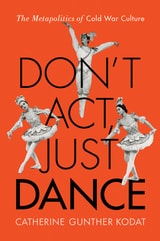
Don't Act, Just Dance
The Metapolitics of Cold War CultureCatherine Gunther Kodat
Rutgers University Press, 2014

Don't Get above Your Raisin'
Country Music and the Southern Working ClassBill C. Malone
University of Illinois Press, 2002
Widely recognized as country music's ranking senior authority, Bill C. Malone explores how the music's defining themes (home and family, religion, rambling, frolic, humor, and politics) have emerged out of the particularities of working people's day-to-day lives. He traces the many contradictory voices and messages of a music that simultaneously extols the virtues of home and the joys of rambling, the assurances of the Christian life and the ecstasies of hedonism, the strength of working-class life and the material lure of middle-class aspirations. The resulting tensions, Malone argues, are a principal source of the music's enduring appeal.
Country musicians have often been people from undistinguished blue-collar backgrounds who have tried to make their way as entertainers in a society that has little respect for the working class. From this ambivalent position, they have voiced the sometimes contradictory values and longings of their culture while also attempting to fulfill the romantic expectations of outsiders.
"For every Garth Brooks," Malone says, "there are a thousand country musicians who perform in local bars, taverns, and American Legion halls and who have never been able to ‘give up their day jobs.' These are musicians whose middle-class dreams are tempered by working-class realities." A powerful and honest expression of the hopes, longings, frailties, and failings of ordinary people, country music increasingly resonates with listeners beyond its core constituency as they struggle with a complex and uncertain world.

Don't Look, Don't Touch, Don't Eat
The Science Behind RevulsionValerie Curtis
University of Chicago Press, 2013
Double Crossover
Gender, Media, and Politics in Global BasketballCourtney M. Cox
University of Illinois Press, 2025
As they compete in leagues around the world, elite women’s basketball players continually adjust to new cultures, rules, and contracts.
Courtney M. Cox follows athletes, coaches, journalists, and advocates of women’s basketball as they pursue careers within the sport. Despite all attempts to contain them or prevent forward momentum, they circumvent expectations and open new possibilities within and outside of the game. Throughout the book, Cox explores the intersection of race and gender against the backdrop of the WNBA, NCAA, and other leagues within the United States and around the world. Blending interviews and participant observation with content analysis, she charts how athletes and advocates of women’s hoops illuminate new forms of navigating the global sports-media complex.
Timely and original, Double Crossover takes readers into the lived world of women’s basketball to shed light on the struggles, triumphs, and contributions of today’s players and those around them.
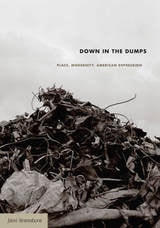
Down in the Dumps
Place, Modernity, American DepressionJani Scandura
Duke University Press, 2007
An interpretive bricolage that draws on an unlikely archive of 1930s detritus—office memos, scribbled manuscripts, scrapbooks, ruined photographs, newspaper clippings, glass eyes, incinerated stage sets, pulp novels, and junk washed ashore—Down in the Dumps escorts its readers through Reno’s divorce factory of the 1930s, where couples from across the United States came to quickly dissolve matrimonial bonds; Key West’s multilingual salvage economy and its status as the island that became the center of an ideological tug-of-war between the American New Deal government and a politically fraught Caribbean; post-Renaissance Harlem, in the process of memorializing, remembering, grieving, and rewriting a modernity that had already passed; and Studio-era Hollywood, Nathanael West’s “dump of dreams,” in which the introduction of sound in film and shifts in art direction began to transform how Americans understood place-making and even being itself. A coda on Alcatraz and the Pentagon brings the book into the present, exploring how American Depression comes to bear on post-9/11 America.

Down to Earth
Satellite Technologies, Industries, and CulturesParks, Lisa
Rutgers University Press, 2012
Down to Earth presents the first comprehensive overview of the geopolitical maneuvers, financial investments, technological innovations, and ideological struggles that take place behind the scenes of the satellite industry. Satellite projects that have not received extensive coverage—microsatellites in China, WorldSpace in South Africa, SiriusXM, the failures of USA 193 and Cosmos 954, and Iridium—are explored. This collection takes readers on a voyage through a truly global industry, from the sites where satellites are launched to the corporate clean rooms where they are designed, and along the orbits and paths that satellites traverse. Combining a practical introduction to the mechanics of the satellite industry, a history of how its practices and technologies have evolved, and a sophisticated theoretical analysis of satellite cultures, Down to Earth opens up a new space for global media studies.
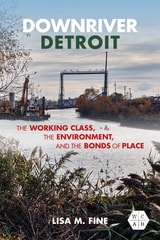
Downriver Detroit
The Working Class, the Environment, and the Bonds of PlaceLisa M. Fine
University of Illinois Press, 2026
Lisa M. Fine examines important moments in the ongoing efforts of the area’s citizens to create a humane and habitable environment. Her analysis shows how people preserved wetlands and the river by working through sportsmen’s organizations, appealing to state agencies, and forming grassroots movements. Fueled by enduring connections to place, local unions fought a proposed nuclear power plant in the 1950s. Years later, steel workers facing the steamroller of deindustrialization tried to preserve their communities by purchasing their own company. The ties that bind gave a unique character to activism in the Downriver region, challenging stereotypes of working-class attitudes toward the environment.
A creative merger of labor and environmental history, Downriver Detroit shows that working people have a right to live in and protect the places they love.
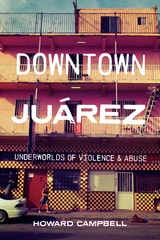
Downtown Juárez
Underworlds of Violence and AbuseHoward Campbell
University of Texas Press, 2021
At least 200,000 people have died in Mexico’s so-called drug war, and the worst suffering has been in Ciudad Juárez, across the border from El Paso, Texas. How did it get so bad? After three decades studying that question, Howard Campbell doesn’t believe there is any one answer. Misguided policies, corruption, criminality, and the borderland economy are all factors. But none of these reasons explain how violence in downtown Juárez has become heartbreakingly “normal.”
A rigorous yet moving account, Downtown Juárez is informed by the sex workers, addicts, hustlers, bar owners, human smugglers, migrants, and down-and-out workers struggling to survive in an underworld where horrifying abuses have come to seem like the natural way of things. Even as Juárez’s elite northeast section thrives on the profits of multinational corporations, and law-abiding citizens across the city mobilize against crime and official malfeasance, downtown’s cantinas, barrios, and brothels are tyrannized by misery.
Campbell’s is a chilling perspective, suggesting that, over time, violent acts feed off each other, losing their connection to any specific cause. Downtown Juárez documents this banality of evil—and confronts it—with the stories of those most affected.
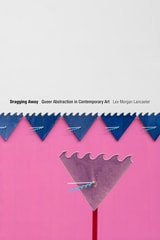
Dragging Away
Queer Abstraction in Contemporary ArtLex Morgan Lancaster
Duke University Press, 2022
Drama of Democracy
Political Representation in MumbaiLisa Björkman
University of Minnesota Press, 2025
The performative arts of political communication and representation in Mumbai
In an era of global political passions, many have wondered whether some sort of natural affinity exists between political style and substance. Does liberal democracy speak the language of rationality and sincerity while political emotion, imagery, and embodiment properly belong to authoritarianism? Taking an ethnographic approach to the relationship between political form and political content, Drama of Democracy explores the material substance of representations (things like heady crowds and rousing images) together with language-based forms of political communication, such as public oration and community meetings.
Drawing on a decade of research in the city of Mumbai, Lisa Björkman shows that embodied performance is the very site and substance of representation and demonstrates how Mumbaikars evaluate performative bids to represent. The ethnographic accounts demonstrate the extraordinary fluency in this evaluative work in Mumbai, where people from all walks of life are remarkably astute at navigating and assessing political signs and representations, endlessly discussing and debating possible meanings of the city’s dense material-semiotic ecologies—whether words or images, cash or crowds, flyers or flowers.
In Mumbai, Björkman argues, the evaluative criterion of representation is not whether something is sign or substance, or even whether people are deemed to utter truths or falsehoods. Rather, what matters is whether and how a performance activates and actuates the social relations and political subjectivities that it professes to display. Drama of Democracy highlights Mumbaikars’ communicative fluency and theatrical acumen to offer a conceptual toolbox through which contemporary political churnings around the globe might be understood.
Dramas of Nationhood
The Politics of Television in EgyptLila Abu-Lughod
University of Chicago Press, 2004
Representing a decade's worth of research, Dramas of Nationhood makes a case for the importance of studying television to answer larger questions about culture, power, and modern self-fashionings. Abu-Lughod explores the elements of developmentalist ideology and the visions of national progress that once dominated Egyptian television—now experiencing a crisis. She discusses the broadcasts in rich detail, from the generic emotional qualities of TV serials and the depictions of authentic national culture, to the debates inflamed by their deliberate strategies for combating religious extremism.
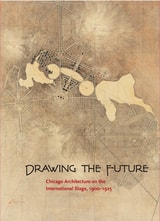
Drawing the Future
Chicago Architecture on the International Stage, 1900-1925David Van Zanten
Northwestern University Press, 2013
Drawing the Future: Chicago Architecture on the International Stage, 1900–1925 is an illustrated catalog with companion essays for an exhibition of the same name at the Mary and Leigh Block Museum of Art at Northwestern University. Drawing the Future explores the creative ferment among Chicago architects in the early twentieth century, coinciding with similar visions around the world. The essays focus on the highlights of the exhibition. David Van Zanten profiles Walter Burley Griffin and Marion Mahony Griffin, Chicago architects who created an influential, prize-winning plan for Canberra, the new capital of Australia. Ashley Dunn looks at the two exhibits at the Musée des Arts Décoratifs in Paris, one devoted to the Griffins in 1914 and the other to the French architect Tony Garnier in 1925, demonstrating the impact of World War I on city planning and architecture. Leslie Coburn examines Chicago’s Neighborhood Center Competition of 1914–15, which sought to redress gaps in Daniel Burnham’s plan of 1909. The ambition and reach of Chicago architecture in this epoch would have lasting influence on cities of the future.

Dream Lovers
The Gamification of RelationshipsAlfie Bown
Pluto Press, 2022
'An exciting, astute analysis of how our capacity for desire has been slotted into the grooves of digital capitalism, and made to work for profit - from porn to Pokémon' - Richard Seymour
We are in the middle of a 'desirevolution' - a fundamental and political transformation of the way we desire as human beings. Perhaps as always, new technologies - with their associated and inherited political biases - are organizing and mapping the future. What we don't seem to notice is that the primary way in which our lives are being transformed is through the manipulation and control of desire itself.
Our very impulses, drives and urges are 'gamified' to suit particular economic and political agendas, changing the way we relate to everything from lovers and friends to food and politicians. Digital technologies are transforming the subject at the deepest level of desire - re-mapping its libidinal economy - in ways never before imagined possible.
From sexbots to smart condoms, fitbits to VR simulators and AI to dating algorithms, the 'love industries' are at the heart of the future smart city and the social fabric of everyday life. This book considers these emergent technologies and what they mean for the future of love, desire, work and capitalism.
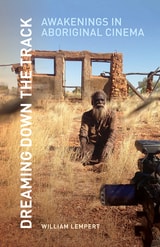
Dreaming Down the Track
Awakenings in Aboriginal CinemaWilliam Lempert
University of Minnesota Press, 2025
What can Aboriginal filmmaking reveal about Indigenous presence and futures?
The product of years of embedded fieldwork within Indigenous film crews in Northwestern Australia, Dreaming Down the Track delves deeply into Aboriginal cinema as a transformative community process. It follows the social lives of projects throughout their production cycles, from planning and editing to screening, broadcasting, and after-images. Across its narrative sweep, this ethnography engages the film career of Kukatja elder Mark Moora to demonstrate the impact of filmmaking on how Aboriginal futures are collectively imagined and called forth.
William Lempert highlights a series of awakenings through which Moora ultimately came to view cinema as a process for catalyzing his family’s return to their home country of Mangkayi. This biographical media journey paints an intimate portrait of the inspiring possibilities and sobering limitations of Indigenous envisioning within settler states. Lempert traces how Moora’s life and films convey a multiplicity of Aboriginal experiences across time and space, from colonial contact to contemporary life in communities like Balgo, including the continued governmental attempts to undermine them.
Amid ongoing negotiations to establish the first treaties between Indigenous nations and Australian states, Dreaming Down the Track illustrates what is at stake in how Aboriginal–State relations are represented and understood, both within communities and for the broader public. Lempert stays true to Moora’s insight that film can preserve community stories for generations to come, toward the aim of enacting sovereign futures.

Dreaming in Russian
The Cuban Soviet ImaginaryBy Jacqueline Loss
University of Texas Press, 2013
The specter of the Soviet Union lingers in Cuba, yet until now there has been no book-length work on the ways Cubans process their country’s relationship with the Soviet bloc. Dreaming in Russian at last brings into the light the reality that for nearly three decades, the Soviet Union subsidized the island economically, intervened in military matters, and exported distinct pedagogical and cultural models to Cuba. Drawing on interviews with Cuban artists and intellectuals, as well as treasures from cinematographic and bibliographic archives, Jacqueline Loss delivers the first book to show that Cuba remembers and retains many aspects of the Soviet era, far from shedding those cultural facets as relics of the Cold War.
Weaving together intriguing, seldom-seen images, Dreaming in Russian showcases the ways in which Cuba’s relationship to its Soviet benefactors lingered after the disintegration of the U.S.S.R. in 1991. Analyzing numerous literary texts and works of visual art, Loss also incorporates aspects of architecture, popular culture, the space race, and other strands to create a captivating new perspective on Cuban society. Among the luminaries featured are poet Reina María Rodríguez, writer Antonio José Ponte, visual artist Tonel, and novelist Wendy Guerra. A departure from traditional cultural history, Loss’s approach instead presents a kaleidoscopic series of facets, reflecting the hybrid nature of the self-images that emerged in the aftermath of the Soviet aegis. As speculations about Cuba’s future under Fidel Castro’s heir apparent continue, the portrait that emerges in Dreaming in Russian is both timely and mesmerizing.
Dreams in Double Time
On Race, Freedom, and BebopJonathan Leal
Duke University Press, 2023
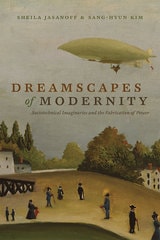
Dreamscapes of Modernity
Sociotechnical Imaginaries and the Fabrication of PowerEdited by Sheila Jasanoff and Sang-Hyun Kim
University of Chicago Press, 2015
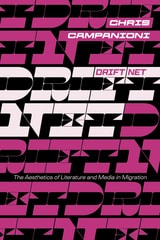
Drift Net
The Aesthetics of Literature and Media in MigrationChris Campanioni
Lever Press, 2025
Through a model Campanioni calls a “migratory text,” Drift Net advances a theory of literature and art born in translation that calls into question established theories of world literature, national literatures, literary periodization, and translation itself. Through an analysis of works born in translation and produced in passage, detention, and exile, Campanioni utilizes this model to read creatively across a wide range of social and political formations, from the experience of his parents' exiles to alternative housing initiatives and asylum reform efforts throughout Europe, including the largest LGBT+ refugee center in the world. Drawing on a mixed methodology of qualitative interviews with asylum applicants and shelter directors, textual analysis, and autoethnographic narrative, Drift Net traces literary developments alongside contemporary social and political interventions. This approach proposes interventions on the organizational levels of asylum, integration, public housing, and membership. It also marks the ways migrant creators have reformulated subjectivity through the same genres and modes that have contributed to their devaluation as minoritized subjects.
Drift Net both deepens and broadens our conceptualization of migrant literature, and recovers an understanding and application of transmedia that predates digital cultures. Campanioni offers a wide-ranging study of texts including Edward Said and Jean Mohr’s After the Last Sky: Palestinian Lives, Edgar Garcia’s Skins of Columbus, Anna Seghers’s Transit, Francis Ponge’s Soap, Walid Raad’s The Atlas Group, Klára Hosnedlová’s embroidered paintings, Reem Karssli and Caroline Williams’s Now is the Time To Say Nothing, Cornelia Schleime’s paper prints, and more. Drift Net formulates the “migratory” as a site of artistic production, resistance, and possibility, where theory is not an end but the beginning of tools and practices that might help researchers, instructors, and organizers to develop their strategies.

Drones, Tones, and Timbres
Sounding Place among Nomads of the Inner Asian Mountain-SteppesCarole Pegg
University of Illinois Press, 2024
Based on more than twenty years of collaborative research, Carole Pegg’s long-awaited participatory ethnography explores how Indigenous nomadic peoples of Russia’s southern Siberian republics (Altai, Khakassia, Tyva) sound multiphonies of place in a post-Soviet global world. Inspired by the mountain-steppe ecology and pathways of nomadism, soundscapes created in performative ritual events cross political and multiple-world boundaries in a shamanic-animist universe, enabling human and spirit actor interactions in a series of sensuous worlds. As with the “throat-singing” for which Indigenous Altai-Sayan peoples are famous, senses of place involve sonic relations, rootedness, movement, and plurality. Pegg echoes their drone-partials musical and ontological models in an innovative theoretical entwinement. Three strands form the book’s multivocal drone, the partials of which sound in each chapter: ontological sonicality and musicality that enables emplacement and movement; the importance of shamanism-animism--at the core of Indigenous spiritual practices--for personhood and community; and the agency of sonic performances. Sounding place, Pegg demonstrates, is essential to the identities, ways of life, and very senses of being of Indigenous Altai-Sayan peoples.
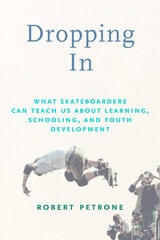
Dropping In
What Skateboarders Can Teach Us about Learning, Schooling, and Youth DevelopmentRobert Petrone
University of Massachusetts Press, 2023
The die-hard local skateboarders of Franklin Skatepark—a group of working-class, Latino and white young men in the rural Midwest—are typically classified by schools and society as “struggling,” “at-risk,” “failing,” and “in crisis.” But at the skatepark, they thrive and succeed, not only by landing tricks but also by finding meaning and purpose in their lives.
In Dropping In, Robert Petrone draws from multiple years of ethnographic research to bring readers into this rich environment, exploring how and why these young men engage more with skateboarding and its related cultural communities than with school. For them, it is in these alternative communities and spaces that they meet their intellectual, literate, and learning needs; cultivate meaningful and supportive relationships; and develop a larger understanding of their place in the world. By looking at what these skateboarders can teach us about what is right and working in their lives, Petrone asks educators and others committed to youth development to rethink schooling structures and practices to provide equitable education for all students.

Drug War Zone
Frontline Dispatches from the Streets of El Paso and JuárezBy Howard Campbell
University of Texas Press, 2009
Winner, Southwest Book Award, Border Regional Library Association, 2011
Thousands of people die in drug-related violence every year in Mexico. Ciudad Juárez, Chihuahua, adjacent to El Paso, Texas, has become the most violent city in the Mexican drug war. Much of the cocaine, marijuana, and methamphetamine consumed in the United States is imported across the Mexican border, making El Paso/Juárez one of the major drug-trafficking venues in the world.
In this anthropological study of drug trafficking and anti-drug law enforcement efforts on the U.S.-Mexico border, Howard Campbell uses an ethnographic perspective to chronicle the recent Mexican drug war, focusing especially on people and events in the El Paso/Juárez area. It is the first social science study of the violent drug war that is tearing Mexico apart.
Based on deep access to the drug-smuggling world, this study presents the drug war through the eyes and lives of direct participants. Half of the book consists of oral histories from drug traffickers, and the other half from law enforcement officials. There is much journalistic coverage of the drug war, but very seldom are the lived experiences of traffickers and "narcs" presented in such vivid detail. In addition to providing an up-close, personal view of the drug-trafficking world, Campbell explains and analyzes the functioning of drug cartels, the corruption that facilitates drug trafficking, the strategies of smugglers and anti-narcotics officials, and the perilous culture of drug trafficking that Campbell refers to as the "Drug War Zone."

Drugs for Life
How Pharmaceutical Companies Define Our HealthJoseph Dumit
Duke University Press, 2012

Drugs in Afghanistan
Opium, Outlaws and Scorpion TalesDavid Macdonald
Pluto Press, 2007
Afghanistan is the world's largest producer of opium and heroin. This book explores the devastating impact that the drugs trade has had on the Afghan people.
Author David Macdonald has worked as a drugs advisor to the UN. Based on his extensive experience, this book breaks down the myths surrounding the cultivation and consumption of drugs, providing a detailed analysis of the history of drug use within the country. He examines the impact of over 25 years of continuous conflict, and shows how poverty and instability has led to an increase in drugs consumption. He also considers the recent rise in the use of pharmaceutical drugs, resulting in dangerous chemical cocktails and analyses the effect of Afghanistan's drug trade on neighbouring countries.

Dry Place
Landscapes Of Belonging And ExclusionPatricia L. Price
University of Minnesota Press, 2004
Gathers tales from the Southwestern United States and Northern Mexico to understand the relationship between people and place in a borderland
Landscape is the space of negotiation between human beings and the physical world, and rarely are the negotiations more complex and subtle than those conducted through the desert landscape along the Mexico-U.S. border.
Patricia L. Price views the shaping of the landscape on and around the border through various narratives that have sought to establish claims to these dry lands. Most prominent are the accounts of Anglo-American expansionism and Manifest Destiny juxtaposed with the Chicano nationalist tale of Aztlán in the twentieth century, all constituting collective, contending claims to the U.S. Southwest. Demonstrating how stories can become vehicles for changing places and identities, Price considers characters old and new who inhabit the contemporary borderlands between Mexico and the United States—ranging from longstanding manifestations of good and evil in the figures of the Virgin of Guadalupe and the Devil to a collection of lay saints embodying current concerns. Dry Place weaves together theoretical insights with field-based inquiry, autobiography, and creative writing to arrive at a textured understanding of the bordered landscape of late modern subjectivity.
Dubai, the City as Corporation
Ahmed Kanna
University of Minnesota Press, 2010
Exposing local struggles over power and meaning in the making and representation of Dubai, Kanna examines the core questions of what gets built and for whom. His work, unique in its view of the interconnectedness of cultural identity, the built environment, and politics, offers an instructive picture of how different factions—from local and non-Arab residents and expatriate South Asians to the cultural and economic elites of the city—have all participated in the creation and marketing of Dubai. The result is an unparalleled account of the ways in which the built environment shapes and is shaped by the experience of globalization and neoliberalism in a diverse, multinational city.
Duped
Truth-Default Theory and the Social Science of Lying and DeceptionTimothy R. Levine
University of Alabama Press, 2020
Unmasking the science of deception—and why truth wins by default.
From the advent of fake news to climate-science denial and Bernie Madoff’s appeal to investors, people can be astonishingly gullible. Some people appear authentic and sincere even when the facts discredit them, and many people fall victim to conspiracy theories and economic scams that should be dismissed as obviously ludicrous. This happens because of a near-universal human tendency to operate within a mindset that can be characterized as a “truth-default.” We uncritically accept most of the messages we receive as “honest.” We all are perceptually blind to deception. We are hardwired to be duped. The question is, can anything be done to militate against our vulnerability to deception without further eroding the trust in people and social institutions that we so desperately need in civil society?
Timothy R. Levine’s Duped: Truth-Default Theory and the Social Science of Lying and Deception recounts a decades-long program of empirical research that culminates in a new theory of deception—truth-default theory. This theory holds that the content of incoming communication is typically and uncritically accepted as true, and most of the time, this is good. Truth-default allows humans to function socially. Further, because most deception is enacted by a few prolific liars, the so called “truth-bias” is not really a bias after all. Passive belief makes us right most of the time, but the catch is that it also makes us vulnerable to occasional deceit.
Levine’s research on lie detection and truth-bias has produced many provocative new findings over the years. He has uncovered what makes some people more believable than others and has discovered several ways to improve lie-detection accuracy. In Duped, Levine details where these ideas came from, how they were tested, and how the findings combine to produce a coherent new understanding of human deception and deception detection.

Durkheim's Philosophy of Science and the Sociology of Knowledge
Creating an Intellectual NicheWarren Schmaus
University of Chicago Press, 1994
Schmaus shows how Durkheim sought to make sociology more rigorous by introducing scientific methods of analysis and explanation into the study of society. Durkheim tried to reveal how implicit, commonly held beliefs actually govern people's lives. Through an original interpretation of Durkheim's landmark writings, Schmaus argues that Durkheim, in his empirical studies, refined both the methods of sociology and a theory about society's shared knowledge and practices.
This book opens a new window on the development of Durkheim's thought and demonstrates how a philosophy of science can inspire the rise of a new science.
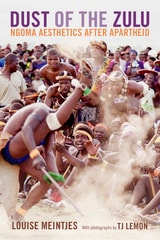
Dust of the Zulu
Ngoma Aesthetics after ApartheidLouise Meintjes
Duke University Press, 2017

Dwelling in Resistance
Living with Alternative Technologies in AmericaSchelly, Chelsea
Rutgers University Press, 2017
Schelly portrays a wide range of residential living alternatives utilizing renewable, small-scale, de-centralized technologies. These technologies considerably change how individuals and communities interact with the material world, their natural environment, and one another. Using in depth interviews and compelling ethnographic observations, the book offers an insightful look at different communities’ practices and principles and their successful endeavors in sustainability and self-sufficiency.
Dying Unneeded
The Cultural Context of the Russian Mortality CrisisMichelle A. Parsons
Vanderbilt University Press, 2014
Middle-aged Muscovites talk about being unneeded (ne nuzhny), or having little to give others. Considering this concept of "being unneeded" reveals how political economic transformation undermined the logic of social relations whereby individuals used their position within the Soviet state to give things to other people. Being unneeded is also gendered--while women are still needed by their families, men are often unneeded by state or family. Western literature on the mortality crisis focuses on a lack of social capital, often assuming that what individuals receive is most important, but being needed is more about what individuals give. Social connections--and their influence on health--are culturally specific.
In Soviet times, needed people helped friends and acquaintances push against the limits of the state, crafting a sense of space and freedom. When the state collapsed, this sense of bounded freedom was compromised, and another freedom became deadly.
This book is a recipient of the annual Norman L. and Roselea J. Goldberg Prize for the best project in the area of medicine.

Dürer's Coats
Renaissance Men and Material Cultures of Social RecognitionUlinka Rublack
Central European University Press, 2025