Results by title
8642 books match the query '20th century' and 292 start with d
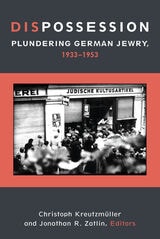
Dispossession
Plundering German Jewry, 1933-1953Christoph Kreutzmüller and Jonathan R. Zatlin, Editors
University of Michigan Press, 2020
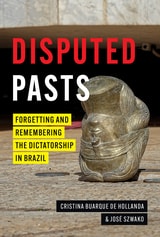
Disputed Pasts
Forgetting and Remembering the Dictatorship in BrazilCristina Buarque de Hollanda and José Szwako
University of Texas Press, 2026
How the memory of military dictatorship shapes Brazil's political divides and the far-right's rise.
Brazil’s military dictatorship ended in 1985, but its history still looms large over the country. Since the restoration of democracy, national politics have been shaped by heated contestation over the dictatorship’s legacy. Cristina Buarque de Hollanda and José Szwako examine how the state, the military, and civil society have variously mourned, celebrated, and suppressed memories of Brazil’s violent past—and to what ends.
As the dictatorship faltered under pressure from the opposition in the streets and in Congress, popular opinion favored democracy, which often meant forgetting. Today, the Brazilian left contends that the past has been silenced, paving the way for Jair Bolsonaro and the far right. Yet the past has been intensely contested: media outlets, social movements, and official commissions have long documented the dictatorship and spurred reparations. Disputed Pasts argues that the conservative ascendency is a reaction to these efforts of remembrance. The right seeks to rehabilitate the violent past by discrediting victims and elevating the dictatorship’s anti-communist ideology. Far from forgetting the past, Bolsonaro and Bolsonarismo actively remember and celebrate it.
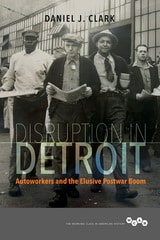
Disruption in Detroit
Autoworkers and the Elusive Postwar BoomDaniel J. Clark
University of Illinois Press, 2018
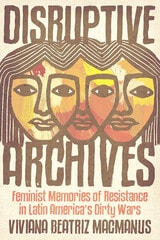
Disruptive Archives
Feminist Memories of Resistance in Latin America's Dirty WarsViviana Beatriz MacManus
University of Illinois Press, 2020
Haunting and methodologically innovative, Disruptive Archives attests to the power of women's storytelling and memory in the struggle to reclaim history.
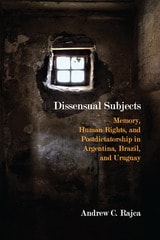
Dissensual Subjects
Memory, Human Rights, and Postdictatorship in Argentina, Brazil, and UruguayAndrew C. Rajca
Northwestern University Press, 2018
Through an engaging exploration of the concept of “never again” (nunca más/nunca mais) and close analysis of photography exhibits, audiovisual installations, and other art forms in spaces of cultural memory, the book explores how aesthetic interventions can suggest alternative ways of framing human rights subjectivity beyond the rhetoric of liberal humanitarianism. The book visits sites of memory, two of which functioned as detention and torture centers during dictatorships, to highlight the tensions between the testimonial tenor of permanent exhibits and the aesthetic interventions of temporary installations there. Rajca thus introduces perspectives that both undo common understandings of authoritarian violence and its effects as well as reconfigure who or what are made visible as subjects of memory and human rights in postdictatorship countries.
Dissensual Subjects offers much to those concerned with numerous interlocking fields: memory, human rights, political subjectivity, aesthetics, cultural studies, visual culture, Southern Cone studies, postdictatorship studies, and sites of memory.
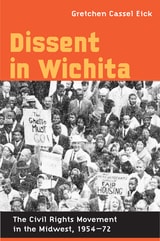
Dissent in Wichita
The Civil Rights Movement in the Midwest, 1954-72Gretchen Cassel Eick
University of Illinois Press, 2001
Winner of the Richard L. Wentworth Prize in American History, Byron Caldwell Smith Book Prize, and the William Rockhill Nelson Award
On a hot summer evening in 1958, a group of African American students in Wichita, Kansas, quietly entered Dockum's Drug Store and sat down at the whites-only lunch counter. This was the beginning of the first sustained, successful student sit-in of the modern civil rights movement, instigated in violation of the national NAACP's instructions.
Dissent in Wichita traces the contours of race relations and black activism in this unexpected locus of the civil rights movement. Based on interviews with more than eighty participants in and observers of Wichita's civil rights struggles, this powerful study hones in on the work of black and white local activists, setting their efforts in the context of anticommunism, FBI operations against black nationalists, and the civil rights policies of administrations from Eisenhower through Nixon.
Through her close study of events in Wichita, Eick reveals the civil rights movement as a national, not a southern, phenomenon. She focuses particularly on Chester I. Lewis, Jr., a key figure in the local as well as the national NAACP. Lewis initiated one of the earliest investigations of de facto school desegregation by the Department of Health, Education, and Welfare and successfully challenged employment discrimination in the nation's largest aircraft industries.
Dissent in Wichita offers a moving account of the efforts of Lewis, Vivian Parks, Anna Jane Michener, and other courageous individuals to fight segregation and discrimination in employment, public accommodations, housing, and schools. This volume also offers the first extended examination of the Young Turks, a radical movement to democratize and broaden the agenda of the NAACP for which Lewis provided critical leadership.
Through a close study of personalities and local politics in Wichita over two decades, Eick demonstrates how the tenor of black activism and white response changed as economic disparities increased and divisions within the black community intensified. Her analysis, enriched by the words and experiences of men and women who were there, offers new insights into the civil rights movement as a whole and into the complex interplay between local and national events.
Dissident Practices
Brazilian Women Artists, 1960s–2020sClaudia Calirman
Duke University Press, 2023
Dissident Syria
Making Oppositional Arts Officialmiriam cooke
Duke University Press, 2007
A renowned scholar of Arab cultures, cooke spent six months in Syria during the mid-1990s familiarizing herself with the country’s literary scene, particularly its women writers. While she was in Damascus, dissidents told her that to really understand life under Hafiz Asad, she had to speak with playwrights, filmmakers, and, above all, the authors of “prison literature.” She shares what she learned in Dissident Syria. She describes touring a sculptor’s studio, looking at the artist’s subversive work as well as at pieces commissioned by the government. She relates a playwright’s view that theater is unique in its ability to stage protest through innuendo and gesture. Turning to film, she shares filmmakers’ experiences of making movies that are praised abroad but rarely if ever screened at home. Filled with the voices of writers and artists, Dissident Syria reveals a community of conscience within Syria to those beyond its borders.
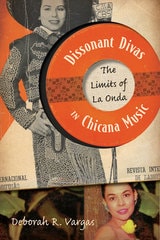
Dissonant Divas in Chicana Music
The Limits of La OndaDeborah R. Vargas
University of Minnesota Press, 2012
Musical sound has been central to heteromasculinist productions of nation and homeland, whether Chicano, Tejano, Texan, Mexican, or American. If this assertion holds true, as Deborah R. Vargas suggests, then what are we to make of those singers and musicians whose representations of gender and sexuality are irreconcilable with canonical Chicano/Tejano music or what Vargas refers to as “la onda”? These are the “dissonant divas” Vargas discusses, performers who stimulate our listening for alternative borderlands imaginaries that are inaudible within the limits of “la onda.”
Dissonant Divas in Chicana Music focuses on the Texan monument of the Alamo and its association with Rosita Fernandez; Tejano corrido folklore and its musical antithesis in Chelo Silva; the female accordion-playing bodies of Ventura Alonza and Eva Ybarra as incompatible with the instrumental labor of conjunto music; geography as national border, explored through the multiple national music scales negotiated by Eva Garza; and racialized gender, viewed through Selena’s integration of black diasporic musical sound. Vargas offers a feminist analysis of these figures’ contributions by advancing a notion of musical dissonance—a dissonance that recognizes the complexity of gender, sexuality, and power within Chicana/o culture.
Incorporating ethnographic fieldwork, oral history, and archival research, Vargas’s study demonstrates how these singers work together to explode the limits of Texan, Chicano, Tejano, Mexican, and American identities.
Dissonant Voices
Race, Jazz, and Innovative Poetics in Midcentury AmericaJoseph Pizza
University of Iowa Press, 2023
Distance Manipulation
The Russian Modernist Search for a New DramaJoanna Kot
Northwestern University Press, 1999
Kot studies experimental dramas by Gippius, Sologub, Blok, and Ivanov, but the centerpiece of the book is Chekhov's Cherry Orchard his last and greatest play. Kot argues that it presents a subtle balance of distancing and emotive techniques.
An invaluable guide to the often bewildering nature of so-called "innovative" twentieth-century works, this book will appeal to anyone interested in modern theater.
Distant Early Warning
Marshall McLuhan and the Transformation of the Avant-GardeAlex Kitnick
University of Chicago Press, 2021
Kitnick builds the story of McLuhan’s entanglement with artists by carefully drawing out the connections among McLuhan, his theories, and the artists themselves. The story is packed with big names: Marcel Duchamp, Niki de Saint Phalle, Jasper Johns, Andy Warhol, Nam June Paik, and others. Kitnick masterfully weaves this history with McLuhan’s own words and his provocative ideas about what art is and what artists should do, revealing McLuhan’s influence on the avant-garde through the confluence of art and theory. The illuminating result sheds light on new aspects of McLuhan, showing him not just as a theorist, or an influencer, but as a richly multifaceted figure who, among his many other accolades, affected multiple generations of artists and their works. The book finishes with Kitnick overlaying McLuhan’s ethos onto the state of contemporary and post-internet art. This final channeling of McLuhan is a swift and beautiful analysis, with a personal touch, of art’s recent transgressions and what its future may hold.
Distant Reading
Performance, Readership, and Consumption in Contemporary PoetryPeter Middleton
University of Alabama Press, 2005
A dynamic account of the history, practice, and theory of poetry as performance.
Distant Reading considers poetry as performance, offers new insights into its popularity, and proposes a new history of its origins. It also explores related issues concerning the reception of poetry, the impact of the computer on how we read poetry, the persistence of the letter "I" in poems by avant-garde poets, the strangeness of the line-break as a demand on the reader's attention, and the idea of the reader as consumer. These themes are connected by a historically contextualized and theoretically sophisticated discussion of contemporary American and British poets continuing to work in the modernist tradition.
The introductory essay establishes a new methodology that transforms close reading into what Middleton calls "distant reading," interpretive reading that acknowledges the distances that texts travel from their point of composition to readers in other geographical and historical locations. It indicates that poetic innovation is often driven by a desire on the part of the poet to make this distance do cultural work in the meanings that the poem generates.
Ultimately, Distant Reading treats poetry as a cultural practice that is always situated within specific sites of performance—recited on stage, displayed in magazines, laid out on a page, scrolled on the computer screen—rather than as a transcendent cloud of meaning tethered only to its words.
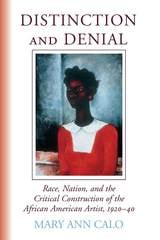
Distinction and Denial
Race, Nation, and the Critical Construction of the African American Artist, 1920-40Mary Ann Calo
University of Michigan Press, 2007
Distinctionand Denial challenges conventional theories of race and art by examining the role early twentieth-century art critics played in marginalizing African American artists. Mary Ann Calo dispels the myth of a unified African American artistic tradition through an engaging study of the germinal writing of Alain Locke and other significant critics of the era, who argued that African American artists were both a diverse group and a constituent element of America’s cultural center. By documenting the effects of the “Negro aesthetic” on African American artists working in the interwar years, Distinctionand Denial shows that black artistic production existed between the claims of a distinctly African American tradition and full inclusion into American modernist culture—never fully inside or outside the mainstream.
“A major contribution to the scholarship of African American artists in the inter-war period. With scrupulous research and probing analyses, Calo’s study enables scholars, students, and those interested in the Harlem Renaissance to grasp the intellectual debates, institutional support, and art world promotion that advanced an emerging cohort of African American artists.”
—Patricia Hills, Boston University
“A careful, thorough, historically grounded study that builds a new and significant argument challenging conventional histories of African American art. Sure to become indispensable to any scholarly discussion of American art or African American cultural studies.”
—Helen Langa, American University
Mary Ann Calo is Professor of Art History and Director of the Institute for the Creative and Performing Arts at Colgate University. She is author of Bernard Berenson and the Twentieth Century and editor of Critical Issues in American Art: A Book of Readings.
Distorted Mirrors
Americans and Their Relations with Russia and China in the Twentieth CenturyDonald E. Davis & Eugene P. Trani
University of Missouri Press, 2009

Disturbers of the Twentieth Century
Catholic Social Critics in Modern BritainAdam Schwartz
Catholic University of America Press, 2026
Disturbing Indians
The Archaeology of Southern FictionAnnette Trefzer
University of Alabama Press, 2007
How Faulkner, Welty, Lytle, and Gordon reimagined and reconstructed the Native American past in their work.
In this book, Annette Trefzer argues that not only have Native Americans played an active role in the construction of the South’s cultural landscape—despite a history of colonization, dispossession, and removal aimed at rendering them invisible—but that their under-examined presence in southern literature also provides a crucial avenue for a post-regional understanding of the American South. William Faulkner, Eudora Welty, Andrew Lytle, and Caroline Gordon created works about the Spanish conquest of the New World, the Cherokee frontier during the Revolution, the expansion into the Mississippi Territory, and the slaveholding societies of the American southeast. They wrote 100 years after the forceful removal of Native Americans from the southeast but consistently returned to the idea of an "Indian frontier," each articulating a different vision and discourse about Native Americans—wholesome and pure in the vision of some, symptomatic of hybridity and universality for others.
Trefzer contends that these writers engage in a double discourse about the region and nation: fabricating regional identity by invoking the South’s "native" heritage and pointing to issues of national guilt, colonization, westward expansion, and imperialism in a period that saw the US sphere of influence widen dramatically. In both cases, the "Indian" signifies regional and national self-definitions and contributes to the shaping of cultural, racial, and national "others." Trefzer employs the idea of archeology in two senses: quite literally the excavation of artifacts in the South during the New Deal administration of the 1930s (a surfacing of material culture to which each writer responded) and archeology as a method for exploring texts she addresses (literary digs into the textual strata of America’s literature and its cultural history).
Disturbing the Light
Samuel Green
Carnegie Mellon University Press, 2020
Divergent Trajectories
Interviews with Innovative Fiction WritersFlore Chevaillier
The Ohio State University Press, 2017
Including interviews with R. M. Berry, Debra Di Blasi, Percival Everett, Thalia Field, Renee Gladman, Bhanu Kapil, Lance Olsen, Michael Martone, Carole Maso, Joseph McElroy, Christina Milletti, Alan Singer, and Steve Tomasula, Divergent Trajectories provides a framework that allows innovative authors to discuss in some depth their works, backgrounds, formal research, thematic preferences, genre treatment, aesthetic philosophies, dominant linguistic expressions, cultural trends, and the literary canon. Through an examination of these concepts, writers ask what “traditional” and “innovative” writing is, and most of all, what fiction is today.
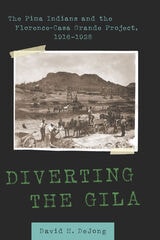
Diverting the Gila
The Pima Indians and the Florence-Casa Grande Project, 1916–1928David H. DeJong
University of Arizona Press, 2021
Diverting the Gila explores the complex web of tension, distrust, and political maneuvering to divide and divert the scarce waters of the Gila River. Residents of Florence, Casa Grande, and the Pima Reservation fought for vital access to water rights. Into this political foray stepped Arizona’s freshman congressman Carl Hayden, who not only united the farming communities but also used Pima water deprivation to the advantage of Florence-Casa Grande and Upper Gila Valley growers. The result was the federal Florence-Casa Grande Project that, as legislated, was intended to benefit Pima growers on the Gila River Indian Reservation first and foremost. As was often the case in the West, well-heeled, nontribal political interests manipulated the laws at the expense of the Indigenous community.
Diverting the Gila is the sequel to David H. DeJong’s 2009 Stealing the Gila, and it continues to tell the story of the forerunner to the San Carlos Irrigation Project and the Gila River Indian Community’s struggle to regain access to their water.
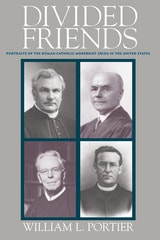
Divided Friends
William L. Portier
Catholic University of America Press, 2013
Divided Parties, Strong Leaders
Ruth Bloch Rubin
University of Chicago Press, 2025
Drawing on nearly a century of legislative history, this careful account invites readers to think anew about when, why, and how leaders of divided parties wield power in Congress.
For decades, legislative scholars have viewed party divisions as critical constraints on congressional leadership. The more a party’s rank and file disagree with one another, the weaker their leaders are predicted to be; as member preferences converge, leader power is thought to increase.
In a powerful corrective to this prevailing view, Ruth Bloch Rubin argues that party divisions are not inherently limiting. Divided Parties, Strong Leaders highlights and examines variation in how members of party factions choose to work together. She shows that leaders of divided parties are well positioned to overcome, and even draw strength from, their divided ranks when the collaborative efforts of their coalitions’ competing factions are evenly matched. By contrast, their capacity to get what they want is more limited when one faction has out-collaborated its competition. Presenting detailed case studies of some of the most storied leaders of the postwar Congress, including Speakers Sam Rayburn and Nancy Pelosi, Bloch Rubin analyzes the factional configuration each leader encountered and explains why it mattered for their exercise of power.
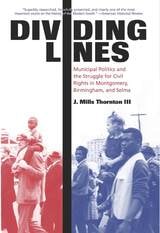
Dividing Lines
Municipal Politics and the Struggle for Civil Rights in Montgomery, Birmingham, and SelmaJ. Mills Thornton, III
University of Alabama Press, 2006
Presents the story of the civil rights movement from the perspective of community-municipal history at the grassroots level
Thornton demonstrates that the movement had powerful local sources in its three birth cities—Montgomery, Birmingham, and Selma. There, the arcane mechanisms of state and city governance and the missteps of municipal politicians and civic leaders—independent of emerging national trends in racial mores—led to the great swell of energy for change that became the civil rights movement.
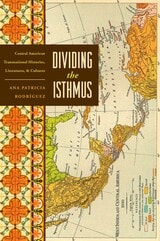
Dividing the Isthmus
Central American Transnational Histories, Literatures, and CulturesBy Ana Patricia Rodríguez
University of Texas Press, 2009
In 1899, the United Fruit Company (UFCO) was officially incorporated in Boston, Massachusetts, beginning an era of economic, diplomatic, and military interventions in Central America. This event marked the inception of the struggle for economic, political, and cultural autonomy in Central America as well as an era of homegrown inequities, injustices, and impunities to which Central Americans have responded in creative and critical ways. This juncture also set the conditions for the creation of the Transisthmus—a material, cultural, and symbolic site of vast intersections of people, products, and narratives.
Taking 1899 as her point of departure, Ana Patricia Rodríguez offers a comprehensive, comparative, and meticulously researched book covering more than one hundred years, between 1899 and 2007, of modern cultural and literary production and modern empire-building in Central America. She examines the grand narratives of (anti)imperialism, revolution, subalternity, globalization, impunity, transnational migration, and diaspora, as well as other discursive, historical, and material configurations of the region beyond its geophysical and political confines.
Focusing in particular on how the material productions and symbolic tropes of cacao, coffee, indigo, bananas, canals, waste, and transmigrant labor have shaped the transisthmian cultural and literary imaginaries, Rodríguez develops new methodological approaches for studying cultural production in Central America and its diasporas.
Monumental in scope and relentlessly impassioned, this work offers new critical readings of Central American narratives and contributes to the growing field of Central American studies.
Divine Beauty
The Aesthetics of Charles HartshorneDaniel A. Dombrowski
Vanderbilt University Press, 2004
As Daniel A. Dombrowski explains, Hartshorne advanced a neoclassical or process theism that contrasted with the "classical" theism defended by traditionalist Jews, Christians, and Muslim believers. His conception of God was dipolar, which could attribute to God certain qualities that traditionalists would exclude. For example, in Hartshorne's view, God can embrace excellent aspects of both activity and passivity, or of permanence and change; classical theists, on the other hand, exclude passivity and change from their conceptions.
Dombrowski goes on to explain the ramifications of Hartshorne's view of God for aesthetics, which for him had both broad and narrow meanings: all sensory feeling or sensation, in the broad sense, and a disciplined feeling for beauty, in the narrow sense. Included are discussions on Hartshorne's famous appreciation for the aesthetics of bird song; his view of beauty as a mean between two sets of extremes; his idea of the aesthetic attitude, which concentrates on values that are intrinsic and immediately felt; and the place of death in his aesthetics, in which the value of our lives consists in the beauty or intensity of experience that we contribute to the divine life.
Filling an important gap in our understanding of Hartshorne, Divine Beauty also makes a persuasive case for the superiority of his neoclassical theism over classical theism.
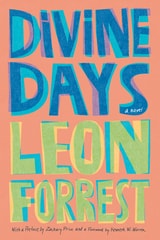
Divine Days
A NovelLeon Forrest; Foreword by Kenneth W. Warren, Preface by Zachary Price
Northwestern University Press, 2023
“I have an awful memory for faces, but an excellent one for voices,” muses Joubert Jones, the aspiring playwright at the center of Divine Days. A kaleidoscopic whorl of characters, language, music, and Black experience, this saga follows Jones for one week in 1966 as he pursues the lore and legends of fictional Forest County, a place resembling Chicago’s South Side. Joubert is a veteran, recently returned to the city, who works for his aunt Eloise’s newspaper and pours drinks at her Night Light Lounge. He wants to write a play about Sugar-Groove, a drifter, “eternal wunderkind,” and local folk hero who seems to have passed away. Sugar-Groove’s disappearance recalls the subject of one of Joubert’s earlier writing attempts—W. A. D. Ford, a protean, diabolical preacher who led a religious sect known as “Divine Days.” Joubert takes notes as he learns about both tricksters, trying to understand their significance.
Divine Days introduces readers to a score of indelible characters: Imani, Joubert’s girlfriend, an artist and social worker searching for her lost siblings and struggling to reconcile middle class life with her values and Black identity; Eloise, who raised Joubert and whose influence is at odds with his writerly ambitions; (Oscar) Williemain, a local barber, storyteller, and founder of the Royal Rites and Righteous Ramblings Club; and the Night Light’s many patrons. With a structure inspired by James Joyce and jazz, Leon Forrest folds references to African American literature and cinema, Shakespeare, the Bible, and classical mythology into a heady quest that embraces life in all its tumult and adventure.
This edition brings Forrest’s masterpiece back into print, incorporating hundreds of editorial changes that the author had requested from W. W. Norton, but were not made for their editions in 1993 and 1994. Much of the inventory from the original printing of the book by Another Chicago Press in 1992 had been destroyed in a disastrous warehouse fire.
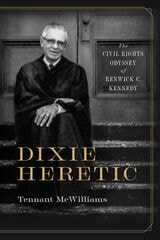
Dixie Heretic
The Civil Rights Odyssey of Renwick C. KennedyTennant McWilliams
University of Alabama Press, 2023
A life-and-times biography of the minister and social reformer Renwick C. Kennedy
Drawn from some 5,000 letters, six decades of daily-diary writings, and extensive interviews, Dixie Heretic: The Civil Rights Odyssey of Renwick C. Kennedy offers a life-and-times biography of the Alabama Black Belt minister, Renwick C. Kennedy (1900–1985). Here, Tennant McWilliams gives an unvarnished account of Kennedy’s tortuous efforts to make his congregants and other southern whites “better Christians.”
Kennedy came from “upcountry” South Carolina, a place rife with Scotch-Irish Associate Reformed Presbyterians—people of biblical infallibility and individual piety and salvation. In 1927, after a life-changing theology education at Princeton, he moved to Camden, Alabama, county seat of Wilcox County. There, he came to believe that God had a mandate for him: to change the “Half Christian” conservative, and the often violent, racial behaviors around him. As a neo-orthodox Protestant, Kennedy never rejected literal approaches to the Bible. Still, out of the “Full Christian” Social Gospel, he urged changed racial behavior. Ultimately this led him to publish confrontational short stories and essays in Christian Century and New Republic—most set in fictitious “Yaupon County.”
In World War II, Kennedy served as a chaplain with the famed 102nd Evacuation Hospital. He came home hoping the Allied victory would spur Americans to fight racial segregation just as they had fought racial fascism in Europe. The 1948 Dixiecrat movement dashed these hopes, turning much of his neo-orthodox optimism to cynicism. His hope found fleeting resurgence in the civil rights movement, and saw Kennedy quietly leading desegregation of Troy University, where he was an administrator. But the era’s assassinations, combined with George Wallace and the rise of southern white Republicans, regularly returned him to the frustrated hopes of 1948 and fostered a pessimism about truly changed hearts that he took to his grave in 1985.
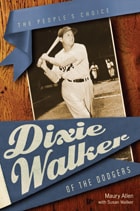
Dixie Walker of the Dodgers
The People's ChoiceMaury Allen and Susan Walker
University of Alabama Press, 2010
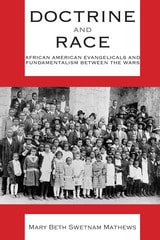
Doctrine and Race
African American Evangelicals and Fundamentalism between the WarsMary Beth Swetnam Mathews
University of Alabama Press, 2017
Doctrine and Race examines the history of African American Baptists and Methodists of the early twentieth century and their struggle for equality in the context of white Protestant fundamentalism.
By presenting African American Protestantism in the context of white Protestant fundamentalism, Doctrine and Race: African American Evangelicals and Fundamentalism between the Wars demonstrates that African American Protestants were acutely aware of the manner in which white Christianity operated and how they could use that knowledge to justify social change. Mary Beth Swetnam Mathews’s study scrutinizes how white fundamentalists wrote blacks out of their definition of fundamentalism and how blacks constructed a definition of Christianity that had, at its core, an intrinsic belief in racial equality. In doing so, this volume challenges the prevailing scholarly argument that fundamentalism was either a doctrinal debate or an antimodernist force. Instead, it was a constantly shifting set of priorities for different groups at different times.
A number of African American theologians and clergy identified with many of the doctrinal tenets of the fundamentalism of their white counterparts, but African Americans were excluded from full fellowship with the fundamentalists because of their race. Moreover, these scholars and pastors did not limit themselves to traditional evangelical doctrine but embraced progressive theological concepts, such as the Social Gospel, to help them achieve racial equality. Nonetheless, they identified other forward-looking theological views, such as modernism, as threats to “true” Christianity.
Mathews demonstrates that, although traditional portraits of “the black church” have provided the illusion of a singular unified organization, black evangelical leaders debated passionately among themselves as they sought to preserve select aspects of the culture around them while rejecting others. The picture that emerges from this research creates a richer, more profound understanding of African American denominations as they struggled to contend with a white American society that saw them as inferior.
Doctrine and Race melds American religious history and race studies in innovative and compelling ways, highlighting the remarkable and rich complexity that attended to the development of African American Protestant movements.
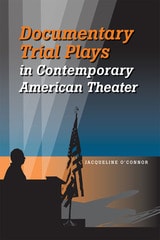
Documentary Trial Plays in Contemporary American Theater
Jacqueline O’Connor
Southern Illinois University Press, 2013
From the Chicago Conspiracy Trial and the O. J. Simpson trial to the Clarence Thomas/Anita Hill congressional hearings, legal and legislative proceedings in the latter part of the twentieth-century kept Americans spellbound. Situated on the shifting border between imagination and the law, trial plays edit, arrange, and reproduce court records, media coverage, and first-person interviews, transforming these elements into a performance. In this first book-length critical study of contemporary American documentary theater, Jacqueline O’Connor examines in depth ten such plays, all written and staged since 1970, and considers the role of the genre in re-creating and revising narratives of significant conflicts in contemporary history.
Documentary theater, she shows, is a particularly appropriate and widely utilized theatrical form for engaging in debate about tensions between civil rights and institutional power, the inconsistency of justice, and challenges to gender norms. For each of the plays discussed, including The Trial of the Catonsville Nine, Unquestioned Integrity: The Hill/Thomas Hearings, and The Laramie Project, O'Connor provides historical context and a brief production history before considering the trial the play focuses on. Grouping plays historically and thematically, she demonstrates how dramatic representation advances our understanding of the law's power while revealing the complexities that hinder society's pursuit of justice.
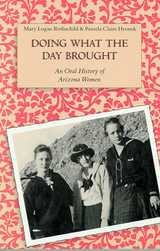
Doing What the Day Brought
An Oral History of Arizona WomenMary Logan Rothschild and Pamela Claire Hronek
University of Arizona Press, 1992
Drawing on interviews with twenty-nine individuals, Doing What the Day Brought examines the everyday lives of women from the late nineteenth century to the present day and demonstrates the role they have played in shaping the modern Arizona community.
Focusing on "ordinary" women, the book crosses race, ethnic, religious, economic, and marital lines to include Arizona women from diverse backgrounds. Rather than simply editing each woman's words, Rothschild and Hronek have analyzed these oral histories for common themes and differences and have woven portions into a narrative that gives context to the individual lives. The resulting life-course format moves naturally from childhood to home life, community service, and participation in the work force, and concludes with reflections on changes witnessed in the lifetimes of these women.
For the women whose lives are presented here, it may have been common to gather dead saguaro cactus ribs to make outdoor fires to boil laundry water, or to give birth on a dirt floor. Their stories capture not only changes in a state where history has overlooked the role of women, but the changing roles of American women over the course of this century.
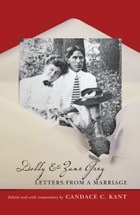
Dolly and Zane Grey
Letters from a MarriageCandace C. Kant
University of Nevada Press, 2011
Popular western writer Zane Grey was a literary celebrity during his lifetime and the center of a huge enterprise based on his writing, which included books, magazine serials, film and stage versions of his stories, even comic strips. His wife, Dolly, closely guided Grey's career almost from its beginning, editing and sometimes revising his work, negotiating with publishers and movie studios, and skillfully managing the considerable fortune derived from these activities.
Dolly maintained the facade of a conventional married life that was essential to Grey's public image and the traditional middle-class values his work reflected. This facade was constantly threatened by Grey's numerous affairs with other women. The stress of hiding these dalliances placed a huge strain on their relationship, and much of Zane and Dolly's union was sustained largely by correspondence. Their letters--thousands of them--reveal the true nature of this complex partnership. As edited by Candace Kant, the letters offer an engrossing portrait of an extremely unorthodox marriage and its times.
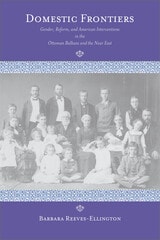
Domestic Frontiers
Gender, Reform, and American Interventions in the Ottoman Balkans and the Near EastBarbara Reeves-Ellington
University of Massachusetts Press, 2013
During the nineteenth and early twentieth centuries, American Protestant missionaries attempted to export their religious beliefs and cultural ideals to the Ottoman Empire. Seeking to attract Orthodox Christians and even Muslims to their faith, they promoted the paradigm of the “Christian home” as the foundation of national progress. Yet the missionaries' efforts not only failed to win many converts but also produced some unexpected results.
Drawing on a broad range of sources—Ottoman, Bulgarian, Russian, French, and English—Barbara Reeves-Ellington tracks the transnational history of this little-known episode of American cultural expansion. She shows how issues of gender and race influenced the missionaries' efforts as well as the complex responses of Ottoman subjects to American intrusions into their everyday lives. Women missionaries—married and single—employed the language of Christian domesticity and female moral authority to challenge the male-dominated hierarchy of missionary society and to forge bonds of feminist internationalism. At the same time, Orthodox Christians adapted the missionaries' ideology to their own purposes in developing a new strain of nationalism that undermined Ottoman efforts to stem growing sectarianism within their empire. By the beginning of the twentieth century, as some missionaries began to promote international understanding rather than Protestantism, they also paved the way for future expansion of American political and commercial interests.
Domestications
American Empire, Literary Culture, and the Postcolonial LensHosam Aboul-Ela
Northwestern University Press, 2018
Domestications traces a genealogy of American global engagement with the Global South since World War II. Hosam Aboul-Ela reads American writers contrapuntally against intellectuals from the Global South in their common—yet ideologically divergent—concerns with hegemony, world domination, and uneven development. Using Edward Said’s Culture and Imperialism as a model, Aboul-Ela explores the nature of U.S. imperialism’s relationship to literary culture through an exploration of five key terms from the postcolonial bibliography: novel, idea, perspective, gender, and space.
Within this framework the book examines juxtapositions including that of Paul Bowles’s Morocco with North African intellectuals’ critique of Orientalism, the global treatment of Vietnamese liberation movements with the American narrative of personal trauma in the novels of Tim O’Brien and Hollywood film, and the war on terror’s philosophical idealism with Korean and post-Arab nationalist materialist archival fiction.
Domestications departs from other recent studies of world literature in its emphases not only on U.S. imperialism but also on intellectuals working in the Global South and writing in languages other than English and French. Although rooted in comparative literature, its readings address issues of key concern to scholars in American studies, postcolonial studies, literary theory, and Middle Eastern studies.
Domesticity And Dirt
Housewives and Domestic Servants in the United States, 1920-1945Phyllis Palmer
Temple University Press, 1991
In the era after Suffrage, white middle-class housewives abandoned moves toward paid work for themselves, embraced domestic life, and felt entitled to servants. In Domesticity and Dirt, Phyllis Palmer examines the cultural norms that led such women to take on the ornamental and emotional elements of the job while relegating the hard physical work and demeaning service tasks to servants—mainly women of color. Using novels, films, magazine articles, home economics texts, and government-funded domestic training course manuals, the author details cultural expectations about middle-class homelife.
Palmer describes how government-funded education programs encouraged the divisions of labor and identity and undercut domestic workers’ organized efforts during the 1930s to win inclusion in New Deal programs regulating labor conditions. Aided by less powerful black civil rights groups, without the assistance of trade unions or women’s clubs, domestics failed to win legal protections and the legal authority and self-respect these brought to covered workers. The author also reveals how middle- class women responded ambivalently to the call to aid women workers when labor reforms threatened their domestic arrangements.
Throughout her study, Palmer questions why white middle-class women looked to new technology and domestic help to deal with cultural demands upon "the perfect housewife" rather than expecting their husbands to help. When the supply of servants declined during the 1950s, middle-class housewives were left isolated with lots of housework. Although they rapidly followed their servants into paid work outside the home, they remain responsible for housework and child care.
In the series Women in the Political Economy, edited by Ronnie J. Steinberg.
Don't Act, Just Dance
The Metapolitics of Cold War CultureCatherine Gunther Kodat
Rutgers University Press, 2014
Don't Ask
Philip Levine
University of Michigan Press, 1981
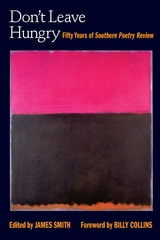
Don't Leave Hungry
Fifty Years of Southern Poetry ReviewJames Smith
University of Arkansas Press, 2009

Done in a Day
Telex from the Fall of SaigonElisa Tamarkin
University of Chicago Press, 2026
Named one of Lit Hub's most anticipated books of the year.
A searing reflection on the last day of the Vietnam War and the beginning of the end of foreign reporting in the nation’s daily newspapers.
Done in a Day turns on a single event: the April 30, 1975, departure of the last helicopter evacuating civilians from the rooftop of the US embassy in Saigon. Elisa Tamarkin’s interest in that helicopter begins with the fact that her stepfather, the Saigon bureau chief for the Chicago Daily News, was on it—the last American correspondent to leave Saigon as it fell. His report was filed from a naval ship on the South China Sea at a time when no other telexes were going through.
Now, more than fifty years later, Tamarkin offers a social and cultural autopsy of that moment, based in personal history but vividly unfolding amid the vast documentation of America’s obvious defeat, which never seemed to register even as it got out, in the writings of journalists and essayists, in the backchannel cables between US ambassador Graham Martin and Henry Kissinger, in congressional hearings, and in photographs of the war’s end. The story is also set against the imminent disappearance of war coverage in city newspapers—and of the newspapers themselves—once proud, in the words of the Chicago Daily News, of bringing readers the “literature of the day” that was “done in a day.”
Done in a Day braids history, criticism, and memoir to tell the paired stories of Saigon’s liberation and the demise of the news. The result is a haunting essay about all that ended in a day—and about what it means to recognize and to write about endings even as we live through them.

Don’t Kill Your Baby
Public Health and the Decline of Breastfeeding in the Nineteenth and Twentieth CenturiesJacqueline H. Wolf
The Ohio State University Press, 2001
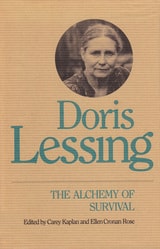
Doris Lessing
The Alchemy of SurvivalCarey Kaplan
Ohio University Press, 1988
Long neglected by the academic world because of her rejection of belletristic values and resistance to convenient literary taxonomy, Doris Lessing has nonetheless built an international following of serious, dedicated readers. Acknowledging the difficulties posed by the multiple dimensions of Lessing’s work, Kaplan and Rose have gathered eleven essays that address her artistic, philosophical, political, and psychological complexity, and so provide a welcome introduction to the extraordinary depth and diversity of this important contemporary novelist.
Lessing has been described as an “alchemical” writer, in that her work is directed toward changing people’s lives and perceptions rather than simply recording experience. Accordingly, the contributors examine her various postures and tactics for the purpose of discovering how the alchemical elements inform her various personae. Frederick C. Stern discusses Lessing’s commitment to radical humanist thought, while Carey Kaplan examines how Lessing’s imperialist past has shaped her futuristic fiction. Elizabeth Abel offers a feminist interpretation of the pattern of brother-sister incest in Lessing’s work, showing how Lessing has established Antigone as a female alternative to the Oedipal myth of male incest. Particularly insightful is Eve Bertelsen’s report of her interview with Lessing, demonstrating how Lessing’s often evasive style of adversarial dialogue works in concert with her refusal to be conveniently pigeonholed by academic analysis.
For those readers new to her work, Doris Lessing: The Alchemy of Survival will serve as a useful introduction to Lessing’s concerns and techniques. Those who have long admired her writing will find in this collection new keys to understanding Lessing’s philosophical, political, and psychological complexity.
Doris Lessing
The Poetics of ChangeGayle Greene
University of Michigan Press, 1997
Doris Lessing has been a chronicler of our age for nearly half a century, and a study of her writing career does not yield easy generalizations. Difficult though she is to categorize, she is always concerned with change, with a search for "something new" against "the nightmare repetition" of history. The feminist quest she articulated in The Children of Violence and The Golden Notebook entered the culture with the force of a new myth: these books changed lives. The Golden Notebook--together with such works as The Second Sex and The Feminine Mystique--raised the consciousness of a generation of women readers and played a major part in making the second wave of feminism. It is the power of Lessing's novels to change people's lives, the effect she had raising the consciousness of a generation of women and the effect she continues to have on young readers, that is the subject of this book.
Gayle Greene employs an eclectic range of approaches (psychoanalytic, Marxist, biographical, historical, intertextual, formalist, feminist) to shed new light on Lessing's remarkable achievement. She sees Lessing as a feminist writer, not in offering strong female role models who climb top the top of existing social structures, but in envisioning, and indeed helping to bring about, a transformation of those structures. Lessing critiques Western values of individualism, competition, and materialism in terms similar to those developed by feminism; and, in getting us to view our culture from without, in teaching us to read cultural constructs as systems, her novels perform the deconstructing and demystifying work of feminism.
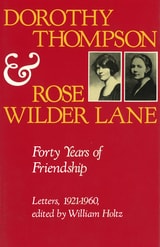
Dorothy Thompson and Rose Wilder Lane
Forty Years of Friendship, Letters, 1921-1960Edited by William Holtz
University of Missouri Press, 1991
The friendship between Dorothy Thompson and Rose Wilder Lane began in 1920 in the publicity office of the American Red Cross in Paris and continued until Thompson’s death in 1961. Although both women are today remembered primarily for their connections with others —Thompson as the wife of Sinclair Lewis, and Lane as the daughter of Laura Ingalls Wilder, author of the “Little House” books —each was remarkable in her own right.
Both women had a vital engagement with life that led them in fearless pursuit of experience. In 1939, Thompson appeared on the cover of Time, which judged her second only to Eleanor Roosevelt among influential women of the day. Typical of Lane were her travels through the mountains of Albania, the deserts of Syria, and Soviet Georgia in the 1920s and her visit as a journalist to Vietnam in 1965 at the age of seventy-eight.
The correspondence of these two talented and articulate women reveals their personal concerns, social ideas, and political/economic philosophies and how they changed over time. Their letters tell the story of the first generation of women to come of age during the twentieth century, as they tried to cope with problems that women still face today. Along with the letters themselves, Holtz has included annotations and footnotes that provide biographical information, as well as explaining personal and topical references.
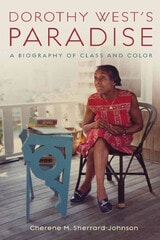
Dorothy West's Paradise
A Biography of Class and ColorSherrard-Johnson, Cherene
Rutgers University Press, 2012
Dorothy West is best known as one of the youngest writers involved in the Harlem Renaissance. Subsequently, her work is read as a product of the urban aesthetics of this artistic movement. But West was also intimately rooted in a very different milieu—Oak Bluffs, an exclusive retreat for African Americans on Martha’s Vineyard. She played an integral role in the development and preservation of that community. In the years between publishing her two novels, 1948’s The Living is Easy and the 1995 bestseller The Wedding, she worked as a columnist for the Vineyard Gazette.
Dorothy West’s Paradise captures the scope of the author’s long life and career, reading it alongside the unique cultural geography of Oak Bluffs and its history as an elite African American enclave—a place that West envisioned both as a separatist refuge and as a space for interracial contact. An essential book for both fans of West’s fiction and students of race, class, and American women’s lives, Dorothy West’s Paradise offers an intimate biography of an important author and a privileged glimpse into the society that shaped her work.
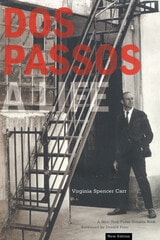
Dos Passos
A LifeVirginia Spencer Carr
Northwestern University Press, 2004
An intimate biography of a great American writer.
He rose from a childhood as the illegitimate son of a financial titan to become the man Sartre called "the greatest writer of our time." A progressive writer who turned his passions into the groundbreaking U.S.A. trilogy, John Dos Passos later embraced conservative causes. At the height of his career he was considered a peer of Hemingway and Fitzgerald, yet he died in obscurity in 1970.
Award-winning biographer Virginia Spencer Carr examines the contradictions of Dos Passos's life with an in-depth study of the man. Using the writer's letters and journals, and with assistance from the Dos Passos family, Carr reconstructs an epic life, one of literary acclaim and bitter obscurity, restless wandering and happy marriage, friendship with Edmund Wilson and feuds with Hemingway. First published to acclaim in 1984, Dos Passos remains the definitive personal portrait of the author.
Double Cross
Japanese Americans In Black And White ChicagoJacalyn D. Harden
University of Minnesota Press, 2003
Examines relations between peoples of color to offer a compelling new approach to understanding race in America
Since the Great Migration of the early twentieth century, Chicago has been a cauldron of race relations, symbolizing the tenacity of discrimination and segregation. But as in other cities with significant populations of Latinos and Asians, Arabs and Jews, this image belies complex racial dynamics. In Double Cross, Jacalyn D. Harden provides an essential rethinking of the ways we understand and talk about race, using an examination of the Japanese American community of Chicago’s Far North Side to form an innovative new framework for looking at race, identity, and political change.
The Japanese American community in Chicago rapidly expanded between 1940 and 1950 in the aftermath of wartime internment and government relocation programs. Harden tells their story through archival research and interviews with some of the first Japanese Americans who were relocated to Chicago in the 1940s, incorporating her own experiences as an African American scholar who has lived in Japan. The result is a compelling and surprising account of racial interactions, one that clarifies the complex interweaving between black and Asian lives and reclaims a lost history of solidarity between the two groups.Moving from the Great Migration to the “great relocation” to gentrification, Harden explores the shared history of civil rights struggles that firmly links Japanese and African Americans, most importantly the issue of reparations (for internment during World War II and slavery, respectively). She describes the efforts of Japanese Americans to “double-cross the color line” by building coalitions across race, age, and class boundaries, and their vexed position as sometimes “colored,” sometimes white (for example, the Japanese American soldier who was instructed to use the white washrooms at boot camp in Alabama during World War II, while thousands were being relocated to internment camps).Double Cross is a major contribution to our thought about race relations, challenging orthodoxy and shedding new light on the complex identities, conflicting interests, and external forces that have defined the concept of race in the United States.
Double-Consciousness/Double Bind
Theoretical Issues in Twentieth-Century Black LiteratureSandra Adell
University of Illinois Press, 1994
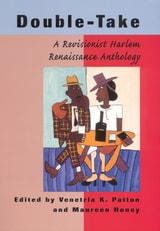
Double-Take
A Revisionist Harlem Renaissance AnthologyPatton, Venetria K
Rutgers University Press, 2001
The editors have included works from a wide variety of genres-poetry, short stories, drama, and essays-allowing readers to understand the true interdisciplinary quality of this cultural movement. Biographical sketches of the authors are provided and most of the pieces are included in their entirety. Double-Take also includes artwork and illustrations, many of which are from original journals and have never before been reprinted. Significantly, Double-Take is the first Harlem Renaissance title to include song lyrics to illustrate the interrelation of various art forms.
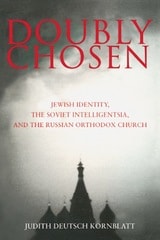
Doubly Chosen
Jewish Identity, the Soviet Intelligentsia, and the Russian Orthodox ChurchJudith Deutsch Kornblatt
University of Wisconsin Press, 2004
Doubly Chosen provides the first detailed study of a unique cultural and religious phenomenon in post-Stalinist Russia—the conversion of thousands of Russian Jewish intellectuals to Orthodox Christianity, first in the 1960s and later in the 1980s. These time periods correspond to the decades before and after the great exodus of Jews from the Soviet Union. Judith Deutsch Kornblatt contends that the choice of baptism into the Church was an act of moral courage in the face of Soviet persecution, motivated by solidarity with the values espoused by Russian Christian dissidents and intellectuals. Oddly, as Kornblatt shows, these converts to Russian Orthodoxy began to experience their Jewishness in a new and positive way.
Working primarily from oral interviews conducted in Russia, Israel, and the United States, Kornblatt underscores the conditions of Soviet life that spurred these conversions: the virtual elimination of Judaism as a viable, widely practiced religion; the transformation of Jews from a religious community to an ethnic one; a longing for spiritual values; the role of the Russian Orthodox Church as a symbol of Russian national culture; and the forging of a new Jewish identity within the context of the Soviet dissident movement.

Down and Dirty Down South
Politics and the Art of RevengeRoger Glasgow
Butler Center for Arkansas Studies, 2016
While pursuing a race for district prosecutor in the 1970s, Glasgow had run afoul of the local political machine. The machine later decided to teach Glasgow a lesson even though he’d lost the race. Down and Dirty Down South is Glasgow’s story of how he attempted to clear his name and also track down the people who had set him up for charges of smuggling illegal drugs into the United States.